
Application of Anion Exchange Chromatography with Pulsed Amperometric
- Slides: 1
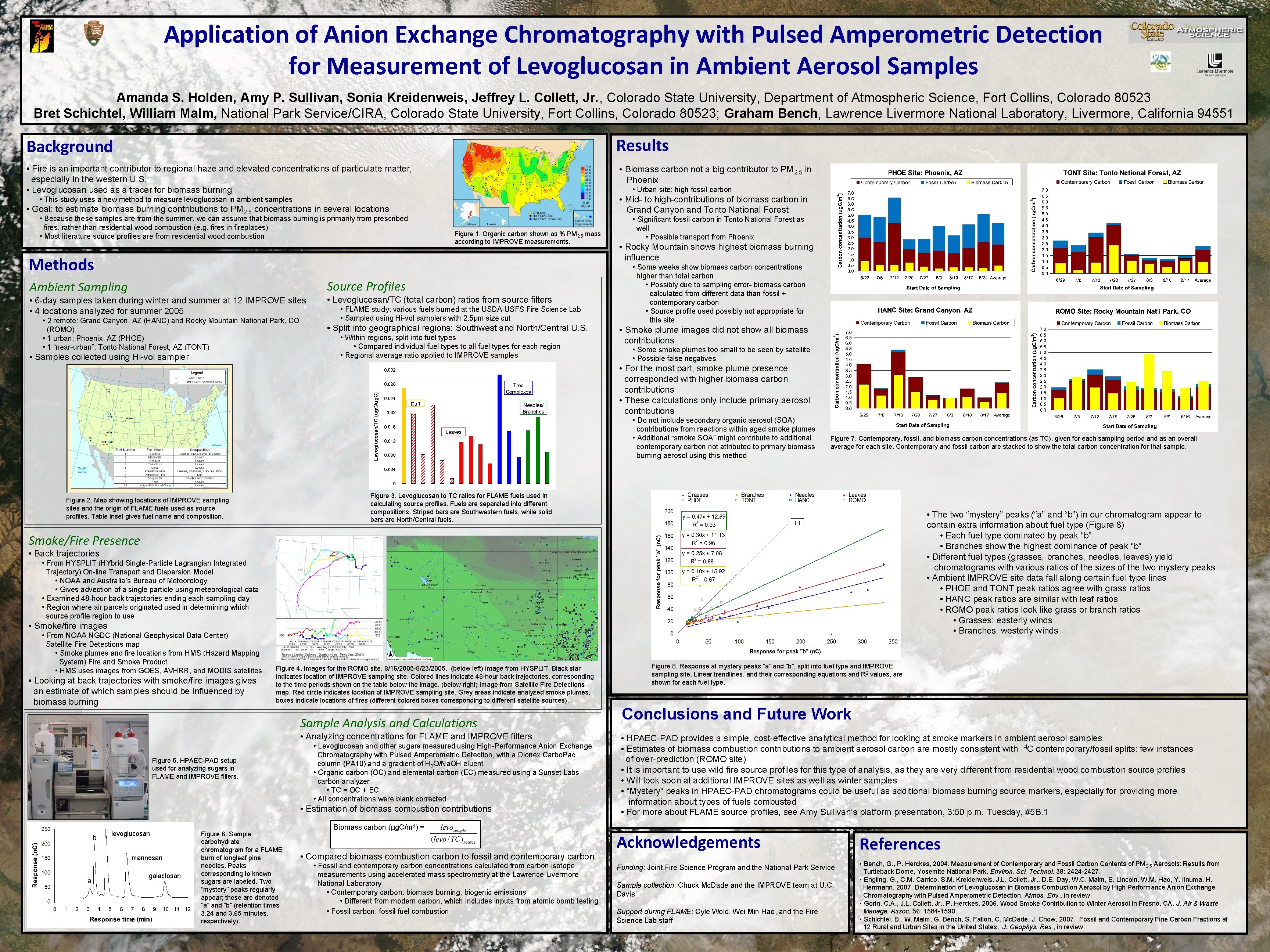
Application of Anion Exchange Chromatography with Pulsed Amperometric Detection for Measurement of Levoglucosan in Ambient Aerosol Samples Amanda S. Holden, Amy P. Sullivan, Sonia Kreidenweis, Jeffrey L. Collett, Jr. , Colorado State University, Department of Atmospheric Science, Fort Collins, Colorado 80523 Bret Schichtel, William Malm, National Park Service/CIRA, Colorado State University, Fort Collins, Colorado 80523; Graham Bench, Lawrence Livermore National Laboratory, Livermore, California 94551 Results Background • Fire is an important contributor to regional haze and elevated concentrations of particulate matter, especially in the western U. S. • Levoglucosan used as a tracer for biomass burning • Biomass carbon not a big contributor to PM 2. 5 in Phoenix • Urban site: high fossil carbon • Mid- to high-contributions of biomass carbon in Grand Canyon and Tonto National Forest • This study uses a new method to measure levoglucosan in ambient samples • Goal: to estimate biomass burning contributions to PM 2. 5 concentrations in several locations • Because these samples are from the summer, we can assume that biomass burning is primarily from prescribed fires, rather than residential wood combustion (e. g. fires in fireplaces) • Most literature source profiles are from residential wood combustion Figure 1. Organic carbon shown as % PM 2. 5 mass according to IMPROVE measurements. Methods Source Profiles Ambient Sampling • 6 -day samples taken during winter and summer at 12 IMPROVE sites • 4 locations analyzed for summer 2005 • 2 remote: Grand Canyon, AZ (HANC) and Rocky Mountain National Park, CO (ROMO) • 1 urban: Phoenix, AZ (PHOE) • 1 “near-urban”: Tonto National Forest, AZ (TONT) • Samples collected using Hi-vol sampler • Levoglucosan/TC (total carbon) ratios from source filters • FLAME study: various fuels burned at the USDA-USFS Fire Science Lab • Sampled using Hi-vol samplers with 2. 5μm size cut • Split into geographical regions: Southwest and North/Central U. S. • Within regions, split into fuel types • Compared individual fuel types to all fuel types for each region • Regional average ratio applied to IMPROVE samples • Significant fossil carbon in Tonto National Forest as well • Possible transport from Phoenix • Rocky Mountain shows highest biomass burning influence • Some weeks show biomass carbon concentrations higher than total carbon • Possibly due to sampling error- biomass carbon calculated from different data than fossil + contemporary carbon • Source profile used possibly not appropriate for this site • Smoke plume images did not show all biomass contributions • Some smoke plumes too small to be seen by satellite • Possible false negatives • For the most part, smoke plume presence corresponded with higher biomass carbon contributions • These calculations only include primary aerosol contributions • Do not include secondary organic aerosol (SOA) contributions from reactions within aged smoke plumes • Additional “smoke SOA” might contribute to additional contemporary carbon not attributed to primary biomass burning aerosol using this method Figure 3. Levoglucosan to TC ratios for FLAME fuels used in calculating source profiles. Fuels are separated into different compositions. Striped bars are Southwestern fuels, while solid bars are North/Central fuels. Figure 2. Map showing locations of IMPROVE sampling sites and the origin of FLAME fuels used as source profiles. Table inset gives fuel name and composition. Figure 7. Contemporary, fossil, and biomass carbon concentrations (as TC), given for each sampling period and as an overall average for each site. Contemporary and fossil carbon are stacked to show the total carbon concentration for that sample. • The two “mystery” peaks (“a” and “b”) in our chromatogram appear to contain extra information about fuel type (Figure 8) • Each fuel type dominated by peak “b” • Branches show the highest dominance of peak “b” • Different fuel types (grasses, branches, needles, leaves) yield chromatograms with various ratios of the sizes of the two mystery peaks • Ambient IMPROVE site data fall along certain fuel type lines • PHOE and TONT peak ratios agree with grass ratios • HANC peak ratios are similar with leaf ratios • ROMO peak ratios look like grass or branch ratios • Grasses: easterly winds • Branches: westerly winds 1: 1 Smoke/Fire Presence • Back trajectories • From HYSPLIT (HYbrid Single-Particle Lagrangian Integrated Trajectory) On-line Transport and Dispersion Model • NOAA and Australia’s Bureau of Meteorology • Gives advection of a single particle using meteorological data • Examined 48 -hour back trajectories ending each sampling day • Region where air parcels originated used in determining which source profile region to use • Smoke/fire images • From NOAA NGDC (National Geophysical Data Center) Satellite Fire Detections map • Smoke plumes and fire locations from HMS (Hazard Mapping System) Fire and Smoke Product • HMS uses images from GOES, AVHRR, and MODIS satellites • Looking at back trajectories with smoke/fire images gives an estimate of which samples should be influenced by biomass burning Figure 4. Images for the ROMO site, 8/16/2005 -8/23/2005. (below left) Image from HYSPLIT. Black star indicates location of IMPROVE sampling site. Colored lines indicate 48 -hour back trajectories, corresponding to the time periods shown on the table below the image. (below right) Image from Satellite Fire Detections map. Red circle indicates location of IMPROVE sampling site. Grey areas indicate analyzed smoke plumes, boxes indicate locations of fires (different colored boxes corresponding to different satellite sources). Sample Analysis and Calculations • Analyzing concentrations for FLAME and IMPROVE filters Figure 5. HPAEC-PAD setup used for analyzing sugars in FLAME and IMPROVE filters. • Levoglucosan and other sugars measured using High-Performance Anion Exchange Chromatography with Pulsed Amperometric Detection, with a Dionex Carbo. Pac column (PA 10) and a gradient of H 2 O/Na. OH eluent • Organic carbon (OC) and elemental carbon (EC) measured using a Sunset Labs carbon analyzer • TC = OC + EC • All concentrations were blank corrected • Estimation of biomass combustion contributions b levoglucosan mannosan a galactosan Figure 6. Sample carbohydrate chromatogram for a FLAME burn of longleaf pine needles. Peaks corresponding to known sugars are labeled. Two “mystery” peaks regularly appear; these are denoted “a” and “b” (retention times 3. 24 and 3. 65 minutes, respectively). Biomass carbon (μg. C/m 3) = • Compared biomass combustion carbon to fossil and contemporary carbon • Fossil and contemporary carbon concentrations calculated from carbon isotope measurements using accelerated mass spectrometry at the Lawrence Livermore National Laboratory • Contemporary carbon: biomass burning, biogenic emissions • Different from modern carbon, which includes inputs from atomic bomb testing • Fossil carbon: fossil fuel combustion Figure 8. Response at mystery peaks “a” and “b”, split into fuel type and IMPROVE sampling site. Linear trendlines, and their corresponding equations and R 2 values, are shown for each fuel type. Conclusions and Future Work • HPAEC-PAD provides a simple, cost-effective analytical method for looking at smoke markers in ambient aerosol samples • Estimates of biomass combustion contributions to ambient aerosol carbon are mostly consistent with 14 C contemporary/fossil splits: few instances of over-prediction (ROMO site) • It is important to use wild fire source profiles for this type of analysis, as they are very different from residential wood combustion source profiles • Will look soon at additional IMPROVE sites as well as winter samples • “Mystery” peaks in HPAEC-PAD chromatograms could be useful as additional biomass burning source markers, especially for providing more information about types of fuels combusted • For more about FLAME source profiles, see Amy Sullivan’s platform presentation, 3: 50 p. m. Tuesday, #5 B. 1 Acknowledgements Funding: Joint Fire Science Program and the National Park Service Sample collection: Chuck Mc. Dade and the IMPROVE team at U. C. Davis Support during FLAME: Cyle Wold, Wei Min Hao, and the Fire Science Lab staff References • Bench, G. , P. Herckes, 2004. Measurement of Contemporary and Fossil Carbon Contents of PM 2. 5 Aerosols: Results from Turtleback Dome, Yosemite National Park. Environ. Sci. Technol. 38: 2424 -2427. • Engling, G. , C. M. Carrico, S. M. Kreidenweis, J. L. Collett, Jr. , D. E. Day, W. C. Malm, E. Lincoln, W. M. Hao, Y. Iinuma, H. Herrmann, 2007. Determination of Levoglucosan in Biomass Combustion Aerosol by High Performance Anion Exchange Chromatography with Pulsed Amperometric Detection. Atmos. Env. , in review. • Gorin, C. A. , J. L. Collett, Jr. , P. Herckes, 2006. Wood Smoke Contribution to Winter Aerosol in Fresno, CA. J. Air & Waste Manage. Assoc. 56: 1584 -1590. • Schichtel, B. , W. Malm, G. Bench, S. Fallon, C. Mc. Dade, J. Chow, 2007. Fossil and Contemporary Fine Carbon Fractions at 12 Rural and Urban Sites in the United States, J. Geophys. Res. , in review.