
Application of Adult Learning Theory to Clinical Training
- Slides: 24
Application of Adult Learning Theory to Clinical Training Ann Downer, Ed. D Executive Director, CHER Director, International Training and Education Center on HIV (I-TECH) University of Washington Seattle April 2003 Building global capacity to improve the care of people living with HIV/AIDS
“If telling were the same as teaching, we’d all be so smart we could hardly stand it. ” -Robert Mager Building global capacity to improve the care of people living with HIV/AIDS
Learning Objectives At the end of this session, you will be able to: v Describe how traditional principles of adult learning theory are applied to educational design and effective group facilitation; v Judge the relevance of principles in varying cultural contexts and educational settings; and v Adopt or adapt the principles of adult learning Building global capacity to improve the care of people living with HIV/AIDS theory as needed in order to improve clinical training practice.
Workshop Outline Before lunch: participants will review the history of principles which underlie contemporary practices in adult education. v Introductions and personal observations v Reviewing the historical origins of adult learning theory After lunch: participants will critically analyze principles of adult learning theory and suggest ways to apply these principles in order to improve clinical teaching. Building global capacity to improve the care of people living with HIV/AIDS v Identifying principles and how they manifest in practice v Refining or adapting principles for different settings v Improving the practice of clinical training
Reflection Exercise • Take a moment to remember a good teacher – someone you knew recently or long ago. • In your opinion, what 1 or 2 personal characteristics made him/her an effective teacher?
Basic Principles of Adult Learning Effective adult educators: • Create a climate that is psychologically safe for learning. “When threat to self is low, learning can proceed. ” - Carl Rogers Building global capacity to improve the care of people living with HIV/AIDS
Basic Principles of Adult Learning Effective adult educators: • Show respect for the experience and knowledge of learners. • Prepare content that is relevant to the immediate needs of learners. Building global capacity to improve the care of people living with HIV/AIDS “Adults seldom learn, remember or use answers for which they do not already have questions. ” - Andrews, Houston, & Bryant Adult Learners
Basic Principles of Adult Learning Effective adult educators: • Use the knowledge and experience of learners as a major resource for teaching. • Incorporate didactic, affective and skill- building methods into teaching. • Recognize that adults have multiple responsibilities. Building global capacity to improve the care of people living with HIV/AIDS “Be sincere, be brief, and be seated. ” - Roosevelt
Origins of Modern Learning Theory The values associated with modern Western education stem from the written works of the early Greeks and are closely associated with the study of rhetoric- the art of expression and the persuasive use of language. v Logos v Pathos v Ethos These ideas resonate through the centuries and create the foundation for Western philosophies about education today. Building global capacity to improve the care of people living with HIV/AIDS
Origins (continued) Educational planning is also influenced by the development of psychology and ideas derived from research conducted in predominantly American, European and northern cultures. Strong influences include: v Cognitive v Behavioral Building global capacity to improve the care of people living with HIV/AIDS Today's cognitive psychologists tend to be "universalists, " assuming that everyone perceives, thinks, and reasons in the same way. We will return to this issue later in the workshop.
Emergence of Andragogy Thorndyke (Adult Learning, 1928) challenged long-held assumptions that people don’t learn much after childhood and re-directed discussion toward how adults learn. Research on preferences and styles of learning (Jung, 1969) also advanced knowledge of adult learning. v. Perceiving information: sensing and intuiting v. Decision making: feeling and thinking Building global capacity to improve the care of people living with HIV/AIDS
Principles of Andragogy Research focusing on adult learning expanded greatly in the 1950 s, 60 s, and 70 s with the infusion of insights from psychology and further exploration of the difference between adult and child cognition. Key assumptions about adult learning emerged from this research: v Immediacy v Self-direction v Experience v Motivation Building global capacity to improve the care of people living with HIV/AIDS Knowles (1998), Vella (1995), and others popularized these principles, resulting in broad dissemination and adoption into practice.
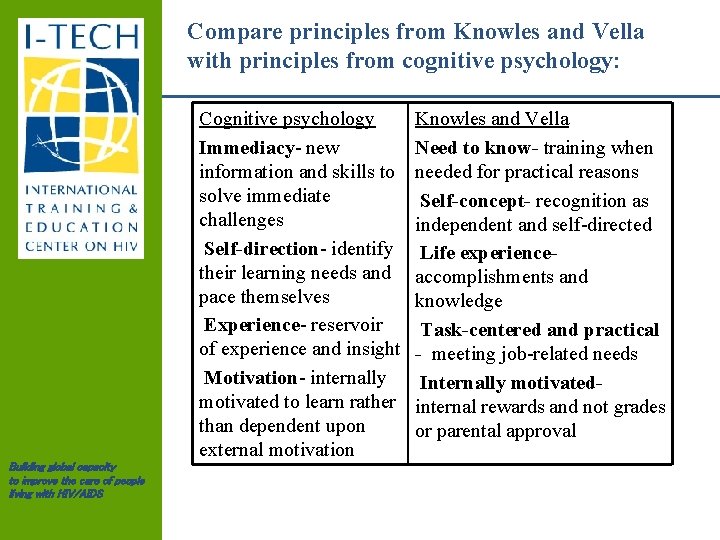
Compare principles from Knowles and Vella with principles from cognitive psychology: Building global capacity to improve the care of people living with HIV/AIDS Cognitive psychology Immediacy- new information and skills to solve immediate challenges Self-direction- identify their learning needs and pace themselves Experience- reservoir of experience and insight Motivation- internally motivated to learn rather than dependent upon external motivation Knowles and Vella Need to know- training when needed for practical reasons Self-concept- recognition as independent and self-directed Life experienceaccomplishments and knowledge Task-centered and practical - meeting job-related needs Internally motivatedinternal rewards and not grades or parental approval
Transitionfrom Principles to Practice Andragogy greatly influences the practice of training throughout the world today. We look next at how these principles are put into practice in the design, delivery, and evaluation of training programs. Building global capacity to improve the care of people living with HIV/AIDS
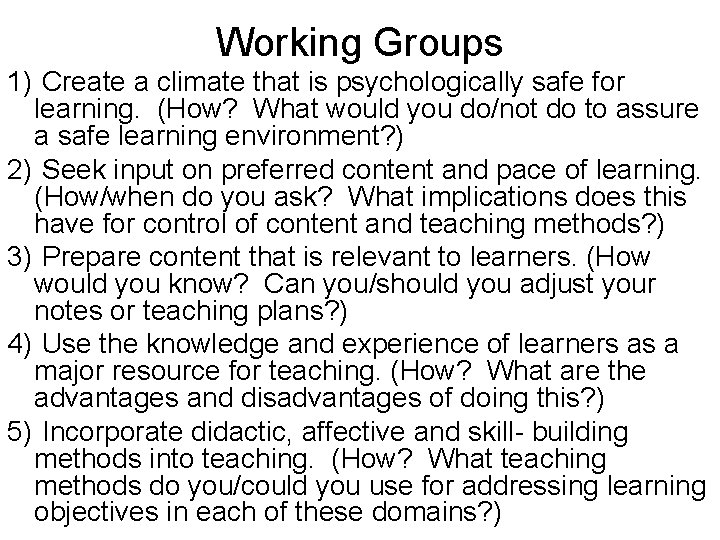
Working Groups 1) Create a climate that is psychologically safe for learning. (How? What would you do/not do to assure a safe learning environment? ) 2) Seek input on preferred content and pace of learning. (How/when do you ask? What implications does this have for control of content and teaching methods? ) 3) Prepare content that is relevant to learners. (How would you know? Can you/should you adjust your notes or teaching plans? ) 4) Use the knowledge and experience of learners as a major resource for teaching. (How? What are the advantages and disadvantages of doing this? ) 5) Incorporate didactic, affective and skill- building methods into teaching. (How? What teaching methods do you/could you use for addressing learning objectives in each of these domains? )
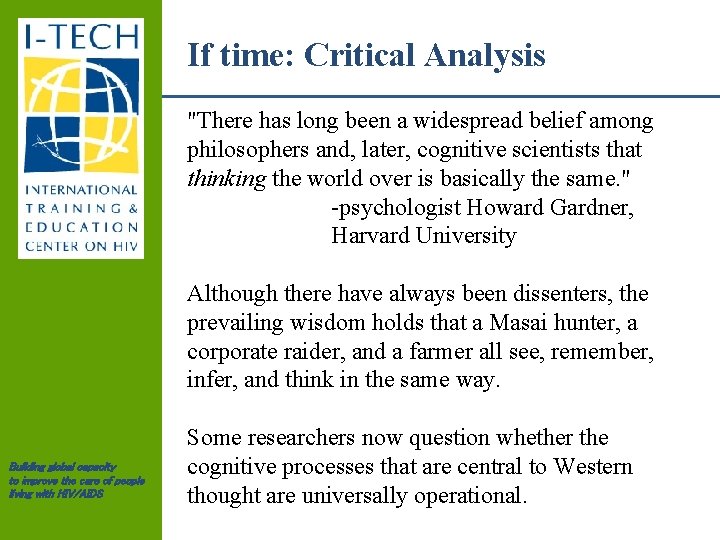
If time: Critical Analysis "There has long been a widespread belief among philosophers and, later, cognitive scientists that thinking the world over is basically the same. " -psychologist Howard Gardner, Harvard University Although there have always been dissenters, the prevailing wisdom holds that a Masai hunter, a corporate raider, and a farmer all see, remember, infer, and think in the same way. Building global capacity to improve the care of people living with HIV/AIDS Some researchers now question whether the cognitive processes that are central to Western thought are universally operational.
If time: Analysis (continued) "Human cognition is not everywhere the same. " -psychologist Richard E. Nisbett, University of Michigan, The Geography of Thought: How Asians and Westerners Think Differently. . . And Why (2003) This book compares the cognitive differences between people from East Asia (Korea, China and Japan) and Westerners (from Europe, the British commonwealth and North America). Building global capacity to improve the care of people living with HIV/AIDS Examples of East-West differences from the book.
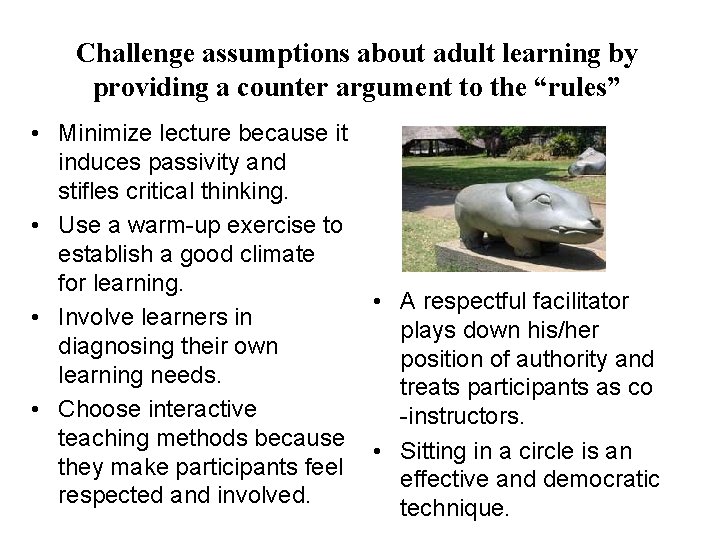
Challenge assumptions about adult learning by providing a counter argument to the “rules” • Minimize lecture because it induces passivity and stifles critical thinking. • Use a warm-up exercise to establish a good climate for learning. • Involve learners in diagnosing their own learning needs. • Choose interactive teaching methods because they make participants feel respected and involved. • A respectful facilitator plays down his/her position of authority and treats participants as co -instructors. • Sitting in a circle is an effective and democratic technique.
If time: Analysis (continued) However, at least some studies in developing countries (Diouf, 2000) suggest that: v while cultural norms and values strongly influence what adults learn; when they learn; why they learn; and who provides the instruction, v they do not affect how adults learn. Building global capacity to improve the care of people living with HIV/AIDS Framing educational research and practice as Western or non-Western may create false dichotomies, but perhaps allows us to raise important questions about the assumptions we make as trainers.
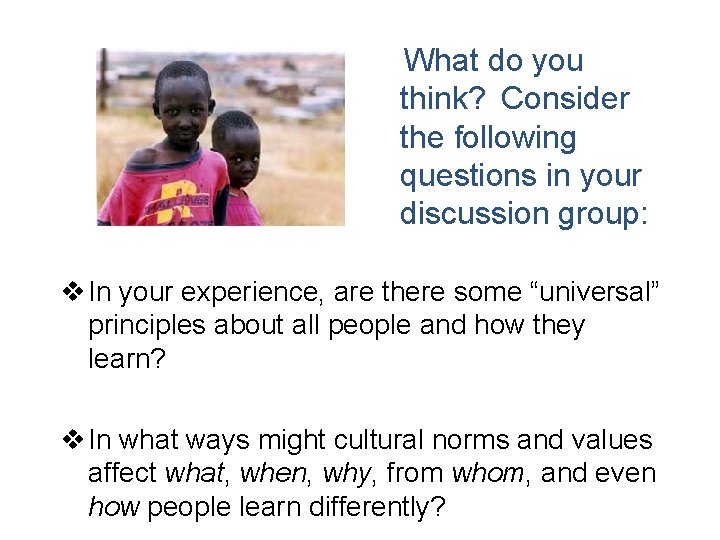
What do you think? Consider the following questions in your discussion group: v In your experience, are there some “universal” principles about all people and how they learn? v In what ways might cultural norms and values affect what, when, why, from whom, and even how people learn differently?
The Role of Trainer Debate the following statement with two or three people sitting near you. Building global capacity to improve the care of people living with HIV/AIDS Trainers are not entertainers. They are professionals who are tasked with providing accurate, quality information so that learners can perform their jobs effectively once they leave a training program. It is learners’ responsibility to pay attention, and they should not expect a trainer to motivate them to listen and learn.
Workshop Summary Now that you have completed this workshop, you should be able to: v Describe how traditional principles of adult learning theory are applied to educational design and effective group facilitation; v Judge the relevance of principles in varying cultural contexts and educational settings; and v Adopt or adapt the principles of adult learning theory as needed in order to improve clinical training practice. Building global capacity to improve the care of people living with HIV/AIDS
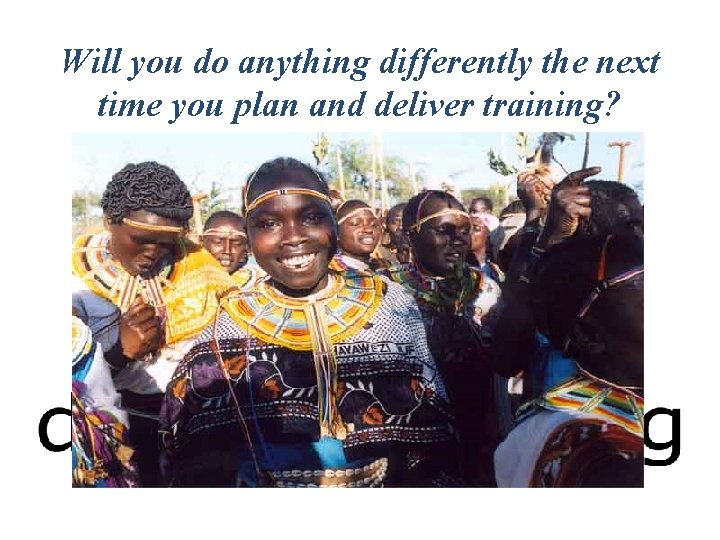
Will you do anything differently the next time you plan and deliver training?
Workshop Follow-up: Feedback on this Workshop Please complete the workshop evaluation form in order to help us evaluate whether this workshop will affect the way you develop and deliver training programs in future. Thank you. Building global capacity to improve the care of people living with HIV/AIDS