
Application of a Variable Speed Compressor to a
Application of a Variable Speed Compressor to a Residential No-Frost Freezer John Dieckmann, Member, TIAX LLC, Detlef Westphalen, Member, TIAX LLC, William Murphy, TIAX LLC, Paul Sikir, Member, Sub-Zero Freezer Company, Christopher Rieger, Sub-Zero Freezer Company Seminar 41 January 27, 2004
Continuously Variable Capacity Modulation General Discussion Continuously variable capacity modulation has significant advantages over on-off capacity control in many refrigeration and air conditioning applications. u Energy efficiency ä Maximize HX utilization, minimize temperature lift ä Flow rate cubed fan power law u Temperature u Humidity control u Noise JD/db/army. D 00154/4 -03 1
Continuously Variable Capacity Modulation General Discussion Maximum capacity vs. design load and part load. u Refrigeration and air conditioning systems need to have enough capacity to maintain the desired temperature at a worst-case, design load operating condition u For example, residential air conditioning systems face a worst-case load when the outdoor temperature and humidity and insolation are high and indoor heat generation levels (from people, lights, appliances, etc. ) are high. Often conditions are much more moderate and less capacity is required u Home refrigerators face maximum loads when door openings are frequent, warm items have been placed in the interior, and when the indoor temperature is high. When the refrigerator is left undisturbed for an extended period of time, the cooling load is much less JD/db/army. D 00154/4 -03 2
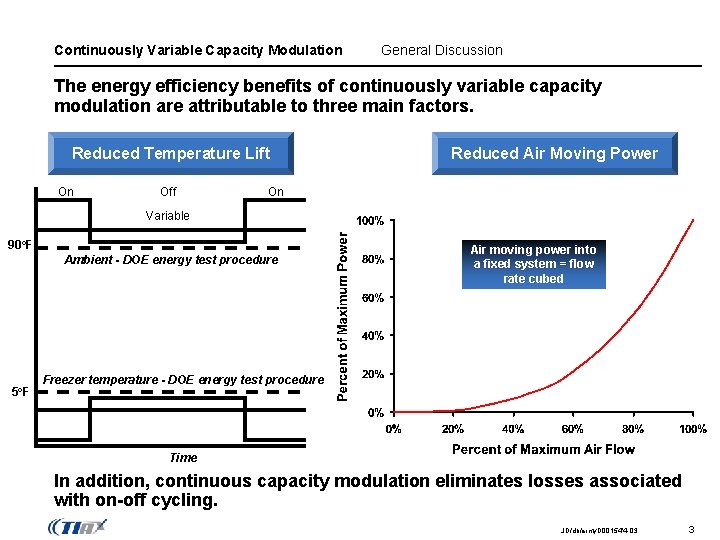
Continuously Variable Capacity Modulation General Discussion The energy efficiency benefits of continuously variable capacity modulation are attributable to three main factors. Reduced Temperature Lift On Off Reduced Air Moving Power On Variable 90 o. F Ambient - DOE energy test procedure 5 o. F Air moving power into a fixed system = flow rate cubed Freezer temperature - DOE energy test procedure Time In addition, continuous capacity modulation eliminates losses associated with on-off cycling. JD/db/army. D 00154/4 -03 3
Continuously Variable Capacity Modulation General Discussion Energy efficient caveats – home refrigeration scale. u The method used to continuously modulate capacity must be efficient ä Throttle valves, like a suction pressure regulator are very inefficient ä Hot gas bypass is very inefficient ä Variable speed compressor operation can be a highly efficient means of capacity modulation u Variable speed compressor - energy pluses and minuses: ä Losses in electronic drive ä ECM motor efficiency > induction motor efficiency for fractional horsepower motors ä Compressor speed range u Refrigerant u Fan flow control efficiency and speed modulation efficiency JD/db/army. D 00154/4 -03 4
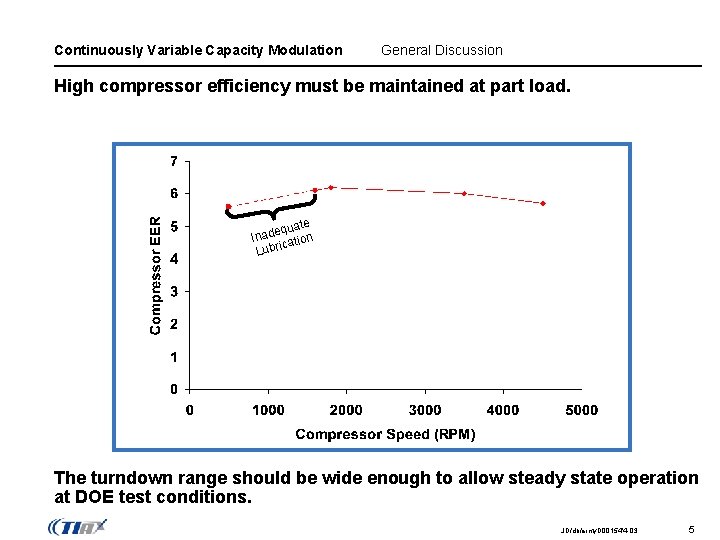
Continuously Variable Capacity Modulation General Discussion High compressor efficiency must be maintained at part load. te equa Inad ation ic Lubr The turndown range should be wide enough to allow steady state operation at DOE test conditions. JD/db/army. D 00154/4 -03 5
Continuously Variable Capacity Modulation General Discussion Cost-effectiveness of variable speed drive in home refrigerators and freezers. u There are many options for reducing the energy consumption of a home refrigerator ä Thicker foam insulated walls ä Increased thermal resistance of door perimeter thermal break and door gasket ä More efficient evaporator fan ä More efficient condenser fan ä Vacuum panel insulation ä Variable speed compressor u. A basic market issue remains - if the efficiency advantage and energy cost savings are not recognized by the buyer, no market pull ä With home refrigerators, annual electric energy cost savings ~$10 - 20/year ä Appliance stores display many brands, sizes, colors, features no room for premium efficiency ä Energy savings are significant on a national basis, hence standards JD/db/army. D 00154/4 -03 6
Continuously Variable Capacity Modulation General Discussion More energy efficiency caveats - component availability. u GRAPH Global Production of Variable speed Refrigerant Compressors for Home Refrigerators u ECM fans u 2 -speed ECM fans u Variable speed ECM fans u Small thermostatic expansion valves Data? ? Source? ? ? JD/db/army. D 00154/4 -03 7
Continuously Variable Capacity Modulation Application to 700 TF NAECA - Energy efficiency standards and the energy test procedure (10 CFR 430 etc). u Many (18) product classes (top mount, side by side, with through the door ice dispenser, manual defrost, automatic defrost, freezers, etc. ) ä Efficiency requirement for each product class is expressed in terms of maximum allowable annual energy consumption (as determined by the DOE energy test procedure 10 CFR 430 subpt B, App A 1 and B 1) vs. interior volume: Emax = a(AV) + b u The current requirements (in effect since July, 2001) for the “upright freezer with automatic defrost” product class (Class 9) are particularly stringent ä Emax = 12. 43 AV + 326. 1 (AV in cubic feet) ä For freezer, AV = 1. 73 x actual interior volume ä For the 700 TF, AV = 1. 73 x 15. 31 = 26. 49 cubic feet ä For the 700 TF, maximum annual energy under the current standard is 655 k. Wh/year (1. 795 k. Wh/day), 17% less than under the previous standard (in effect from 1/1/93 through 6/30/01 JD/db/army. D 00154/4 -03 8
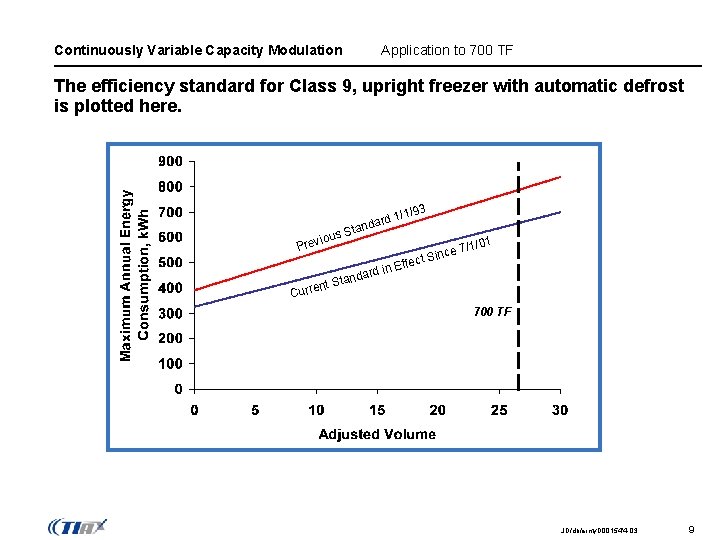
Continuously Variable Capacity Modulation Application to 700 TF The efficiency standard for Class 9, upright freezer with automatic defrost is plotted here. rd anda s St iou Prev 3 1/1/9 1 7/1/0 e n Eff di ndar a t S nt nce ct Si e Curr 700 TF JD/db/army. D 00154/4 -03 9
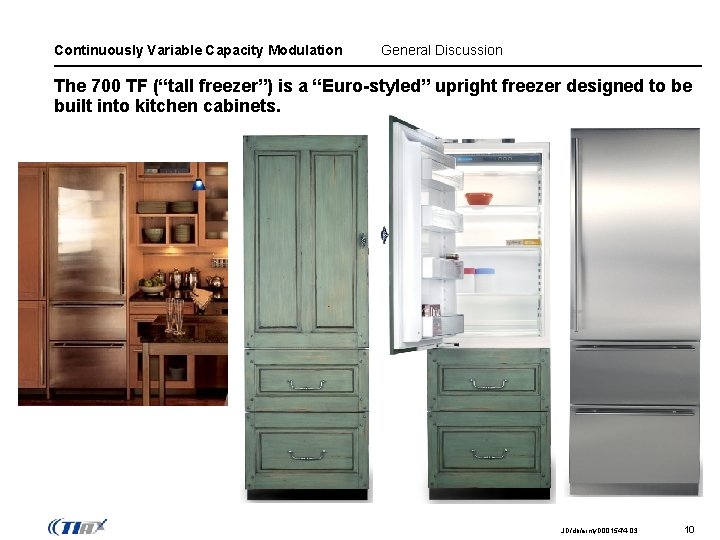
Continuously Variable Capacity Modulation General Discussion The 700 TF (“tall freezer”) is a “Euro-styled” upright freezer designed to be built into kitchen cabinets. JD/db/army. D 00154/4 -03 10
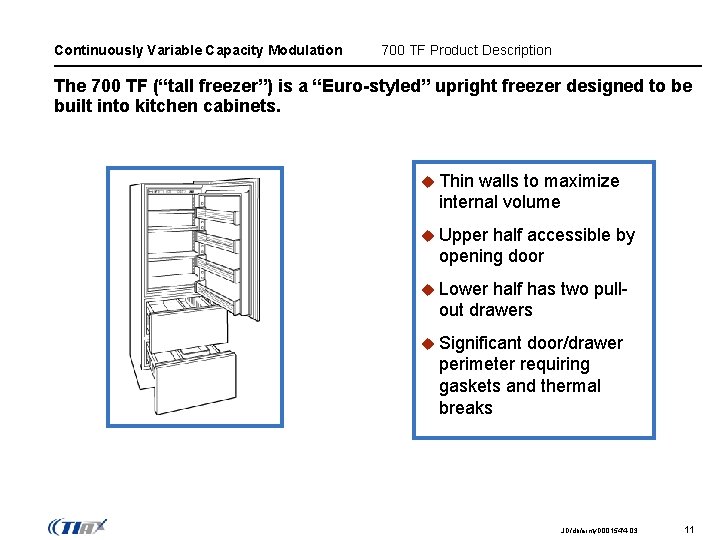
Continuously Variable Capacity Modulation 700 TF Product Description The 700 TF (“tall freezer”) is a “Euro-styled” upright freezer designed to be built into kitchen cabinets. u Thin walls to maximize internal volume u Upper half accessible by opening door u Lower half has two pullout drawers u Significant door/drawer perimeter requiring gaskets and thermal breaks JD/db/army. D 00154/4 -03 11
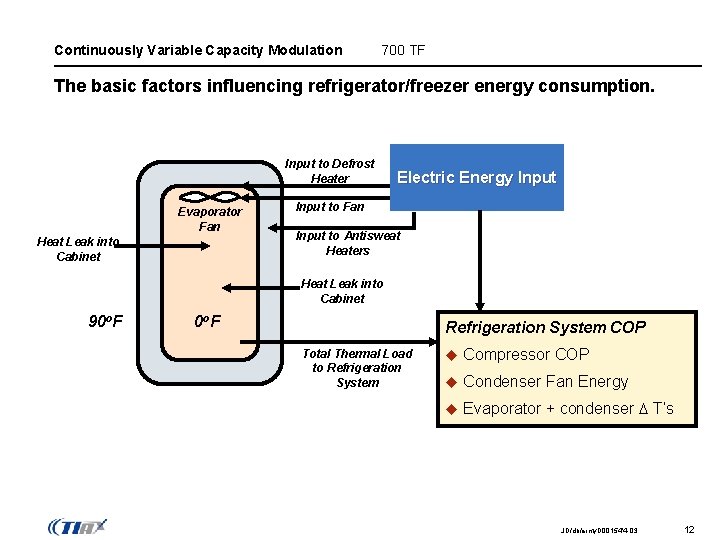
Continuously Variable Capacity Modulation 700 TF The basic factors influencing refrigerator/freezer energy consumption. Input to Defrost Heater Evaporator Fan Heat Leak into Cabinet Electric Energy Input to Fan Input to Antisweat Heaters Heat Leak into Cabinet 90 o. F 0 o F Refrigeration System COP Total Thermal Load to Refrigeration System u Compressor COP u Condenser Fan Energy u Evaporator + condenser D T’s JD/db/army. D 00154/4 -03 12
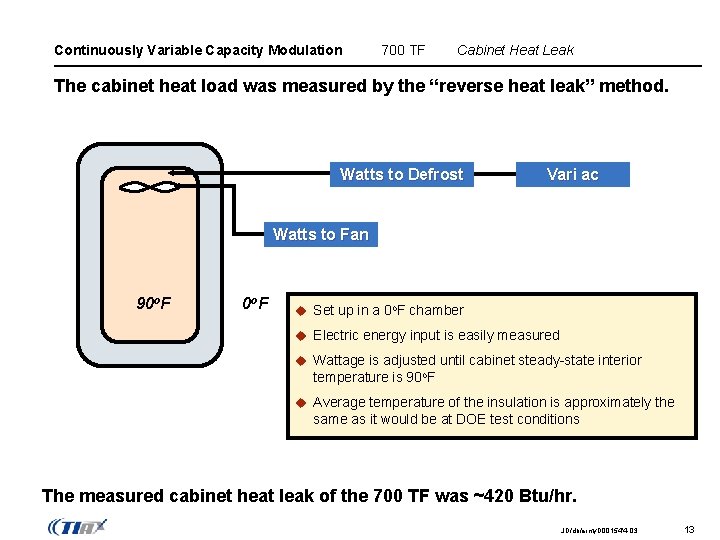
Continuously Variable Capacity Modulation 700 TF Cabinet Heat Leak The cabinet heat load was measured by the “reverse heat leak” method. Watts to Defrost Vari ac Watts to Fan 90 o. F 0 o F u Set up in a 0 o. F chamber u Electric energy input is easily measured u Wattage is adjusted until cabinet steady-state interior temperature is 90 o. F u Average temperature of the insulation is approximately the same as it would be at DOE test conditions The measured cabinet heat leak of the 700 TF was ~420 Btu/hr. JD/db/army. D 00154/4 -03 13
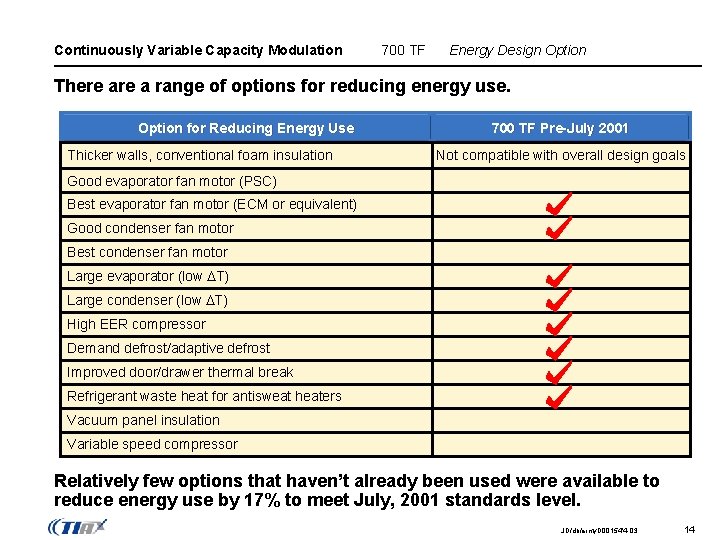
Continuously Variable Capacity Modulation 700 TF Energy Design Option There a range of options for reducing energy use. Option for Reducing Energy Use Thicker walls, conventional foam insulation 700 TF Pre-July 2001 Not compatible with overall design goals Good evaporator fan motor (PSC) Best evaporator fan motor (ECM or equivalent) Good condenser fan motor Best condenser fan motor Large evaporator (low DT) Large condenser (low DT) High EER compressor Demand defrost/adaptive defrost Improved door/drawer thermal break Refrigerant waste heat for antisweat heaters Vacuum panel insulation Variable speed compressor Relatively few options that haven’t already been used were available to reduce energy use by 17% to meet July, 2001 standards level. JD/db/army. D 00154/4 -03 14
Continuously Variable Capacity Modulation Implementation in 700 TF Compressor The key component is the variable speed compressors. u Variable speed compressors were nominally available from approximately five compressor manufacturers ä Full capacity EER’s varied from ~6 Btu/watt-hr to low 5’s ä Speed turndown ranges varied from 2 to 1 to 2 1/2 to 1 u Final selection for production was strongly influenced by strength of manufacturer’s commitment to supply compressors reliably JD/db/army. D 00154/4 -03 15
Continuously Variable Capacity Modulation Implementation in 700 TF Other important components needed to implement variable speed. u Speed control for temperature control ä 700 TF was already electronically controlled (microprocessor based), with thermistors used for temperature sensing, display, and control ä The existing microprocessor had ample under used capacity to implement a set of speed control algorithms, new software was needed ä Control board hardware modifications were needed to provide the speed control signal to the compressor drive electronics u Evaporator fan - ideally variable speed, but only commercially realistic alternatives were single speed u Expansion device - capillary was found to be adequate u Evaporator and condenser sizes were maintained at previous sizes (might be some potential to cost-optimize by down-sizing) JD/db/army. D 00154/4 -03 16
Continuously Variable Capacity Modulation General Discussion Performance Test Data JD/db/army. D 00154/4 -03 17
Continuously Variable Capacity Modulation General Discussion Conclusions/Observations/Acknowledgements u Capacity modulation in a home refrigerator or freezer can reduce the annual energy consumption by 15% to 25% (as measured by the DOE Test Procedure) u The costs of variable speed compressors and the electronic, microprocessorbased control system needed to control the speed have been decreasing, increasing the potential for cost effective applications. u Beyond energy savings, advantages include quiet part load operation, better, steadier temperature control and better food preservation u Acknowledgement: Subzero and the Technology and Innovation Group of Arthur D. Little (since spun off as TIAX LLC) collaborated on this project JD/db/army. D 00154/4 -03 18
- Slides: 19