
Applicability and Tradeoffs of ICN for Efficient Io

Applicability and Tradeoffs of ICN for Efficient Io. T draft-lindgren-icnrg-efficientiot-01 presented by Adeel Malik IRTF ICNRG Interim ICNRG meeting, Paris September 27 th, 2014

Motivation and Objectives • How to support efficient and scalable Io. T over existing ICN proposals with small changes to the ICN concepts – Io. T shares several characteristics with typical ICN applications – However, heterogeneity of Io. T networks introduces challenges • In this draft we cover: - – Advantages of ICN for Io. T – Challenges with ICN for Io. T – Design choices and associated trade-offs to allow for effective, efficient, scalable and secure handling of Io. T data in an ICN network • Objective – Avoid introducing Io. T-specific architectural changes in ICN
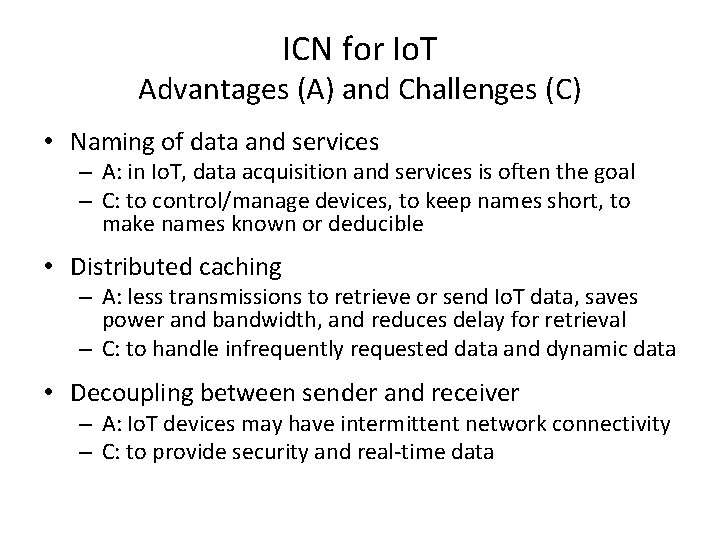
ICN for Io. T Advantages (A) and Challenges (C) • Naming of data and services – A: in Io. T, data acquisition and services is often the goal – C: to control/manage devices, to keep names short, to make names known or deducible • Distributed caching – A: less transmissions to retrieve or send Io. T data, saves power and bandwidth, and reduces delay for retrieval – C: to handle infrequently requested data and dynamic data • Decoupling between sender and receiver – A: Io. T devices may have intermittent network connectivity – C: to provide security and real-time data
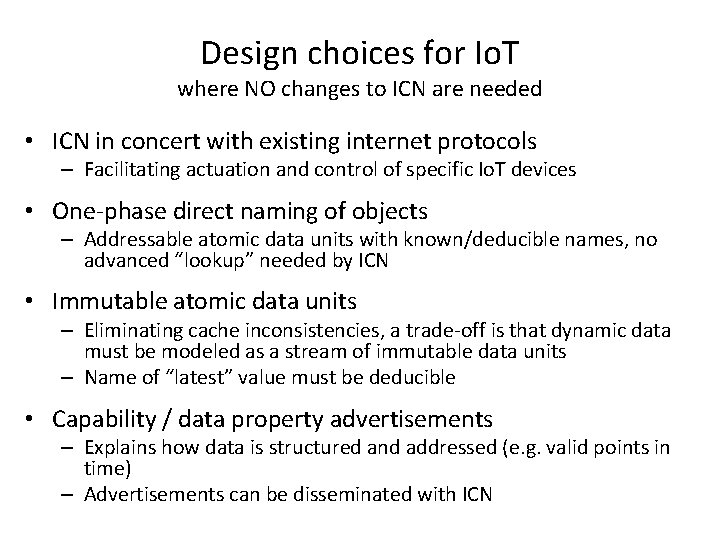
Design choices for Io. T where NO changes to ICN are needed • ICN in concert with existing internet protocols – Facilitating actuation and control of specific Io. T devices • One-phase direct naming of objects – Addressable atomic data units with known/deducible names, no advanced “lookup” needed by ICN • Immutable atomic data units – Eliminating cache inconsistencies, a trade-off is that dynamic data must be modeled as a stream of immutable data units – Name of “latest” value must be deducible • Capability / data property advertisements – Explains how data is structured and addressed (e. g. valid points in time) – Advertisements can be disseminated with ICN
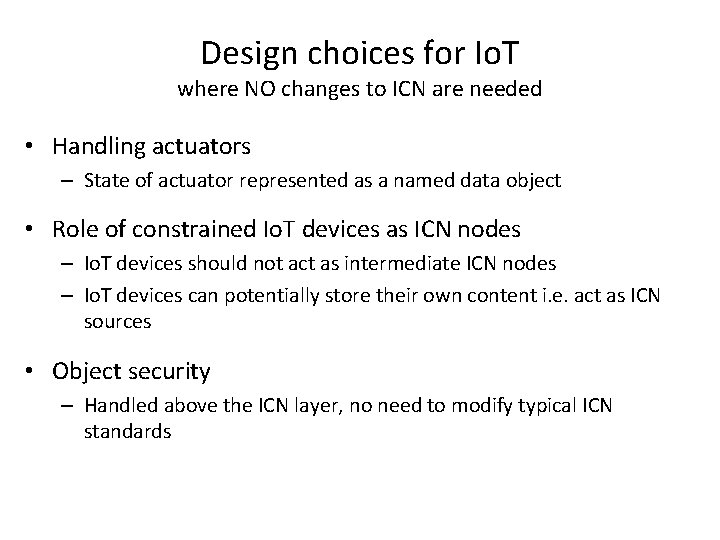
Design choices for Io. T where NO changes to ICN are needed • Handling actuators – State of actuator represented as a named data object • Role of constrained Io. T devices as ICN nodes – Io. T devices should not act as intermediate ICN nodes – Io. T devices can potentially store their own content i. e. act as ICN sources • Object security – Handled above the ICN layer, no need to modify typical ICN standards
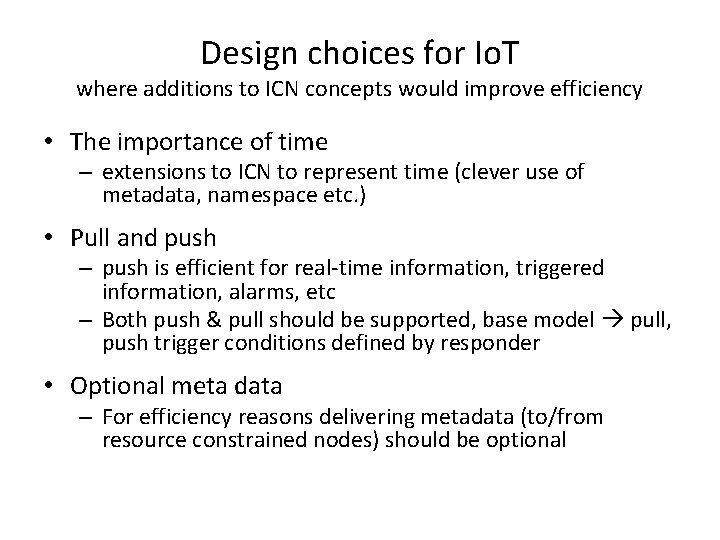
Design choices for Io. T where additions to ICN concepts would improve efficiency • The importance of time – extensions to ICN to represent time (clever use of metadata, namespace etc. ) • Pull and push – push is efficient for real-time information, triggered information, alarms, etc – Both push & pull should be supported, base model pull, push trigger conditions defined by responder • Optional meta data – For efficiency reasons delivering metadata (to/from resource constrained nodes) should be optional
Discussion • Feedback • Next steps
- Slides: 7