
Appendix Map of the EU and Candidate Countries

- Slides: 25
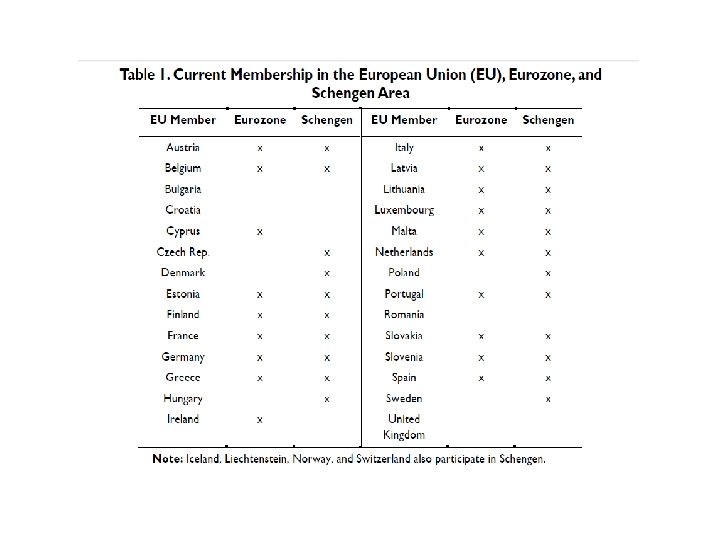
Appendix. Map of the EU and Candidate Countries Figure 1. European Union (EU) Member States and Aspirant Countries
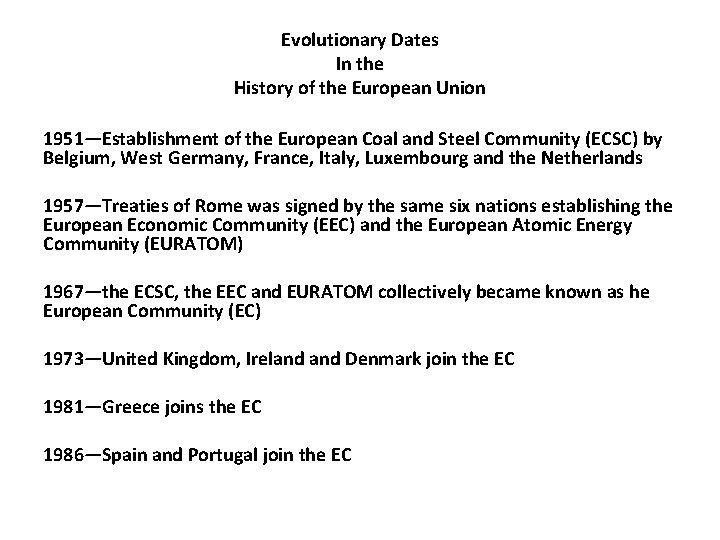
Evolutionary Dates In the History of the European Union 1951—Establishment of the European Coal and Steel Community (ECSC) by Belgium, West Germany, France, Italy, Luxembourg and the Netherlands 1957—Treaties of Rome was signed by the same six nations establishing the European Economic Community (EEC) and the European Atomic Energy Community (EURATOM) 1967—the ECSC, the EEC and EURATOM collectively became known as he European Community (EC) 1973—United Kingdom, Ireland Denmark join the EC 1981—Greece joins the EC 1986—Spain and Portugal join the EC
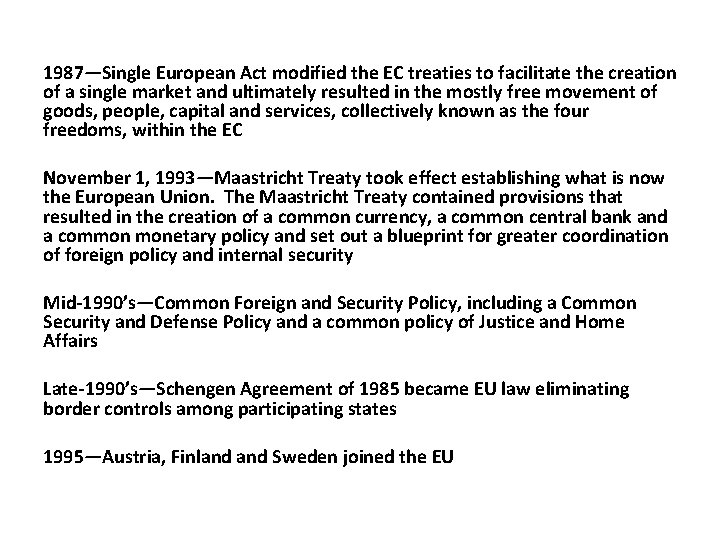
1987—Single European Act modified the EC treaties to facilitate the creation of a single market and ultimately resulted in the mostly free movement of goods, people, capital and services, collectively known as the four freedoms, within the EC November 1, 1993—Maastricht Treaty took effect establishing what is now the European Union. The Maastricht Treaty contained provisions that resulted in the creation of a common currency, a common central bank and a common monetary policy and set out a blueprint for greater coordination of foreign policy and internal security Mid-1990’s—Common Foreign and Security Policy, including a Common Security and Defense Policy and a common policy of Justice and Home Affairs Late-1990’s—Schengen Agreement of 1985 became EU law eliminating border controls among participating states 1995—Austria, Finland Sweden joined the EU
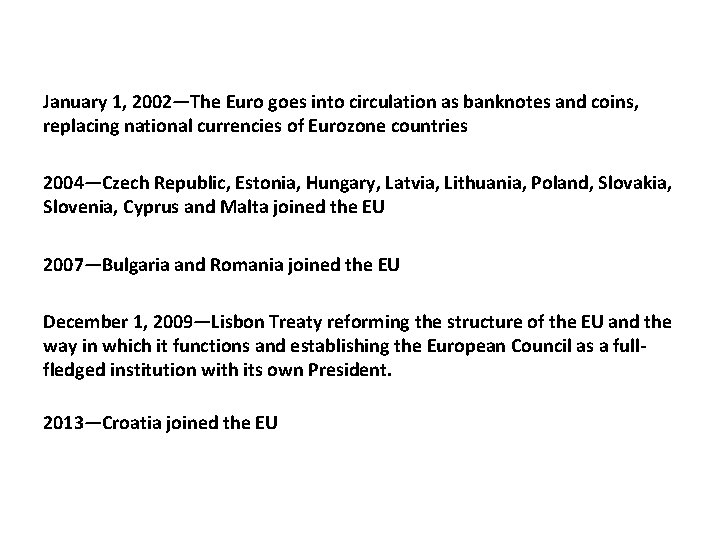
January 1, 2002—The Euro goes into circulation as banknotes and coins, replacing national currencies of Eurozone countries 2004—Czech Republic, Estonia, Hungary, Latvia, Lithuania, Poland, Slovakia, Slovenia, Cyprus and Malta joined the EU 2007—Bulgaria and Romania joined the EU December 1, 2009—Lisbon Treaty reforming the structure of the EU and the way in which it functions and establishing the European Council as a fullfledged institution with its own President. 2013—Croatia joined the EU