
Appendix H Chapter 40 Fluoroscopy Spot film camera




- Slides: 31
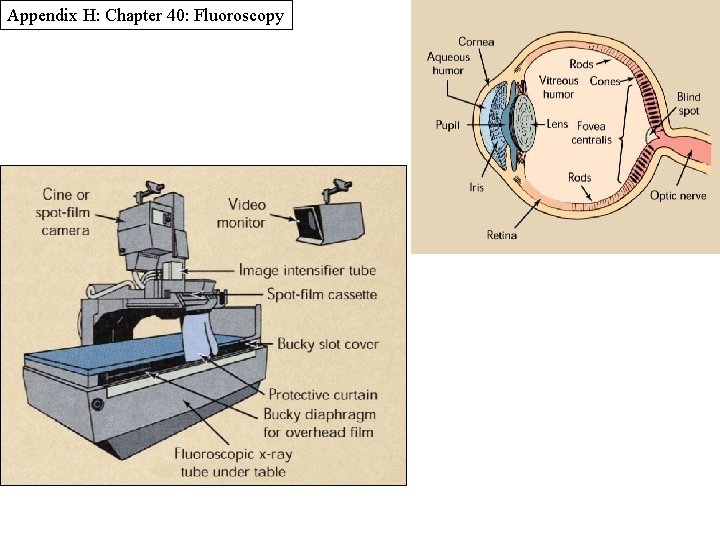
Appendix H: Chapter 40: Fluoroscopy
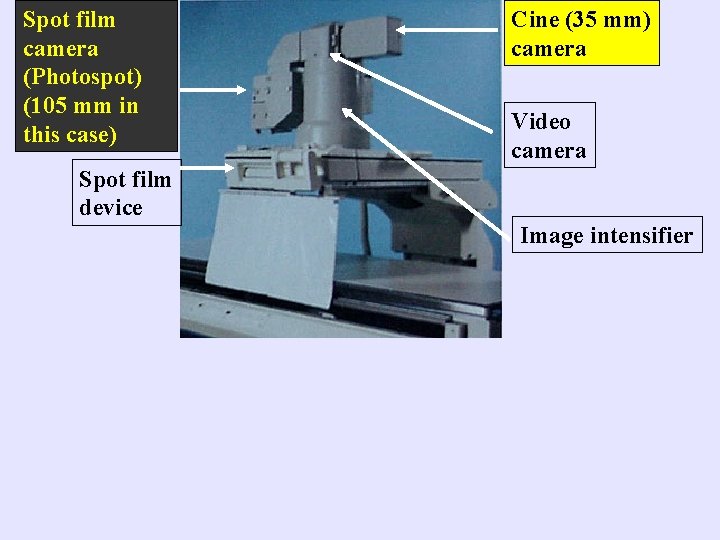
Spot film camera (Photospot) (105 mm in this case) Cine (35 mm) camera Video camera Spot film device Image intensifier
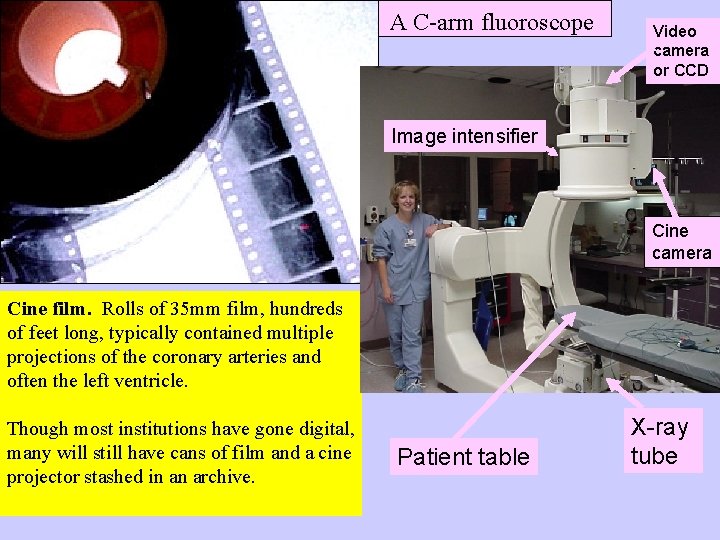
A C-arm fluoroscope Video camera or CCD Image intensifier Cine camera Cine film. Rolls of 35 mm film, hundreds of feet long, typically contained multiple projections of the coronary arteries and often the left ventricle. Though most institutions have gone digital, many will still have cans of film and a cine projector stashed in an archive. Patient table X-ray tube
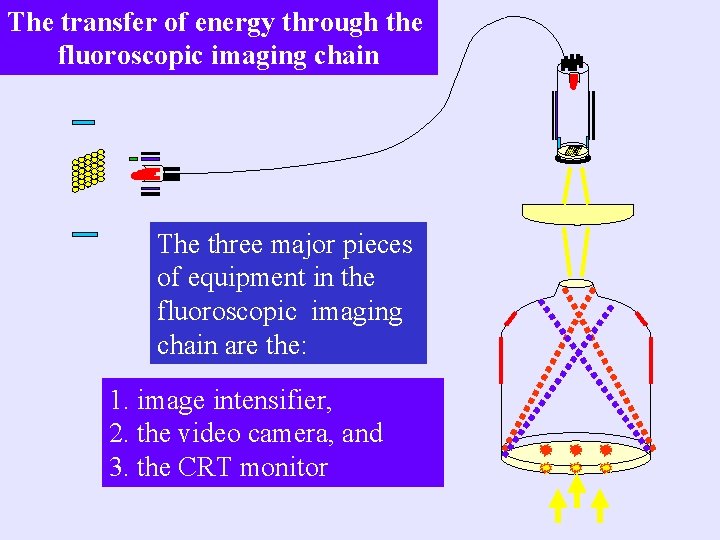
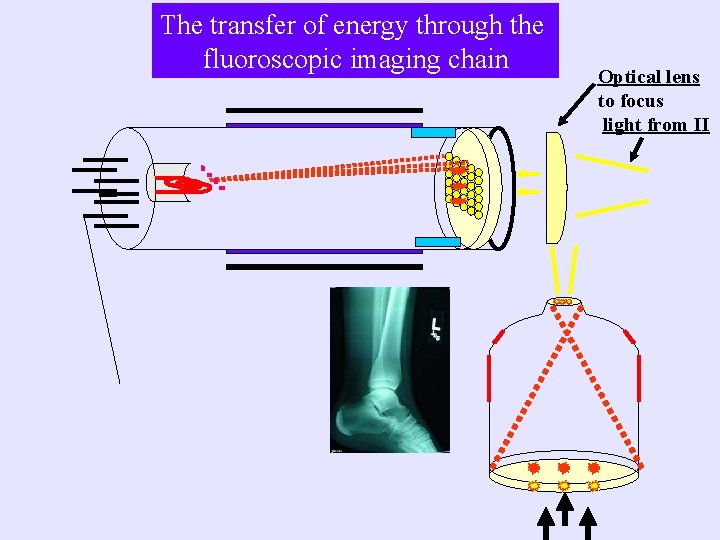
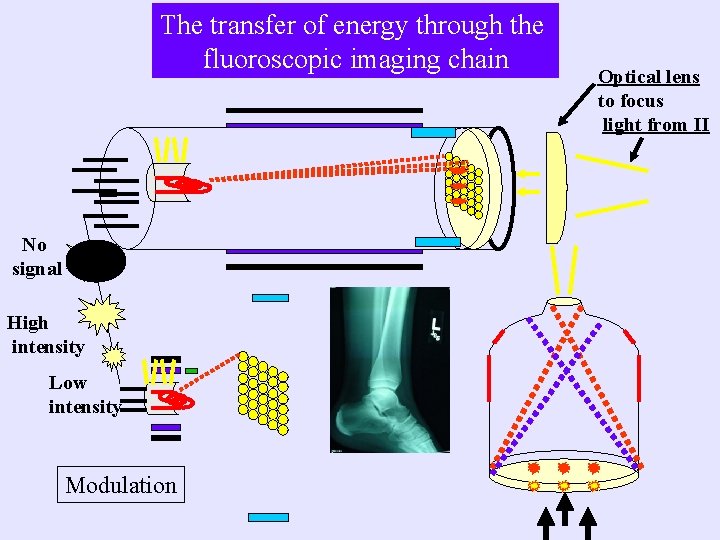
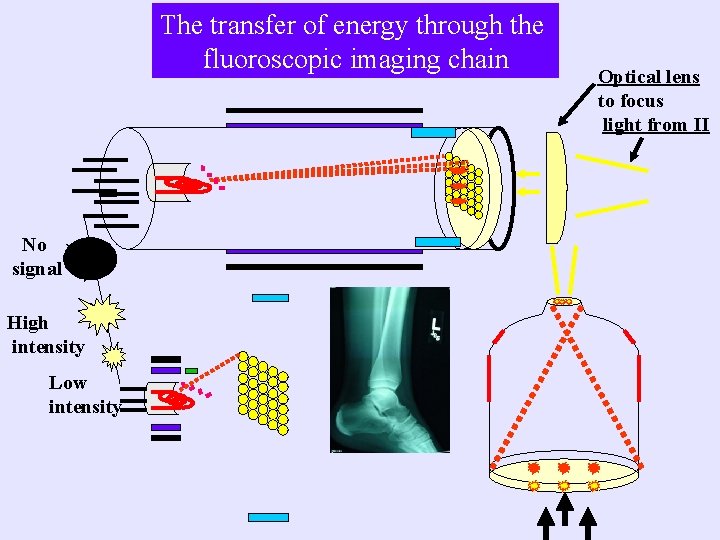
The transfer of energy through the fluoroscopic imaging chain The three major pieces of equipment in the fluoroscopic imaging chain are the: 1. image intensifier, 2. the video camera, and 3. the CRT monitor
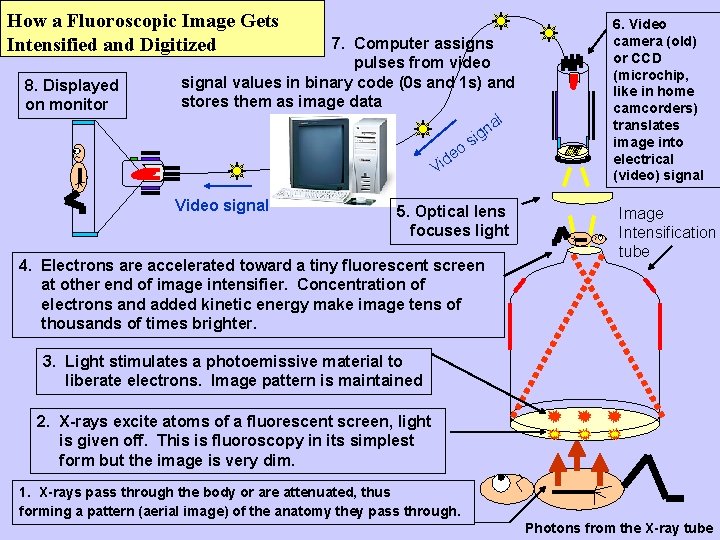
How a Fluoroscopic Image Gets Intensified and Digitized 8. Displayed on monitor 7. Computer assigns pulses from video signal values in binary code (0 s and 1 s) and stores them as image data al n sig o de Vi Video signal 5. Optical lens focuses light 4. Electrons are accelerated toward a tiny fluorescent screen at other end of image intensifier. Concentration of electrons and added kinetic energy make image tens of thousands of times brighter. 6. Video camera (old) or CCD (microchip, like in home camcorders) translates image into electrical (video) signal Image Intensification tube 3. Light stimulates a photoemissive material to liberate electrons. Image pattern is maintained 2. X-rays excite atoms of a fluorescent screen, light is given off. This is fluoroscopy in its simplest form but the image is very dim. 1. X-rays pass through the body or are attenuated, thus forming a pattern (aerial image) of the anatomy they pass through. Photons from the X-ray tube
Image Intensifier (II) Output Phosphor Zinc Cadmium Sulfide Anode 25, 000 V Electrostatic focusing lens Glass envelope Photocathode Cesium & Antimony Input Phosphor Cs. I Concave surface so all electrons arrive at the output screen at the same time, but causes vignetting.
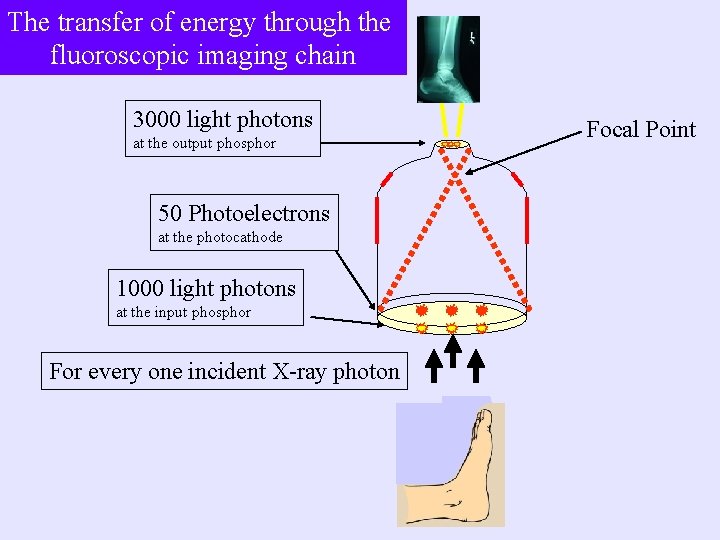
The transfer of energy through the fluoroscopic imaging chain 3000 light photons at the output phosphor 50 Photoelectrons at the photocathode 1000 light photons at the input phosphor For every one incident X-ray photon Focal Point
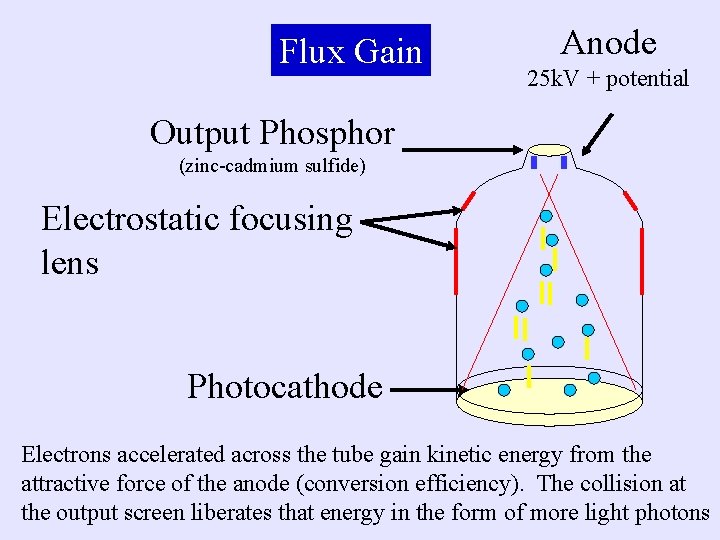
Flux Gain Anode 25 k. V + potential Output Phosphor (zinc-cadmium sulfide) Electrostatic focusing lens Photocathode Electrons accelerated across the tube gain kinetic energy from the attractive force of the anode (conversion efficiency). The collision at the output screen liberates that energy in the form of more light photons
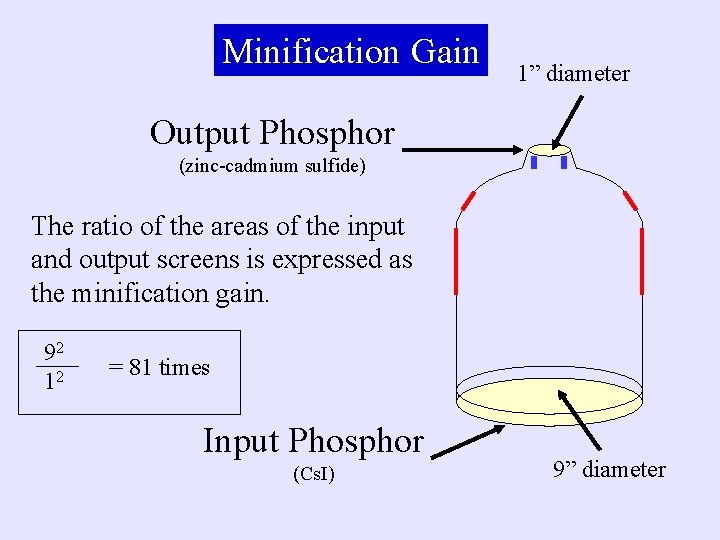
Minification Gain 1” diameter Output Phosphor (zinc-cadmium sulfide) The ratio of the areas of the input and output screens is expressed as the minification gain. 92 12 = 81 times Input Phosphor (Cs. I) 9” diameter
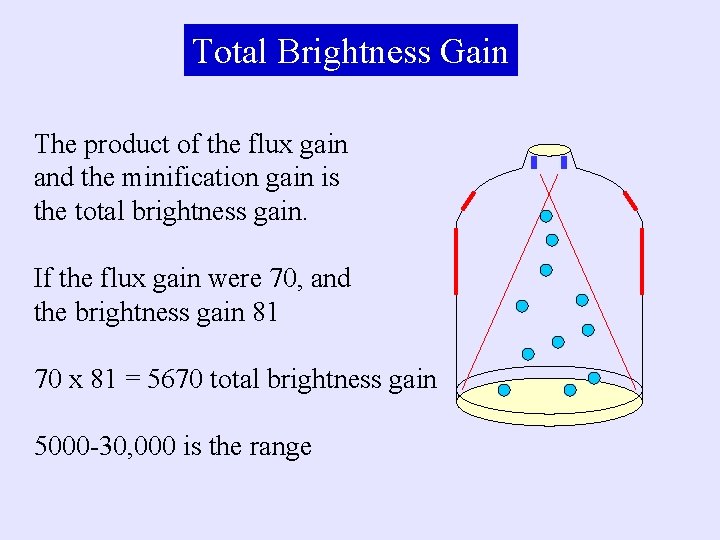
Total Brightness Gain The product of the flux gain and the minification gain is the total brightness gain. If the flux gain were 70, and the brightness gain 81 70 x 81 = 5670 total brightness gain 5000 -30, 000 is the range
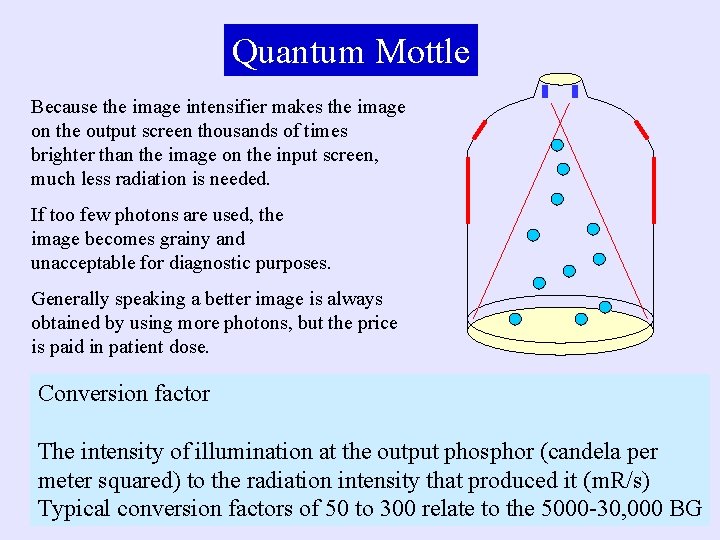
Quantum Mottle Because the image intensifier makes the image on the output screen thousands of times brighter than the image on the input screen, much less radiation is needed. If too few photons are used, the image becomes grainy and unacceptable for diagnostic purposes. Generally speaking a better image is always obtained by using more photons, but the price is paid in patient dose. Conversion factor The intensity of illumination at the output phosphor (candela per meter squared) to the radiation intensity that produced it (m. R/s) Typical conversion factors of 50 to 300 relate to the 5000 -30, 000 BG
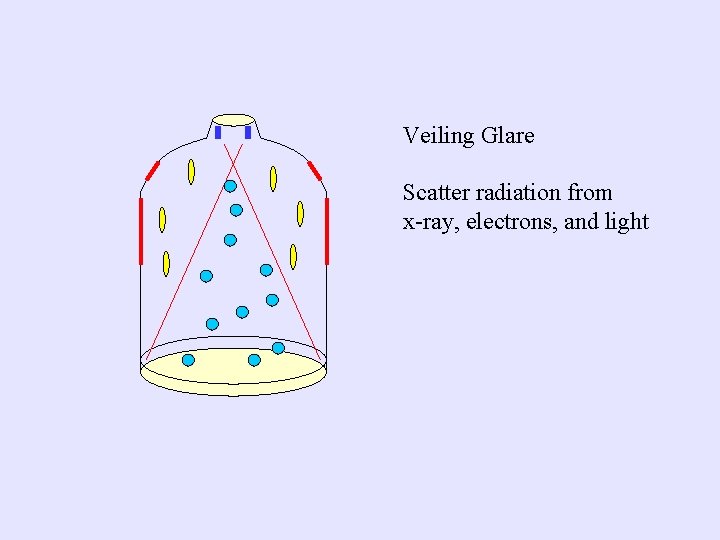
Veiling Glare Scatter radiation from x-ray, electrons, and light
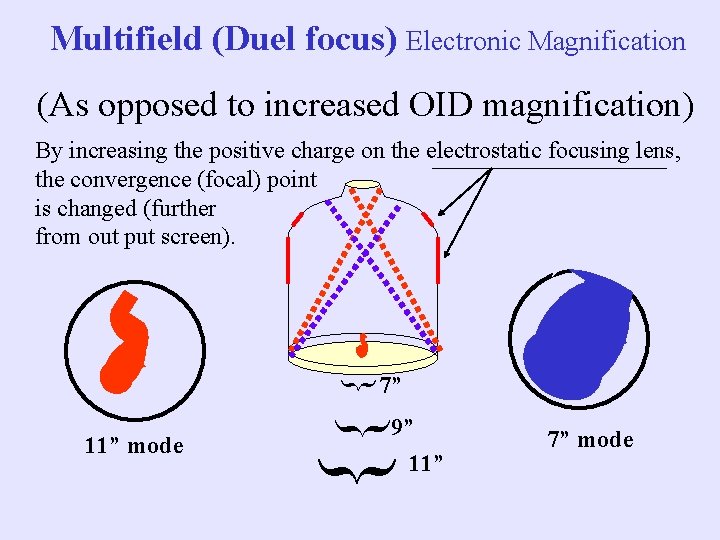
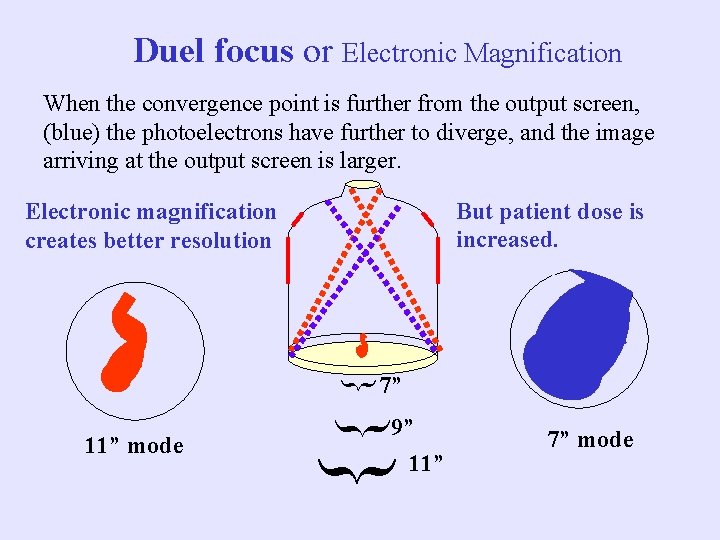
Multifield (Duel focus) Electronic Magnification (As opposed to increased OID magnification) By increasing the positive charge on the electrostatic focusing lens, the convergence (focal) point is changed (further from out put screen). } 7” }} 11” mode 9” 11” 7” mode
Duel focus or Electronic Magnification When the convergence point is further from the output screen, (blue) the photoelectrons have further to diverge, and the image arriving at the output screen is larger. But patient dose is increased. Electronic magnification creates better resolution } 7” }} 11” mode 9” 11” 7” mode
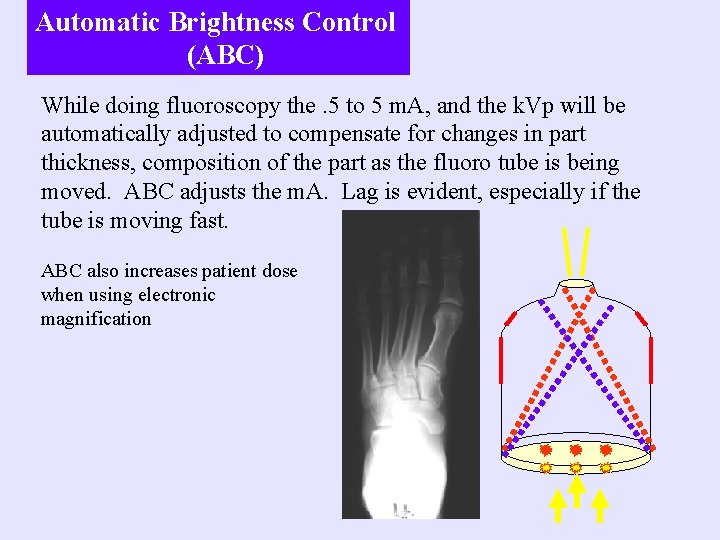
Automatic Brightness Control (ABC) While doing fluoroscopy the. 5 to 5 m. A, and the k. Vp will be automatically adjusted to compensate for changes in part thickness, composition of the part as the fluoro tube is being moved. ABC adjusts the m. A. Lag is evident, especially if the tube is moving fast. ABC also increases patient dose when using electronic magnification
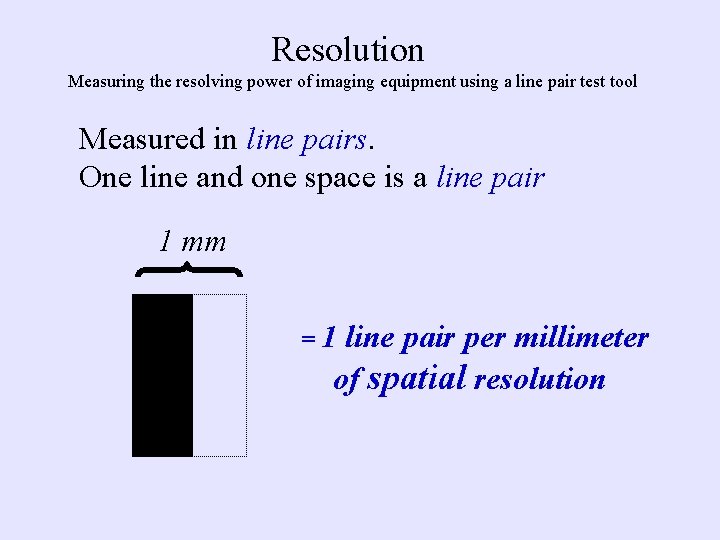
Resolution Measuring the resolving power of imaging equipment using a line pair test tool Measured in line pairs. One line and one space is a line pair 1 mm =1 line pair per millimeter of spatial resolution
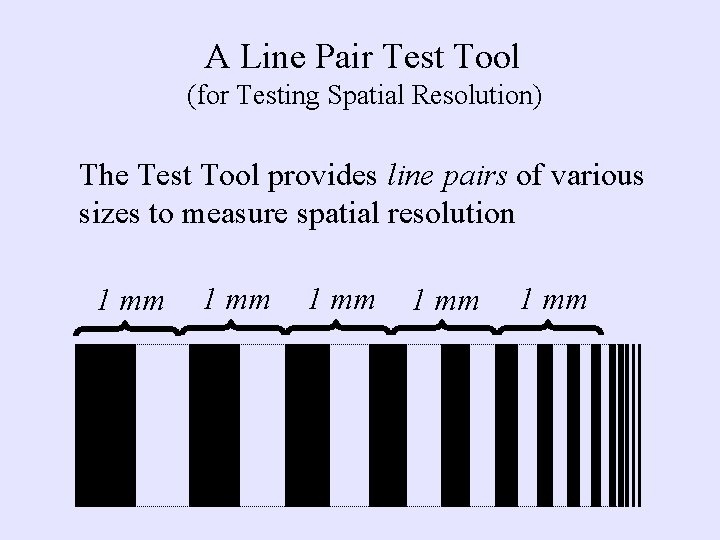
A Line Pair Test Tool (for Testing Spatial Resolution) The Test Tool provides line pairs of various sizes to measure spatial resolution 1 mm 1 mm
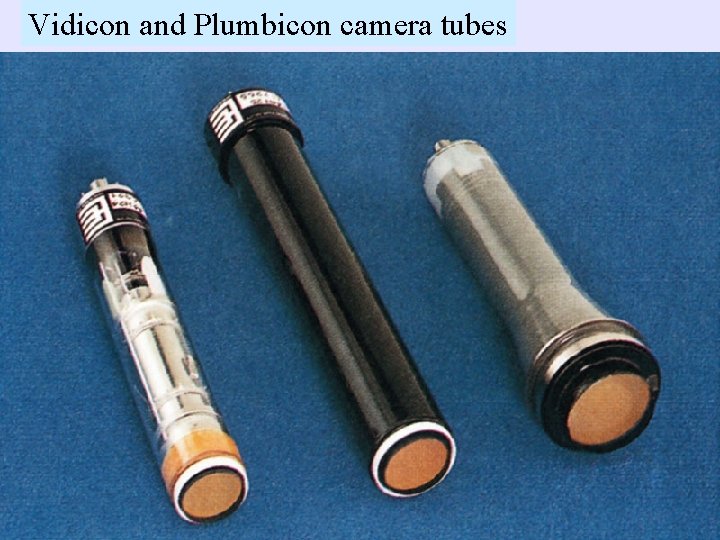
Vidicon and Plumbicon camera tubes
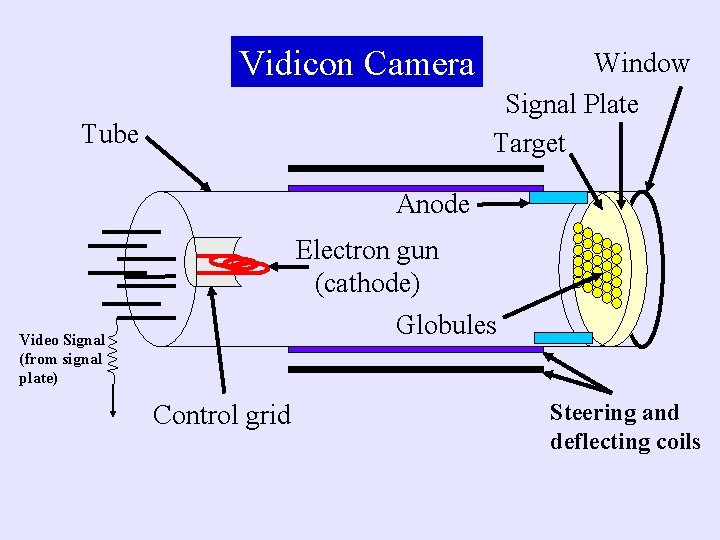
Vidicon Camera Tube Window Signal Plate Target Anode Electron gun (cathode) Globules Video Signal (from signal plate) Control grid Steering and deflecting coils
The transfer of energy through the fluoroscopic imaging chain Optical lens to focus light from II
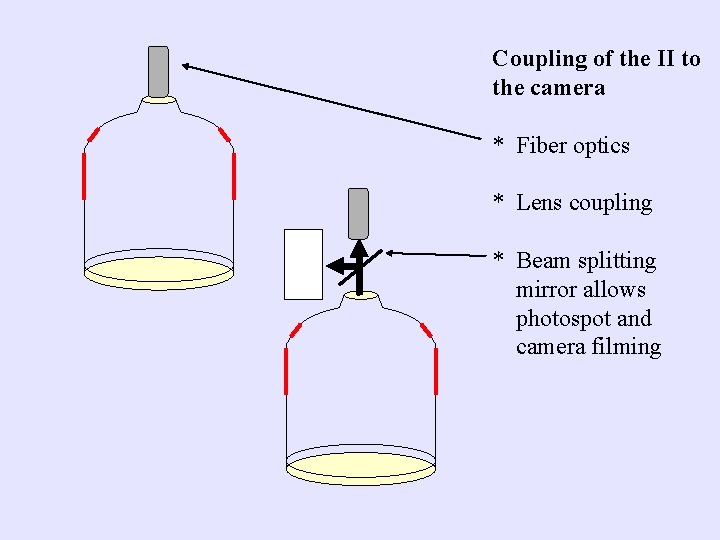
Coupling of the II to the camera * Fiber optics * Lens coupling * Beam splitting mirror allows photospot and camera filming
The transfer of energy through the fluoroscopic imaging chain No signal High intensity Low intensity Modulation Optical lens to focus light from II
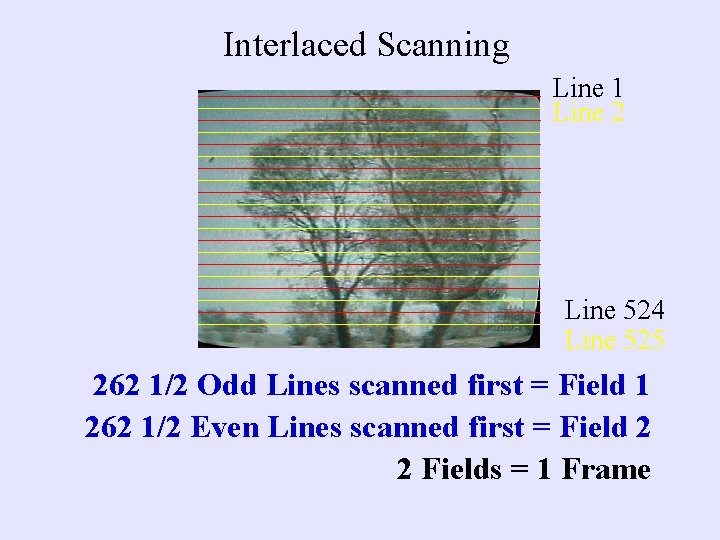
Interlaced Scanning Line 1 Line 2 Line 524 Line 525 262 1/2 Odd Lines scanned first = Field 1 262 1/2 Even Lines scanned first = Field 2 2 Fields = 1 Frame
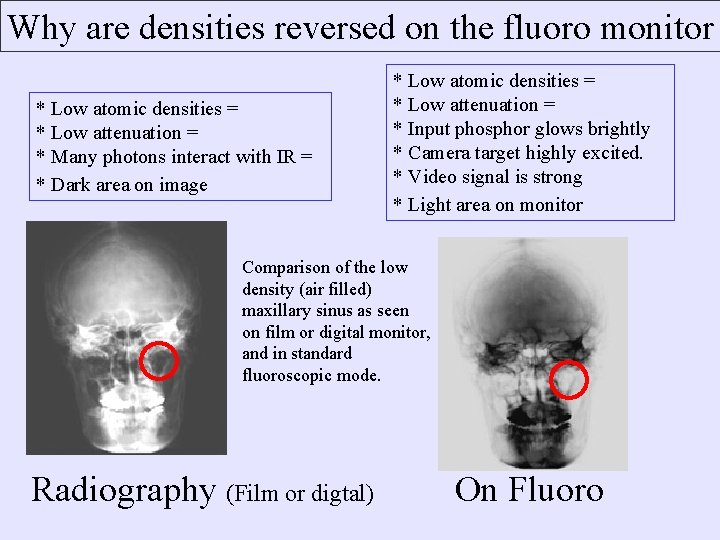
Why are densities reversed on the fluoro monitor * Low atomic densities = * Low attenuation = * Many photons interact with IR = * Dark area on image * Low atomic densities = * Low attenuation = * Input phosphor glows brightly * Camera target highly excited. * Video signal is strong * Light area on monitor Comparison of the low density (air filled) maxillary sinus as seen on film or digital monitor, and in standard fluoroscopic mode. Radiography (Film or digtal) On Fluoro
The transfer of energy through the fluoroscopic imaging chain No signal High intensity Low intensity Optical lens to focus light from II
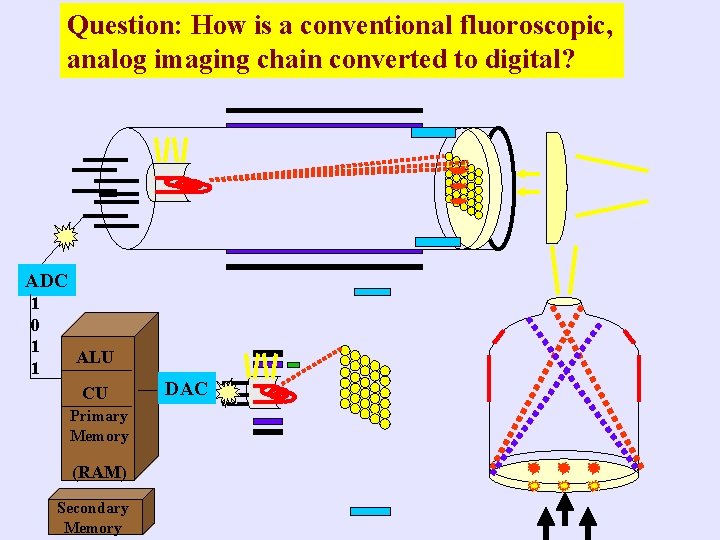
Question: How is a conventional fluoroscopic, analog imaging chain converted to digital? ADC 1 0 1 1 ALU CU Primary Memory (RAM) Secondary Memory DAC
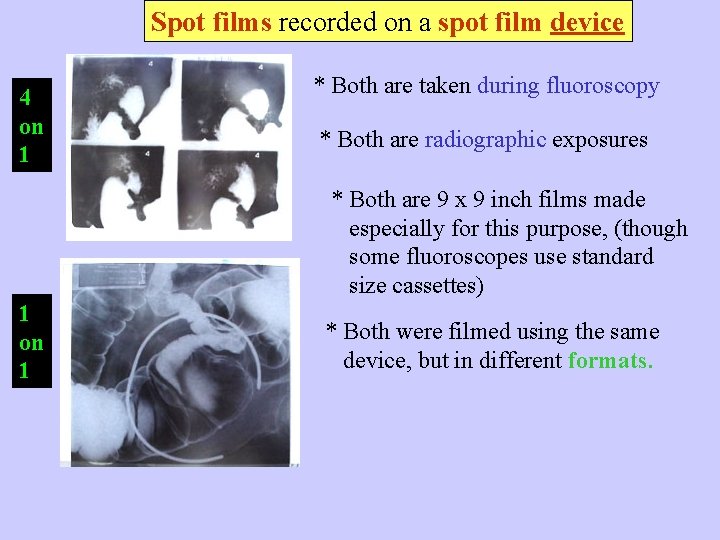
Spot films recorded on a spot film device 4 on 1 * Both are taken during fluoroscopy * Both are radiographic exposures * Both are 9 x 9 inch films made especially for this purpose, (though some fluoroscopes use standard size cassettes) 1 on 1 * Both were filmed using the same device, but in different formats.
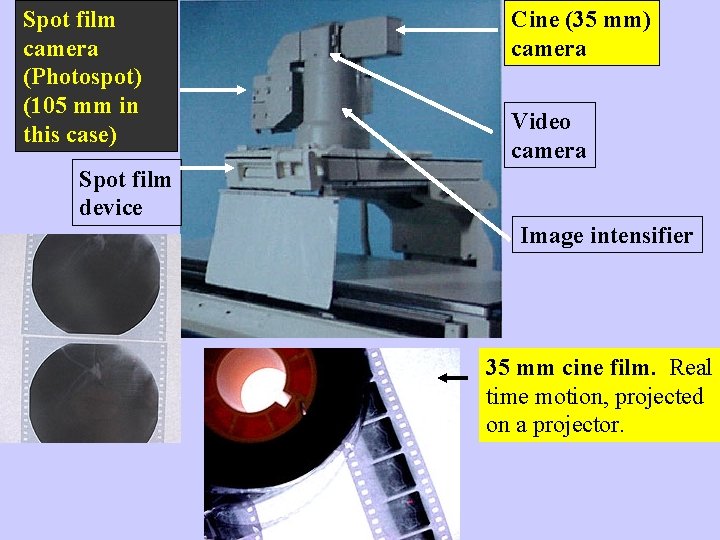
Spot film camera (Photospot) (105 mm in this case) Cine (35 mm) camera Video camera Spot film device Image intensifier 35 mm cine film. Real time motion, projected on a projector.
Spot films (Photospots) recorded on a spot film (photospot) camera 105 mm identifiable by sprockets * Both were taken during fluoroscopy that drives the roll of film that is unique for this size * Both are fluoroscopic exposures (i. e. taken off the output phosphor of the II. ) 105 mm * Both are serial films (not designed to be projected as a moving image, but taken in rapid sequence such as 1, 2, or 4 a second * Both are filmed by the same camera but are different sizes. 90 mm (cut film)
Flat Screen Monitors