
Appendix G Validation Appendix G JCI Data Inter

- Slides: 10
Appendix G: Validation Appendix G JCI Data Inter- Rater Reliability/ Chart Audit Validation Methodology Introduction One critically important aspect of credible performance measurement is assuring the quality of the data collected. Data quality is fundamental to assuring the usefulness of the data for quality improvement efforts and for other purposes. That is, if data are flawed, then quality improvement efforts may not be appropriately targeted and may ultimately result in wasted effort. Benefits to using quality data are that it enables hospital leadership to make informed decisions; bad decisions are often due to bad data. Thus, in order to assure data quality it is recommended that hospitals utilize one of the two following validation comparison/calculation methodologies to assess interrater reliability as required by the Joint Commission International Accreditation Standards for Hospitals, Quality Improvement and Patient Safety (QPS) standards. The indication and frequency for internal data validation is outlined in the intent statement of QPS. 5 Standards. These standards require that at least the clinical measures selected to meet QPS. 3. 1 are included in the validation process. The QPS validation term is referred to in this document as inter-rater reliability methodology. This inter-rater reliability testing is based upon the chart-audit validation process. The original abstractor of measure data (1 st abstractor) performs chart data collection. To assure the selected data answer and result values are reproducible the validation process begins with a 2 nd abstractor performing validation data re-abstraction using the same data collection process as the 1 st abstractor. Specifically, implementation of these methodologies will allow the organization to assess the extent to which data are being consistently and accurately collected regardless of which individual is completing the data abstraction task. . Based on your organization’s quality improvement program assessment and internal data validation process, either option may be selected to be eligible to meet the validation requirement in QPS. 5. 1 Specification Manual for the Joint Commission International Library of Measures Version 2. 0, effective for January 2013 discharges (1 st Quarter 2013)
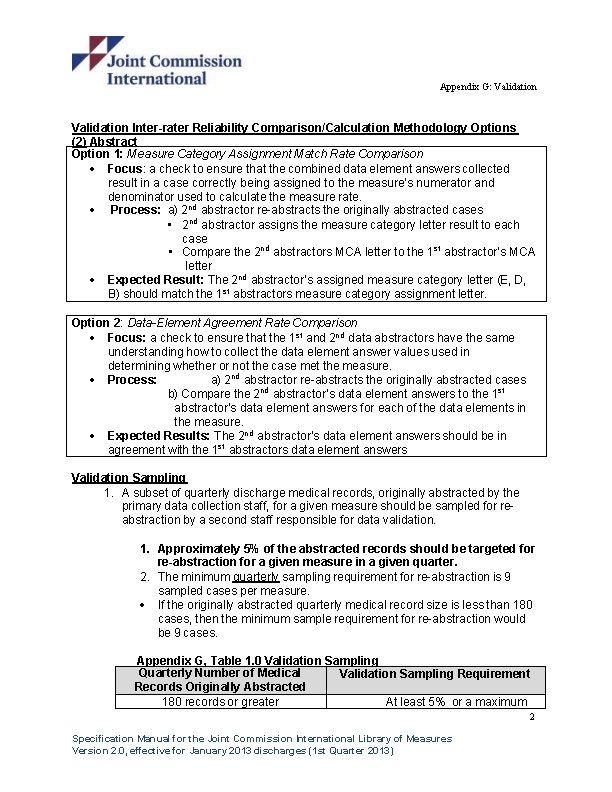
Appendix G: Validation Inter-rater Reliability Comparison/Calculation Methodology Options (2) Abstract Option 1: Measure Category Assignment Match Rate Comparison Focus: a check to ensure that the combined data element answers collected result in a case correctly being assigned to the measure’s numerator and denominator used to calculate the measure rate. Process: a) 2 nd abstractor re-abstracts the originally abstracted cases • 2 nd abstractor assigns the measure category letter result to each case • Compare the 2 nd abstractors MCA letter to the 1 st abstractor’s MCA letter Expected Result: The 2 nd abstractor’s assigned measure category letter (E, D, B) should match the 1 st abstractors measure category assignment letter. Option 2: Data-Element Agreement Rate Comparison Focus: a check to ensure that the 1 st and 2 nd data abstractors have the same understanding how to collect the data element answer values used in determining whether or not the case met the measure. Process: a) 2 nd abstractor re-abstracts the originally abstracted cases b) Compare the 2 nd abstractor’s data element answers to the 1 st abstractor’s data element answers for each of the data elements in the measure. Expected Results: The 2 nd abstractor’s data element answers should be in agreement with the 1 st abstractors data element answers Validation Sampling 1. A subset of quarterly discharge medical records, originally abstracted by the primary data collection staff, for a given measure should be sampled for reabstraction by a second staff responsible for data validation. 1. Approximately 5% of the abstracted records should be targeted for re-abstraction for a given measure in a given quarter. 2. The minimum quarterly sampling requirement for re-abstraction is 9 sampled cases per measure. If the originally abstracted quarterly medical record size is less than 180 cases, then the minimum sample requirement for re-abstraction would be 9 cases. Appendix G, Table 1. 0 Validation Sampling Quarterly Number of Medical Validation Sampling Requirement Records Originally Abstracted 180 records or greater At least 5% or a maximum 2 Specification Manual for the Joint Commission International Library of Measures Version 2. 0, effective for January 2013 discharges (1 st Quarter 2013)
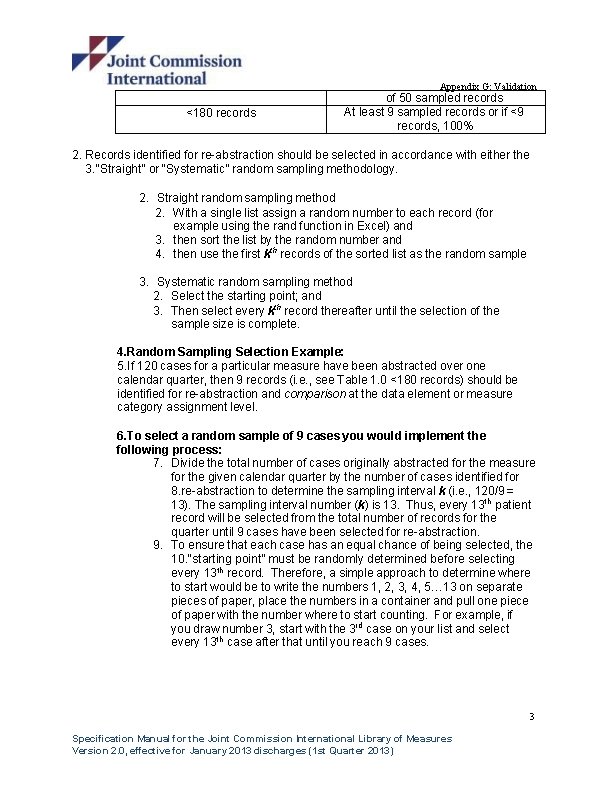
Appendix G: Validation <180 records of 50 sampled records At least 9 sampled records or if <9 records, 100% 2. Records identified for re-abstraction should be selected in accordance with either the 3. “Straight” or “Systematic” random sampling methodology. 2. Straight random sampling method 2. With a single list assign a random number to each record (for example using the rand function in Excel) and 3. then sort the list by the random number and 4. then use the first kth records of the sorted list as the random sample 3. Systematic random sampling method 2. Select the starting point; and 3. Then select every kth record thereafter until the selection of the sample size is complete. 4. Random Sampling Selection Example: 5. If 120 cases for a particular measure have been abstracted over one calendar quarter, then 9 records (i. e. , see Table 1. 0 <180 records) should be identified for re-abstraction and comparison at the data element or measure category assignment level. 6. To select a random sample of 9 cases you would implement the following process: 7. Divide the total number of cases originally abstracted for the measure for the given calendar quarter by the number of cases identified for 8. re-abstraction to determine the sampling interval k (i. e. , 120/9 = 13). The sampling interval number (k) is 13. Thus, every 13 th patient record will be selected from the total number of records for the quarter until 9 cases have been selected for re-abstraction. 9. To ensure that each case has an equal chance of being selected, the 10. “starting point” must be randomly determined before selecting every 13 th record. Therefore, a simple approach to determine where to start would be to write the numbers 1, 2, 3, 4, 5… 13 on separate pieces of paper, place the numbers in a container and pull one piece of paper with the number where to start counting. For example, if you draw number 3, start with the 3 rd case on your list and select every 13 th case after that until you reach 9 cases. 3 Specification Manual for the Joint Commission International Library of Measures Version 2. 0, effective for January 2013 discharges (1 st Quarter 2013)
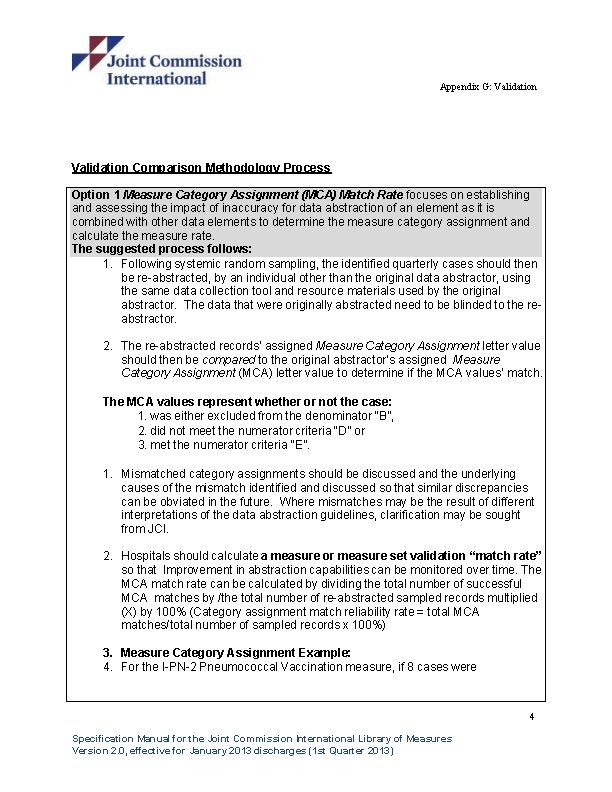
Appendix G: Validation Comparison Methodology Process Option 1 Measure Category Assignment (MCA) Match Rate focuses on establishing and assessing the impact of inaccuracy for data abstraction of an element as it is combined with other data elements to determine the measure category assignment and calculate the measure rate. The suggested process follows: 1. Following systemic random sampling, the identified quarterly cases should then be re-abstracted, by an individual other than the original data abstractor, using the same data collection tool and resource materials used by the original abstractor. The data that were originally abstracted need to be blinded to the reabstractor. 2. The re-abstracted records’ assigned Measure Category Assignment letter value should then be compared to the original abstractor’s assigned Measure Category Assignment (MCA) letter value to determine if the MCA values’ match. The MCA values represent whether or not the case: 1. was either excluded from the denominator “B”, 2. did not meet the numerator criteria “D” or 3. met the numerator criteria “E”. 1. Mismatched category assignments should be discussed and the underlying causes of the mismatch identified and discussed so that similar discrepancies can be obviated in the future. Where mismatches may be the result of different interpretations of the data abstraction guidelines, clarification may be sought from JCI. 2. Hospitals should calculate a measure or measure set validation “match rate” so that Improvement in abstraction capabilities can be monitored over time. The MCA match rate can be calculated by dividing the total number of successful MCA matches by /the total number of re-abstracted sampled records multiplied (X) by 100% (Category assignment match reliability rate = total MCA matches/total number of sampled records x 100%) 3. Measure Category Assignment Example: 4. For the I-PN-2 Pneumococcal Vaccination measure, if 8 cases were 4 Specification Manual for the Joint Commission International Library of Measures Version 2. 0, effective for January 2013 discharges (1 st Quarter 2013)
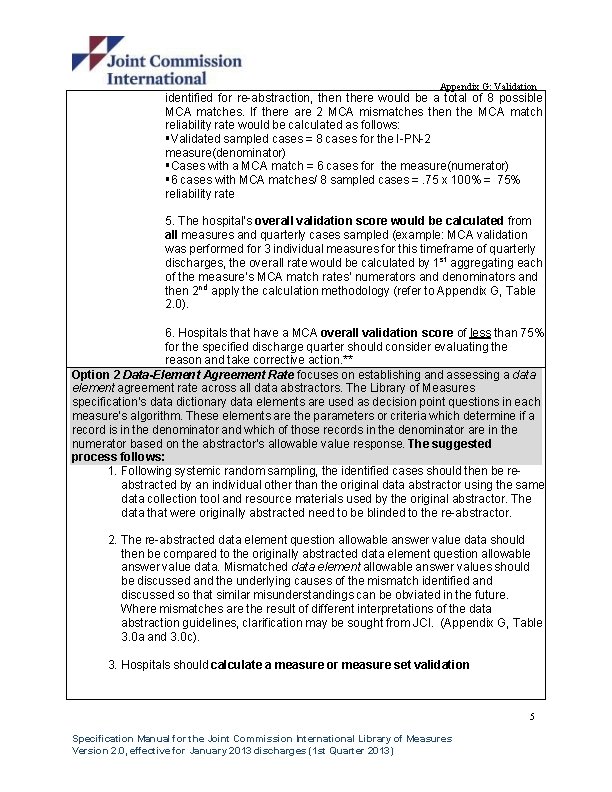
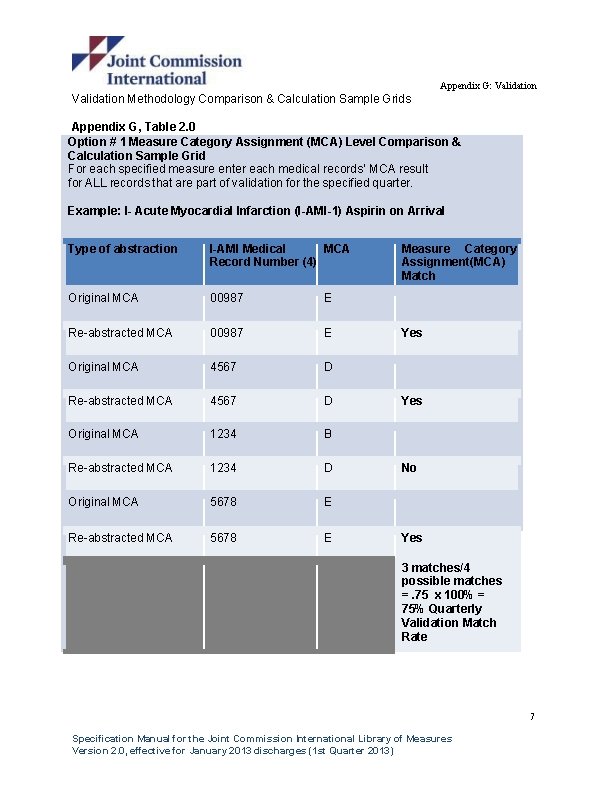
Appendix G: Validation identified for re-abstraction, then there would be a total of 8 possible MCA matches. If there are 2 MCA mismatches then the MCA match reliability rate would be calculated as follows: Validated sampled cases = 8 cases for the I-PN-2 measure(denominator) Cases with a MCA match = 6 cases for the measure(numerator) 6 cases with MCA matches/ 8 sampled cases =. 75 x 100% = 75% reliability rate 5. The hospital’s overall validation score would be calculated from all measures and quarterly cases sampled (example: MCA validation was performed for 3 individual measures for this timeframe of quarterly discharges, the overall rate would be calculated by 1 st aggregating each of the measure’s MCA match rates’ numerators and denominators and then 2 nd apply the calculation methodology (refer to Appendix G, Table 2. 0). 6. Hospitals that have a MCA overall validation score of less than 75% for the specified discharge quarter should consider evaluating the reason and take corrective action. ** Option 2 Data-Element Agreement Rate focuses on establishing and assessing a data element agreement rate across all data abstractors. The Library of Measures specification’s data dictionary data elements are used as decision point questions in each measure’s algorithm. These elements are the parameters or criteria which determine if a record is in the denominator and which of those records in the denominator are in the numerator based on the abstractor’s allowable value response. The suggested process follows: 1. Following systemic random sampling, the identified cases should then be reabstracted by an individual other than the original data abstractor using the same data collection tool and resource materials used by the original abstractor. The data that were originally abstracted need to be blinded to the re-abstractor. 2. The re-abstracted data element question allowable answer value data should then be compared to the originally abstracted data element question allowable answer value data. Mismatched data element allowable answer values should be discussed and the underlying causes of the mismatch identified and discussed so that similar misunderstandings can be obviated in the future. Where mismatches are the result of different interpretations of the data abstraction guidelines, clarification may be sought from JCI. (Appendix G, Table 3. 0 a and 3. 0 c). 3. Hospitals should calculate a measure or measure set validation 5 Specification Manual for the Joint Commission International Library of Measures Version 2. 0, effective for January 2013 discharges (1 st Quarter 2013)
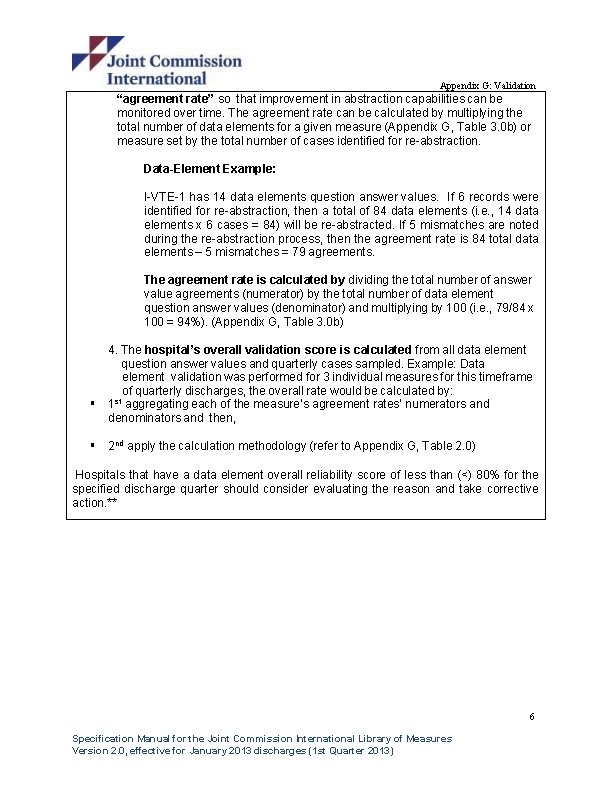
Appendix G: Validation “agreement rate” so that improvement in abstraction capabilities can be monitored over time. The agreement rate can be calculated by multiplying the total number of data elements for a given measure (Appendix G, Table 3. 0 b) or measure set by the total number of cases identified for re-abstraction. Data-Element Example: I-VTE-1 has 14 data elements question answer values. If 6 records were identified for re-abstraction, then a total of 84 data elements (i. e. , 14 data elements x 6 cases = 84) will be re-abstracted. If 5 mismatches are noted during the re-abstraction process, then the agreement rate is 84 total data elements – 5 mismatches = 79 agreements. The agreement rate is calculated by dividing the total number of answer value agreements (numerator) by the total number of data element question answer values (denominator) and multiplying by 100 (i. e. , 79/84 x 100 = 94%). (Appendix G, Table 3. 0 b) 4. The hospital’s overall validation score is calculated from all data element question answer values and quarterly cases sampled. Example: Data element validation was performed for 3 individual measures for this timeframe of quarterly discharges, the overall rate would be calculated by: st 1 aggregating each of the measure’s agreement rates’ numerators and denominators and then, 2 nd apply the calculation methodology (refer to Appendix G, Table 2. 0) Hospitals that have a data element overall reliability score of less than (<) 80% for the specified discharge quarter should consider evaluating the reason and take corrective action. ** 6 Specification Manual for the Joint Commission International Library of Measures Version 2. 0, effective for January 2013 discharges (1 st Quarter 2013)
Appendix G: Validation Methodology Comparison & Calculation Sample Grids Appendix G, Table 2. 0 Option # 1 Measure Category Assignment (MCA) Level Comparison & Calculation Sample Grid For each specified measure enter each medical records’ MCA result for ALL records that are part of validation for the specified quarter. Example: I- Acute Myocardial Infarction (I-AMI-1) Aspirin on Arrival Type of abstraction I-AMI Medical MCA Record Number (4) Original MCA 00987 E Re-abstracted MCA 00987 E Original MCA 4567 D Re-abstracted MCA 4567 D Original MCA 1234 B Re-abstracted MCA 1234 D Original MCA 5678 E Re-abstracted MCA 5678 E Measure Category Assignment(MCA) Match Yes No Yes 3 matches/4 possible matches =. 75 x 100% = 75% Quarterly Validation Match Rate 7 Specification Manual for the Joint Commission International Library of Measures Version 2. 0, effective for January 2013 discharges (1 st Quarter 2013)
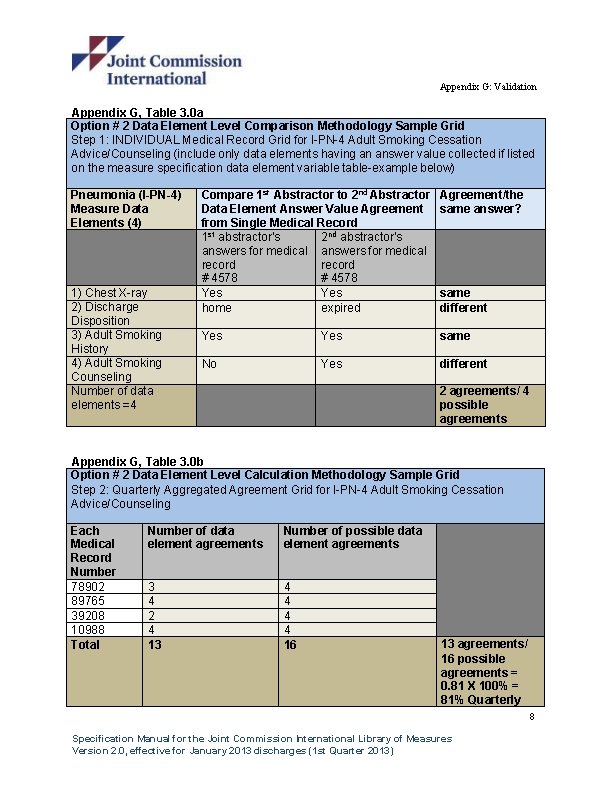
Appendix G: Validation Appendix G, Table 3. 0 a Option # 2 Data Element Level Comparison Methodology Sample Grid Step 1: INDIVIDUAL Medical Record Grid for I-PN-4 Adult Smoking Cessation Advice/Counseling (include only data elements having an answer value collected if listed on the measure specification data element variable table-example below) Pneumonia (I-PN-4) Measure Data Elements (4) 1) Chest X-ray 2) Discharge Disposition 3) Adult Smoking History 4) Adult Smoking Counseling Number of data elements =4 Compare 1 st Abstractor to 2 nd Abstractor Data Element Answer Value Agreement from Single Medical Record 1 st abstractor’s 2 nd abstractor’s answers for medical record # 4578 Yes home expired Agreement/the same answer? Yes same No Yes different same different 2 agreements/ 4 possible agreements Appendix G, Table 3. 0 b Option # 2 Data Element Level Calculation Methodology Sample Grid Step 2: Quarterly Aggregated Agreement Grid for I-PN-4 Adult Smoking Cessation Advice/Counseling Each Medical Record Number 78902 89765 39208 10988 Total Number of data element agreements Number of possible data element agreements 3 4 2 4 13 4 4 16 13 agreements/ 16 possible agreements = 0. 81 X 100% = 81% Quarterly 8 Specification Manual for the Joint Commission International Library of Measures Version 2. 0, effective for January 2013 discharges (1 st Quarter 2013)
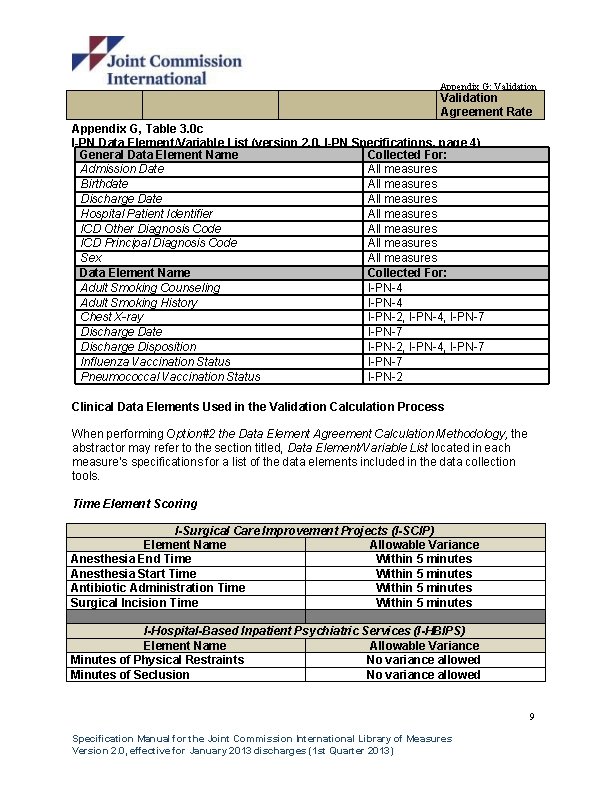
Appendix G: Validation Agreement Rate Appendix G, Table 3. 0 c I-PN Data Element/Variable List (version 2. 0, I-PN Specifications, page 4) General Data Element Name Collected For: Admission Date All measures Birthdate Discharge Date All measures Hospital Patient Identifier All measures ICD Other Diagnosis Code All measures ICD Principal Diagnosis Code All measures Sex Data Element Name Collected For: Adult Smoking Counseling I-PN-4 Adult Smoking History I-PN-4 Chest X-ray I-PN-2, I-PN-4, I-PN-7 Discharge Date I-PN-7 Discharge Disposition I-PN-2, I-PN-4, I-PN-7 Influenza Vaccination Status I-PN-7 Pneumococcal Vaccination Status I-PN-2 Clinical Data Elements Used in the Validation Calculation Process When performing Option#2 the Data Element Agreement Calculation Methodology, the abstractor may refer to the section titled, Data Element/Variable List located in each measure’s specifications for a list of the data elements included in the data collection tools. Time Element Scoring I-Surgical Care Improvement Projects (I-SCIP) Element Name Allowable Variance Anesthesia End Time Within 5 minutes Anesthesia Start Time Within 5 minutes Antibiotic Administration Time Within 5 minutes Surgical Incision Time Within 5 minutes I-Hospital-Based Inpatient Psychiatric Services (I-HBIPS) Element Name Allowable Variance Minutes of Physical Restraints No variance allowed Minutes of Seclusion No variance allowed 9 Specification Manual for the Joint Commission International Library of Measures Version 2. 0, effective for January 2013 discharges (1 st Quarter 2013)
Appendix G: Validation Conclusion The objective of establishing data validation is to continuously improve data abstraction capabilities and data reliability overtime. Rates of inter-rater reliability do not need to be reported to JCI, but this information should be available for the surveyor during the onsite accreditation visit. Validation clarification may be sought from JCI by accessing the JCI Library Web page, under the Ask a Question about the International Library of Measures help link. ** A hospital’s data reliability score low range, indicating further evaluation of the measure data discrepancies is needed, is statistically based on the validation calculation methodology selected (MCA Match rate <75% and Data Element Agreement rate <80%). 10 Specification Manual for the Joint Commission International Library of Measures Version 2. 0, effective for January 2013 discharges (1 st Quarter 2013)