
Appendix F HVL Wedge filter Above Graphic representation
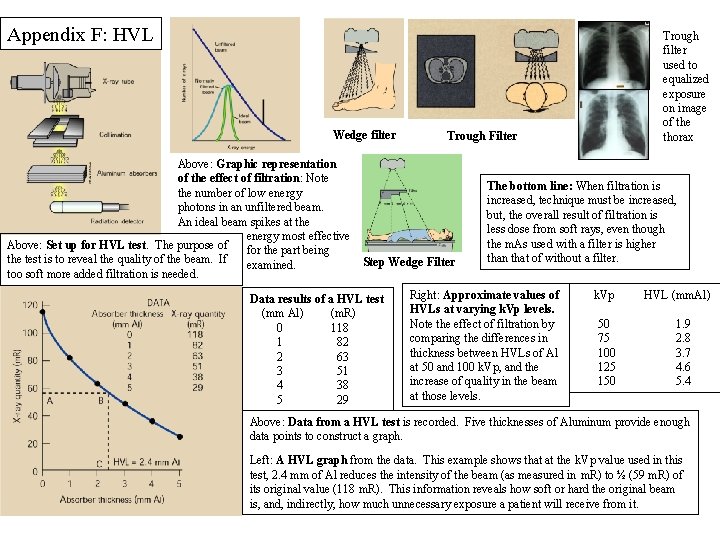
Appendix F: HVL Wedge filter Above: Graphic representation of the effect of filtration: Note the number of low energy photons in an unfiltered beam. An ideal beam spikes at the energy most effective Above: Set up for HVL test. The purpose of for the part being the test is to reveal the quality of the beam. If examined. too soft more added filtration is needed. Trough Filter Step Wedge Filter Data results of a HVL test (mm Al) (m. R) 0 118 1 82 2 63 3 51 4 38 5 29 Trough filter used to equalized exposure on image of the thorax The bottom line: When filtration is increased, technique must be increased, but, the overall result of filtration is less dose from soft rays, even though the m. As used with a filter is higher than that of without a filter. Right: Approximate values of HVLs at varying k. Vp levels. Note the effect of filtration by comparing the differences in thickness between HVLs of Al at 50 and 100 k. Vp, and the increase of quality in the beam at those levels. k. Vp 50 75 100 125 150 HVL (mm. Al) 1. 9 2. 8 3. 7 4. 6 5. 4 Above: Data from a HVL test is recorded. Five thicknesses of Aluminum provide enough data points to construct a graph. Left: A HVL graph from the data. This example shows that at the k. Vp value used in this test, 2. 4 mm of Al reduces the intensity of the beam (as measured in m. R) to ½ (59 m. R) of its original value (118 m. R). This information reveals how soft or hard the original beam is, and, indirectly, how much unnecessary exposure a patient will receive from it.
- Slides: 1