
Appendix E Incident electron target interactions and emission
- Slides: 7
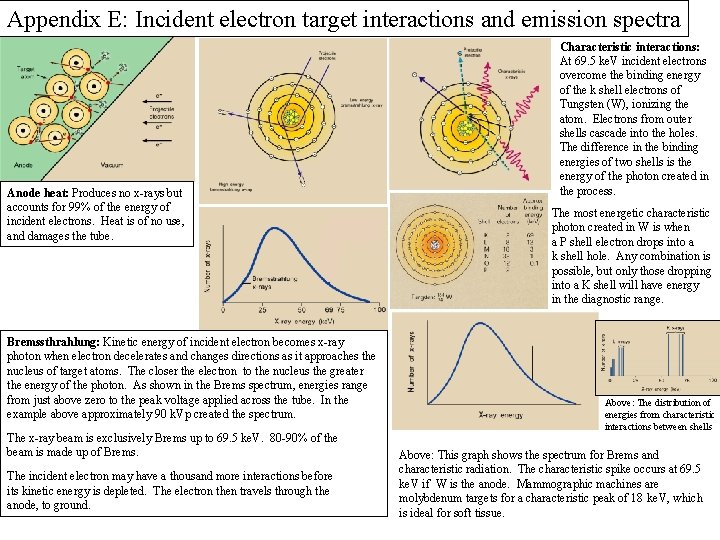
Appendix E: Incident electron target interactions and emission spectra Anode heat: Produces no x-rays but accounts for 99% of the energy of incident electrons. Heat is of no use, and damages the tube. Bremssthrahlung: Kinetic energy of incident electron becomes x-ray photon when electron decelerates and changes directions as it approaches the nucleus of target atoms. The closer the electron to the nucleus the greater the energy of the photon. As shown in the Brems spectrum, energies range from just above zero to the peak voltage applied across the tube. In the example above approximately 90 k. Vp created the spectrum. The x-ray beam is exclusively Brems up to 69. 5 ke. V. 80 -90% of the beam is made up of Brems. The incident electron may have a thousand more interactions before its kinetic energy is depleted. The electron then travels through the anode, to ground. Characteristic interactions: At 69. 5 ke. V incident electrons overcome the binding energy of the k shell electrons of Tungsten (W), ionizing the atom. Electrons from outer shells cascade into the holes. The difference in the binding energies of two shells is the energy of the photon created in the process. The most energetic characteristic photon created in W is when a P shell electron drops into a k shell hole. Any combination is possible, but only those dropping into a K shell will have energy in the diagnostic range. Above: The distribution of energies from characteristic interactions between shells Above: This graph shows the spectrum for Brems and characteristic radiation. The characteristic spike occurs at 69. 5 ke. V if W is the anode. Mammographic machines are molybdenum targets for a characteristic peak of 18 ke. V, which is ideal for soft tissue.
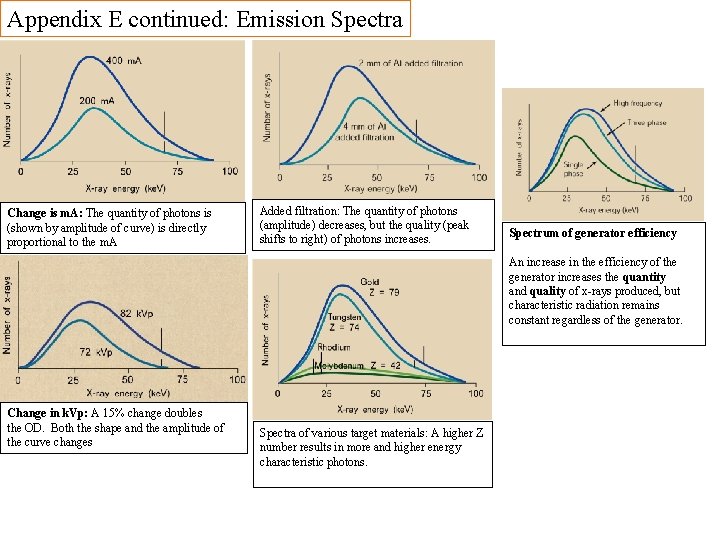
Appendix E continued: Emission Spectra Change is m. A: The quantity of photons is (shown by amplitude of curve) is directly proportional to the m. A Added filtration: The quantity of photons (amplitude) decreases, but the quality (peak shifts to right) of photons increases. Spectrum of generator efficiency An increase in the efficiency of the generator increases the quantity and quality of x-rays produced, but characteristic radiation remains constant regardless of the generator. Change in k. Vp: A 15% change doubles the OD. Both the shape and the amplitude of the curve changes Spectra of various target materials: A higher Z number results in more and higher energy characteristic photons.
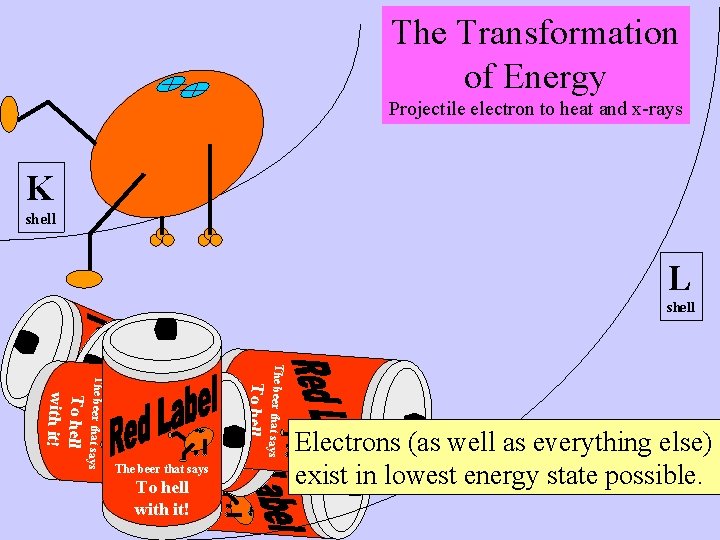
The Transformation of Energy Projectile electron to heat and x-rays K shell L To that says h wit ell h it ! r r bee The The beer that says To hell with it! To that say h s wit ell h it ! shell Electrons (as well as everything else) exist in lowest energy state possible.
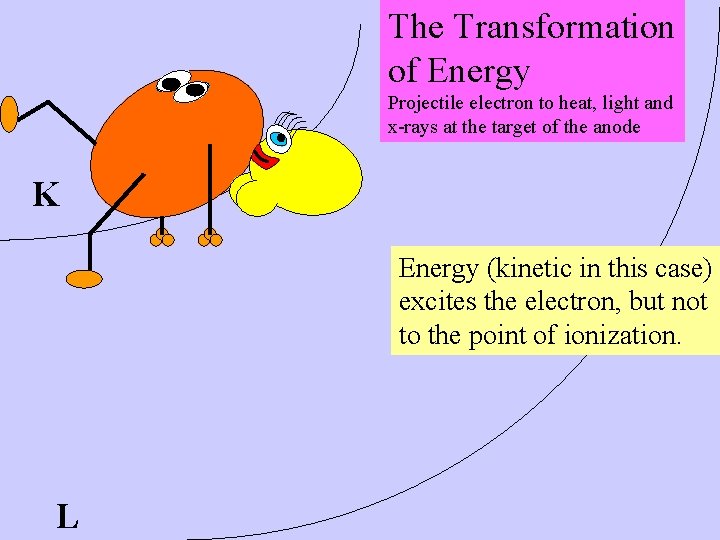
The Transformation of Energy Projectile electron to heat, light and x-rays at the target of the anode K Energy (kinetic in this case) excites the electron, but not to the point of ionization. L
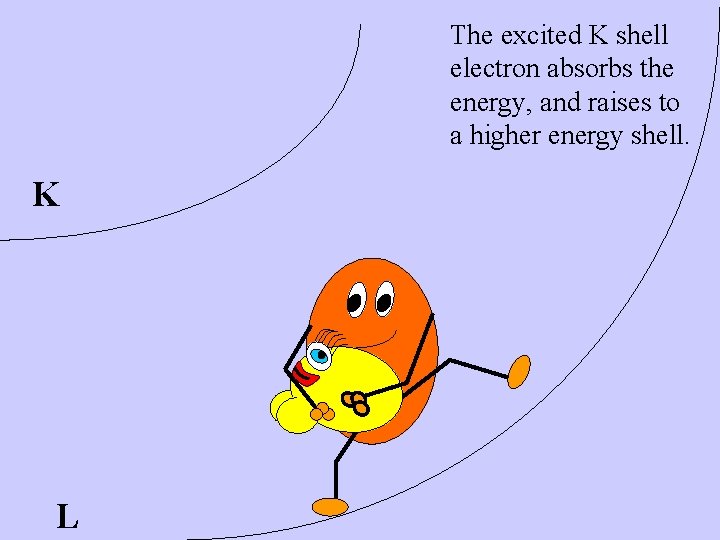
The excited K shell electron absorbs the energy, and raises to a higher energy shell. K L
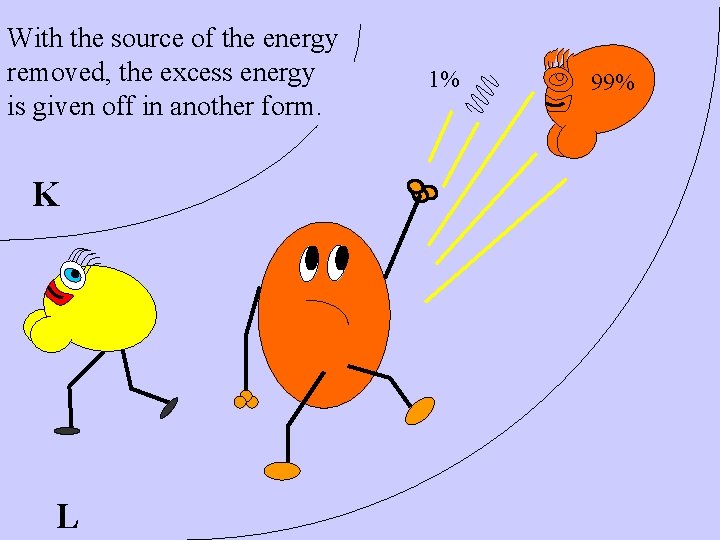
With the source of the energy removed, the excess energy is given off in another form. K L 1% 99%
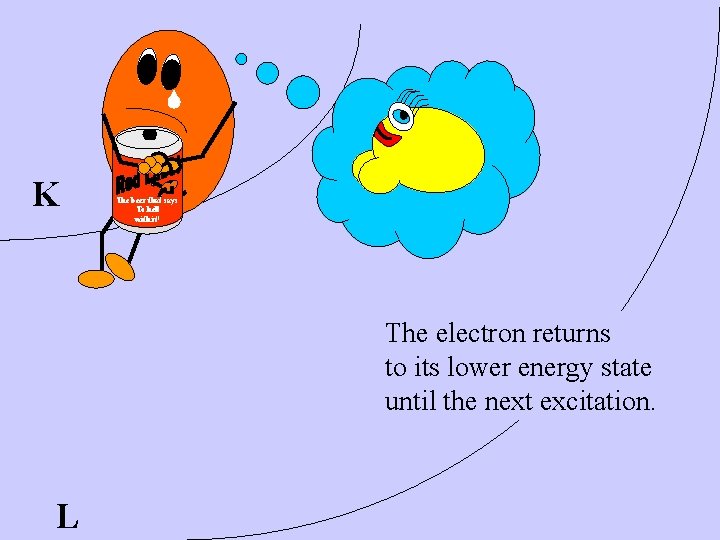
K The beer that says To hell with it! The electron returns to its lower energy state until the next excitation. L