
Appendix E Conceptual MEME Implementation Approach Current State
- Slides: 5
Appendix E – Conceptual MEME Implementation Approach
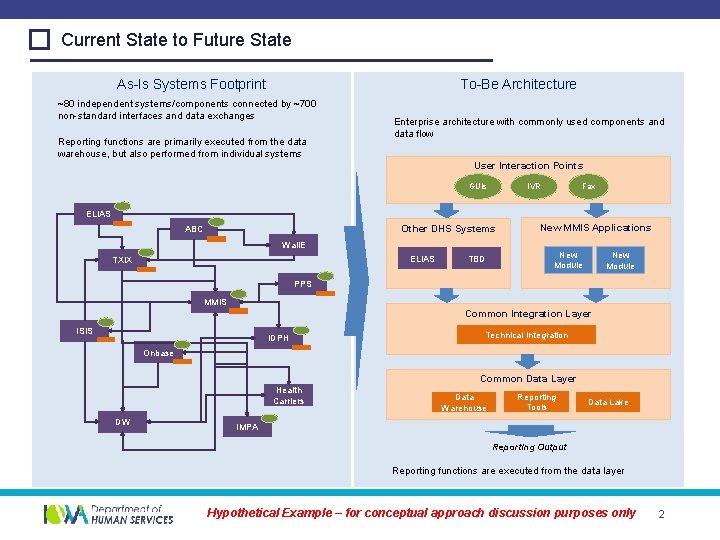
Current State to Future State To-Be Architecture As-Is Systems Footprint ~80 independent systems/components connected by ~700 non-standard interfaces and data exchanges Reporting functions are primarily executed from the data warehouse, but also performed from individual systems Enterprise architecture with commonly used components and data flow User Interaction Points GUIs IVR Fax ELIAS Other DHS Systems ABC Wall. E ELIAS TXIX TBD New MMIS Applications New Module PPS MMIS Common Integration Layer ISIS IDPH Technical Integration Onbase Common Data Layer Health Carriers DW Data Warehouse Reporting Tools Data Lake IMPA Reporting Output Reporting functions are executed from the data layer Hypothetical Example – for conceptual approach discussion purposes only 2
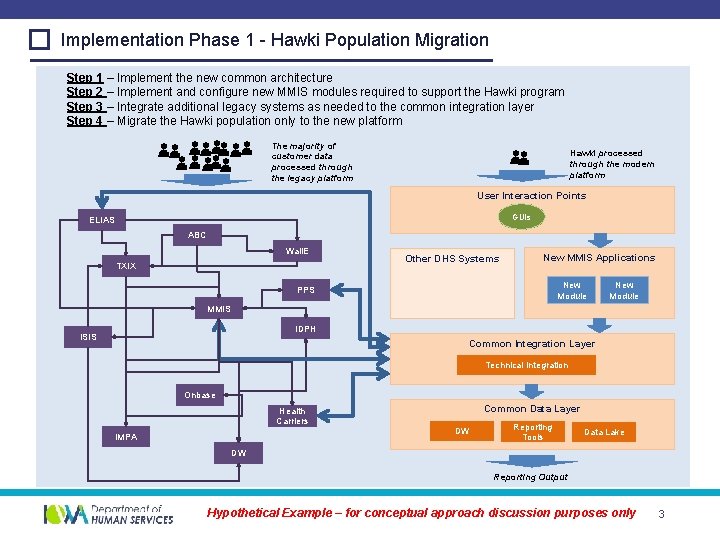
Implementation Phase 1 - Hawki Population Migration Step 1 – Implement the new common architecture Step 2 – Implement and configure new MMIS modules required to support the Hawki program Step 3 – Integrate additional legacy systems as needed to the common integration layer Step 4 – Migrate the Hawki population only to the new platform The majority of customer data processed through the legacy platform Hawki processed through the modern platform User Interaction Points GUIs ELIAS ABC Wall. E TXIX Other DHS Systems New MMIS Applications New Module PPS New Module MMIS IDPH ISIS Common Integration Layer Technical Integration Onbase Health Carriers IMPA Common Data Layer DW Reporting Tools Data Lake DW Reporting Output Hypothetical Example – for conceptual approach discussion purposes only 3
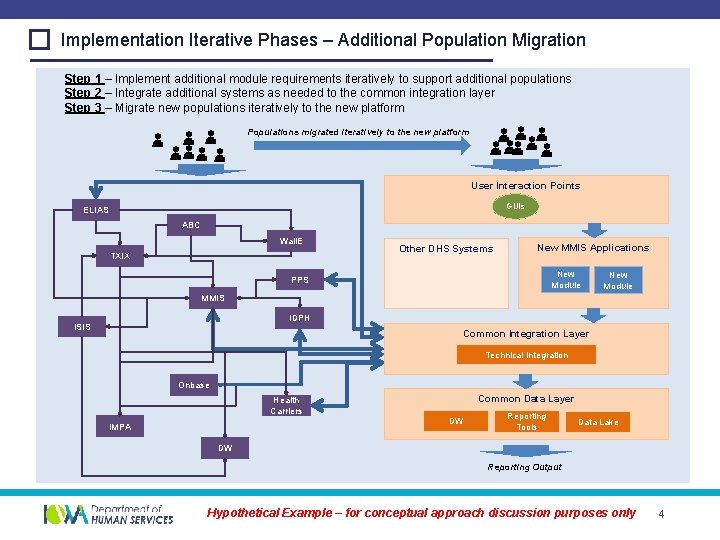
Implementation Iterative Phases – Additional Population Migration Step 1 – Implement additional module requirements iteratively to support additional populations Step 2 – Integrate additional systems as needed to the common integration layer Step 3 – Migrate new populations iteratively to the new platform Populations migrated iteratively to the new platform User Interaction Points GUIs ELIAS ABC Wall. E TXIX Other DHS Systems New MMIS Applications New Module PPS New Module MMIS IDPH ISIS Common Integration Layer Technical Integration Onbase Health Carriers IMPA Common Data Layer DW Reporting Tools Data Lake DW Reporting Output Hypothetical Example – for conceptual approach discussion purposes only 4
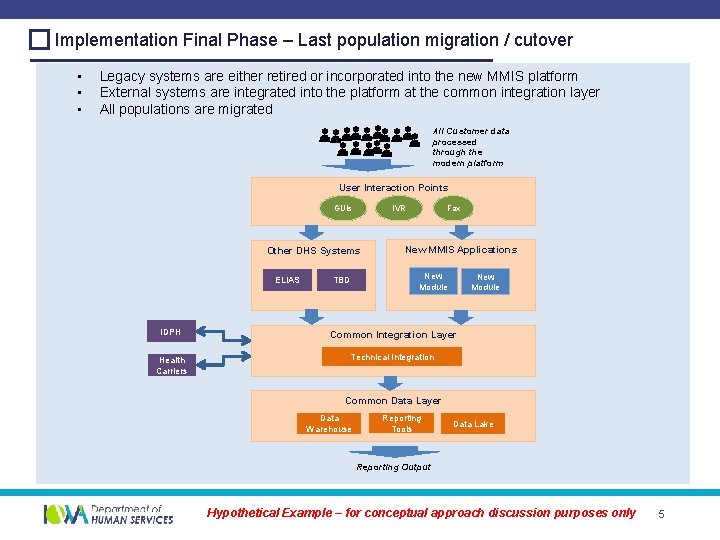
Implementation Final Phase – Last population migration / cutover • • • Legacy systems are either retired or incorporated into the new MMIS platform External systems are integrated into the platform at the common integration layer All populations are migrated All Customer data processed through the modern platform User Interaction Points GUIs IVR Other DHS Systems ELIAS TBD Fax New MMIS Applications New Module IDPH Common Integration Layer Health Carriers Technical Integration Common Data Layer Data Warehouse Reporting Tools Data Lake Reporting Output Hypothetical Example – for conceptual approach discussion purposes only 5