
Appendix 17 A Application of the Binomial Distribution

Appendix 17 A Application of the Binomial Distribution to Evaluate Call Options
Appendix 17 A: Applications of the Binomial Distribution to Evaluate Call Options • In this appendix, we show the binomial distribution is combined with some basic finance concepts to generate a model for determining the price of stock options. • What is an option? • The simple binomial option pricing model • The Generalized Binomial Option Pricing Model 2
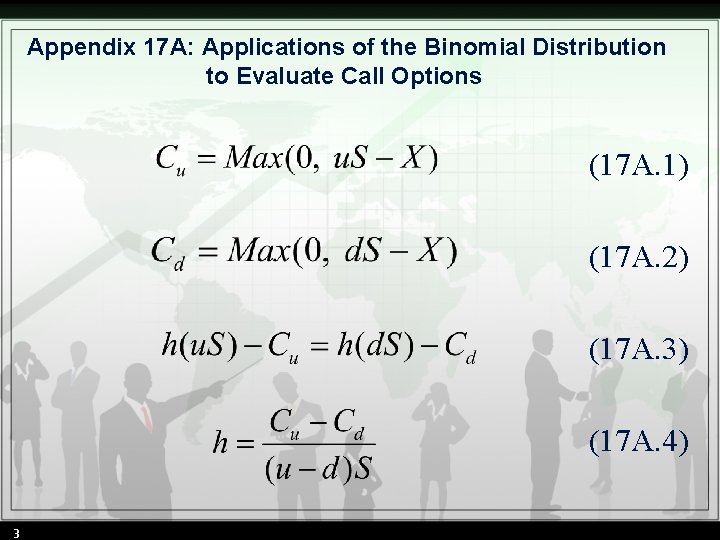
Appendix 17 A: Applications of the Binomial Distribution to Evaluate Call Options (17 A. 1) (17 A. 2) (17 A. 3) (17 A. 4) 3
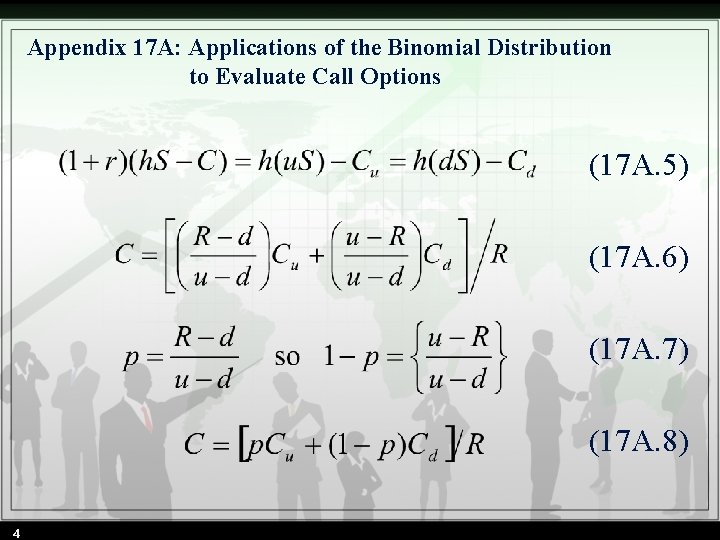
Appendix 17 A: Applications of the Binomial Distribution to Evaluate Call Options (17 A. 5) (17 A. 6) (17 A. 7) (17 A. 8) 4
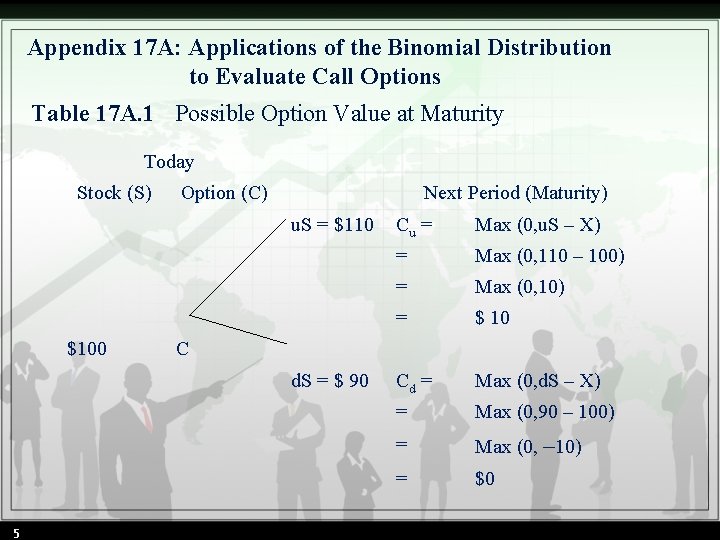
Appendix 17 A: Applications of the Binomial Distribution to Evaluate Call Options Table 17 A. 1 Possible Option Value at Maturity Today Stock (S) Option (C) Next Period (Maturity) u. S = $110 $100 Max (0, u. S – X) = Max (0, 110 – 100) = Max (0, 10) = $ 10 Cd = Max (0, d. S – X) = Max (0, 90 – 100) = Max (0, – 10) = $0 C d. S = $ 90 5 Cu =
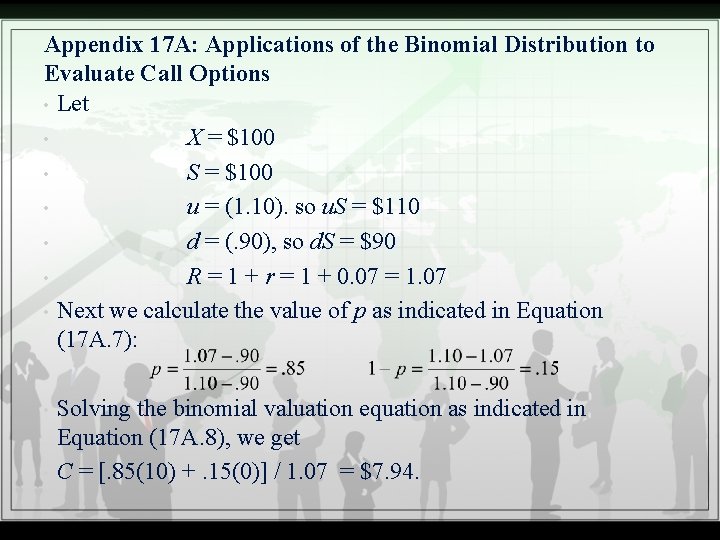
Appendix 17 A: Applications of the Binomial Distribution to Evaluate Call Options • Let • X = $100 • S = $100 • u = (1. 10). so u. S = $110 • d = (. 90), so d. S = $90 • R = 1 + r = 1 + 0. 07 = 1. 07 • Next we calculate the value of p as indicated in Equation (17 A. 7): • • Solving the binomial valuation equation as indicated in Equation (17 A. 8), we get C = [. 85(10) +. 15(0)] / 1. 07 = $7. 94.
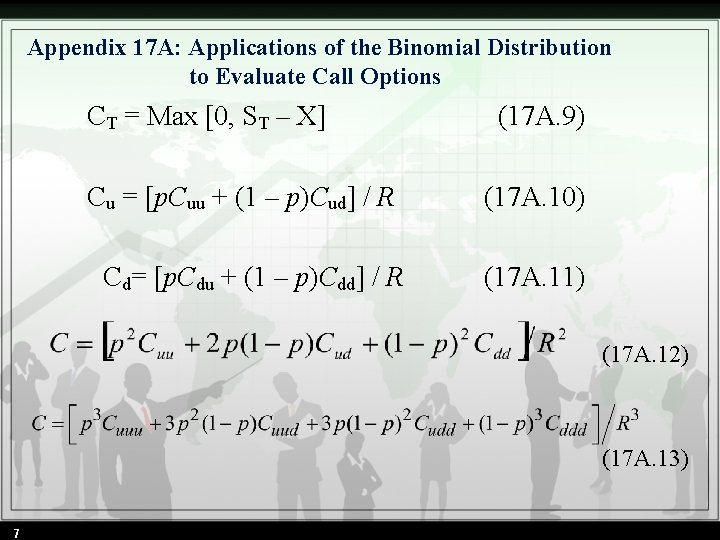
Appendix 17 A: Applications of the Binomial Distribution to Evaluate Call Options CT = Max [0, ST – X] Cu = [p. Cuu + (1 – p)Cud] / R Cd= [p. Cdu + (1 – p)Cdd] / R (17 A. 9) (17 A. 10) (17 A. 11) (17 A. 12) (17 A. 13) 7
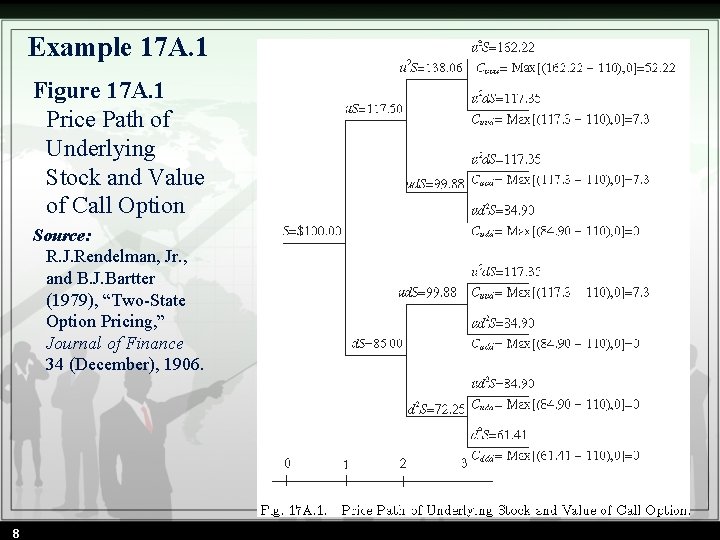
Example 17 A. 1 Figure 17 A. 1 Price Path of Underlying Stock and Value of Call Option Source: R. J. Rendelman, Jr. , and B. J. Bartter (1979), “Two-State Option Pricing, ” Journal of Finance 34 (December), 1906. 8
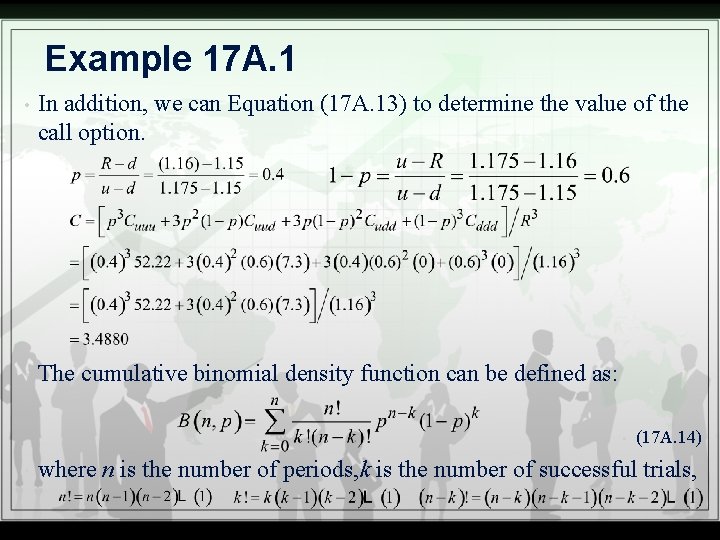
Example 17 A. 1 • In addition, we can Equation (17 A. 13) to determine the value of the call option. • The cumulative binomial density function can be defined as: • • (17 A. 14) where n is the number of periods, k is the number of successful trials,
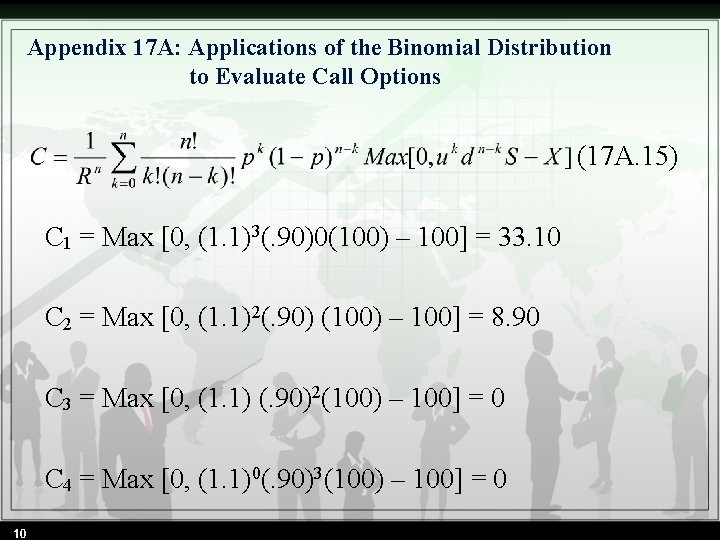
Appendix 17 A: Applications of the Binomial Distribution to Evaluate Call Options (17 A. 15) C 1 = Max [0, (1. 1)3(. 90)0(100) – 100] = 33. 10 C 2 = Max [0, (1. 1)2(. 90) (100) – 100] = 8. 90 C 3 = Max [0, (1. 1) (. 90)2(100) – 100] = 0 C 4 = Max [0, (1. 1)0(. 90)3(100) – 100] = 0 10
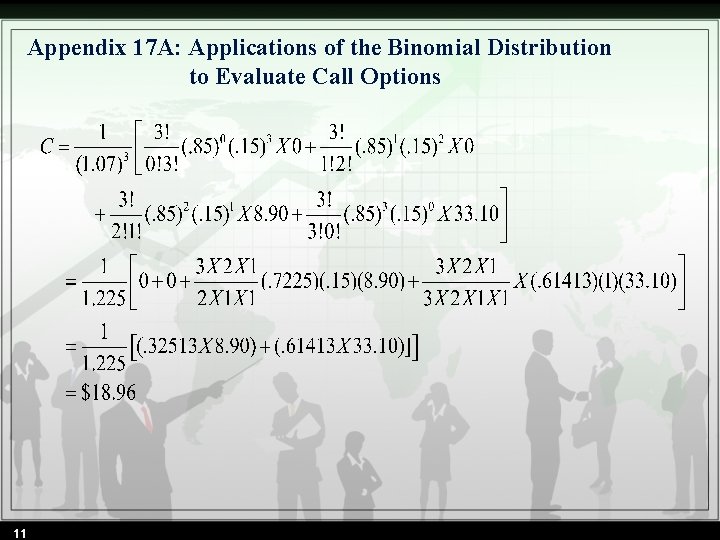
Appendix 17 A: Applications of the Binomial Distribution to Evaluate Call Options 11
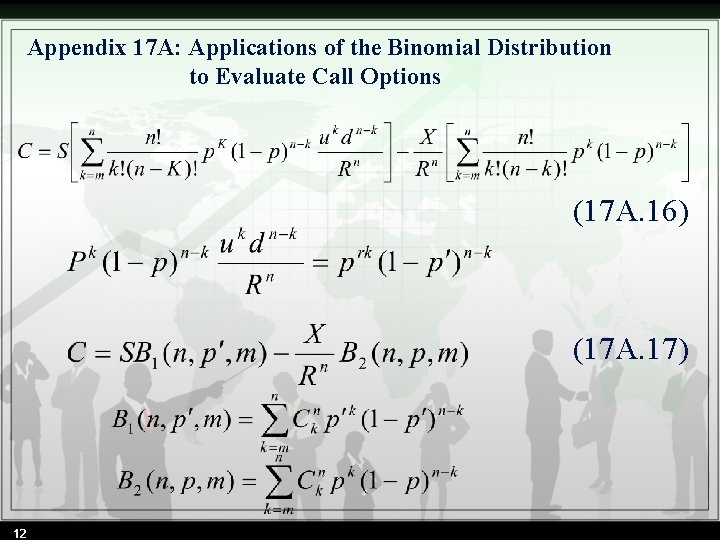
Appendix 17 A: Applications of the Binomial Distribution to Evaluate Call Options (17 A. 16) (17 A. 17) 12
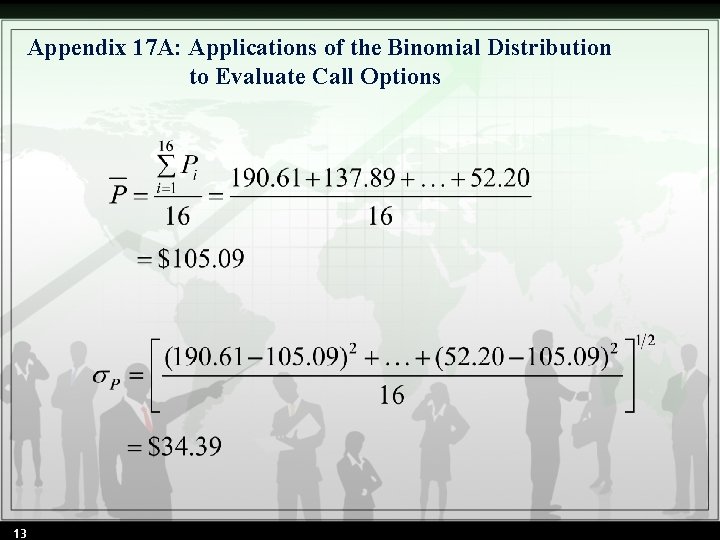
Appendix 17 A: Applications of the Binomial Distribution to Evaluate Call Options 13
- Slides: 13