
Appendix 02 Linear Systems Timeinvariant systems ft Linear
![Impulse Response [1/4] 8](https://slidetodoc.com/presentation_image_h2/f1f8cca73b1fcea6f3afc6a6896a8d7c/image-8.jpg "Impulse Response [1/4] 8")
![Impulse Response [2/4] f(t) h(t) g(t) F( ) H( ) G( ) 9](https://slidetodoc.com/presentation_image_h2/f1f8cca73b1fcea6f3afc6a6896a8d7c/image-9.jpg "Impulse Response [2/4] f(t) h(t) g(t) F( ) H( ) G( ) 9")
![Impulse Response [3/4] Convolution g(t) t 10](https://slidetodoc.com/presentation_image_h2/f1f8cca73b1fcea6f3afc6a6896a8d7c/image-10.jpg "Impulse Response [3/4] Convolution g(t) t 10")
![Impulse Response [4/4] Convolution = * 11](https://slidetodoc.com/presentation_image_h2/f1f8cca73b1fcea6f3afc6a6896a8d7c/image-11.jpg "Impulse Response [4/4] Convolution = * 11")
![The Impulse Function [1/2] The impulse is the identity function under convolution 14](https://slidetodoc.com/presentation_image_h2/f1f8cca73b1fcea6f3afc6a6896a8d7c/image-14.jpg "The Impulse Function [1/2] The impulse is the identity function under convolution 14")
![The Impulse Function [2/2] 15](https://slidetodoc.com/presentation_image_h2/f1f8cca73b1fcea6f3afc6a6896a8d7c/image-15.jpg "The Impulse Function [2/2] 15")
![Step Function [1/3] b b 16](https://slidetodoc.com/presentation_image_h2/f1f8cca73b1fcea6f3afc6a6896a8d7c/image-16.jpg "Step Function [1/3] b b 16")
![Step Function [2/3] b b 17](https://slidetodoc.com/presentation_image_h2/f1f8cca73b1fcea6f3afc6a6896a8d7c/image-17.jpg "Step Function [2/3] b b 17")
![Step Function [3/3] b 18](https://slidetodoc.com/presentation_image_h2/f1f8cca73b1fcea6f3afc6a6896a8d7c/image-18.jpg "Step Function [3/3] b 18")
![Discrete 1 -Dim Convolution [1/5] Matrix 21](https://slidetodoc.com/presentation_image_h2/f1f8cca73b1fcea6f3afc6a6896a8d7c/image-21.jpg "Discrete 1 -Dim Convolution [1/5] Matrix 21")
![Discrete 1 -Dim Convolution [2/5] Example 22](https://slidetodoc.com/presentation_image_h2/f1f8cca73b1fcea6f3afc6a6896a8d7c/image-22.jpg "Discrete 1 -Dim Convolution [2/5] Example 22")
![Discrete 1 -Dim Convolution [3/5] Discrete operation 23](https://slidetodoc.com/presentation_image_h2/f1f8cca73b1fcea6f3afc6a6896a8d7c/image-23.jpg "Discrete 1 -Dim Convolution [3/5] Discrete operation 23")
![Discrete 1 -Dim Convolution [4/5] Graph - Continuous / Discrete 24](https://slidetodoc.com/presentation_image_h2/f1f8cca73b1fcea6f3afc6a6896a8d7c/image-24.jpg "Discrete 1 -Dim Convolution [4/5] Graph - Continuous / Discrete 24")
![Discrete 1 -Dim Convolution [5/5] Wrapping h index array 25](https://slidetodoc.com/presentation_image_h2/f1f8cca73b1fcea6f3afc6a6896a8d7c/image-25.jpg "Discrete 1 -Dim Convolution [5/5] Wrapping h index array 25")
![Discrete Two-Dimensional Convolution [1/3] 27](https://slidetodoc.com/presentation_image_h2/f1f8cca73b1fcea6f3afc6a6896a8d7c/image-27.jpg "Discrete Two-Dimensional Convolution [1/3] 27")
![Discrete Two-Dimensional Convolution [2/3] 28](https://slidetodoc.com/presentation_image_h2/f1f8cca73b1fcea6f3afc6a6896a8d7c/image-28.jpg "Discrete Two-Dimensional Convolution [2/3] 28")
![Discrete Two-Dimensional Convolution [3/3] Kernel matrix Input image Array of products Output image Summer](https://slidetodoc.com/presentation_image_h2/f1f8cca73b1fcea6f3afc6a6896a8d7c/image-29.jpg "Discrete Two-Dimensional Convolution [3/3] Kernel matrix Input image Array of products Output image Summer")

- Slides: 31
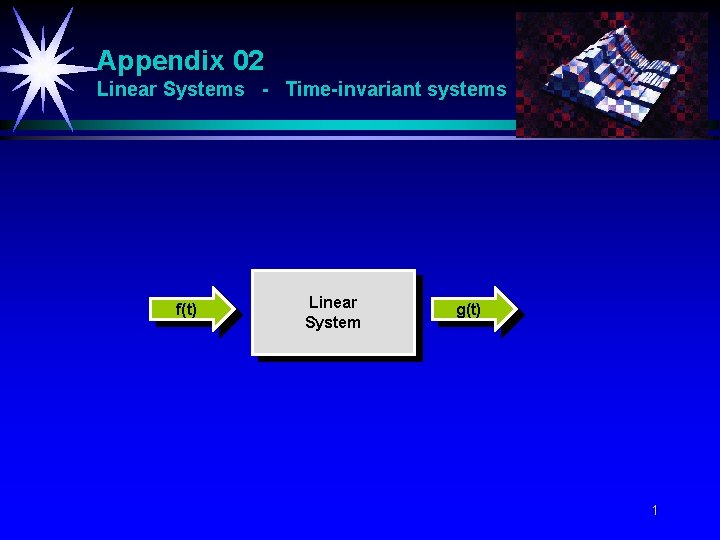
Appendix 02 Linear Systems - Time-invariant systems f(t) Linear System g(t) 1
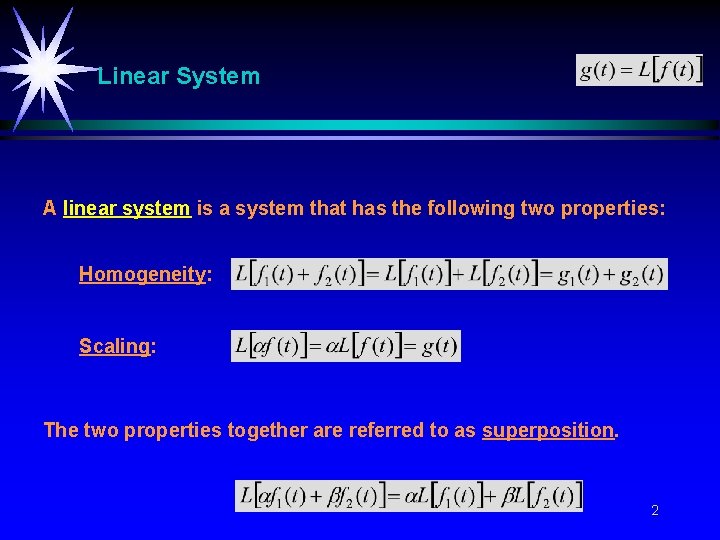
Linear System A linear system is a system that has the following two properties: Homogeneity: Scaling: The two properties together are referred to as superposition. 2
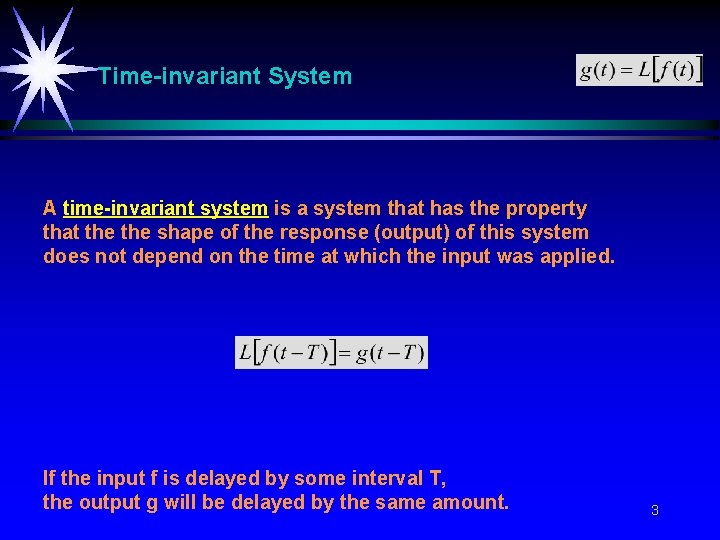
Time-invariant System A time-invariant system is a system that has the property that the shape of the response (output) of this system does not depend on the time at which the input was applied. If the input f is delayed by some interval T, the output g will be delayed by the same amount. 3
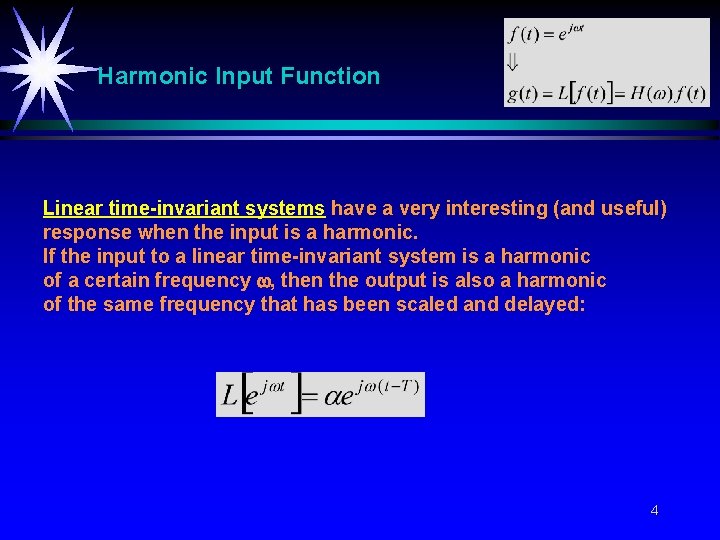
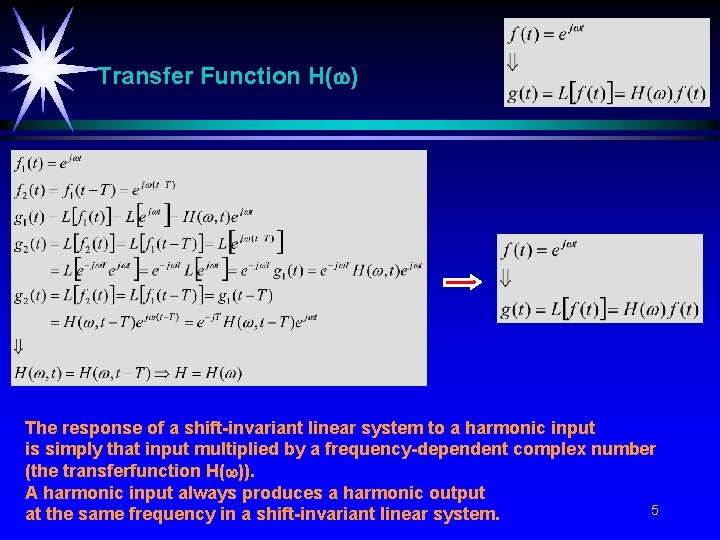
Harmonic Input Function Linear time-invariant systems have a very interesting (and useful) response when the input is a harmonic. If the input to a linear time-invariant system is a harmonic of a certain frequency , then the output is also a harmonic of the same frequency that has been scaled and delayed: 4
Transfer Function H( ) The response of a shift-invariant linear system to a harmonic input is simply that input multiplied by a frequency-dependent complex number (the transferfunction H( )). A harmonic input always produces a harmonic output 5 at the same frequency in a shift-invariant linear system.
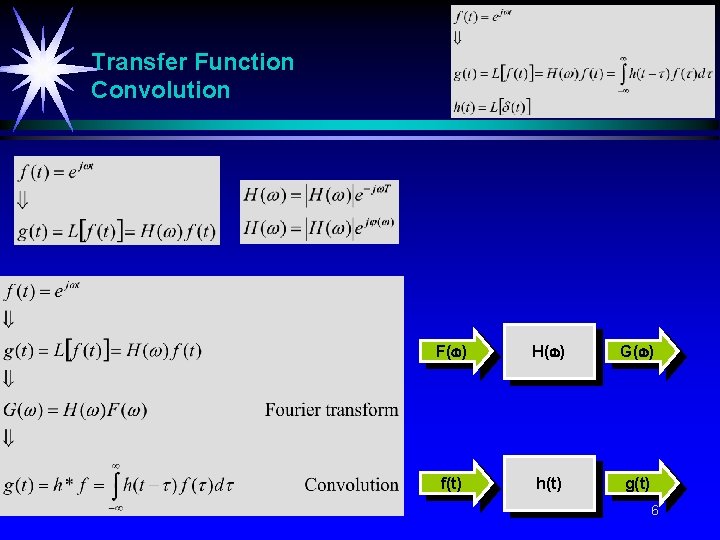
Transfer Function Convolution F( ) H( ) G( ) f(t) h(t) g(t) 6
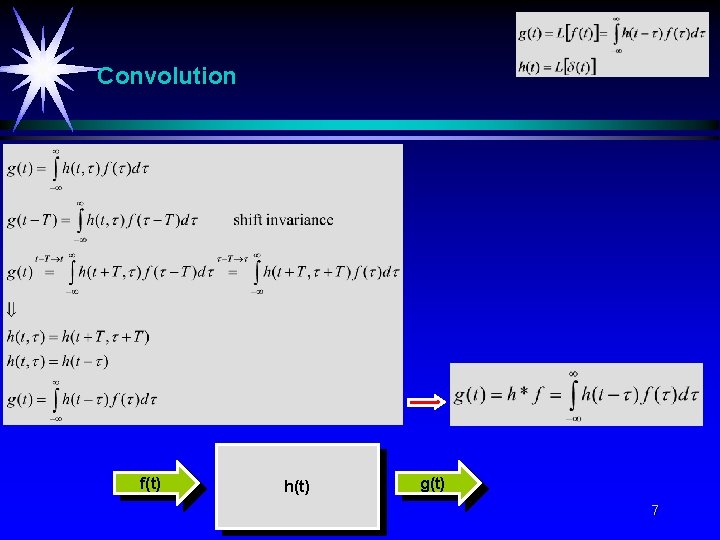
Convolution f(t) h(t) g(t) 7
Impulse Response [1/4] 8
Impulse Response [2/4] f(t) h(t) g(t) F( ) H( ) G( ) 9
Impulse Response [3/4] Convolution g(t) t 10
Impulse Response [4/4] Convolution = * 11
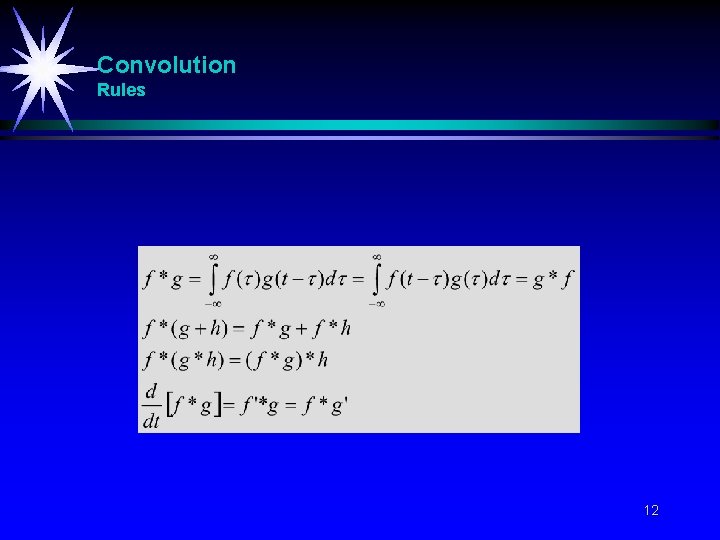
Convolution Rules 12
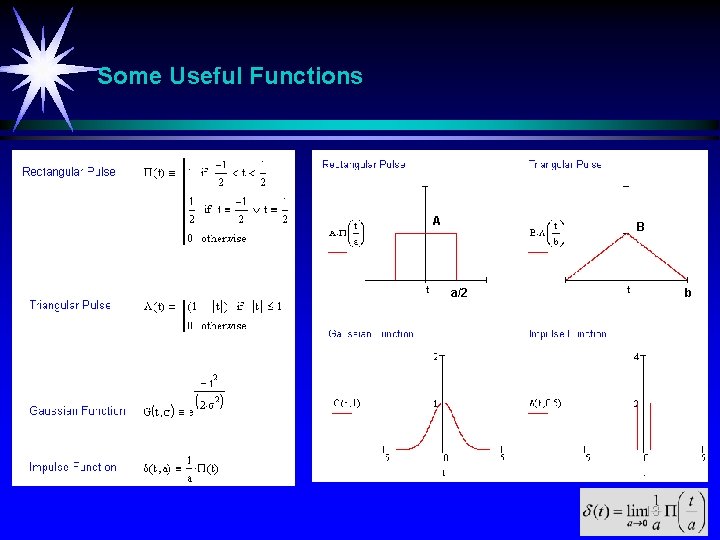
Some Useful Functions A B a/2 b 13
The Impulse Function [1/2] The impulse is the identity function under convolution 14
The Impulse Function [2/2] 15
Step Function [1/3] b b 16
Step Function [2/3] b b 17
Step Function [3/3] b 18
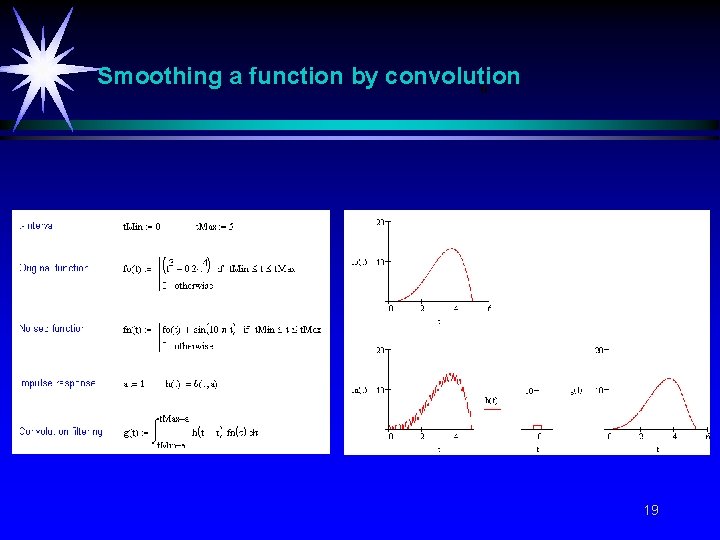
Smoothing a function by convolution b 19
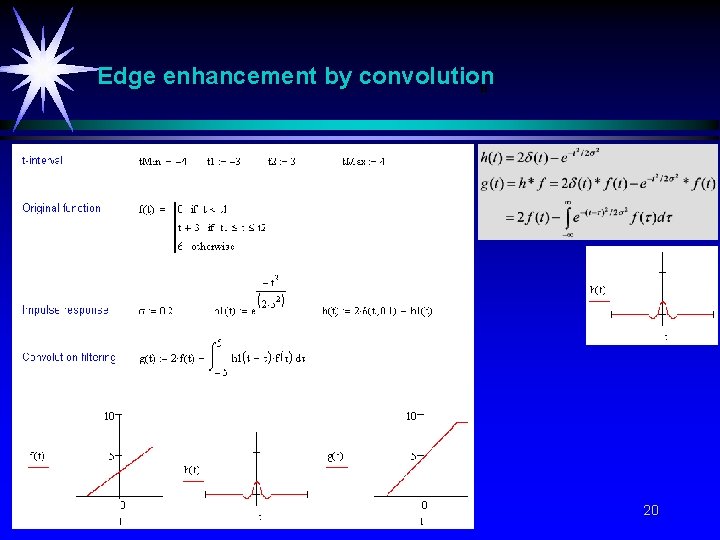
Edge enhancement by convolution b 20
Discrete 1 -Dim Convolution [1/5] Matrix 21
Discrete 1 -Dim Convolution [2/5] Example 22
Discrete 1 -Dim Convolution [3/5] Discrete operation 23
Discrete 1 -Dim Convolution [4/5] Graph - Continuous / Discrete 24
Discrete 1 -Dim Convolution [5/5] Wrapping h index array 25
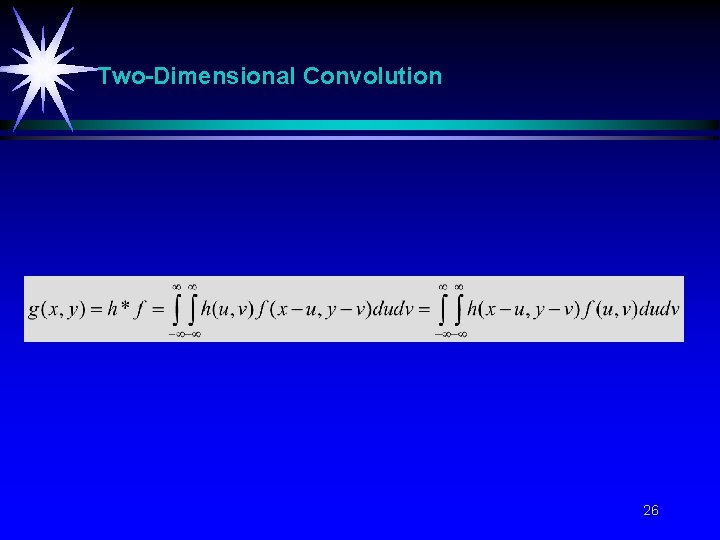
Two-Dimensional Convolution 26
Discrete Two-Dimensional Convolution [1/3] 27
Discrete Two-Dimensional Convolution [2/3] 28
Discrete Two-Dimensional Convolution [3/3] Kernel matrix Input image Array of products Output image Summer x. C Scaling factor Output pixel 29
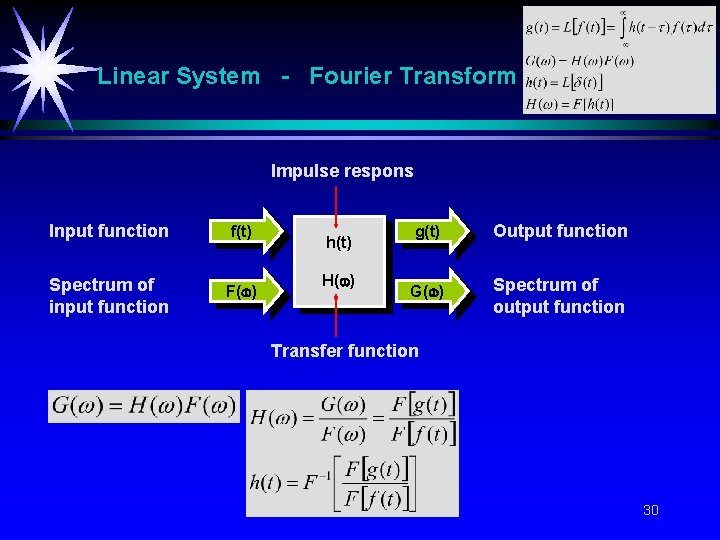
Linear System - Fourier Transform Impulse respons Input function f(t) Spectrum of input function F( ) h(t) H( ) g(t) Output function G( ) Spectrum of output function Transfer function 30
End 31