
Appendix 01 Articles Context 1 2 3 4
- Slides: 16
Appendix 01. Articles
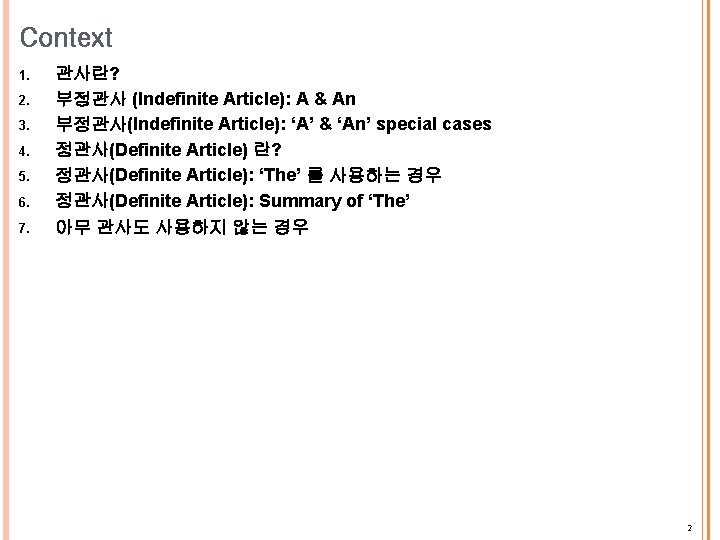
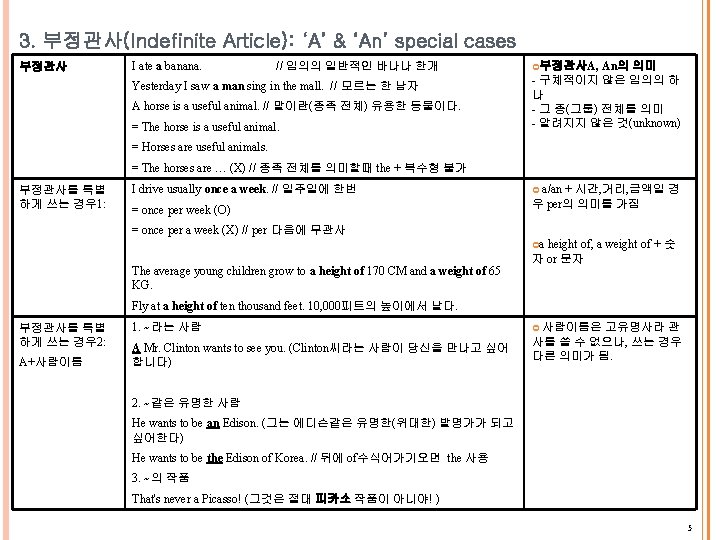
Context 1. 2. 3. 4. 5. 6. 7. 관사란? 부정관사 (Indefinite Article): A & An 부정관사(Indefinite Article): ‘A’ & ‘An’ special cases 정관사(Definite Article) 란? 정관사(Definite Article): ‘The’ 를 사용하는 경우 정관사(Definite Article): Summary of ‘The’ 아무 관사도 사용하지 않는 경우 2
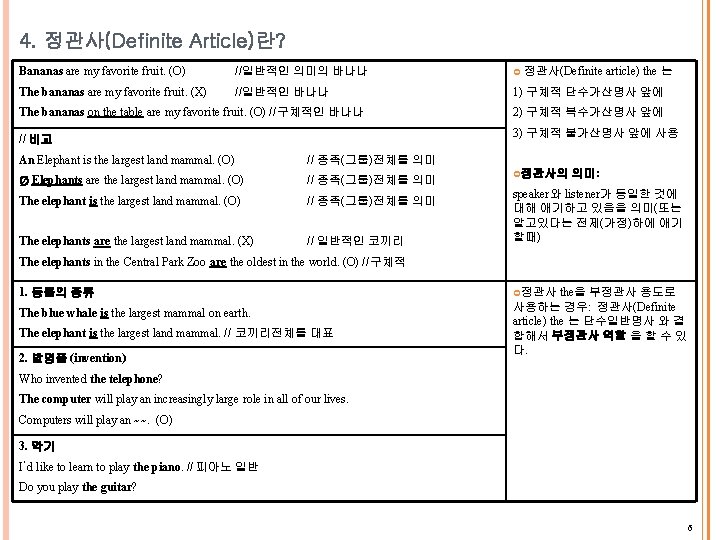
4. 정관사(Definite Article)란? Bananas are my favorite fruit. (O) //일반적인 의미의 바나나 정관사(Definite article) the 는 The bananas are my favorite fruit. (X) //일반적인 바나나 1) 구체적 단수가산명사 앞에 The bananas on the table are my favorite fruit. (O) //구체적인 바나나 2) 구체적 복수가산명사 앞에 3) 구체적 불가산명사 앞에 사용 // 비교 An Elephant is the largest land mammal. (O) // 종족(그룹)전체를 의미 Ø Elephants are the largest land mammal. (O) // 종족(그룹)전체를 의미 The elephant is the largest land mammal. (O) // 종족(그룹)전체를 의미 The elephants are the largest land mammal. (X) // 일반적인 코끼리 정관사의 의미: speaker와 listener가 동일한 것에 대해 애기하고 있음을 의미(또는 알고있다는 전제(가정)하에 애기 할때) The elephants in the Central Park Zoo are the oldest in the world. (O) //구체적 1. 동물의 종류 The blue whale is the largest mammal on earth. The elephant is the largest land mammal. // 코끼리전체를 대표 2. 발명품 (invention) 정관사 the을 부정관사 용도로 사용하는 경우: 정관사(Definite article) the 는 단수일반명사 와 결 합해서 부정관사 역할 을 할 수 있 다. Who invented the telephone? The computer will play an increasingly large role in all of our lives. Computers will play an ~~. (O) 3. 악기 I’d like to learn to play the piano. // 피아노 일반 Do you play the guitar? 6
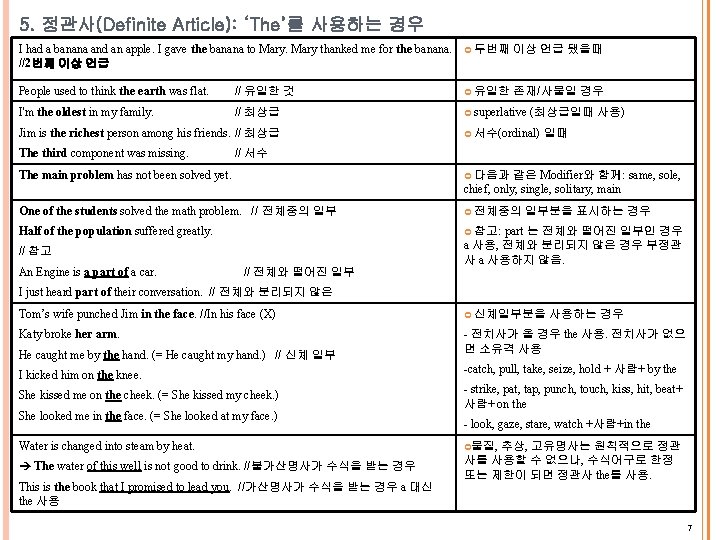
5. 정관사(Definite Article): ‘The’를 사용하는 경우 I had a banana and an apple. I gave the banana to Mary thanked me for the banana. //2번째 이상 언급 두번째 이상 언급 됐을때 People used to think the earth was flat. // 유일한 것 유일한 존재/사물일 경우 I'm the oldest in my family. // 최상급 superlative (최상급일때 사용) Jim is the richest person among his friends. // 최상급 The third component was missing. 서수(ordinal) 일떄 // 서수 The main problem has not been solved yet. 다음과 같은 Modifier와 함께: same, sole, chief, only, single, solitary, main One of the students solved the math problem. // 전체중의 일부분을 표시하는 경우 Half of the population suffered greatly. 참고: part 는 전체와 떨어진 일부인 경우 // 참고 a 사용, 전체와 분리되지 않은 경우 부정관 사 a 사용하지 않음. An Engine is a part of a car. // 전체와 떨어진 일부 I just heard part of their conversation. // 전체와 분리되지 않은 Tom’s wife punched Jim in the face. //In his face (X) 신체일부분을 사용하는 경우 Katy broke her arm. - 전치사가 올 경우 the 사용. 전치사가 없으 면 소유격 사용 He caught me by the hand. (= He caught my hand. ) // 신체 일부 I kicked him on the knee. -catch, pull, take, seize, hold + 사람+ by the She kissed me on the cheek. (= She kissed my cheek. ) - strike, pat, tap, punch, touch, kiss, hit, beat+ 사람+ on the She looked me in the face. (= She looked at my face. ) - look, gaze, stare, watch +사람+in the Water is changed into steam by heat. 물질, 추상, 고유명사는 원칙적으로 정관 The water of this well is not good to drink. //불가산명사가 수식을 받는 경우 사를 사용할 수 없으나, 수식어구로 한정 또는 제한이 되면 정관사 the를 사용. This is the book that I promised to lead you. //가산명사가 수식을 받는 경우 a 대신 the 사용 7
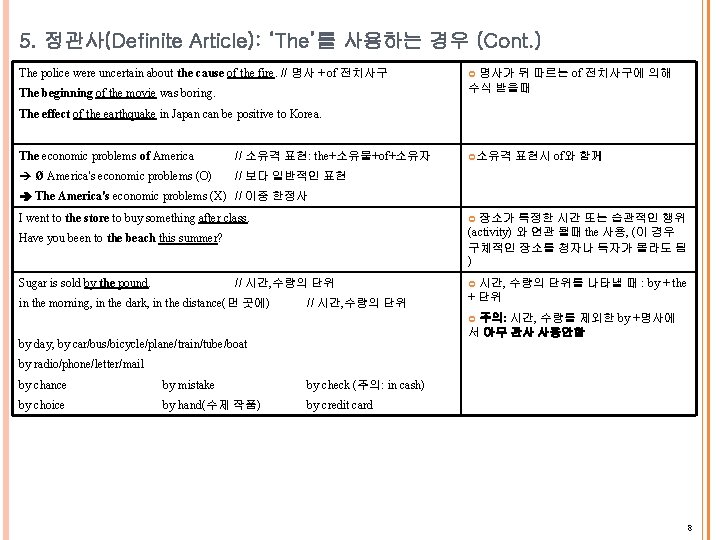
5. 정관사(Definite Article): ‘The’를 사용하는 경우 (Cont. ) The police were uncertain about the cause of the fire. // 명사 + of 전치사구 명사가 뒤 따르는 of 전치사구에 의해 수식 받을때 The beginning of the movie was boring. The effect of the earthquake in Japan can be positive to Korea. The economic problems of America // 소유격 표현: the+소유물+of+소유자 Ø America's economic problems (O) // 보다 일반적인 표현 소유격 표현시 of와 함께 The America's economic problems (X) // 이중 한정사 I went to the store to buy something after class. 장소가 특정한 시간 또는 습관적인 행위 (activity) 와 연관 될때 the 사용, (이 경우 구체적인 장소를 청자나 독자가 몰라도 됨 ) Have you been to the beach this summer? Sugar is sold by the pound. // 시간, 수량의 단위 in the morning, in the dark, in the distance(먼 곳에) // 시간, 수량의 단위를 나타낼 때 : by + the + 단위 주의: 시간, 수량를 제외한 by +명사에 서 아무 관사 사용안함 by day, by car/bus/bicycle/plane/train/tube/boat by radio/phone/letter/mail by chance by mistake by check (주의: in cash) by choice by hand(수제 작품) by credit card 8
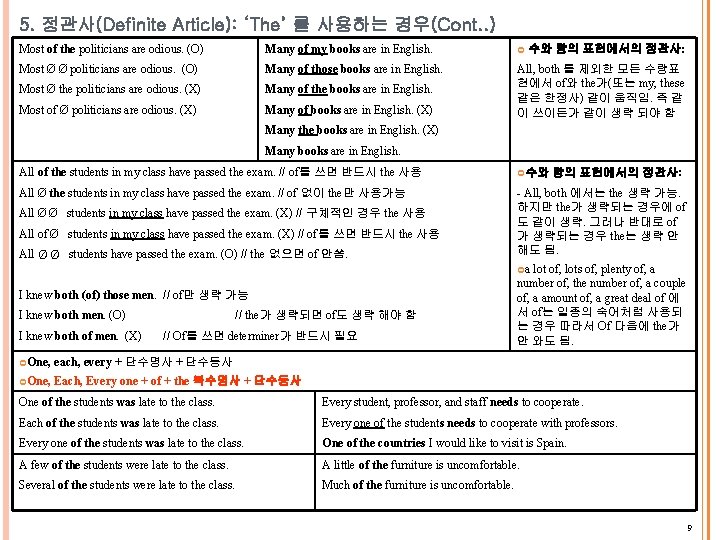
5. 정관사(Definite Article): ‘The’ 를 사용하는 경우(Cont. . ) Most of the politicians are odious. (O) Many of my books are in English. 수와 량의 표현에서의 정관사: Most Ø Ø politicians are odious. (O) Many of those books are in English. Most Ø the politicians are odious. (X) Many of the books are in English. Most of Ø politicians are odious. (X) Many of books are in English. (X) All, both 를 제외한 모든 수량표 현에서 of와 the가(또는 my, these 같은 한정사) 같이 움직임. 즉 같 이 쓰이든가 같이 생략 되야 함 Many the books are in English. (X) Many books are in English. All of the students in my class have passed the exam. // of를 쓰면 반드시 the 사용 수와 량의 표현에서의 정관사: All Ø the students in my class have passed the exam. // of 없이 the만 사용가능 - All, both 에서는 the 생략 가능. 하지만 the가 생략되는 경우에 of 도 같이 생략. 그러나 반대로 of 가 생략되는 경우 the는 생략 안 해도 됨. All Ø Ø students in my class have passed the exam. (X) // 구체적인 경우 the 사용 All of Ø students in my class have passed the exam. (X) // of를 쓰면 반드시 the 사용 All Ø Ø students have passed the exam. (O) // the 없으면 of 안씀. a lot of, lots of, plenty of, a I knew both (of) those men. // of만 생략 가능 I knew both men. (O) I knew both of men. (X) // the가 생략되면 of도 생략 해야 함 // Of를 쓰면 determiner가 반드시 필요 number of, the number of, a couple of, a amount of, a great deal of 에 서 of는 일종의 숙어처럼 사용되 는 경우 따라서 Of 다음에 the가 안 와도 됨. One, each, every + 단수명사 + 단수동사 One, Each, Every one + of + the 복수명사 + 단수동사 One of the students was late to the class. Every student, professor, and staff needs to cooperate. Each of the students was late to the class. Every one of the students needs to cooperate with professors. Every one of the students was late to the class. One of the countries I would like to visit is Spain. A few of the students were late to the class. A little of the furniture is uncomfortable. Several of the students were late to the class. Much of the furniture is uncomfortable. 9
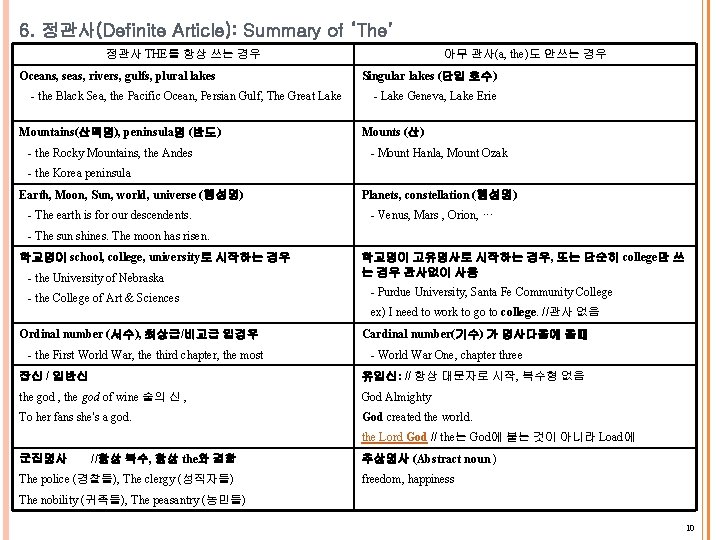
6. 정관사(Definite Article): Summary of ‘The’ 정관사 THE를 항상 쓰는 경우 아무 관사(a, the)도 안쓰는 경우 Oceans, seas, rivers, gulfs, plural lakes Singular lakes (단일 호수) - the Black Sea, the Pacific Ocean, Persian Gulf, The Great Lake - Lake Geneva, Lake Erie Mountains(산맥명), peninsula명 (반도) Mounts (산) - the Rocky Mountains, the Andes - Mount Hanla, Mount Ozak - the Korea peninsula Earth, Moon, Sun, world, universe (행성명) Planets, constellation (행성명) - The earth is for our descendents. - Venus, Mars , Orion, … - The sun shines. The moon has risen. 학교명이 school, college, university로 시작하는 경우 - the University of Nebraska - the College of Art & Sciences 학교명이 고유명사로 시작하는 경우, 또는 단순히 college만 쓰 는 경우 관사없이 사용 - Purdue University, Santa Fe Community College ex) I need to work to go to college. //관사 없음 Ordinal number (서수), 최상급/비교급 일경우 Cardinal number(기수) 가 명사다음에 올때 - the First World War, the third chapter, the most - World War One, chapter three 잡신 / 일반신 유일신: // 항상 대문자로 시작, 복수형 없음 the god , the god of wine 술의 신 , God Almighty To her fans she's a god. God created the world. the Lord God // the는 God에 붙는 것이 아니라 Load에 군집명사 //항상 복수, 항상 the와 결합 The police (경찰들), The clergy (성직자들) 추상명사 (Abstract noun ) freedom, happiness The nobility (귀족들), The peasantry (농민들) 10
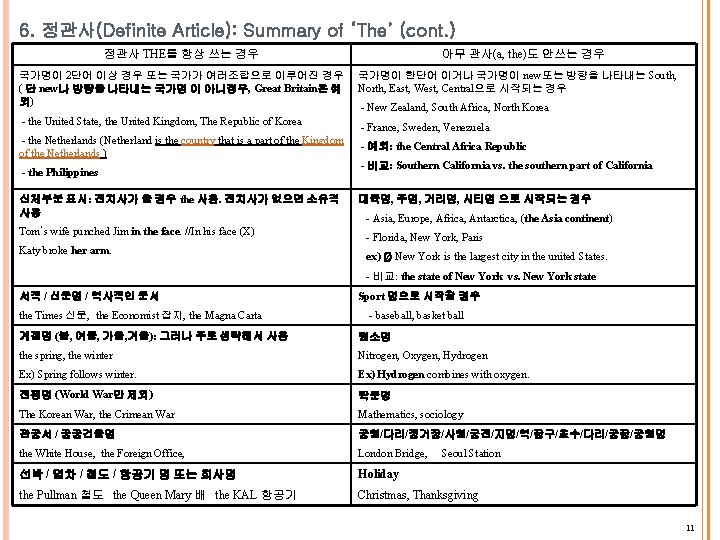
6. 정관사(Definite Article): Summary of ‘The’ (cont. ) 정관사 THE를 항상 쓰는 경우 국가명이 2단어 이상 경우 또는 국가가 여러조합으로 이루어진 경우 ( 단 new나 방향을 나타내는 국가명 이 아니경우, Great Britain은 예 외) - the United State, the United Kingdom, The Republic of Korea - the Netherlands (Netherland is the country that is a part of the Kingdom of the Netherlands ) - the Philippines 신체부분 표시: 전치사가 올 경우 the 사용. 전치사가 없으면 소유격 사용 Tom’s wife punched Jim in the face. //In his face (X) Katy broke her arm. 아무 관사(a, the)도 안쓰는 경우 국가명이 한단어 이거나 국가명이 new또는 방향을 나타내는 South, North, East, West, Central으로 시작되는 경우 - New Zealand, South Africa, North Korea - France, Sweden, Venezuela - 예외: the Central Africa Republic - 비교: Southern California vs. the southern part of California 대륙명, 주명, 거리명, 시티명 으로 시작되는 경우 - Asia, Europe, Africa, Antarctica, (the Asia continent) - Florida, New York, Paris ex) Ø New York is the largest city in the united States. - 비교: the state of New York vs. New York state 서적 / 신문명 / 역사적인 문서 Sport 명으로 시작할 경우 the Times 신문, the Economist 잡지, the Magna Carta - baseball, basket ball 계절명 (봄, 여름, 가을, 겨울): 그러나 주로 생략해서 사용 원소명 the spring, the winter Nitrogen, Oxygen, Hydrogen Ex) Spring follows winter. Ex) Hydrogen combines with oxygen. 전쟁명 (World War만 제외) 학문명 The Korean War, the Crimean War Mathematics, sociology 관공서 / 공공건물명 공원/다리/정거장/사원/궁전/지명/역/항구/호수/다리/공항/공원명 the White House, the Foreign Office, London Bridge, Seoul Station 선박 / 열차 / 철도 / 항공기 명 또는 회사명 Holiday the Pullman 철도 the Queen Mary 배 the KAL 항공기 Christmas, Thanksgiving 11
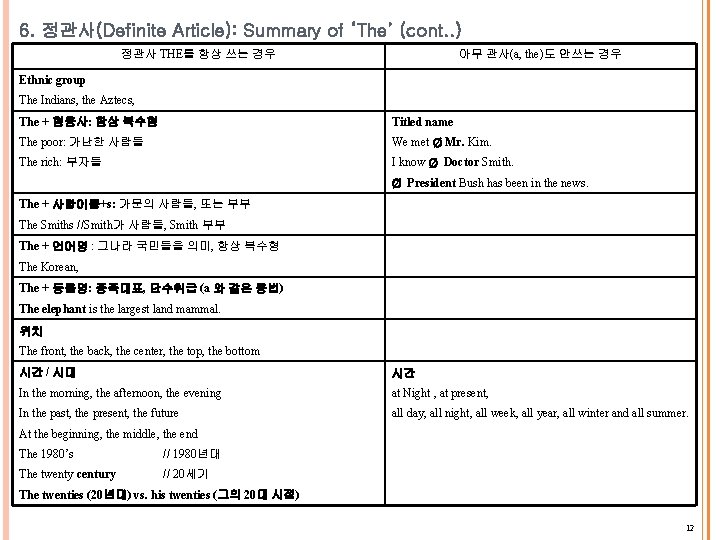
6. 정관사(Definite Article): Summary of ‘The’ (cont. . ) 정관사 THE를 항상 쓰는 경우 아무 관사(a, the)도 안쓰는 경우 Ethnic group The Indians, the Aztecs, The + 형용사: 항상 복수형 Titled name The poor: 가난한 사람들 We met Ø Mr. Kim. The rich: 부자들 I know Ø Doctor Smith. Ø President Bush has been in the news. The + 사람이름+s: 가문의 사람들, 또는 부부 The Smiths //Smith가 사람들, Smith 부부 The + 언어명 : 그나라 국민들을 의미, 항상 복수형 The Korean, The + 동물명: 종족대표, 단수취급 (a 와 같은 용법) The elephant is the largest land mammal. 위치 The front, the back, the center, the top, the bottom 시간 / 시대 시간 In the morning, the afternoon, the evening at Night , at present, In the past, the present, the future all day, all night, all week, all year, all winter and all summer. At the beginning, the middle, the end The 1980’s // 1980년대 The twenty century // 20세기 The twenties (20년대) vs. his twenties (그의 20대 시절) 12
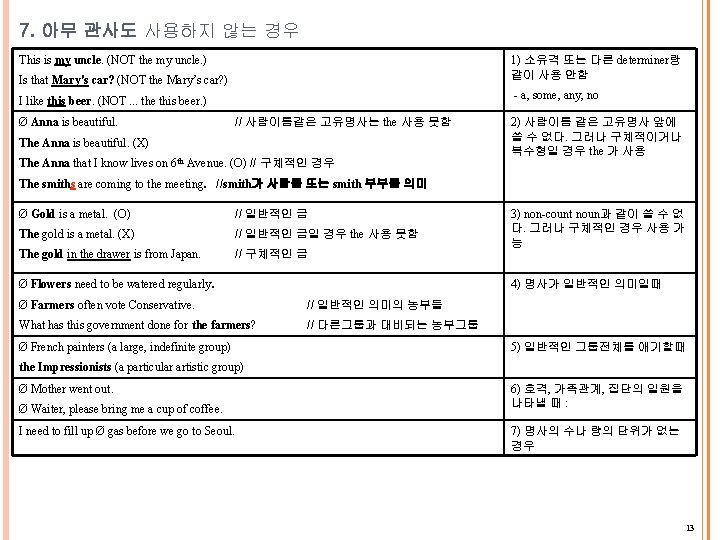
7. 아무 관사도 사용하지 않는 경우 This is my uncle. (NOT the my uncle. ) 1) 소유격 또는 다른 determiner랑 같이 사용 안함 Is that Mary's car? (NOT the Mary’s car? ) - a, some, any, no I like this beer. (NOT. . . the this beer. ) Ø Anna is beautiful. // 사람이름같은 고유명사는 the 사용 못함 The Anna is beautiful. (X) The Anna that I know lives on 6 th Avenue. (O) // 구체적인 경우 2) 사람이름 같은 고유명사 앞에 쓸 수 없다. 그러나 구체적이거나 복수형일 경우 the 가 사용 The smiths are coming to the meeting. //smith가 사람들 또는 smith 부부를 의미 Ø Gold is a metal. (O) // 일반적인 금 The gold is a metal. (X) // 일반적인 금일 경우 the 사용 못함 The gold in the drawer is from Japan. // 구체적인 금 Ø Flowers need to be watered regularly. 4) 명사가 일반적인 의미일때 Ø Farmers often vote Conservative. // 일반적인 의미의 농부들 What has this government done for the farmers? // 다른그룹과 대비되는 농부그룹 Ø French painters (a large, indefinite group) 3) non-count noun과 같이 쓸 수 없 다. 그러나 구체적인 경우 사용 가 능 5) 일반적인 그룹전체를 애기할때 the Impressionists (a particular artistic group) Ø Mother went out. Ø Waiter, please bring me a cup of coffee. I need to fill up Ø gas before we go to Seoul. 6) 호격, 가족관계, 집단의 일원을 나타낼 때 : 7) 명사의 수나 량의 단위가 없는 경우 13
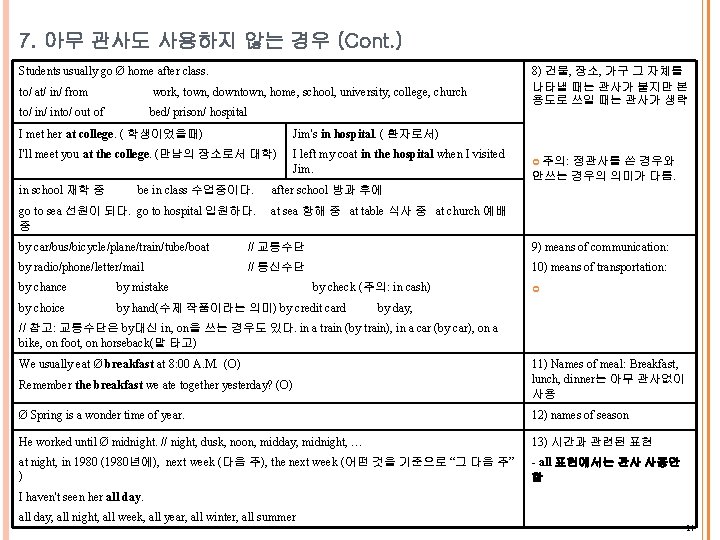
7. 아무 관사도 사용하지 않는 경우 (Cont. ) Students usually go Ø home after class. to/ at/ in/ from work, town, downtown, home, school, university, college, church to/ into/ out of bed/ prison/ hospital I met her at college. ( 학생이었을때) Jim's in hospital. ( 환자로서) I'll meet you at the college. (만남의 장소로서 대학) I left my coat in the hospital when I visited Jim. 8) 건물, 장소, 가구 그 자체를 나타낼 때는 관사가 붙지만 본 용도로 쓰일 때는 관사가 생략 주의: 정관사를 쓴 경우와 안쓰는 경우의 의미가 다름. in school 재학 중 be in class 수업중이다. after school 방과 후에 go to sea 선원이 되다. go to hospital 입원하다. at sea 항해 중 at table 식사 중 at church 예배 중 by car/bus/bicycle/plane/train/tube/boat // 교통수단 9) means of communication: by radio/phone/letter/mail // 통신수단 10) means of transportation: by chance by mistake by check (주의: in cash) by choice by hand(수제 작품이라는 의미) by credit card by day, // 참고: 교통수단은 by대신 in, on을 쓰는 경우도 있다. in a train (by train), in a car (by car), on a bike, on foot, on horseback(말 타고) We usually eat Ø breakfast at 8: 00 A. M. (O) Remember the breakfast we ate together yesterday? (O) 11) Names of meal: Breakfast, lunch, dinner는 아무 관사없이 사용 Ø Spring is a wonder time of year. 12) names of season He worked until Ø midnight. // night, dusk, noon, midday, midnight, … 13) 시간과 관련된 표현 at night, in 1980 (1980년에), next week (다음 주), the next week (어떤 것을 기준으로 “그 다음 주” ) - all 표현에서는 관사 사용안 함 I haven't seen her all day, all night, all week, all year, all winter, all summer 14
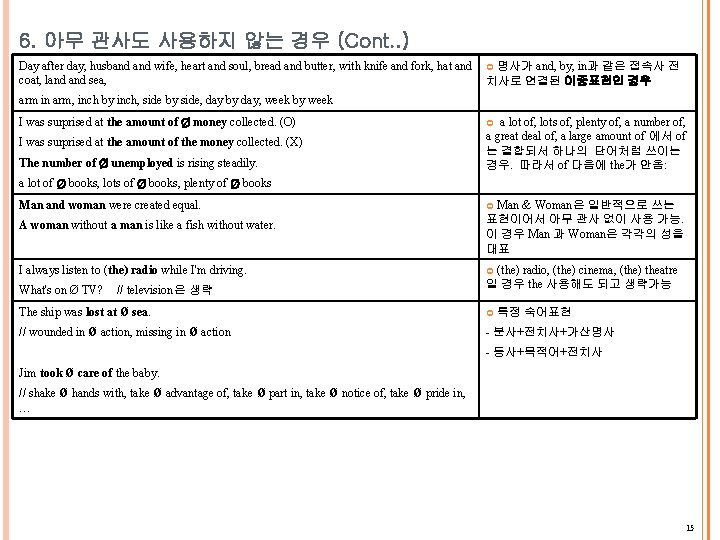
6. 아무 관사도 사용하지 않는 경우 (Cont. . ) Day after day, husband wife, heart and soul, bread and butter, with knife and fork, hat and 명사가 and, by, in과 같은 접속사 전 coat, land sea, 치사로 연결된 이중표현인 경우 arm in arm, inch by inch, side by side, day by day, week by week I was surprised at the amount of Ø money collected. (O) I was surprised at the amount of the money collected. (X) The number of Ø unemployed is rising steadily. a lot of, lots of, plenty of, a number of, a great deal of, a large amount of 에서 of 는 결합되서 하나의 단어처럼 쓰이는 경우. 따라서 of 다음에 the가 안옴: a lot of Ø books, lots of Ø books, plenty of Ø books Man and woman were created equal. A woman without a man is like a fish without water. I always listen to (the) radio while I'm driving. What's on Ø TV? // television은 생략 Man & Woman은 일반적으로 쓰는 표현이어서 아무 관사 없이 사용 가능. 이 경우 Man 과 Woman은 각각의 성을 대표 (the) radio, (the) cinema, (the) theatre 일 경우 the 사용해도 되고 생략가능 The ship was lost at Ø sea. 특정 숙어표현 // wounded in Ø action, missing in Ø action - 분사+전치사+가산명사 - 동사+목적어+전치사 Jim took Ø care of the baby. // shake Ø hands with, take Ø advantage of, take Ø part in, take Ø notice of, take Ø pride in, … 15
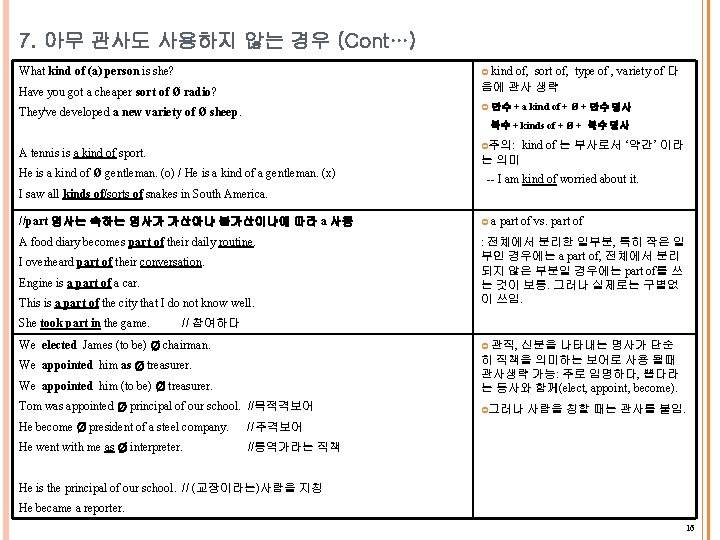
7. 아무 관사도 사용하지 않는 경우 (Cont…) What kind of (a) person is she? kind of, sort of, type of , variety of 다 음에 관사 생략 Have you got a cheaper sort of Ø radio? 단수 + a kind of + Ø + 단수 명사 They've developed a new variety of Ø sheep. 복수 + kinds of + Ø + 복수 명사 주의: kind of 는 부사로서 ‘약간’ 이라 A tennis is a kind of sport. 는 의미 He is a kind of Ø gentleman. (o) / He is a kind of a gentleman. (x) -- I am kind of worried about it. I saw all kinds of/sorts of snakes in South America. //part 명사는 속하는 명사가 가산아냐 불가산이냐에 따라 a 사용 a part of vs. part of A food diary becomes part of their daily routine. : 전체에서 분리한 일부분, 특히 작은 일 부인 경우에는 a part of, 전체에서 분리 되지 않은 부분일 경우에는 part of를 쓰 는 것이 보통. 그러나 실제로는 구별없 이 쓰임. I overheard part of their conversation. Engine is a part of a car. This is a part of the city that I do not know well. She took part in the game. // 참여하다 We elected James (to be) Ø chairman. 관직, 신분을 나타내는 명사가 단순 We appointed him (to be) Ø treasurer. 히 직책을 의미하는 보어로 사용 될때 관사생략 가능: 주로 임명하다, 뽑다라 는 동사와 함께(elect, appoint, become). Tom was appointed Ø principal of our school. //목적격보어 그러나 사람을 칭할 때는 관사를 붙임. We appointed him as Ø treasurer. He become Ø president of a steel company. //주격보어 He went with me as Ø interpreter. //통역가라는 직책 He is the principal of our school. // (교장이라는)사람을 지칭 He became a reporter. 16