
Appeasement by Brady Glasser The Path to War
Appeasement by Brady Glasser
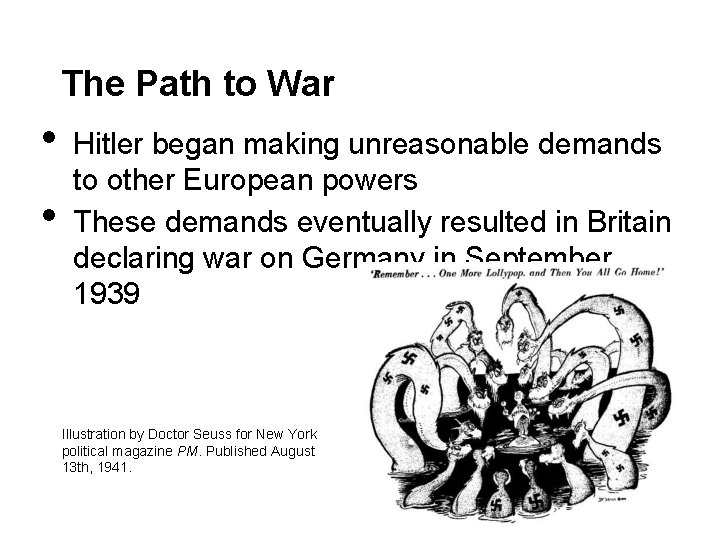
The Path to War • • Hitler began making unreasonable demands to other European powers These demands eventually resulted in Britain declaring war on Germany in September 1939 Illustration by Doctor Seuss for New York political magazine PM. Published August 13 th, 1941.
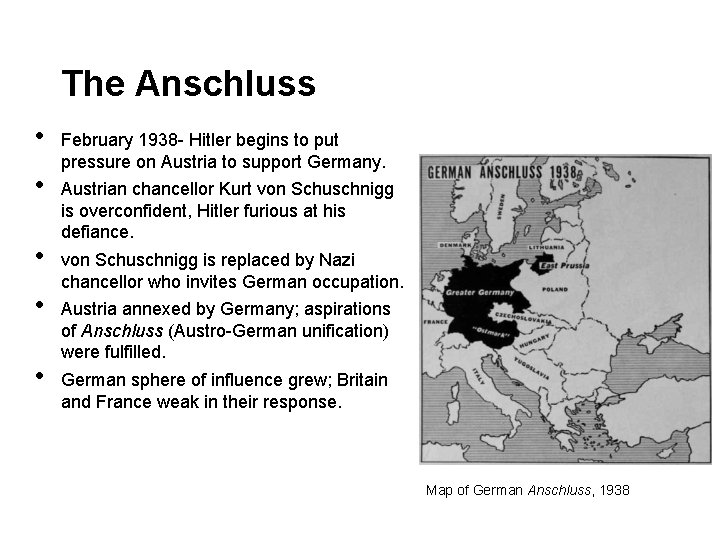
The Anschluss • • • February 1938 - Hitler begins to put pressure on Austria to support Germany. Austrian chancellor Kurt von Schuschnigg is overconfident, Hitler furious at his defiance. von Schuschnigg is replaced by Nazi chancellor who invites German occupation. Austria annexed by Germany; aspirations of Anschluss (Austro-German unification) were fulfilled. German sphere of influence grew; Britain and France weak in their response. Map of German Anschluss, 1938
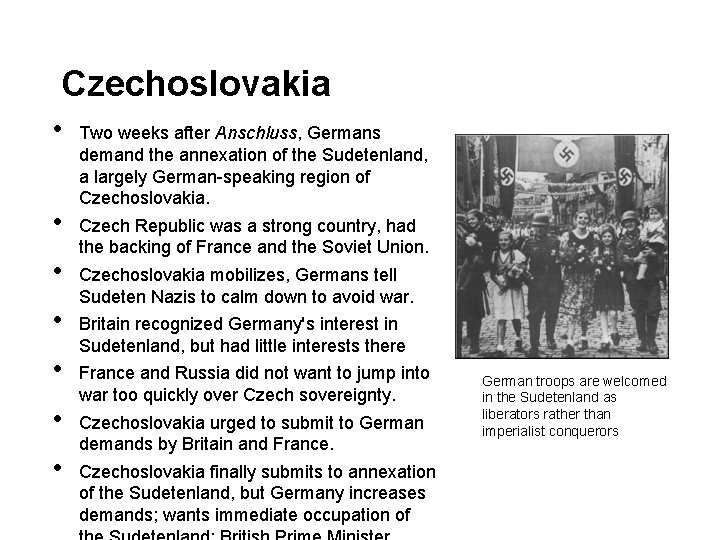
Czechoslovakia • • Two weeks after Anschluss, Germans demand the annexation of the Sudetenland, a largely German-speaking region of Czechoslovakia. Czech Republic was a strong country, had the backing of France and the Soviet Union. Czechoslovakia mobilizes, Germans tell Sudeten Nazis to calm down to avoid war. Britain recognized Germany's interest in Sudetenland, but had little interests there France and Russia did not want to jump into war too quickly over Czech sovereignty. Czechoslovakia urged to submit to German demands by Britain and France. Czechoslovakia finally submits to annexation of the Sudetenland, but Germany increases demands; wants immediate occupation of German troops are welcomed in the Sudetenland as liberators rather than imperialist conquerors
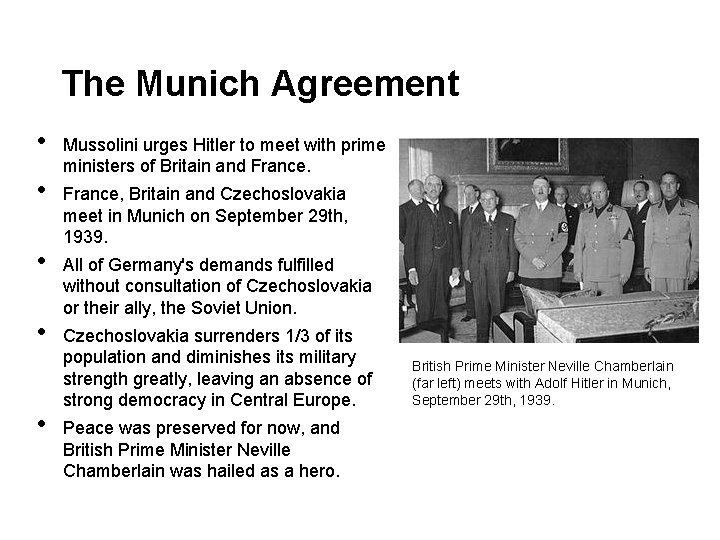
The Munich Agreement • • • Mussolini urges Hitler to meet with prime ministers of Britain and France, Britain and Czechoslovakia meet in Munich on September 29 th, 1939. All of Germany's demands fulfilled without consultation of Czechoslovakia or their ally, the Soviet Union. Czechoslovakia surrenders 1/3 of its population and diminishes its military strength greatly, leaving an absence of strong democracy in Central Europe. Peace was preserved for now, and British Prime Minister Neville Chamberlain was hailed as a hero. British Prime Minister Neville Chamberlain (far left) meets with Adolf Hitler in Munich, September 29 th, 1939.
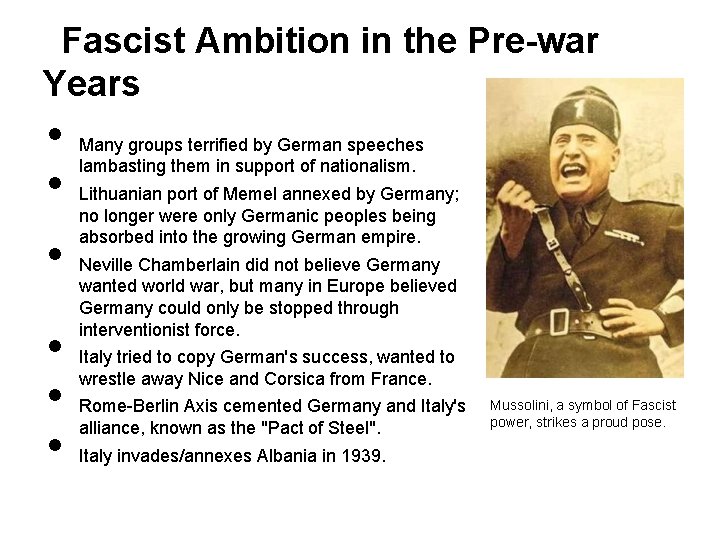
Fascist Ambition in the Pre-war Years • • • Many groups terrified by German speeches lambasting them in support of nationalism. Lithuanian port of Memel annexed by Germany; no longer were only Germanic peoples being absorbed into the growing German empire. Neville Chamberlain did not believe Germany wanted world war, but many in Europe believed Germany could only be stopped through interventionist force. Italy tried to copy German's success, wanted to wrestle away Nice and Corsica from France. Rome-Berlin Axis cemented Germany and Italy's alliance, known as the "Pact of Steel". Italy invades/annexes Albania in 1939. Mussolini, a symbol of Fascist power, strikes a proud pose.
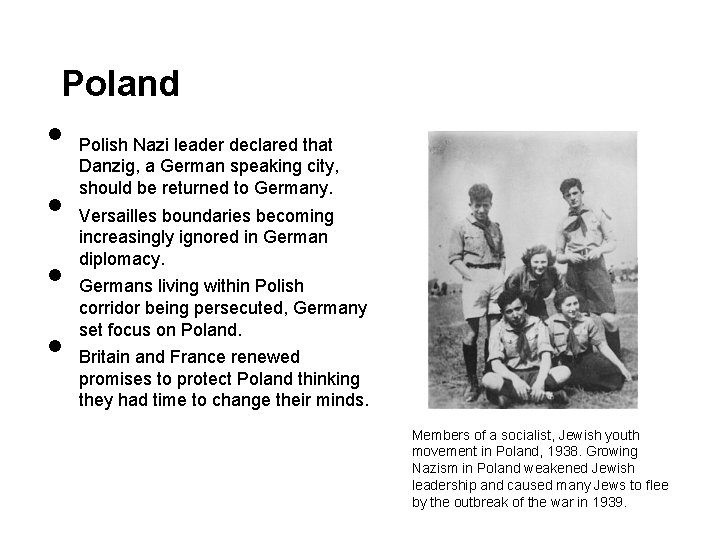
Poland • • Polish Nazi leader declared that Danzig, a German speaking city, should be returned to Germany. Versailles boundaries becoming increasingly ignored in German diplomacy. Germans living within Polish corridor being persecuted, Germany set focus on Poland. Britain and France renewed promises to protect Poland thinking they had time to change their minds. Members of a socialist, Jewish youth movement in Poland, 1938. Growing Nazism in Poland weakened Jewish leadership and caused many Jews to flee by the outbreak of the war in 1939.
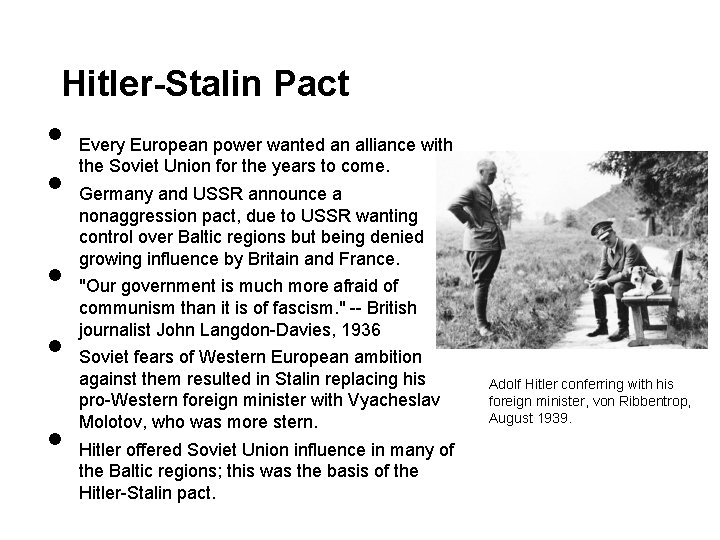
Hitler-Stalin Pact • • Every European power wanted an alliance with the Soviet Union for the years to come. • • "Our government is much more afraid of communism than it is of fascism. " -- British journalist John Langdon-Davies, 1936 • Germany and USSR announce a nonaggression pact, due to USSR wanting control over Baltic regions but being denied growing influence by Britain and France. Soviet fears of Western European ambition against them resulted in Stalin replacing his pro-Western foreign minister with Vyacheslav Molotov, who was more stern. Hitler offered Soviet Union influence in many of the Baltic regions; this was the basis of the Hitler-Stalin pact. Adolf Hitler conferring with his foreign minister, von Ribbentrop, August 1939.
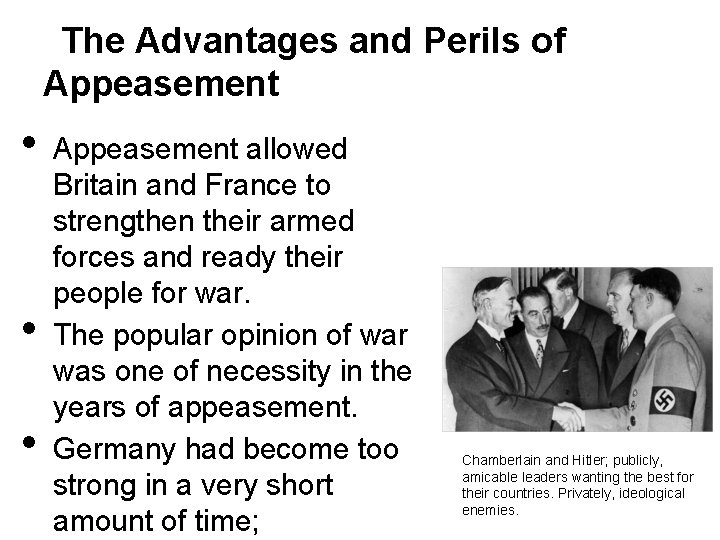
The Advantages and Perils of Appeasement • • • Appeasement allowed Britain and France to strengthen their armed forces and ready their people for war. The popular opinion of war was one of necessity in the years of appeasement. Germany had become too strong in a very short amount of time; Chamberlain and Hitler; publicly, amicable leaders wanting the best for their countries. Privately, ideological enemies.
- Slides: 9