
APPEALS AND FALLACIES A Battle of Wits How
APPEALS AND FALLACIES
� A Battle of Wits � How does this battle of wits play out? Why did the villain fail at the end?
� � Holmes Reasoning
Inductive vs. Deductive Reasoning � � � Inductive reasoning: process of logical reasoning that moves from observations, examples, or facts to a broad generalization Deductive reasoning : process of logical reasoning that begins with a general premise and advances with evidence to a specific conclusion Premise: claim or generalization; starting point for a deductive argument
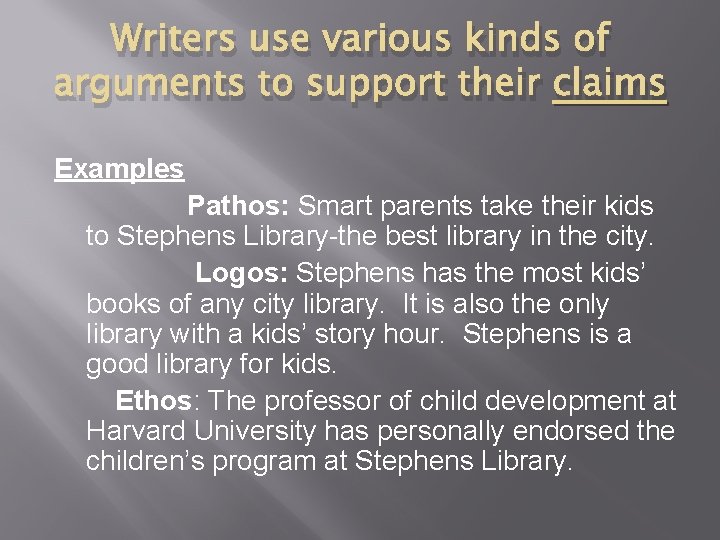
Writers use various kinds of arguments to support their claims Examples Pathos: Smart parents take their kids to Stephens Library-the best library in the city. Logos: Stephens has the most kids’ books of any city library. It is also the only library with a kids’ story hour. Stephens is a good library for kids. Ethos: The professor of child development at Harvard University has personally endorsed the children’s program at Stephens Library.
Writers use various kinds of arguments to support their claims � There are two main types of logical argument: inductive and deductive. The example from the previous slide uses inductive reasoning-it starts with specific facts (it has the most kids’ books; it has a story hour), then moves to a general conclusion (Stephens is a good library for kids). Deductive reasoning starts with a general premise, then moves to a specific conclusion.
Inductive vs. Deductive Reasoning: Here’s How � Step 1: Distinguish logical reasoning from emotional appeals and propaganda. � Ask: Does the argument rely on facts or on feelings? Is information accurate and complete?
Inductive vs. Deductive Reasoning: Here’s How � Step 2: Identify the mode of reasoning in logical arguments. � An argument that uses inductive reasoning moves from the specific to the general.
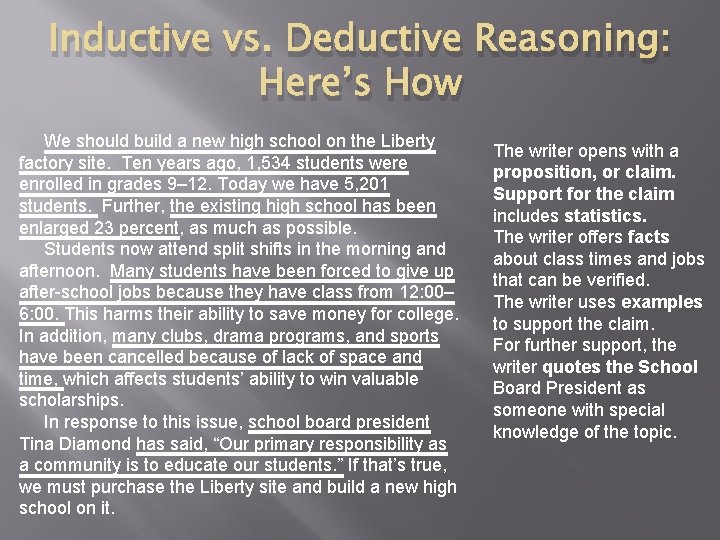
Inductive vs. Deductive Reasoning: Here’s How We should build a new high school on the Liberty factory site. Ten years ago, 1, 534 students were enrolled in grades 9– 12. Today we have 5, 201 students. Further, the existing high school has been enlarged 23 percent, as much as possible. Students now attend split shifts in the morning and afternoon. Many students have been forced to give up after-school jobs because they have class from 12: 00– 6: 00. This harms their ability to save money for college. In addition, many clubs, drama programs, and sports have been cancelled because of lack of space and time, which affects students’ ability to win valuable scholarships. In response to this issue, school board president Tina Diamond has said, “Our primary responsibility as a community is to educate our students. ” If that’s true, we must purchase the Liberty site and build a new high school on it. The writer opens with a proposition, or claim. Support for the claim includes statistics. The writer offers facts about class times and jobs that can be verified. The writer uses examples to support the claim. For further support, the writer quotes the School Board President as someone with special knowledge of the topic.
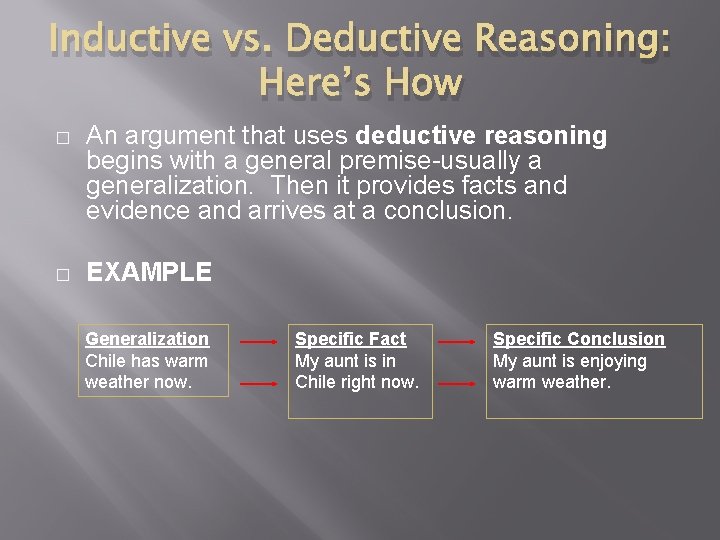
Inductive vs. Deductive Reasoning: Here’s How � An argument that uses deductive reasoning begins with a general premise-usually a generalization. Then it provides facts and evidence and arrives at a conclusion. � EXAMPLE Generalization Chile has warm weather now. Specific Fact My aunt is in Chile right now. Specific Conclusion My aunt is enjoying warm weather.
Inductive vs. Deductive Reasoning: Here’s How � Step 3: Analyze the logic by asking the right questions. � For an inductive argument ask: � Is the evidence accurate? � Does the conclusion follow logically from the evidence? � Is the evidence drawn from a large enough sample, or is it an overgeneralization?
Inductive vs. Deductive Reasoning: Here’s How � Step 3: Analyze the logic by asking the right questions. � For an deductive argument ask: � Is the premise stated or just implied? � Is the premise sound? � Is the conclusion valid?
Emotional Appeals and Propaganda � Emotional appeals try to persuade by stirring up strong feelings, rather than persuading with evidence or facts. Propaganda often relies on emotional appeals and false or distorted claims. To identify emotional appeals, students should look for language designed to invoke fear, create flattery, or build sympathy.
Mode of Reasoning � Inductive reasoning produces probable conclusions that can be modified if the facts change. Deductive reasoning produces certain conclusions-conclusions that are sound as long as the premise is valid.
Validity � An inductive argument relies on accurate evidence. If the evidence were inaccurate, the generalization based upon it would be inaccurate, as it would if the sample were too small. A broader conclusion would be an overgeneralization.
Mode of Reasoning � Deductive arguments may appear in an if… then format. � EXAMPLE If this were a simile, then the word like or the word as would appear. Since they do not, this comparison is not a simile.
Validity � A deductive argument relies on a sound premise. If the general principle is not completely sound, the conclusion is not valid.
Practice – Three Arguments � Argument 1: If elected, I will stand up for honesty and restore pride in our town. My opponent is a dangerous crook. Protect yourself—vote for me. I’ll always be there for you and the town we all care about so much. Does this passage start with an emotional appeal, a specific fact or observation, or a general claim?
Practice – Three Arguments � Argument 1: If elected, I will stand up for honesty and restore pride in our town. My opponent is a dangerous crook. Protect yourself—vote for me. I’ll always be there for you and the town we all care about so much. What emotions does the writer appeal to?
Practice – Three Arguments � Argument 1: If elected, I will stand up for honesty and restore pride in our town. My opponent is a dangerous crook. Protect yourself—vote for me. I’ll always be there for you and the town we all care about so much. What words constitute name calling?
Practice – Three Arguments � Argument 1: If elected, I will stand up for honesty and restore pride in our town. My opponent is a dangerous crook. Protect yourself—vote for me. I’ll always be there for you and the town we all care about so much. Does this passage fit the definition of propaganda: a form of communication that uses false or distorted information to persuade, often for political purposes?
Practice – Three Arguments � Argument 2: With a population of 1. 3 billion, China consumes almost 5 million barrels of oil per day. With a population of 240 million, Indonesia consumes less than 1. 2 million barrels of oil per day. With a roughly comparable population of less than 300 million, the United States consumes a whopping 19. 7 million barrels of oil per day, more than 25 percent of the oil used daily around the world. The United States is by far the world’s hungriest nation for oil and its main product, gasoline. Does this passage start with an emotional appeal, a specific fact or observation, or a general claim?
Practice – Three Arguments � Argument 2: With a population of 1. 3 billion, China consumes almost 5 million barrels of oil per day. With a population of 240 million, Indonesia consumes less than 1. 2 million barrels of oil per day. With a roughly comparable population of less than 300 million, the United States consumes a whopping 19. 7 million barrels of oil per day, more than 25 percent of the oil used daily around the world. The United States is by far the world’s hungriest nation for oil and its main product, gasoline. What type of reasoning does this passage use?
Practice – Three Arguments � Argument 2: With a population of 1. 3 billion, China consumes almost 5 million barrels of oil per day. With a population of 240 million, Indonesia consumes less than 1. 2 million barrels of oil per day. With a roughly comparable population of less than 300 million, the United States consumes a whopping 19. 7 million barrels of oil per day, more than 25 percent of the oil used daily around the world. The United States is by far the world’s hungriest nation for oil and its main product, gasoline. What is the conclusion?
Practice – Three Arguments � Argument 2: With a population of 1. 3 billion, China consumes almost 5 million barrels of oil per day. With a population of 240 million, Indonesia consumes less than 1. 2 million barrels of oil per day. With a roughly comparable population of less than 300 million, the United States consumes a whopping 19. 7 million barrels of oil per day, more than 25 percent of the oil used daily around the world. The United States is by far the world’s hungriest nation for oil and its main product, gasoline. Does this conclusion follow logically from the evidence?
Practice – Three Arguments � Argument 2: With a population of 1. 3 billion, China consumes almost 5 million barrels of oil per day. With a population of 240 million, Indonesia consumes less than 1. 2 million barrels of oil per day. With a roughly comparable population of less than 300 million, the United States consumes a whopping 19. 7 million barrels of oil per day, more than 25 percent of the oil used daily around the world. The United States is by far the world’s hungriest nation for oil and its main product, gasoline. What if the conclusion were “China will one day surpass the U. S. in oil consumption”? Would it still be sound?
Practice – Three Arguments � Argument 3: Teenagers who read regularly in their spare time are likely to get better-thanaverage grades. Arabella reads regularly in her spare time. Arabella is likely to get better thanaverage-grades. Does this passage start with an emotional appeal, a specific fact or observation, or a general claim?
Practice – Three Arguments � Argument 3: Teenagers who read regularly in their spare time are likely to get better-thanaverage grades. Arabella reads regularly in her spare time. Arabella is likely to get better thanaverage-grades. What type of reasoning does this passage use?
Practice – Three Arguments � Argument 3: Teenagers who read regularly in their spare time are likely to get better-thanaverage grades. Arabella reads regularly in her spare time. Arabella is likely to get better thanaverage-grades. What specific conclusion does this passage reach?
Practice – Three Arguments � Argument 3: Teenagers who read regularly in their spare time are likely to get better-thanaverage grades. Arabella reads regularly in her spare time. Arabella is likely to get better thanaverage-grades. If the premise and the facts are true, is this conclusion valid?

DOL
Warm-up � Fallacy: an error in logic � We found a witch! � What mistakes in logic do you notice from this clip?
Fallacy: an error in logic � � A fallacy can be defined as “faulty reasoning, ” an argument or line of talk in which a logical relationship is nonexistent or logical connections are weak. It is important to look for faulty reasoning when writers or speakers are trying to persuade you to do something, buy something, or accept an argument. Before you agree with a conclusion, you need to always examine the argument for sound—strong— logic. It is also important to find and revise faulty reasoning in your own compositions.
Types of Faulty Reasoning � � Either-Or Fallacy: statement that suggests there are only two ways to view a situation EXAMPLE: Either make the cookies now or we won’t have any for the party. The error is providing a limited view of the subject, rather than acknowledging that there may be more than two choices at hand. An either-or fallacy may also use the expression if. . . then.
Types of Faulty Reasoning � � � Oversimplification: explanation of a complex situation as though it were simple EXAMPLE: Getting a good job depends on whom you know. The error is not acknowledging complexity. Knowing people may be a factor in getting some jobs, but getting a job can depend on many elements, including education, work experience, and interview skills. 3 Examples
Types of Faulty Reasoning � � � Overgeneralization: generalization that is too broad EXAMPLE: All cats like to be scratched behind their ears. The error is ignoring exceptions. No doubt there are cats who don’t like to be scratched behind the ears. Note that stereotyping is a dangerous type of overgeneralization. Stereotypes are broad statements about people made on the basis of their gender, ethnicity, race, class, physical stature, religious beliefs, or any other grouping. You can not judge individuals by broad categories. Nor can you jump to conclusions about trends based on the actions of a few.
Types of Faulty Reasoning � � � Circular Reasoning (Petitio principia): repeating an idea rather than providing evidence EXAMPLE: Our team should win because it deserves to be number one. Should win and deserves to be number one have more or less the same meaning. The second statement provides no evidence to support the first.
Types of Faulty Reasoning � � � Evading the Issue(Red Herring): argument that fails to address the central point EXAMPLE: Yes, I broke my promise to lower taxes. Why? Let me say this: Crime is down. The error is not answering the question or addressing the central point.
Types of Faulty Reasoning � � � Attacking the Person (name-calling /Argumentum ad hominem): discrediting an idea by attacking a person EXAMPLE: The senator’s policies should be rejected because she’s completely heartless. The error is labeling the senator with a disparaging name, rather than explaining why her policies should be rejected.
Types of Faulty Reasoning � � � Non sequitur: statement with true but unconnected information EXAMPLE: We will cure cancer. After all, we sent people to the moon. Cancer and people on the moon are not connected. The second statement is true, but it provides no evidence to support the first.
Types of Faulty Reasoning � � False Cause(Post hoc ergo propter hoc): X happened then Y happened; therefore X caused Y EXAMPLE: School enrollment increased as a result of the mayor’s speech. The error is that the relationship between school enrollment and the speech may be chronological or coincidental, not causal. Bears!

Types of Faulty Reasoning � � � Hasty Generalization: conclusion drawn from too little evidence EXAMPLE: Based on last year’s picnic, I predict ours will be rained out as well. The error is drawing a conclusion from experience with a single picnic.
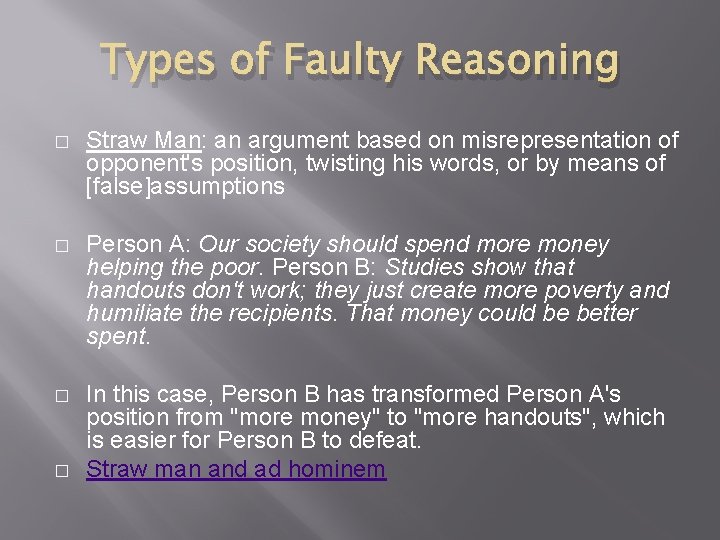
Types of Faulty Reasoning � Straw Man: an argument based on misrepresentation of opponent's position, twisting his words, or by means of [false]assumptions � Person A: Our society should spend more money helping the poor. Person B: Studies show that handouts don't work; they just create more poverty and humiliate the recipients. That money could be better spent. � In this case, Person B has transformed Person A's position from "more money" to "more handouts", which is easier for Person B to defeat. Straw man and ad hominem �
Faulty Reasoning: Practice � Directions: Identify the fallacy (if any). If there is no error, write logical. � Model 1: We need term limits because the mayor should be in office for a limited time.
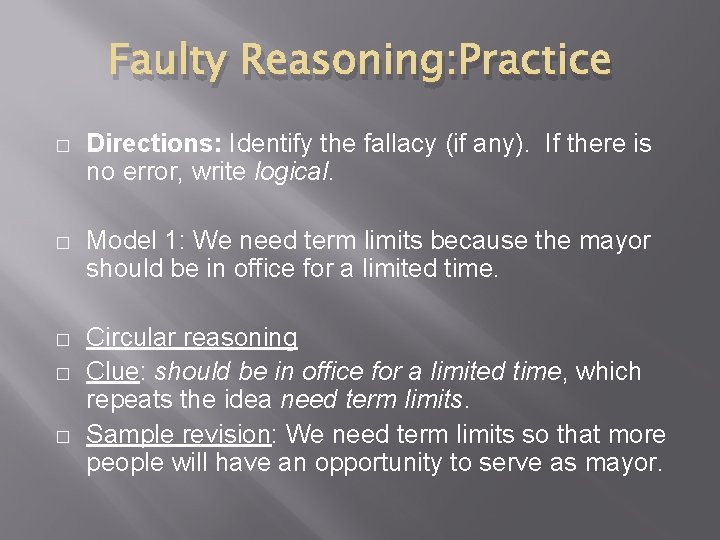
Faulty Reasoning: Practice � Directions: Identify the fallacy (if any). If there is no error, write logical. � Model 1: We need term limits because the mayor should be in office for a limited time. � Circular reasoning Clue: should be in office for a limited time, which repeats the idea need term limits. Sample revision: We need term limits so that more people will have an opportunity to serve as mayor. � �
Faulty Reasoning: Practice � Directions: Identify the fallacy (if any). If there is no error, write logical. � Model 2: I didn’t like that book; the author is stupid.
Faulty Reasoning: Practice � Directions: Identify the fallacy (if any). If there is no error, write logical. � Model 2: I didn’t like that book; the author is stupid. � Attacking the person Clue: stupid. Sample revision: I didn’t like that book; the author’s dialogue seemed unrealistic, and I was disappointed by the ending. � �
Faulty Reasoning: Practice � Directions: Identify the fallacy (if any). If there is no error, write logical. � Model 3: You say that country is not a democracy because it has only one political party. Don’t forget how well that party protects people.
Faulty Reasoning: Practice � Directions: Identify the fallacy (if any). If there is no error, write logical. � Model 3: You say that country is not a democracy because it has only one political party. Don’t forget how well that party protects people. � Evading the issue Clue: how well that party protects people. This does not connect with the first statement. Sample revision: Yes, it is true that country is not a democracy, because it has only one political party. However, many people feel that this one political party protects them well. � �
Faulty Reasoning: Practice � Directions: Identify the fallacy (if any). If there is no error, write logical. � Model 4: If I don’t get the internship, then my journalism career cannot get started.

Faulty Reasoning: Practice � Directions: Identify the fallacy (if any). If there is no error, write logical. � Model 4: If I don’t get the internship, then my journalism career cannot get started. � Either-or fallacy Clue: If. . . then. Sample revision: If I don’t get the internship, I’ll have to find another way to get started in journalism. � �
Faulty Reasoning: Practice � Directions: Identify the fallacy (if any). If there is no error, write logical. � Model 5: Laziness explains poor scores on standardized exams.
Faulty Reasoning: Practice � Directions: Identify the fallacy (if any). If there is no error, write logical. � Model 5: Laziness explains poor scores on standardized exams. � Oversimplification Clue: Laziness explains. Sample revision: A variety of factors explain poor scores on standardized exams. � �
Faulty Reasoning: Practice � Directions: Identify the fallacy (if any). If there is no error, write logical. � Model 6: I’ll wear my red hat to the game because whenever I wear it, we win.
Faulty Reasoning: Practice � Directions: Identify the fallacy (if any). If there is no error, write logical. � Model 6: I’ll wear my red hat to the game because whenever I wear it, we win. � False cause Clue: whenever I wear it, we win. A cause-effect link is made but not proven. Sample revision: I’ll wear my red hat to the game. Coincidentally, all the times I’ve worn that so far, we won. � �
Faulty Reasoning: Practice � Directions: Identify the fallacy (if any). If there is no error, write logical. � Model 7: I know I’ll pass math—Ms. Smith, the math teacher, is my volleyball coach.
Faulty Reasoning: Practice � Directions: Identify the fallacy (if any). If there is no error, write logical. � Model 7: I know I’ll pass math—Ms. Smith, the math teacher, is my volleyball coach. � Non sequitur Clue: is my volleyball coach—an abrupt jump from —pass math. Sample revision: I know I’ll pass math—I’ve kept up with the homework and done well on all the quizzes. � �
Faulty Reasoning: Practice Which statement in each pair contains a fallacy? What type of fallacy is it? Pair 1 � a. All of the students love the school garden. � b. The school garden is important to many students. Pair 2 � a. My sister’s health improved because she moved to Tokyo. � b. My sister’s health improved because she walked a lot after she moved to Tokyo. �
Final Clip Banana in your ear

Warm up
Elements of an Argument � � fact: a statement that can be verified in a reference source or through direct observation opinion: someone’s personal belief, attitude, or judgment argument: writing that expresses a position on an issue or problem and then supports it with reasons and evidence. An argument in writing is not the same thing as the essay, speech, or other work of literature in which it is presented. Arguments appeal strictly to reason, while persuasive essays and speeches contain emotional appeals and rhetorical devices.
Elements of an Argument � � � Claim: a writer’s position on an issue or problem Support: any material that serves to prove a claim. It includes reasons and evidence. Assumptions: opinions or beliefs that are taken for granted. Opposing viewpoints: objections to the writer’s claims Counterarguments: arguments made to oppose (counter) the opposing viewpoints
Elements of an Argument � REMEMBER: A claim is the writer’s main point about the issue under discussion. The issue argued must have at least two valid sides: There is no sense in a writer claiming that “education is important” or “democracy is a good form of government” because we accept those claims to be true.
Elements of an Argument � Writers will often bring up opposing viewpoints, the opposite side of their argument, and then demolish them with counterarguments. Even valid opposing viewpoints can be used to show that writers’ counterarguments are stronger.
Elements of an Argument Here’s How � � Step 1: Identify the claim. Find the sentence(s) that states the writer’s opinion. The claim may appear in the introduction as thesis or in the conclusion as the summary. There can be more than one claim, but the claims will be linked together logically. Sometimes a claim may not be stated, only implied.
Elements of an Argument Here’s How � Step 2: Find the support and assumptions. Determine how the writer proves the claim. The writer will often include assumptions that the audience accepts as valid without further support.
Elements of an Argument Here’s How � � � � Step 2: Find the support and assumptions. Support, usually presented in order of importance, may include: statistics: data such as numbers, percentages, or averages, from reliable sources examples: specific details, such as a particular person, place, thing, or object facts: statements that can be verified in a reference or through direct observation narratives or anecdotes: brief stories that illustrate the point expert opinion: quotations from reliable sources such as scholars or researchers observations and personal experience: a writer’s firsthand account of an event
Elements of an Argument Here’s How � � Step 3: Look for opposing viewpoints and counterarguments. Determine how the writer anticipates opposing viewpoints and provides support to disprove them.
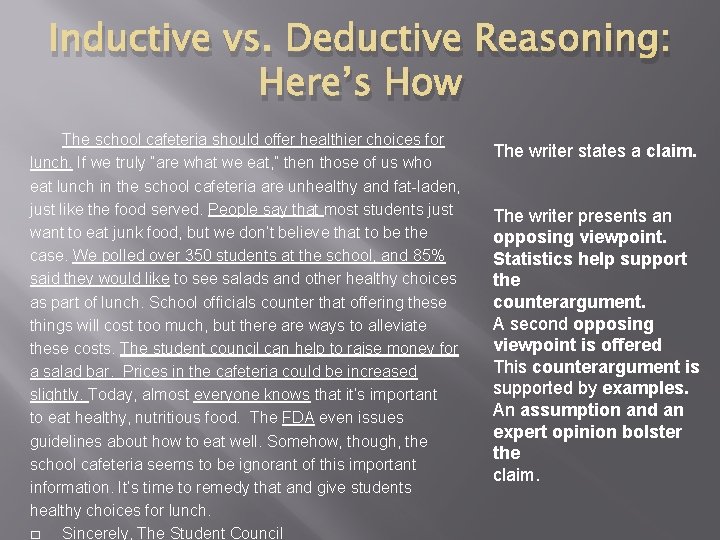
Inductive vs. Deductive Reasoning: Here’s How The school cafeteria should offer healthier choices for lunch. If we truly “are what we eat, ” then those of us who eat lunch in the school cafeteria are unhealthy and fat-laden, just like the food served. People say that most students just want to eat junk food, but we don’t believe that to be the case. We polled over 350 students at the school, and 85% said they would like to see salads and other healthy choices as part of lunch. School officials counter that offering these things will cost too much, but there are ways to alleviate these costs. The student council can help to raise money for a salad bar. Prices in the cafeteria could be increased slightly. Today, almost everyone knows that it’s important to eat healthy, nutritious food. The FDA even issues guidelines about how to eat well. Somehow, though, the school cafeteria seems to be ignorant of this important information. It’s time to remedy that and give students healthy choices for lunch. � Sincerely, The Student Council The writer states a claim. The writer presents an opposing viewpoint. Statistics help support the counterargument. A second opposing viewpoint is offered This counterargument is supported by examples. An assumption and an expert opinion bolster the claim.
Elements of an Argument Patrick Henry
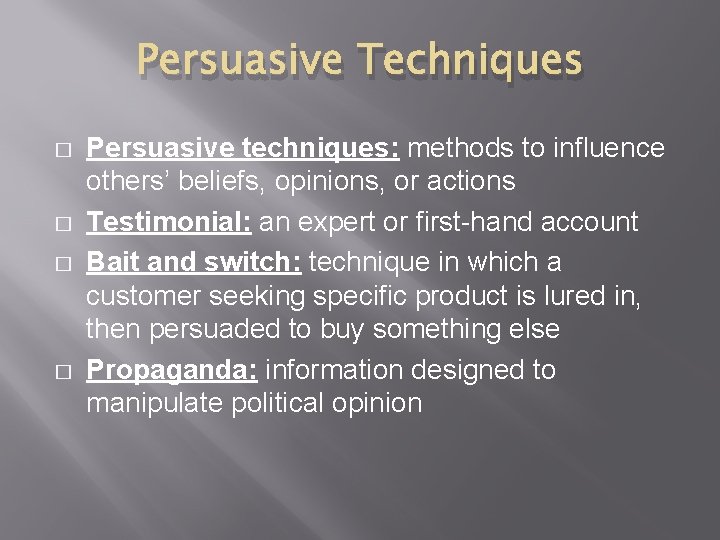
Persuasive Techniques � � Persuasive techniques: methods to influence others’ beliefs, opinions, or actions Testimonial: an expert or first-hand account Bait and switch: technique in which a customer seeking specific product is lured in, then persuaded to buy something else Propaganda: information designed to manipulate political opinion
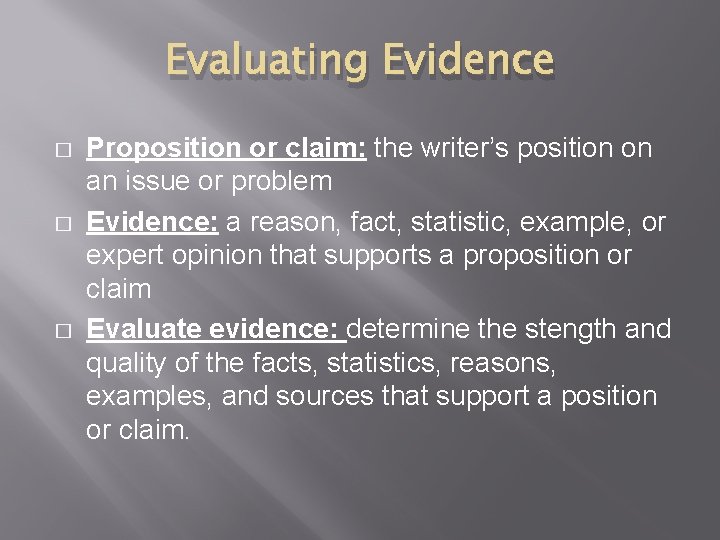
Evaluating Evidence � � � Proposition or claim: the writer’s position on an issue or problem Evidence: a reason, fact, statistic, example, or expert opinion that supports a proposition or claim Evaluate evidence: determine the stength and quality of the facts, statistics, reasons, examples, and sources that support a position or claim.
Evaluating Argument � � � Argument: speaking or writing that expresses a position on an issue and supports it with reasons and evidence Claim: the writer’s position on an issue or problem in an argument Support: reasons and factual evidence presented to prove a claim Reasons: declarations that explain or justify an action, decision, or belief Evidence: a fact, example, or quotation that supports a claim
Evaluating Argument � � Logic: system of reasoning. Good logic finds a valid or reasonable connection between two things. Faulty logic creates a mistaken or unreasonable connection. Fallacy: an error in reasoning Counterargument: an argument made to oppose another argument Propaganda: a form of communication that may use false and deceptive techniques such as name-calling and fear-mongering to persuade
- Slides: 74