
Apoptosis Hussam Telfah MBBS FRCPath Morphology Cell shrinkage
Apoptosis Hussam Telfah, MBBS, FRCPath

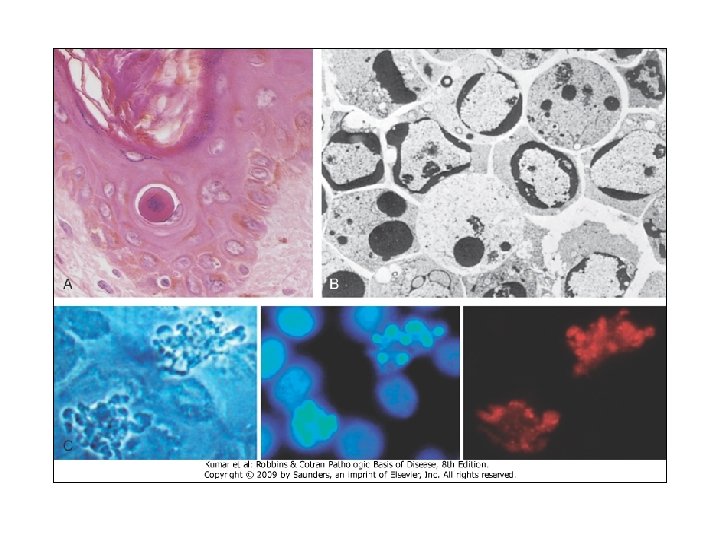
Morphology • Cell shrinkage: dense cytoplasm, tightly packed organelles. • Chromatin condensation: peripherally under the nuclear membrane. • Formation of cytoplasmic blebs and apoptotic bodies: blebbing then fragmentation into membrane bound apoptotic bodies composed of cytoplasm and tightly packed organelles with or without nuclear fragments.
Morphology • Phagocytosis of apoptotic cells or cell bodies by macrophages. • On H&E apoptotic cell appears intensely eosinophilic or shrunken basophilic fragment surrounded by halo.
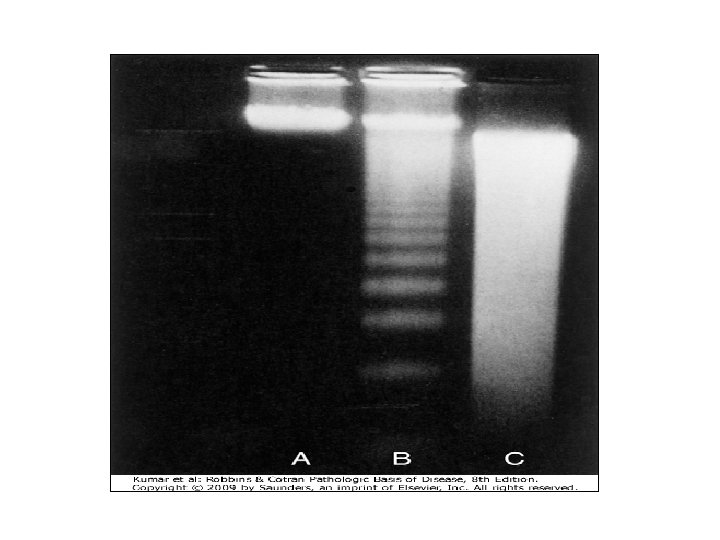
Biochemical features • Activation of Caspases: cysteine proteases that cleave proteins after aspartic acid residues. • Two types: initiators (caspase 9&8) and executioners (caspase 3&6). • DNA and Protein breakdown: DNA breaks down into large 50 to 300 kilobase pieces. Ca⁺² & Mg⁺² dependent endonucleases break DNA into fragments that are multiples of 180 to 200 base pairs. DNA ladders on electrophoresis.
Biochemical features • Membrane alterations and recognition: changes making cells recognisable by phagocytes. Movement of some phospholipids (phosphatidylserine) from the inner leaflet to the outer leaflet of the membrane which are able to bind to receptors on phagocytes.
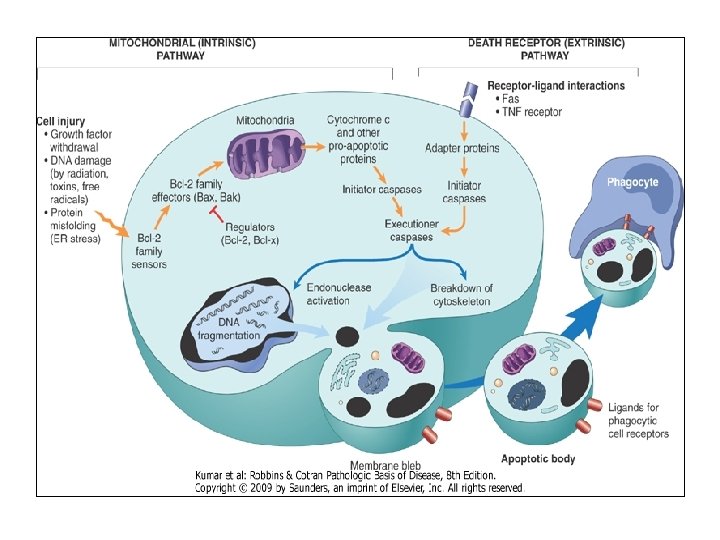
Mechanisms of apoptosis • All cells contain intrinsic mechanisms that signal death or survival and apoptosis results from an imbalance in these signals. • Initiation: intrinsic and extrinsic. • Execution.
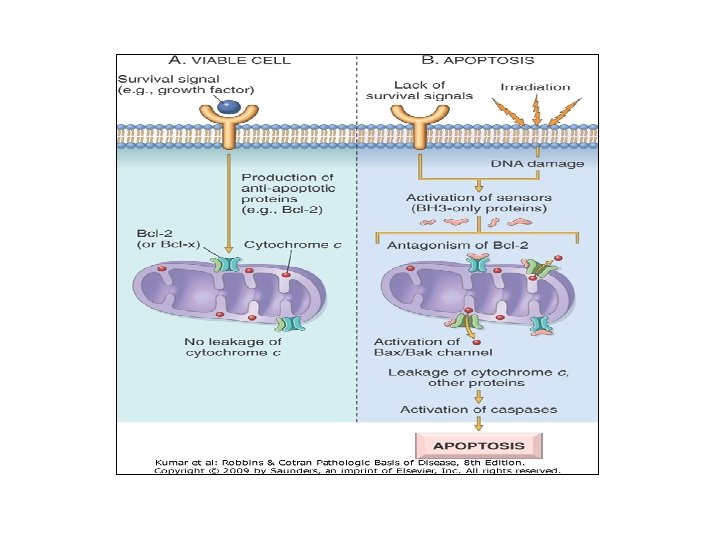
The Mitochondrial (Intrinsic) pathway of apoptosis • Major mechanism. • Release of mitochondrial molecules into the cytosol (cytochrome c). • Release is controlled by pro and anti apoptotic proteins called Bcl family. • Bcl family; 20 members. • Growth factors and other survival signals stimulate production of anti-apoptotic proteins (Bcl-2, Bclx & Mcl-1) in cytoplasm and mitochondrial membranes.
The intrinsic pathway of apoptosis • Stress (loss of survival signals, DNA damage. . . ) activates some sensors. • Sensors of damage (BH 3 -only proteins) are Bcl family members including Bim, Bid & Bad. • Sensors activate proapoptosis factors (Bax & Bak) leading to formation of channels and leakage of mitochondrial proteins (cytochrome c) and activation of caspases.
The intrinsic pathway of apoptosis • Cytochrome c binds to Apaf-1(apoptosis activating factor) forming apoptosome which binds to caspase-9 (the critical initiator caspase). • Other mitochondrial proteins (Smac/DIABLO) enter the cytoplasm blocking the inhibitors of apoptosis (Bcl-2 and Bcl-xl) the function of which is block the activation of caspases.
The Death Receptor (Extrinsic) pathway • Initiated by plasma membrane death receptors (TNF receptor family). • Death domain: cytoplasmic involved in protein -protein interactions. • TNF-1 with related protein called Fas (CD 95) expressed on the surface of many cells. • Its ligand Fas. L is expressed on activated Tcells.
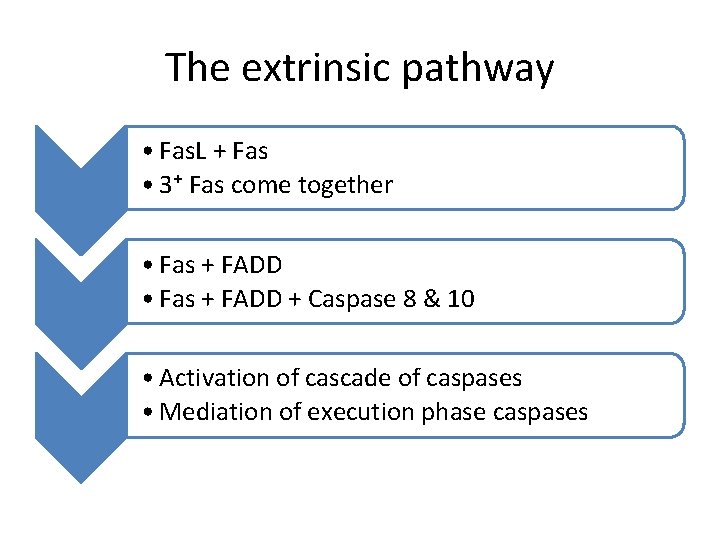
The extrinsic pathway • Fas. L + Fas • 3⁺ Fas come together • Fas + FADD + Caspase 8 & 10 • Activation of cascade of caspases • Mediation of execution phase caspases
The extrinsic pathway • Inhibition: FLIP which binds to Caspase 8. • Some viruses and normal cells uses this inhibitor to protect themselves from Fasmediated apoptosis. • Sometimes both pathways interact with each other. Hepatocyte Fas signaling activates Bid which activates the mitochondrial pathway.
The execution phase • Final step after the initiation phase. • Caspases 3 & 6. • Activation of DNase, degradation of structural components of nuclear matrix (fragmentation of nuclei). • The way apoptotic bodies are formed is still not clarified.
Removal of dead cells • Apoptotic bodies are edible for phagocytes before they release their components. • Membranes of these bodies are flipped out in which the phosphatidylserine is expressed on the outer layer of the membrane where it is recognised by macrophage receptors. • Abs bind to Apo. Bodies recognised by complement system (C 1 q).
Examples of apoptosis • Growth factor deprivation. Intrinsic pathway. • DNA damage. Radiation or chemicals mediated DNA damage called genotoxic stress. DNA damage induce accumulation of P 53 protein (tumour suppressor gene) which arrests the cell cycle giving time for repair or else triggers apoptosis. Mutated P 53 might lead to neoplastic transformation.
Examples of apoptosis • Protein misfolding. Chaperones in ER control proper folding of newly synthesized proteins and misfolded proteins are ubiquitinated and targeted for proteolysis in proteosomes. • If misfolded proteins accumulate this will trigger a what so called unfolded protein response which leads to increase production of chaperones, enhance proteosomal degradation and slow protein translation so reducing the load of such proteins.
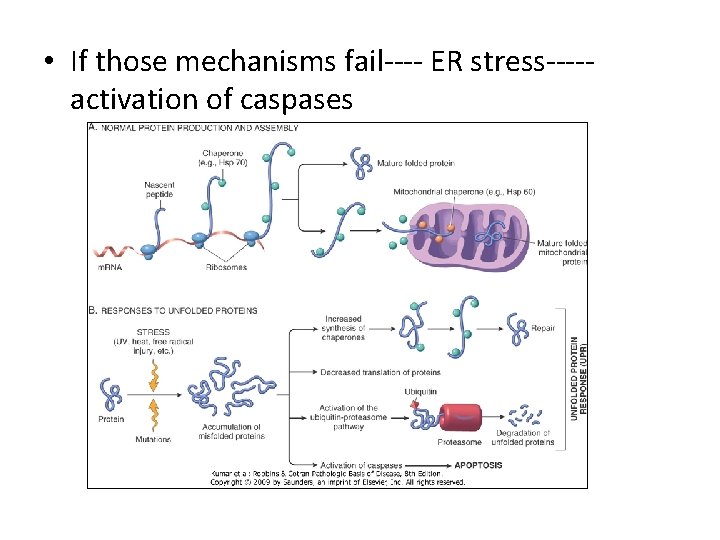
• If those mechanisms fail---- ER stress----activation of caspases
Examples of apoptosis • Apoptosis induced by TNF receptor family. Elimination of T-cells that recognise self antigen. Mutation---Autoimmune diseases. • Cytotoxic lymphocyte mediated apoptosis. Once activated after binding with antigens it produces perforin which promotes entry of granzymes having the ability to activate caspases. Also they activate the extrinsic pathway.
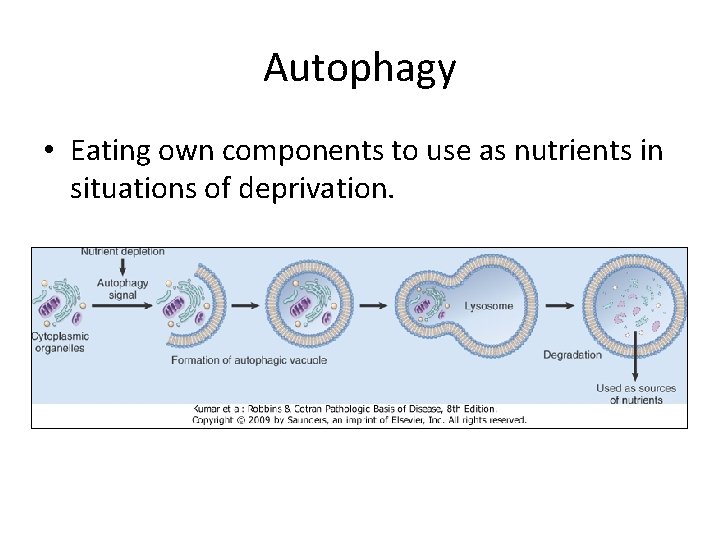
Autophagy • Eating own components to use as nutrients in situations of deprivation.
- Slides: 23