
APOLOGY OF SOCRATES and CRITO Apology of Socrates
![Final Words to “the [true] Jurors” Proclaims again that “the good man can’t be](https://slidetodoc.com/presentation_image/d6f5a728c681cb2ebc1cfc707078ed68/image-9.jpg "Final Words to “the [true] Jurors” Proclaims again that “the good man can’t be")
- Slides: 17
APOLOGY OF SOCRATES and CRITO
Apology of Socrates’ “Defense Speech” - Plato’s Defense of Philosophy
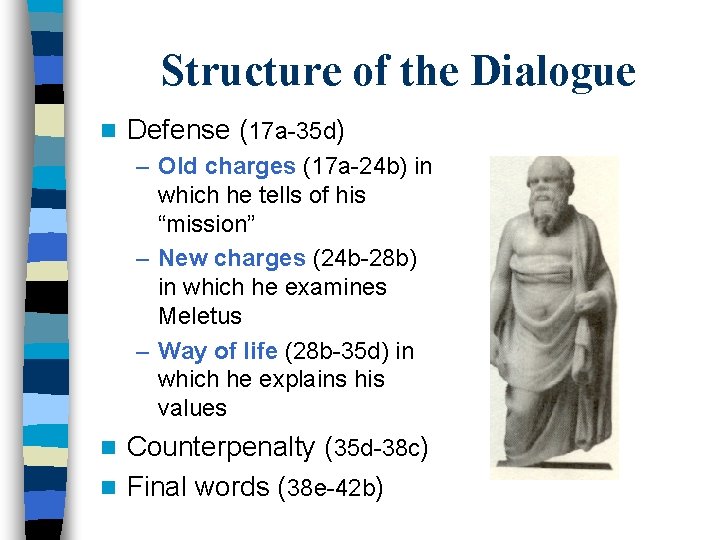
Structure of the Dialogue n Defense (17 a-35 d) – Old charges (17 a-24 b) in which he tells of his “mission” – New charges (24 b-28 b) in which he examines Meletus – Way of life (28 b-35 d) in which he explains his values Counterpenalty (35 d-38 c) n Final words (38 e-42 b) n
Response to the “Old Charges” He does not: – “investigate things under earth or in heavens” – “make the worse argument stronger” n He takes no pay and is no “teacher” n Reputation for wisdom = “service to the god” n His “wisdom” = he “knows he does not know” (about the highest things) n – vs. Sophistic ‘wisdom’ – vs. divine wisdom
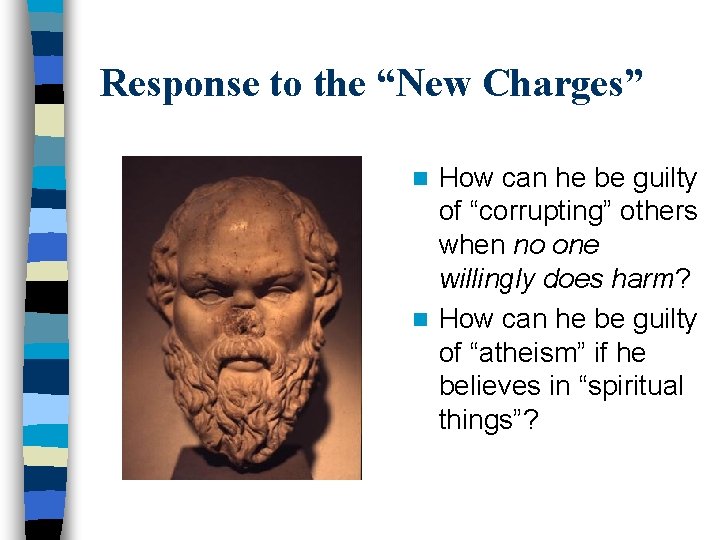
Response to the “New Charges” How can he be guilty of “corrupting” others when no one willingly does harm? n How can he be guilty of “atheism” if he believes in “spiritual things”? n
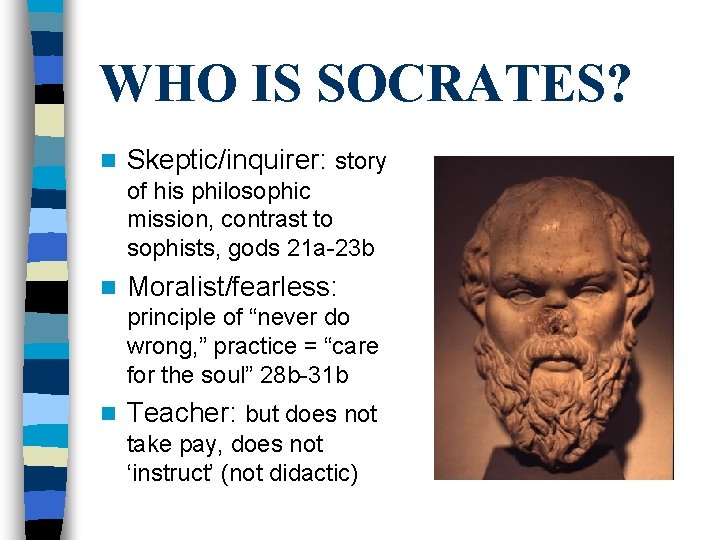
WHO IS SOCRATES? n Skeptic/inquirer: story of his philosophic mission, contrast to sophists, gods 21 a-23 b n Moralist/fearless: principle of “never do wrong, ” practice = “care for the soul” 28 b-31 b n Teacher: but does not take pay, does not ‘instruct’ (not didactic)
Socrates’ Way of Life Socrates “knows” he must never do wrong; must seek virtue and truth n Socrates = gadfly sent to Athens as gift from the gods n “the good man can’t be harmed” n
The Examined Life n “If I tell you that I do this as my duty to the god, you will think I am ironical. If I tell you I do this because it is the greatest good, and because the unexamined life is not worth living for a human being, you will believe me even less. ” (38 a)
Final Words to “the [true] Jurors” Proclaims again that “the good man can’t be harmed” n Argues “death may be a blessing, if it is endless sleep, or if there is an afterlife, in which we may converse with wise and good men. ” n
Paradoxes in the Apology n n n Why doesn’t Socrates make a “better” speech (one that would get him free)? Why does Socrates think “no man willingly does wrong”(25 e)? Does Socrates “not know” the highest things (21 d), or does he “know” them (29 b-e)? Why does Socrates say “the good man can’t be harmed” (30 d, 41 d)? What does he mean? Why does Socrates say “the unexamined life is not worth living for a human being”(38 a)?
Unresolved Issues n Is Socrates = a danger to the peace and security of Athens, or a godsend? n Is Socratic philosophy an enemy to the Greek religion, or religion in general, or a friend and natural companion? n Is Socrates’ serenity even in the face of death a merely personal quality, or is it somehow rooted in philosophy?
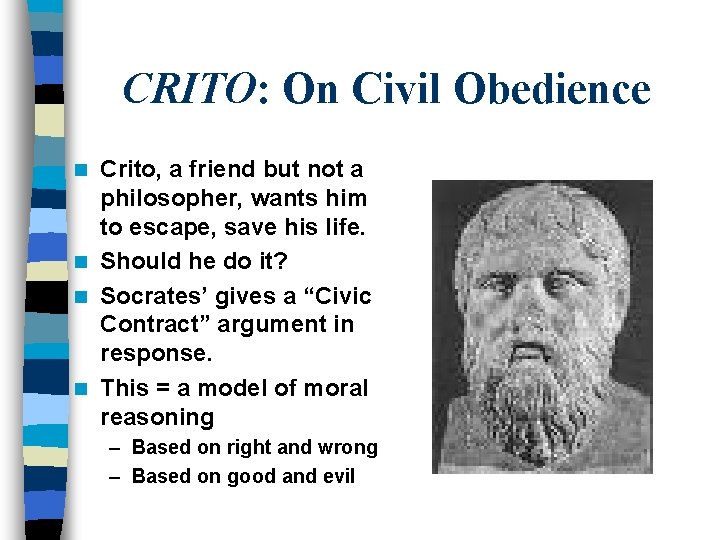
CRITO: On Civil Obedience Crito, a friend but not a philosopher, wants him to escape, save his life. n Should he do it? n Socrates’ gives a “Civic Contract” argument in response. n This = a model of moral reasoning n – Based on right and wrong – Based on good and evil
Socrates’ Argument – I: One should never do wrong One should do what reason says is best. 46 b 2. Life is not worth living if our soul* is corrupted. 48 ad 3. Our soul/conscience is corrupted if we [knowingly] do wrong. 49 a 4. Therefore we should never do wrong. 49 b 1. *Defined as conscience.
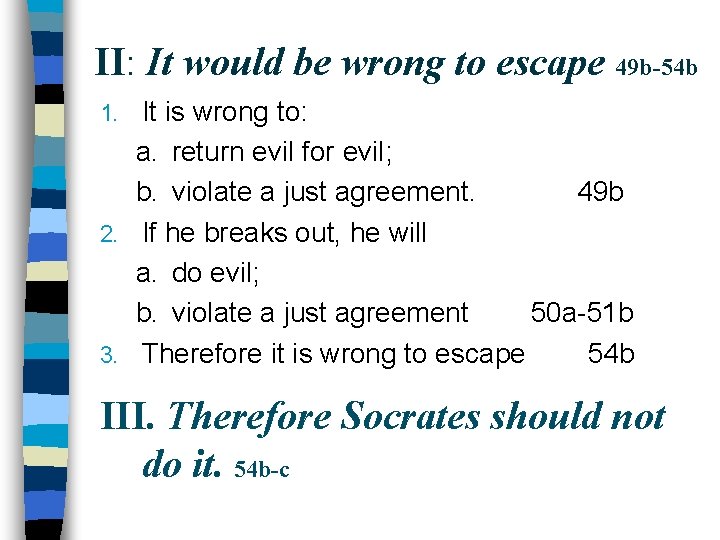
II: It would be wrong to escape 49 b-54 b It is wrong to: a. return evil for evil; b. violate a just agreement. 49 b 2. If he breaks out, he will a. do evil; b. violate a just agreement 50 a-51 b 3. Therefore it is wrong to escape 54 b 1. III. Therefore Socrates should not do it. 54 b-c
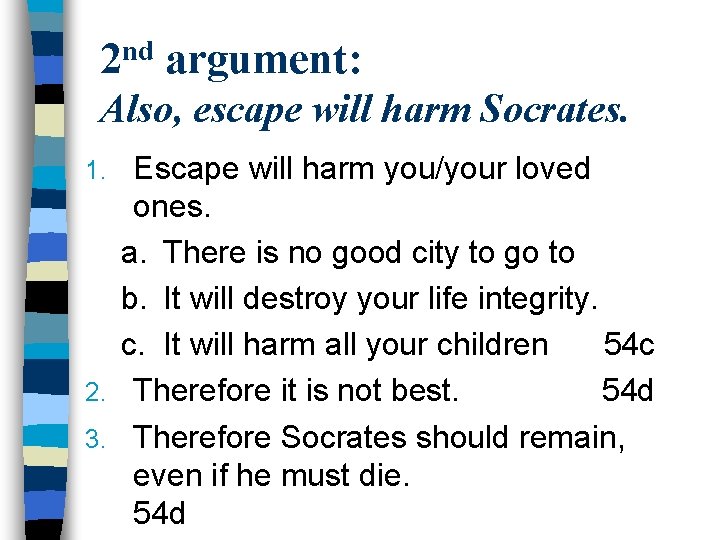
nd 2 argument: Also, escape will harm Socrates. Escape will harm you/your loved ones. a. There is no good city to go to b. It will destroy your life integrity. c. It will harm all your children 54 c 2. Therefore it is not best. 54 d 3. Therefore Socrates should remain, even if he must die. 54 d 1.
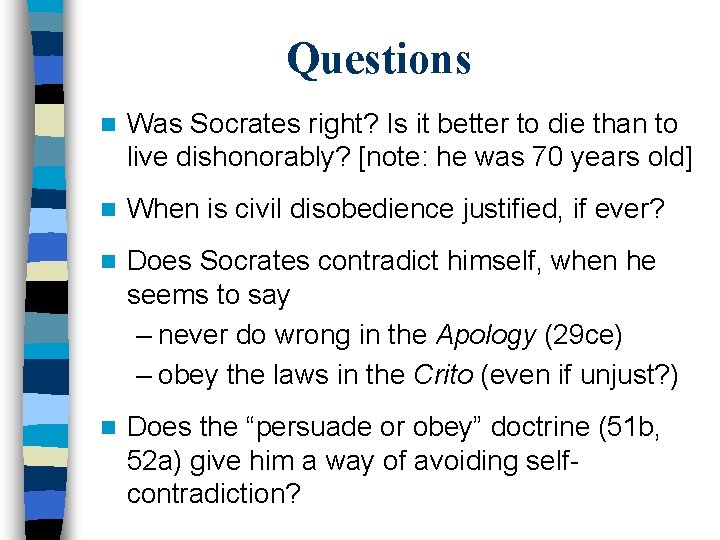
Questions n Was Socrates right? Is it better to die than to live dishonorably? [note: he was 70 years old] n When is civil disobedience justified, if ever? n Does Socrates contradict himself, when he seems to say – never do wrong in the Apology (29 ce) – obey the laws in the Crito (even if unjust? ) n Does the “persuade or obey” doctrine (51 b, 52 a) give him a way of avoiding selfcontradiction?
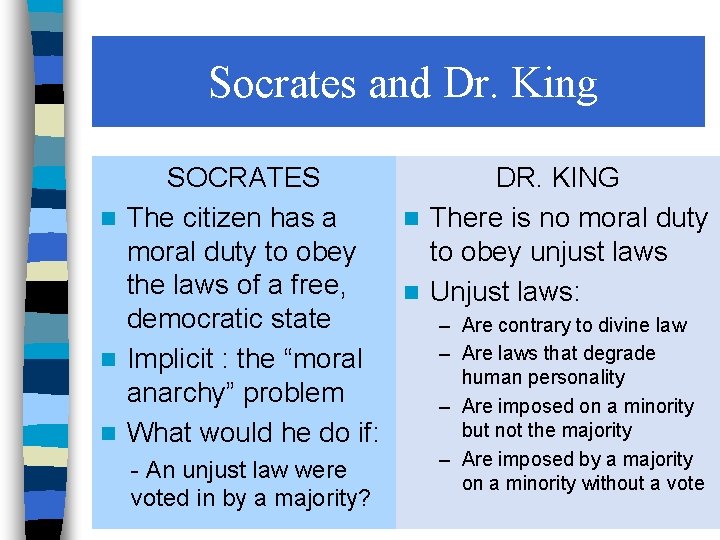
Socrates and Dr. King SOCRATES DR. KING n The citizen has a n There is no moral duty to obey unjust laws the laws of a free, n Unjust laws: democratic state – Are contrary to divine law – Are laws that degrade n Implicit : the “moral human personality anarchy” problem – Are imposed on a minority but not the majority n What would he do if: - An unjust law were voted in by a majority? – Are imposed by a majority on a minority without a vote