
Apologetics Night 1 Presented By Eric Douma Introduction

Apologetics Night 1 Presented By Eric Douma
Introduction To Logic Ø Logic is not “man-made” but “God-made” and “man-discovered. ” Ø Definition of Logic: Logic is the study of right reason or valid inferences and the attending fallacies, formal and informal. Ø Logic is a policeman of thought. It tells us at times, “You can’t go there. ”
Introduction To Logic Ø The Laws of Logic: These laws are fundamental to right reasoning. They cannot be discarded or “gotten behind” because they must be assumed to be true in order to deny. 1. Law of noncontradiction = If A then not non. A at the same time and in the same relationship. Law of identity= A is A. Law of excluded middle= either A or non-A. Law of rational inference= Going from what is known to what is unknown using inferences. Law or Causality= Every effect has a cause. 2. 3. 4. 5.
Understanding the Laws Law of noncontradiction= If A then not non-A at the same time and in the same sense. 1. Misunderstanding = Matthew 10: 39 He who has found his life will lose it, and he who has lost his life for My sake will find it. Different Sense: Temporal Life Eternal Life lose it gain it Ø 2. Misunderstanding = Trinity: some claim in error, “You believe in one God and three Gods at the same time. ” Different Sense: God Person One Three
Understanding the Laws Correct understanding: 1 st Corinthians 15: 12 -13 Now if Christ is preached, that He has been raised from the dead, how do some among you say that there is no resurrection of the dead? {But if there is no resurrection of the dead, not even Christ has been raised…} Ø Ø If there has been a resurrection ( of Jesus) Then it is not true that there are no such things as resurrections! A -A
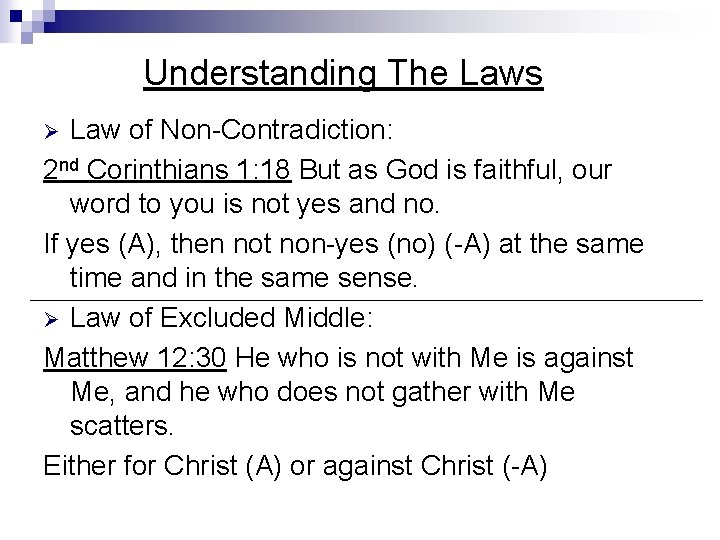
Understanding The Laws Law of Non-Contradiction: 2 nd Corinthians 1: 18 But as God is faithful, our word to you is not yes and no. If yes (A), then not non-yes (no) (-A) at the same time and in the same sense. Ø Law of Excluded Middle: Matthew 12: 30 He who is not with Me is against Me, and he who does not gather with Me scatters. Either for Christ (A) or against Christ (-A) Ø
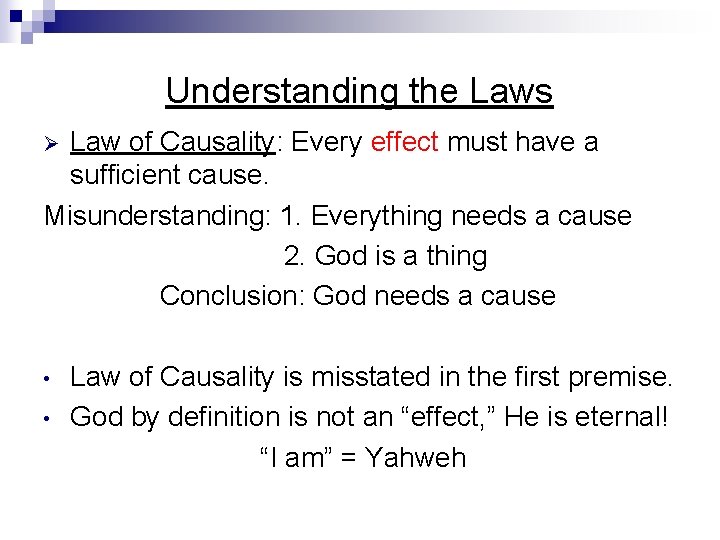
Understanding the Laws Law of Causality: Every effect must have a sufficient cause. Misunderstanding: 1. Everything needs a cause 2. God is a thing Conclusion: God needs a cause Ø • • Law of Causality is misstated in the first premise. God by definition is not an “effect, ” He is eternal! “I am” = Yahweh
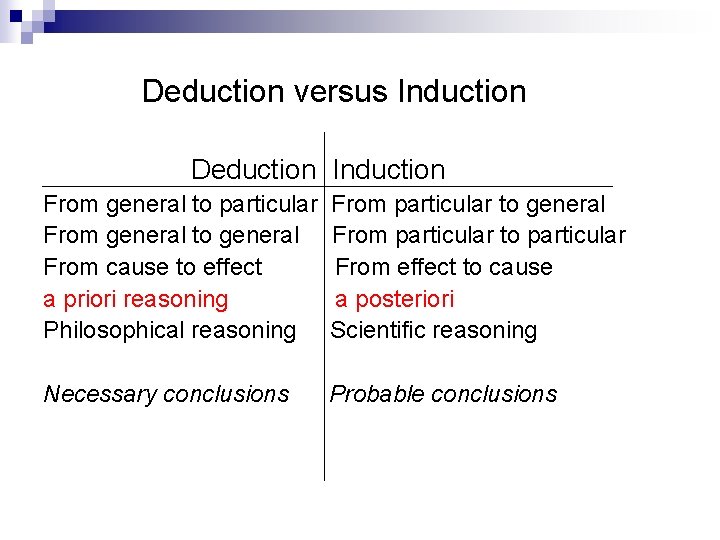
Deduction versus Induction Deduction Induction From general to particular From general to general From cause to effect a priori reasoning Philosophical reasoning From particular to general From particular to particular From effect to cause a posteriori Scientific reasoning Necessary conclusions Probable conclusions
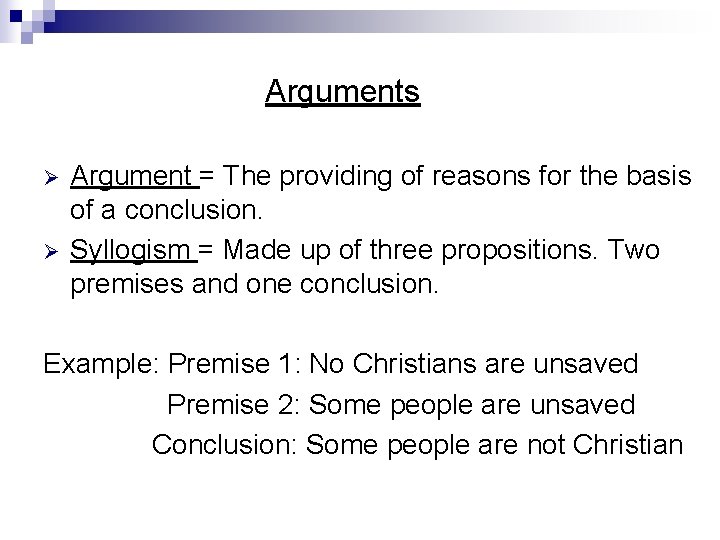
Arguments Ø Ø Argument = The providing of reasons for the basis of a conclusion. Syllogism = Made up of three propositions. Two premises and one conclusion. Example: Premise 1: No Christians are unsaved Premise 2: Some people are unsaved Conclusion: Some people are not Christian
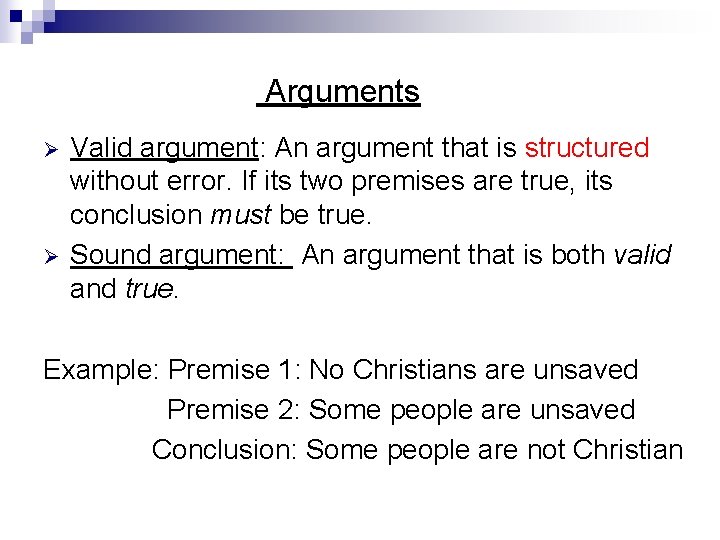
Arguments Ø Ø Valid argument: An argument that is structured without error. If its two premises are true, its conclusion must be true. Sound argument: An argument that is both valid and true. Example: Premise 1: No Christians are unsaved Premise 2: Some people are unsaved Conclusion: Some people are not Christian
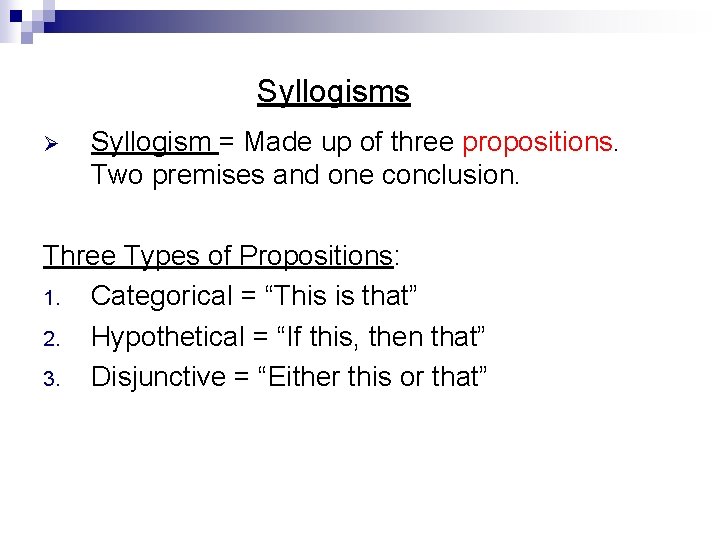
Syllogisms Ø Syllogism = Made up of three propositions. Two premises and one conclusion. Three Types of Propositions: 1. Categorical = “This is that” 2. Hypothetical = “If this, then that” 3. Disjunctive = “Either this or that”
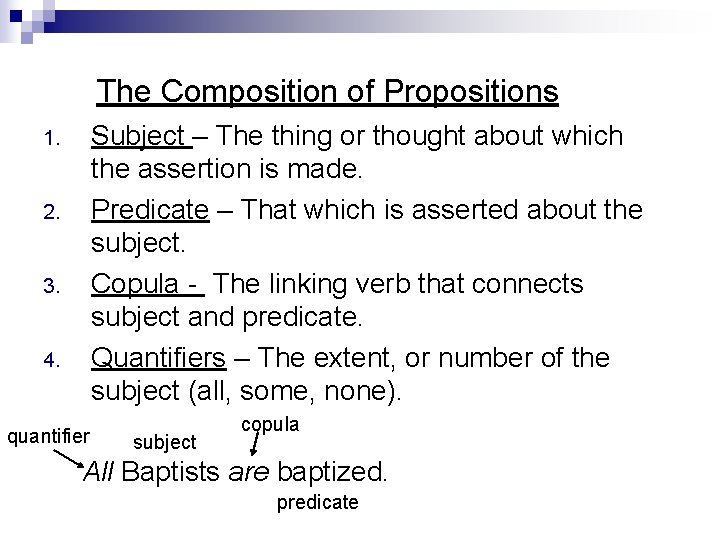
The Composition of Propositions Subject – The thing or thought about which the assertion is made. Predicate – That which is asserted about the subject. Copula - The linking verb that connects subject and predicate. Quantifiers – The extent, or number of the subject (all, some, none). 1. 2. 3. 4. quantifier subject copula All Baptists are baptized. predicate
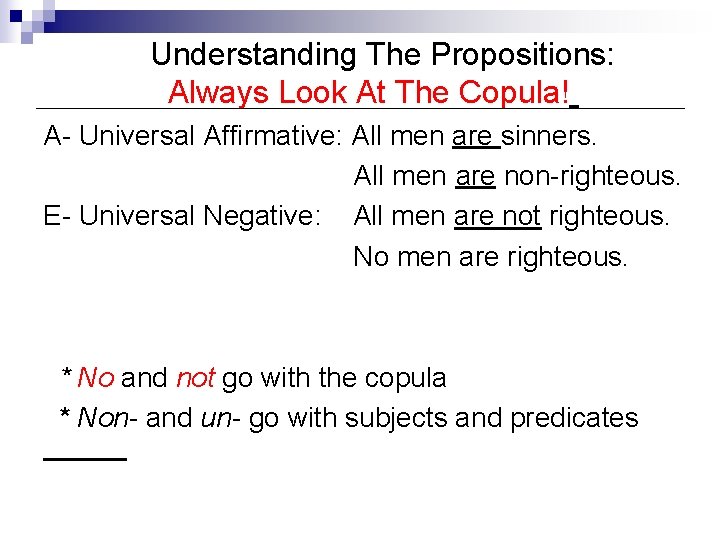
Understanding The Propositions: Always Look At The Copula! A- Universal Affirmative: All men are sinners. All men are non-righteous. E- Universal Negative: All men are not righteous. No men are righteous. * No and not go with the copula * Non- and un- go with subjects and predicates
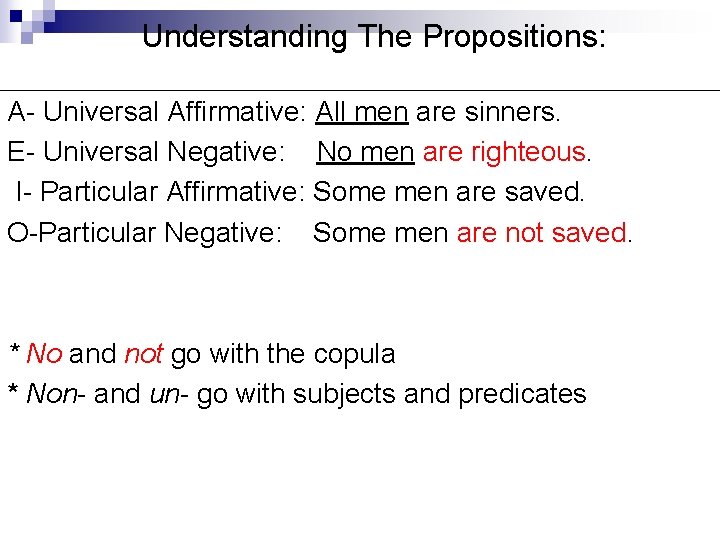
Understanding The Propositions: A- Universal Affirmative: All men are sinners. E- Universal Negative: No men are righteous. I- Particular Affirmative: Some men are saved. O-Particular Negative: Some men are not saved. * No and not go with the copula * Non- and un- go with subjects and predicates
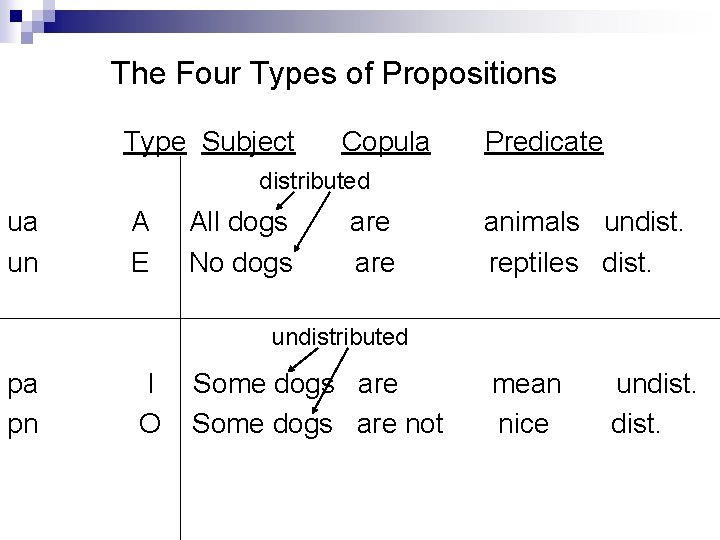
The Four Types of Propositions Type Subject Copula Predicate distributed ua un A E All dogs No dogs are animals undist. reptiles dist. undistributed pa pn I O Some dogs are not mean nice undist.
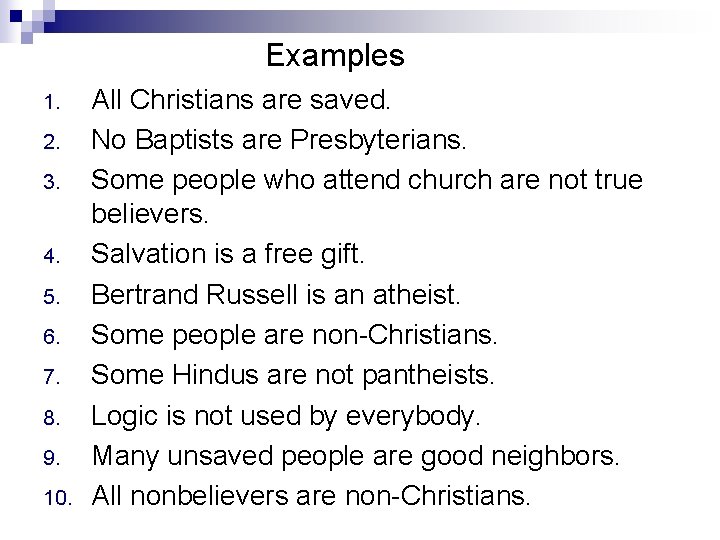
Examples 1. 2. 3. 4. 5. 6. 7. 8. 9. 10. All Christians are saved. No Baptists are Presbyterians. Some people who attend church are not true believers. Salvation is a free gift. Bertrand Russell is an atheist. Some people are non-Christians. Some Hindus are not pantheists. Logic is not used by everybody. Many unsaved people are good neighbors. All nonbelievers are non-Christians.
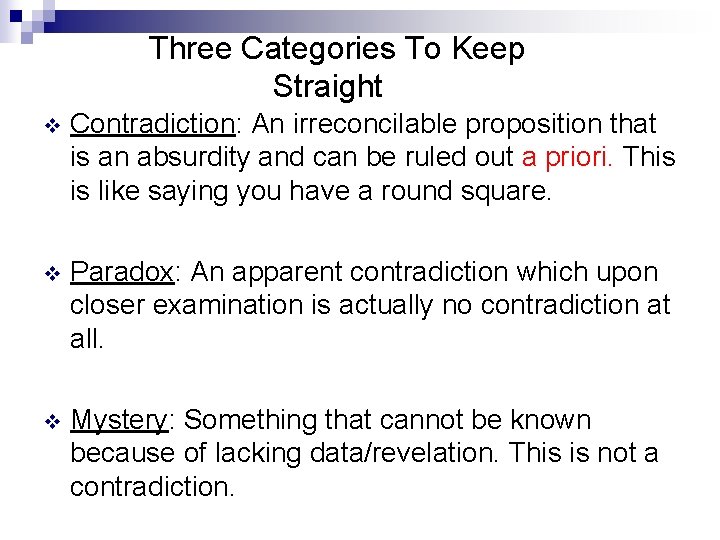
Three Categories To Keep Straight v Contradiction: An irreconcilable proposition that is an absurdity and can be ruled out a priori. This is like saying you have a round square. v Paradox: An apparent contradiction which upon closer examination is actually no contradiction at all. v Mystery: Something that cannot be known because of lacking data/revelation. This is not a contradiction.
- Slides: 17