
Apollo 13 Pressure Vessel Failure W L Castner
- Slides: 13
Apollo 13 Pressure Vessel Failure W. L. Castner & G. M. Ecord March 2011 1
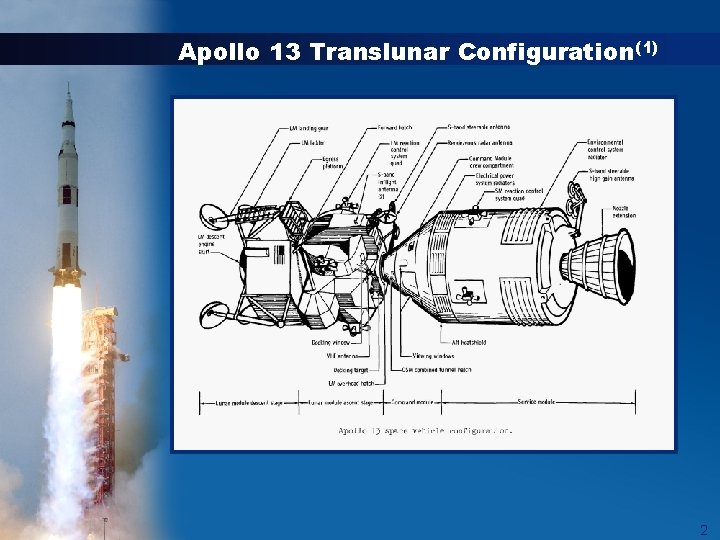
Apollo 13 Translunar Configuration(1) 2
Apollo 13 Timeline (2) • Apollo 13 was launched April 11, 1970 at 13: 13 pm CST • 000: 00 GET – Lift Off • 000: 12: 40 GET – Reached Earth Orbit • 002: 41: 47 GET – Translunar Injection • 005: 59 GET – S-IVB Maneuver for Lunar Impact • 055: 53: 20 GET – Oxygen Tank #2 Fans Turned On • 055: 54: 53 GET – Oxygen Tank #2 Exploded (200, 000 miles from earth) • 055: 20 GET – CMP says “OK Houston, we have a problem here” • 061: 29: 43 GET – Mid-Course Correction Burn for Free Return to Earth • 077: 27: 39 GET – Pericynthion • 077: 56: 40 GET – S-IVB Impacted Lunar Surface • 079: 27: 38 GET – Transearth Injection Burn • 138: 02: 06 GET – Service Module Jettisoned • 141: 30: 02 GET – Lunar Module Jettisoned • 142: 40: 47 GET – Entry Interface • 142: 54: 00 GET – Splashdown • Apollo 13 Landed April 17, 1970 at 12: 08 pm CST 3
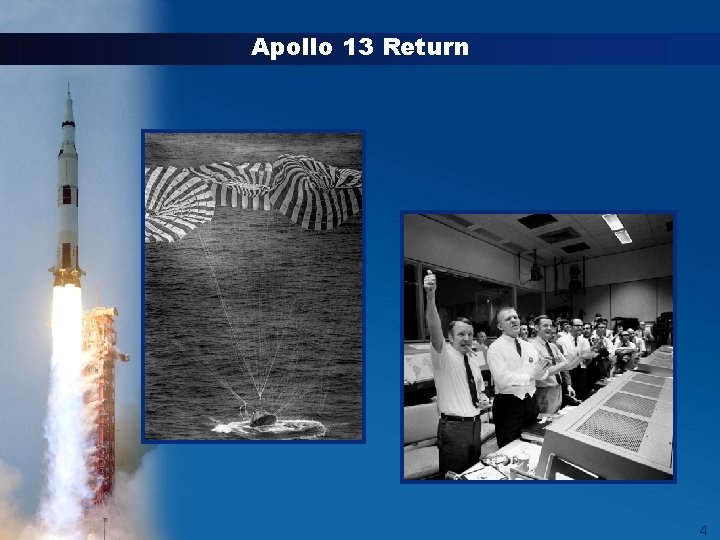
Apollo 13 Return 4
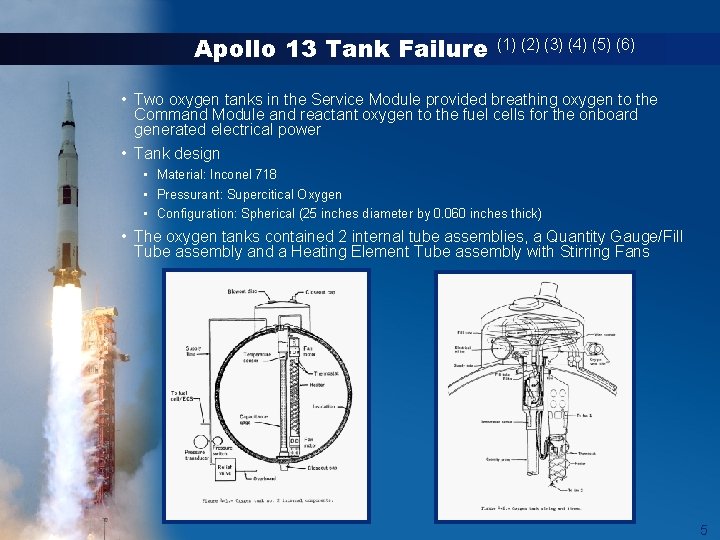
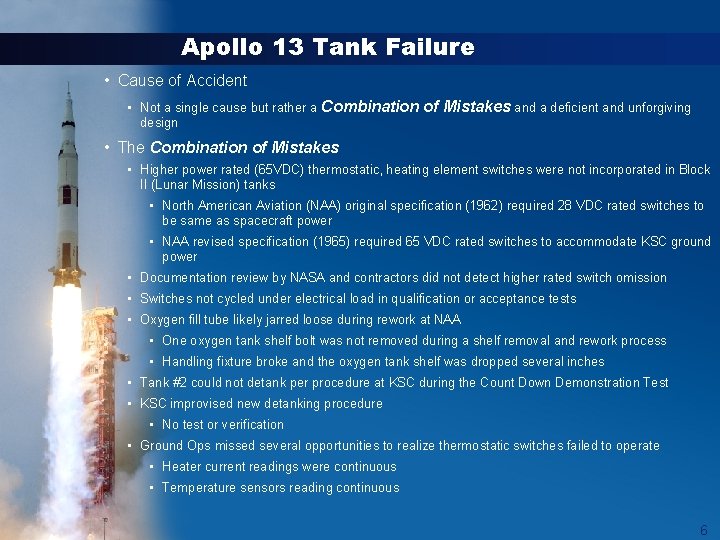
Apollo 13 Tank Failure (1) (2) (3) (4) (5) (6) • Two oxygen tanks in the Service Module provided breathing oxygen to the Command Module and reactant oxygen to the fuel cells for the onboard generated electrical power • Tank design • Material: Inconel 718 • Pressurant: Supercitical Oxygen • Configuration: Spherical (25 inches diameter by 0. 060 inches thick) • The oxygen tanks contained 2 internal tube assemblies, a Quantity Gauge/Fill Tube assembly and a Heating Element Tube assembly with Stirring Fans 5
Apollo 13 Tank Failure • Cause of Accident • Not a single cause but rather a Combination of Mistakes and a deficient and unforgiving design • The Combination of Mistakes • Higher power rated (65 VDC) thermostatic, heating element switches were not incorporated in Block II (Lunar Mission) tanks • North American Aviation (NAA) original specification (1962) required 28 VDC rated switches to be same as spacecraft power • NAA revised specification (1965) required 65 VDC rated switches to accommodate KSC ground power • Documentation review by NASA and contractors did not detect higher rated switch omission • Switches not cycled under electrical load in qualification or acceptance tests • Oxygen fill tube likely jarred loose during rework at NAA • One oxygen tank shelf bolt was not removed during a shelf removal and rework process • Handling fixture broke and the oxygen tank shelf was dropped several inches • Tank #2 could not detank per procedure at KSC during the Count Down Demonstration Test • KSC improvised new detanking procedure • No test or verification • Ground Ops missed several opportunities to realize thermostatic switches failed to operate • Heater current readings were continuous • Temperature sensors reading continuous 6
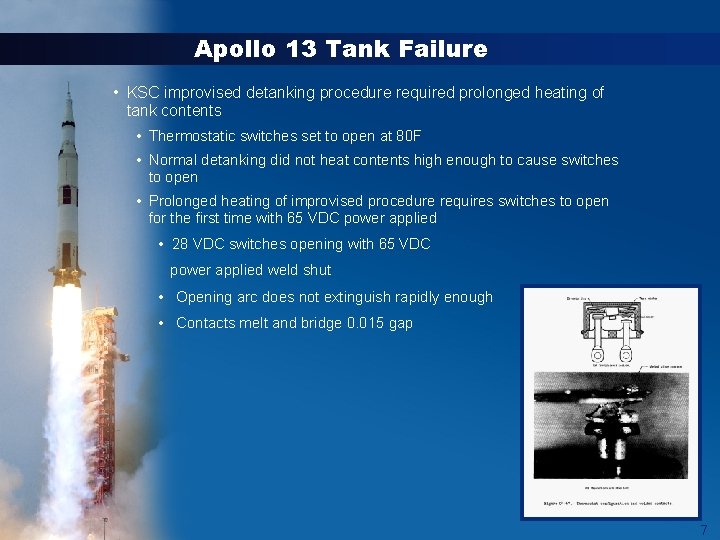
Apollo 13 Tank Failure • KSC improvised detanking procedure required prolonged heating of tank contents • Thermostatic switches set to open at 80 F • Normal detanking did not heat contents high enough to cause switches to open • Prolonged heating of improvised procedure requires switches to open for the first time with 65 VDC power applied • 28 VDC switches opening with 65 VDC power applied weld shut • Opening arc does not extinguish rapidly enough • Contacts melt and bridge 0. 015 gap 7
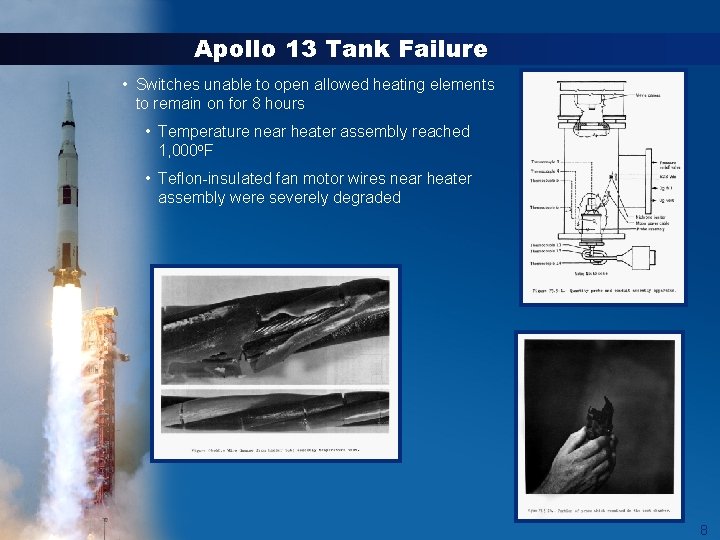
Apollo 13 Tank Failure • Switches unable to open allowed heating elements to remain on for 8 hours • Temperature near heater assembly reached 1, 000 o. F • Teflon-insulated fan motor wires near heater assembly were severely degraded 8
Apollo 13 Tank Failure • Accident Sequence of Events • The improvised detanking procedure created a hazardous condition in tank #2 due to overheated and degraded wire insulation • When fan motors turned on at 55: 54: 20 GET an electric arc ignited teflon wire insulation inside tank • Rapidly rising heat and pressure inside tank caused electrical conduit to rupture in dome area • Explosive release of high pressure oxygen into the service module fuel cell compartment • Extensive damage defeats all of the redundancy of having two tanks and three fuel cells • Overpressure blows exterior panel off of fuel cell compartment (Bay 4) • Primary source of breathing oxygen and onboard power generation lost 9
Apollo 13 Tank Failure • Apollo 13 Review Board Comments (1) • “The accident is judged to have been nearly catastrophic. Only outstanding performance on the part of the crew, Mission Control, and other members of the team which supported the operations successfully returned the crew to Earth. ” • NASA Administrator’s Comments to Congress June 16, 1970 (1) • “The Board feels that the nature of the Apollo 13 equipment failure holds important lessons which, when applied to future missions, will contribute to the safety and effectiveness of manned space flight. ” 10
Apollo 13 Tank Failure • Board Recommendations/Lessons Learned • Remove from contact with oxygen all wiring and unsealed motors • Minimize use of more combustible materials, Teflon, aluminum, etc. • Some felt installing correctly rated switch would be sufficient • Wound up with a major tank redesign • Implement rigorous re-qualification program and review potential operations problems • Whenever significant anomalies occur during launch preparation, standard procedures should require: • Presentation of all prior anomalies including the explained ones • Presence and participation of experts intimately familiar with the details of the subsystem • Reassess all Apollo subsystems and engineering organizations responsible for them to assure: • Adequate understanding of the engineering and manufacturing details at all levels • Where necessary, organizational elements should be strengthened • In-depth reviews should be conducted regarding design soundness and operational experience 11
Apollo 13 Tank Failure • More lessons learned • Failures often due to a number of causes • The margin between success and failure is often close • The randomness of an event’s occurrence can be the margin • Qualification testing is the space industry’s gold standard • Verifies design • Test what will fly • All changes must be verified • Fly what is tested Apollo 13 is a great example of Success through Failure 12
References 1) Report of Apollo 13 Review Board; June 15, 1970 2) NASA SP-2000 -4029; Apollo by the Numbers; Richard W. Orloff; Revised September 2004 3) MSC Apollo 13 Investigation Team Final Report, Panels 1 -10; June 1970 4) Thirteen: The Apollo Flight That Failed; Henry S. F. Cooper Jr. ; 1972 5) Failure Is Not an Option; Gene Kranz; 2000 6) Flight; Chris Kraft; 2001 13