
Apollo 13 By Divya Lobo and Anshul Rangwani

Apollo 13 By: Divya Lobo and Anshul Rangwani
What everything Represents • X-axis: It represents the time • Y-axis: Distance from the moon • Equation: Y= 3 x^2 -78 x+500 • The graph is decreasing because the longer the time is the shorter the distance from the moon is • y-intercept: (0, 500) • The y-intercept represents the original distance from the moon
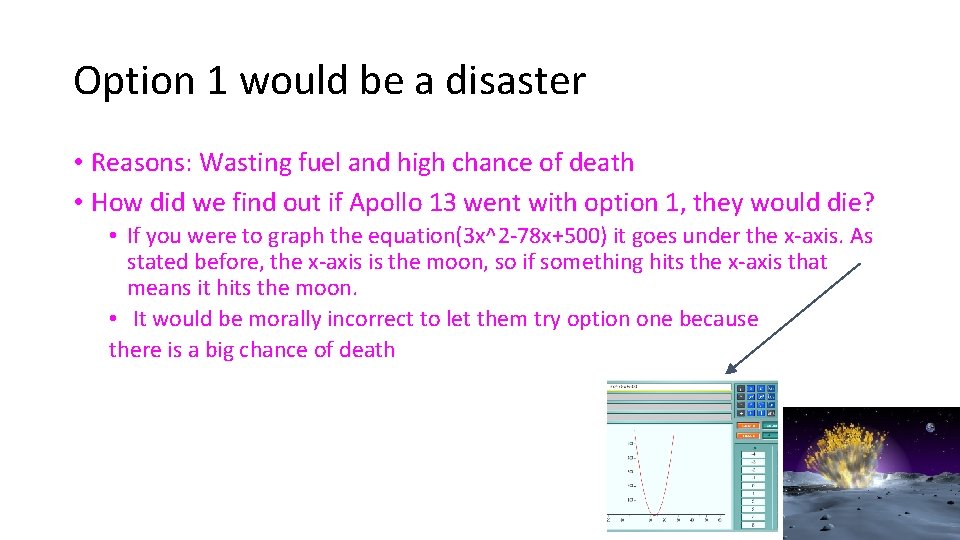
Option 1 would be a disaster • Reasons: Wasting fuel and high chance of death • How did we find out if Apollo 13 went with option 1, they would die? • If you were to graph the equation(3 x^2 -78 x+500) it goes under the x-axis. As stated before, the x-axis is the moon, so if something hits the x-axis that means it hits the moon. • It would be morally incorrect to let them try option one because there is a big chance of death
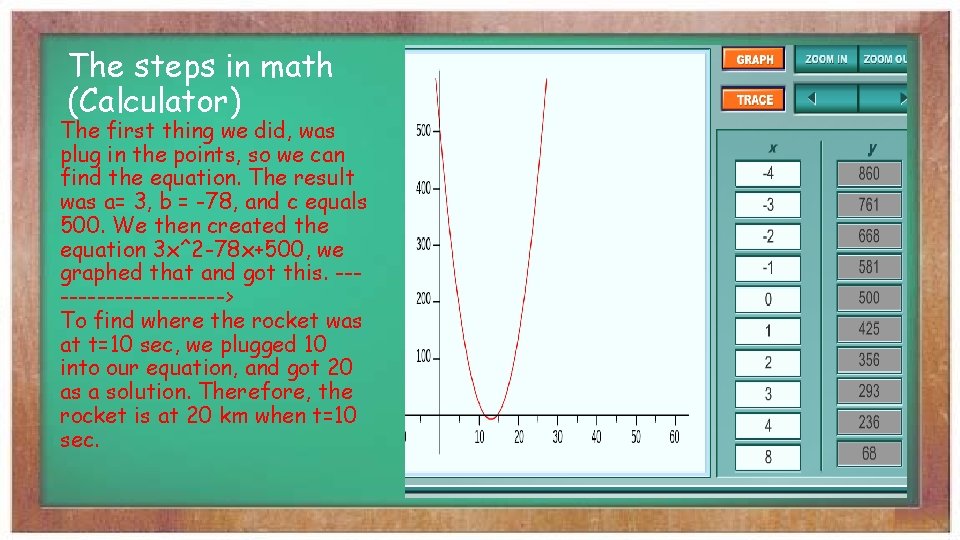
The steps in math (Calculator) The first thing we did, was plug in the points, so we can find the equation. The result was a= 3, b = -78, and c equals 500. We then created the equation 3 x^2 -78 x+500, we graphed that and got this. ----------> To find where the rocket was at t=10 sec, we plugged 10 into our equation, and got 20 as a solution. Therefore, the rocket is at 20 km when t=10 sec.
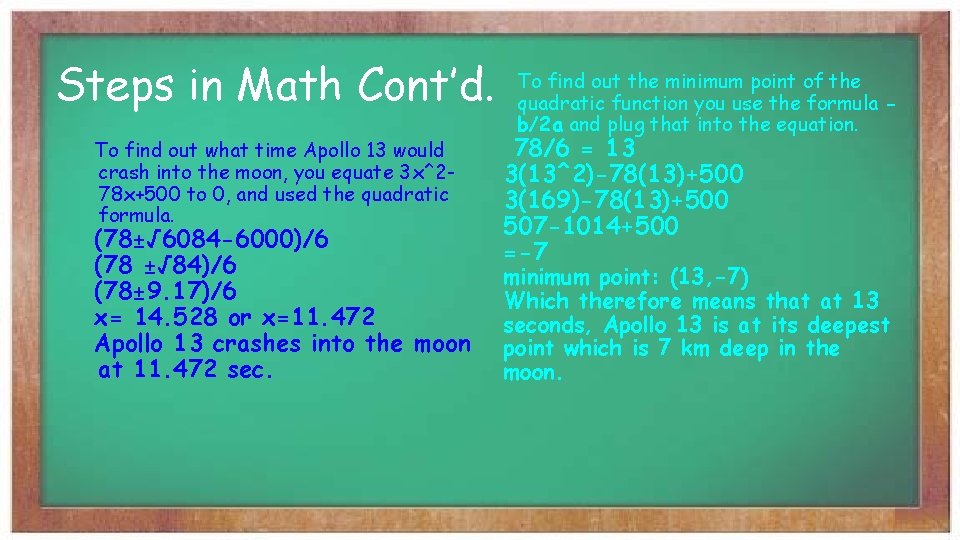
Steps in Math Cont’d. To find out what time Apollo 13 would crash into the moon, you equate 3 x^278 x+500 to 0, and used the quadratic formula. (78±√ 6084 -6000)/6 (78 ±√ 84)/6 (78± 9. 17)/6 x= 14. 528 or x=11. 472 Apollo 13 crashes into the moon at 11. 472 sec. To find out the minimum point of the quadratic function you use the formula b/2 a and plug that into the equation. 78/6 = 13 3(13^2)-78(13)+500 3(169)-78(13)+500 507 -1014+500 =-7 minimum point: (13, -7) Which therefore means that at 13 seconds, Apollo 13 is at its deepest point which is 7 km deep in the moon.
- Slides: 5