
Apneic Ventilation and ECMO Applications and use during
- Slides: 1
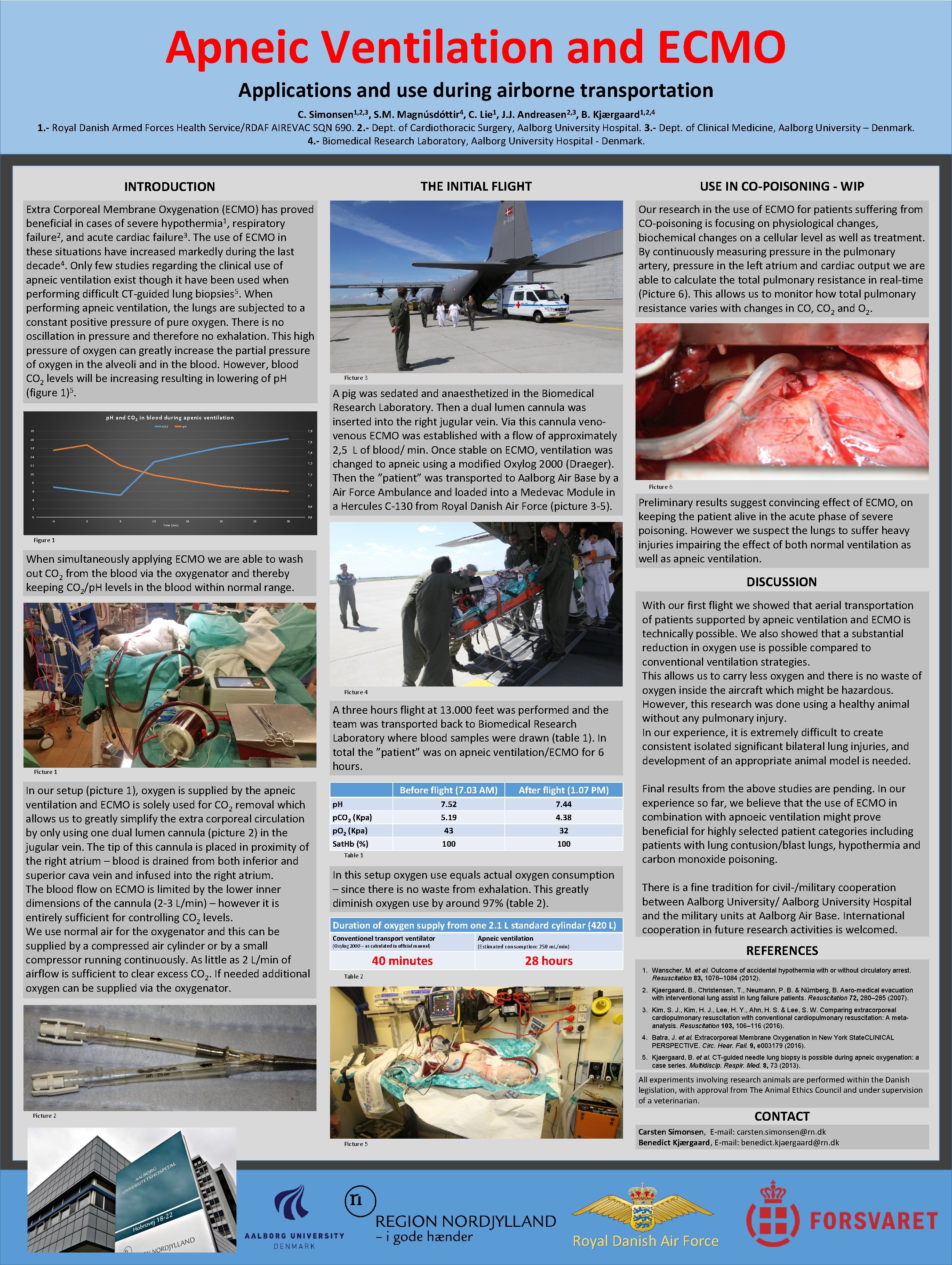
Apneic Ventilation and ECMO Applications and use during airborne transportation C. Simonsen 1, 2, 3, S. M. Magnúsdóttir 4, C. Lie 1, J. J. Andreasen 2, 3, B. Kjærgaard 1, 2, 4 1. - Royal Danish Armed Forces Health Service/RDAF AIREVAC SQN 690. 2. - Dept. of Cardiothoracic Surgery, Aalborg University Hospital. 3. - Dept. of Clinical Medicine, Aalborg University – Denmark. 4. - Biomedical Research Laboratory, Aalborg University Hospital - Denmark. THE INITIAL FLIGHT INTRODUCTION Extra Corporeal Membrane Oxygenation (ECMO) has proved beneficial in cases of severe hypothermia 1, respiratory failure 2, and acute cardiac failure 3. The use of ECMO in these situations have increased markedly during the last decade 4. Only few studies regarding the clinical use of apneic ventilation exist though it have been used when performing difficult CT-guided lung biopsies 5. When performing apneic ventilation, the lungs are subjected to a constant positive pressure of pure oxygen. There is no oscillation in pressure and therefore no exhalation. This high pressure of oxygen can greatly increase the partial pressure of oxygen in the alveoli and in the blood. However, blood CO 2 levels will be increasing resulting in lowering of p. H (figure 1)5. p. H and CO 2 in blood during apenic ventilation CO 2 p. H 20 7, 6 18 7, 5 16 7, 4 14 7, 3 12 10 7, 2 8 7, 1 6 7 4 6, 9 2 0 -5 0 5 10 Time (min) 15 20 25 30 USE IN CO-POISONING - WIP Our research in the use of ECMO for patients suffering from CO-poisoning is focusing on physiological changes, biochemical changes on a cellular level as well as treatment. By continuously measuring pressure in the pulmonary artery, pressure in the left atrium and cardiac output we are able to calculate the total pulmonary resistance in real-time (Picture 6). This allows us to monitor how total pulmonary resistance varies with changes in CO, CO 2 and O 2. Picture 3 A pig was sedated anaesthetized in the Biomedical Research Laboratory. Then a dual lumen cannula was inserted into the right jugular vein. Via this cannula venous ECMO was established with a flow of approximately 2, 5 L of blood/ min. Once stable on ECMO, ventilation was changed to apneic using a modified Oxylog 2000 (Draeger). Then the ”patient” was transported to Aalborg Air Base by a Air Force Ambulance and loaded into a Medevac Module in a Hercules C-130 from Royal Danish Air Force (picture 3 -5). 6, 8 Figure 1 When simultaneously applying ECMO we are able to wash out CO 2 from the blood via the oxygenator and thereby keeping CO 2/p. H levels in the blood within normal range. In our setup (picture 1), oxygen is supplied by the apneic ventilation and ECMO is solely used for CO 2 removal which allows us to greatly simplify the extra corporeal circulation by only using one dual lumen cannula (picture 2) in the jugular vein. The tip of this cannula is placed in proximity of the right atrium – blood is drained from both inferior and superior cava vein and infused into the right atrium. The blood flow on ECMO is limited by the lower inner dimensions of the cannula (2 -3 L/min) – however it is entirely sufficient for controlling CO 2 levels. We use normal air for the oxygenator and this can be supplied by a compressed air cylinder or by a small compressor running continuously. As little as 2 L/min of airflow is sufficient to clear excess CO 2. If needed additional oxygen can be supplied via the oxygenator. Preliminary results suggest convincing effect of ECMO, on keeping the patient alive in the acute phase of severe poisoning. However we suspect the lungs to suffer heavy injuries impairing the effect of both normal ventilation as well as apneic ventilation. DISCUSSION Picture 4 Picture 1 Picture 6 A three hours flight at 13. 000 feet was performed and the team was transported back to Biomedical Research Laboratory where blood samples were drawn (table 1). In total the ”patient” was on apneic ventilation/ECMO for 6 hours. Before flight (7. 03 AM) After flight (1. 07 PM) 7. 52 5. 19 43 100 7. 44 4. 38 32 100 p. H p. CO 2 (Kpa) p. O 2 (Kpa) Sat. Hb (%) Table 1 In this setup oxygen use equals actual oxygen consumption – since there is no waste from exhalation. This greatly diminish oxygen use by around 97% (table 2). Duration of oxygen supply from one 2. 1 L standard cylindar (420 L) Conventionel transport ventilator (Oxylog 2000 – as calculated in official manual) 40 minutes Table 2 Apneic ventilation With our first flight we showed that aerial transportation of patients supported by apneic ventilation and ECMO is technically possible. We also showed that a substantial reduction in oxygen use is possible compared to conventional ventilation strategies. This allows us to carry less oxygen and there is no waste of oxygen inside the aircraft which might be hazardous. However, this research was done using a healthy animal without any pulmonary injury. In our experience, it is extremely difficult to create consistent isolated significant bilateral lung injuries, and development of an appropriate animal model is needed. Final results from the above studies are pending. In our experience so far, we believe that the use of ECMO in combination with apnoeic ventilation might prove beneficial for highly selected patient categories including patients with lung contusion/blast lungs, hypothermia and carbon monoxide poisoning. There is a fine tradition for civil-/military cooperation between Aalborg University/ Aalborg University Hospital and the military units at Aalborg Air Base. International cooperation in future research activities is welcomed. REFERENCES (Estimated consumption: 250 m. L/min) 28 hours 1. Wanscher, M. et al. Outcome of accidental hypothermia with or without circulatory arrest. Resuscitation 83, 1078– 1084 (2012). 2. Kjaergaard, B. , Christensen, T. , Neumann, P. B. & Nürnberg, B. Aero-medical evacuation with interventional lung assist in lung failure patients. Resuscitation 72, 280– 285 (2007). 3. Kim, S. J. , Kim, H. J. , Lee, H. Y. , Ahn, H. S. & Lee, S. W. Comparing extracorporeal cardiopulmonary resuscitation with conventional cardiopulmonary resuscitation: A metaanalysis. Resuscitation 103, 106– 116 (2016). 4. Batra, J. et al. Extracorporeal Membrane Oxygenation in New York State. CLINICAL PERSPECTIVE. Circ. Hear. Fail. 9, e 003179 (2016). 5. Kjaergaard, B. et al. CT-guided needle lung biopsy is possible during apneic oxygenation: a case series. Multidiscip. Respir. Med. 8, 73 (2013). All experiments involving research animals are performed within the Danish legislation, with approval from The Animal Ethics Council and under supervision of a veterinarian. CONTACT Picture 2 Picture 5 Carsten Simonsen, E-mail: carsten. simonsen@rn. dk Benedict Kjærgaard, E-mail: benedict. kjaergaard@rn. dk Royal Danish Air Force