
APICS Certification and Endorsement Comparison Chart Designation Name
- Slides: 4
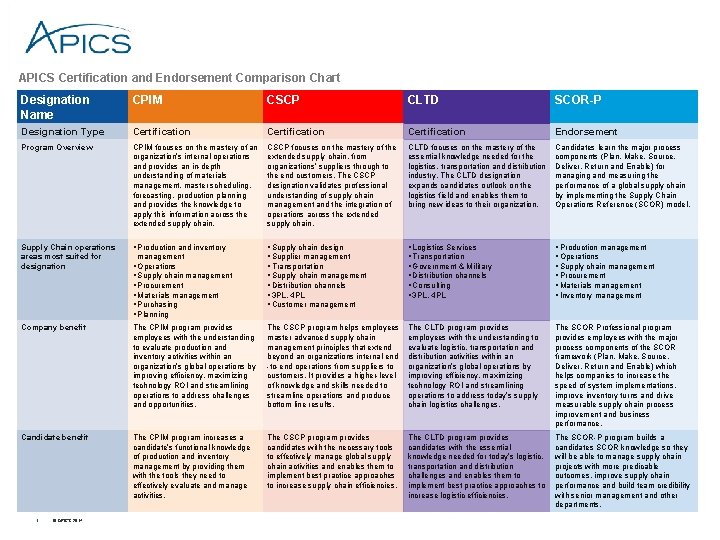
APICS Certification and Endorsement Comparison Chart Designation Name CPIM CSCP CLTD SCOR-P Designation Type Certification Endorsement Program Overview CPIM focuses on the mastery of an organization’s internal operations and provides an in-depth understanding of materials management, master scheduling, forecasting, production planning and provides the knowledge to apply this information across the extended supply chain. CSCP focuses on the mastery of the extended supply chain, from organizations’ suppliers through to the end customers. The CSCP designation validates professional understanding of supply chain management and the integration of operations across the extended supply chain. CLTD focuses on the mastery of the essential knowledge needed for the logistics, transportation and distribution industry. The CLTD designation expands candidates outlook on the logistics field and enables them to bring new ideas to their organization. Candidates learn the major process components (Plan, Make, Source, Deliver, Return and Enable) for managing and measuring the performance of a global supply chain by implementing the Supply Chain Operations Reference (SCOR) model. Supply Chain operations areas most suited for designation § Production and inventory § Supply chain design § Supplier management § Transportation § Supply chain management § Distribution channels § 3 PL, 4 PL § Customer management § Logistics Services § Transportation § Government & Military § Distribution channels § Consulting § 3 PL, 4 PL § Production management § Operations § Supply chain management § Procurement § Materials management § Inventory management Company benefit The CPIM program provides employees with the understanding to evaluate production and inventory activities within an organization’s global operations by improving efficiency, maximizing technology ROI and streamlining operations to address challenges and opportunities. The CSCP program helps employees master advanced supply chain management principles that extend beyond an organizations internal end -to-end operations from suppliers to customers. It provides a higher-level of knowledge and skills needed to streamline operations and produce bottom line results. The CLTD program provides employees with the understanding to evaluate logistic, transportation and distribution activities within an organization’s global operations by improving efficiency, maximizing technology ROI and streamlining operations to address today’s supply chain logistics challenges. The SCOR Professional program provides employees with the major process components of the SCOR framework (Plan, Make, Source, Deliver, Return and Enable) which helps companies to increase the speed of system implementations, improve inventory turns and drive measurable supply chain process improvement and business performance. Candidate benefit The CPIM program increases a candidate’s functional knowledge of production and inventory management by providing them with the tools they need to effectively evaluate and manage activities. The CSCP program provides candidates with the necessary tools to effectively manage global supply chain activities and enables them to implement best practice approaches to increase supply chain efficiencies. The CLTD program provides candidates with the essential knowledge needed for today’s logistic, transportation and distribution challenges and enables them to implement best practice approaches to increase logistic efficiencies. The SCOR-P program builds a candidates SCOR knowledge so they will be able to manage supply chain projects with more predicable outcomes, improve supply chain performance and build team credibility with senior management and other departments. 1 © APICS 2017 management § Operations § Supply chain management § Procurement § Materials management § Purchasing § Planning
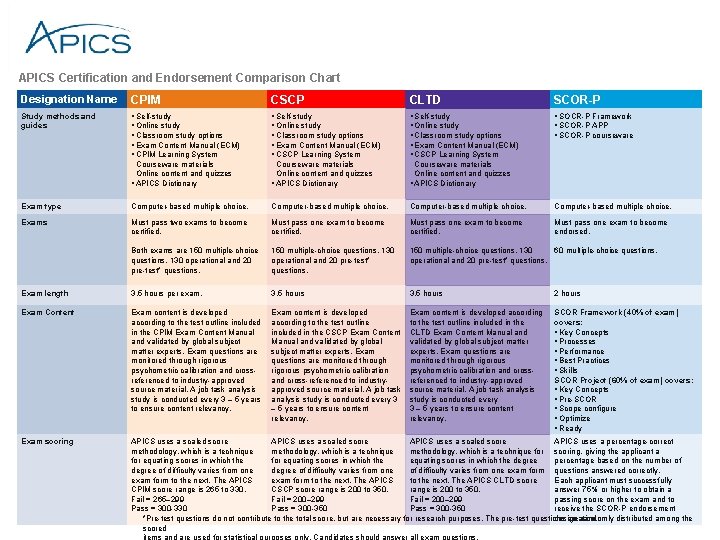
APICS Certification and Endorsement Comparison Chart Designation Name CPIM CSCP CLTD SCOR-P Study methods and guides § Self-study § Online study § Classroom study options § Exam Content Manual (ECM) § CPIM Learning System § Self-study § Online study § Classroom study options § Exam Content Manual (ECM) § CSCP Learning System § SOCR-P Framework § SCOR-P APP § SCOR-P courseware Courseware materials Online content and quizzes § APICS Dictionary Exam type Computer-based multiple choice. Exams Must pass two exams to become certified. Must pass one exam to become endorsed. Both exams are 150 multiple-choice questions. 130 operational and 20 pre-test* questions. 150 multiple-choice questions. 130 60 multiple-choice questions. operational and 20 pre-test* questions. Exam length 3. 5 hours per exam. 3. 5 hours 2 hours Exam Content Exam content is developed according to the test outline included in the CPIM Exam Content Manual and validated by global subject matter experts. Exam questions are monitored through rigorous psychometric calibration and crossreferenced to industry-approved source material. A job task analysis study is conducted every 3 – 5 years to ensure content relevancy. Exam content is developed according to the test outline included in the CSCP Exam Content Manual and validated by global subject matter experts. Exam questions are monitored through rigorous psychometric calibration and cross-referenced to industryapproved source material. A job task analysis study is conducted every 3 – 5 years to ensure content relevancy. Exam content is developed according to the test outline included in the CLTD Exam Content Manual and validated by global subject matter experts. Exam questions are monitored through rigorous psychometric calibration and crossreferenced to industry-approved source material. A job task analysis study is conducted every 3 – 5 years to ensure content relevancy. SCOR Framework (40% of exam) covers: § Key Concepts § Processes § Performance § Best Practices § Skills SCOR Project (60% of exam) covers: § Key Concepts § Pre-SCOR § Scope configure § Optimize § Ready Exam scoring APICS uses a scaled score APICS uses a percentage-correct methodology, which is a technique for scoring, giving the applicant a for equating scores in which the degree percentage based on the number of degree of difficulty varies from one exam form questions answered correctly. exam form to the next. The APICS CLTD score Each applicant must successfully CPIM score range is 265 to 330. CSCP score range is 200 to 350. answer 75% or higher to obtain a Fail = 265– 299 Fail = 200– 299 passing score on the exam and to Pass = 300 -330 Pass = 300 -350 receive the SCOR-P endorsement *Pre-test questions do not contribute to the total score, but are necessary for research purposes. The pre-test questions are randomly distributed among the designation. scored 2 © APICS 2017
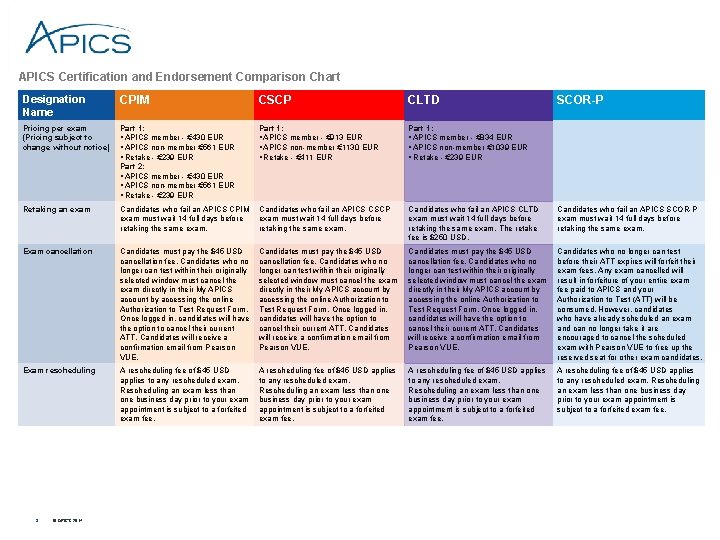
APICS Certification and Endorsement Comparison Chart Designation Name CPIM CSCP CLTD Pricing per exam (Pricing subject to change without notice) Part 1: § APICS member - € 430 EUR § APICS non-member € 561 EUR § Retake - € 239 EUR Part 2: § APICS member - € 430 EUR § APICS non-member € 561 EUR § Retake - € 239 EUR Part 1: § APICS member - € 913 EUR § APICS non-member € 1130 EUR § Retake - € 411 EUR Part 1: § APICS member - € 834 EUR § APICS non-member € 1039 EUR § Retake - € 239 EUR Retaking an exam Candidates who fail an APICS CPIM exam must wait 14 full days before retaking the same exam. Candidates who fail an APICS CSCP exam must wait 14 full days before retaking the same exam. Candidates who fail an APICS CLTD exam must wait 14 full days before retaking the same exam. The retake fee is $250 USD. Candidates who fail an APICS SCOR-P exam must wait 14 full days before retaking the same exam. Exam cancellation Candidates must pay the $45 USD cancellation fee. Candidates who no longer can test within their originally selected window must cancel the exam directly in their My APICS account by accessing the online Authorization to Test Request Form. Once logged in, candidates will have the option to cancel their current ATT. Candidates will receive a confirmation email from Pearson VUE. Candidates who no longer can test before their ATT expires will forfeit their exam fees. Any exam cancelled will result in forfeiture of your entire exam fee paid to APICS and your Authorization to Test (ATT) will be consumed. However, candidates who have already scheduled an exam and can no longer take it are encouraged to cancel the scheduled exam with Pearson VUE to free up the reserved seat for other exam candidates. Exam rescheduling A rescheduling fee of $45 USD applies to any rescheduled exam. Rescheduling an exam less than one business day prior to your exam appointment is subject to a forfeited exam fee. 3 © APICS 2017 SCOR-P
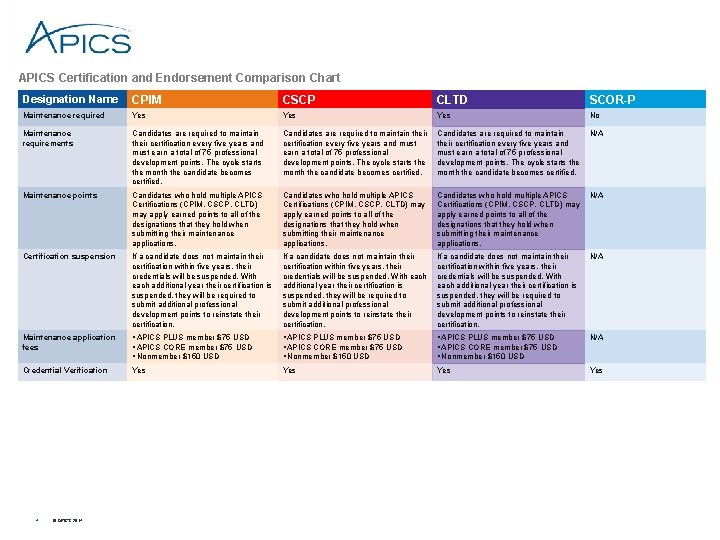
APICS Certification and Endorsement Comparison Chart Designation Name CPIM CSCP CLTD SCOR-P Maintenance required Yes Yes No Maintenance requirements Candidates are required to maintain their certification every five years and must earn a total of 75 professional development points. The cycle starts the month the candidate becomes certified. N/A Maintenance points Candidates who hold multiple APICS Certifications (CPIM, CSCP, CLTD) may apply earned points to all of the designations that they hold when submitting their maintenance applications. N/A Certification suspension If a candidate does not maintain their certification within five years, their credentials will be suspended. With each additional year their certification is suspended, they will be required to submit additional professional development points to reinstate their certification. N/A Maintenance application fees § APICS PLUS member $75 USD § APICS CORE member $75 USD § Nonmember $150 USD N/A Credential Verification Yes Yes 4 © APICS 2017