
API Special Summer Meeting 2015 API 17 TR
- Slides: 6
API Special Summer Meeting - 2015 API 17 TR 11: Pressure Effects on Subsea Hardware During Flowline Pressure Testing in Deep Water (Publication September 2015) - Mike Williams, FMCTI (Retired) - Frans Kopp, Shell International E&P (Retired)
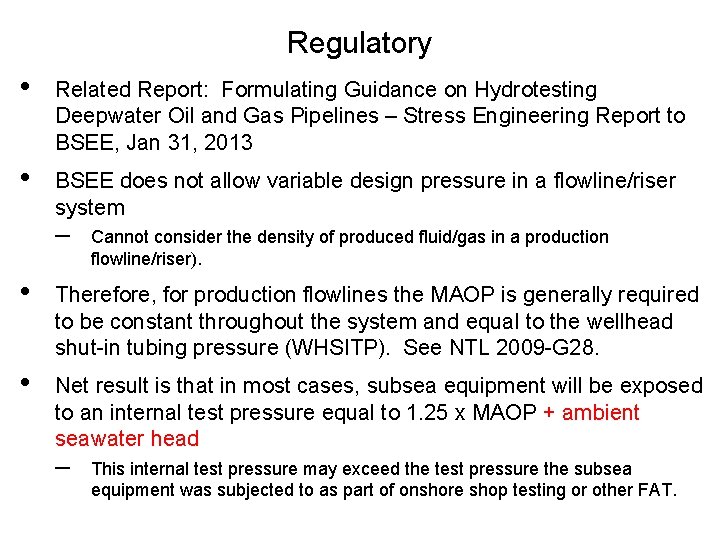
Regulatory • Related Report: Formulating Guidance on Hydrotesting Deepwater Oil and Gas Pipelines – Stress Engineering Report to BSEE, Jan 31, 2013 • BSEE does not allow variable design pressure in a flowline/riser system – Cannot consider the density of produced fluid/gas in a production flowline/riser). • Therefore, for production flowlines the MAOP is generally required to be constant throughout the system and equal to the wellhead shut-in tubing pressure (WHSITP). See NTL 2009 -G 28. • Net result is that in most cases, subsea equipment will be exposed to an internal test pressure equal to 1. 25 x MAOP + ambient seawater head – This internal test pressure may exceed the test pressure the subsea equipment was subjected to as part of onshore shop testing or other FAT.
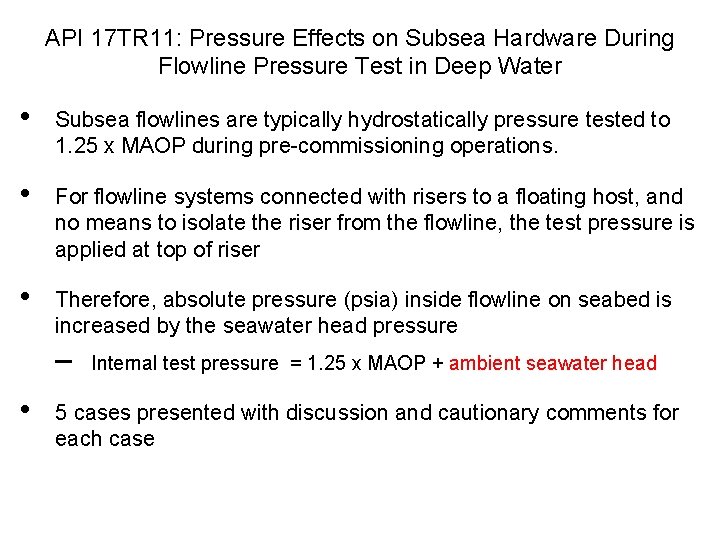
API 17 TR 11: Pressure Effects on Subsea Hardware During Flowline Pressure Test in Deep Water • Subsea flowlines are typically hydrostatically pressure tested to 1. 25 x MAOP during pre-commissioning operations. • For flowline systems connected with risers to a floating host, and no means to isolate the riser from the flowline, the test pressure is applied at top of riser • Therefore, absolute pressure (psia) inside flowline on seabed is increased by the seawater head pressure – • Internal test pressure = 1. 25 x MAOP + ambient seawater head 5 cases presented with discussion and cautionary comments for each case
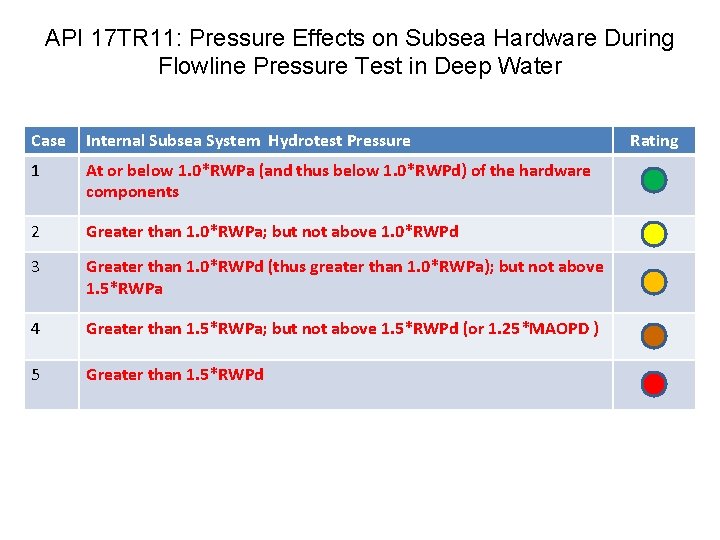
API 17 TR 11: Pressure Effects on Subsea Hardware During Flowline Pressure Test in Deep Water Case Internal Subsea System Hydrotest Pressure 1 At or below 1. 0*RWPa (and thus below 1. 0*RWPd) of the hardware components 2 Greater than 1. 0*RWPa; but not above 1. 0*RWPd 3 Greater than 1. 0*RWPd (thus greater than 1. 0*RWPa); but not above 1. 5*RWPa 4 Greater than 1. 5*RWPa; but not above 1. 5*RWPd (or 1. 25*MAOPD ) 5 Greater than 1. 5*RWPd Rating
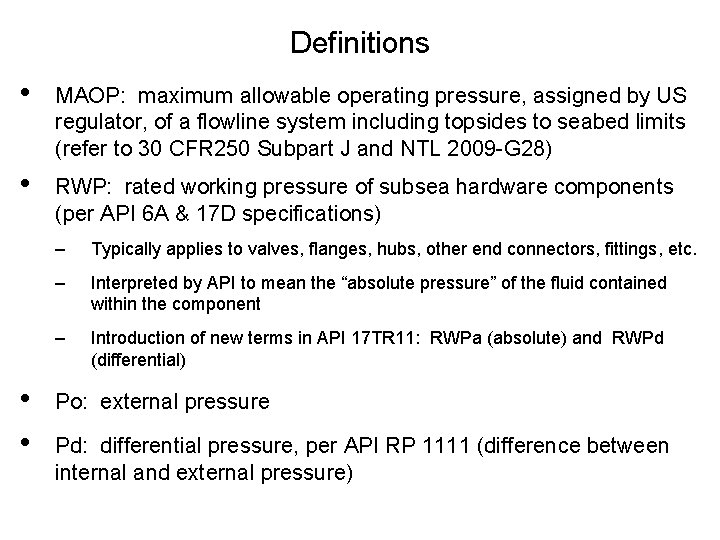
Definitions • MAOP: maximum allowable operating pressure, assigned by US regulator, of a flowline system including topsides to seabed limits (refer to 30 CFR 250 Subpart J and NTL 2009 -G 28) • RWP: rated working pressure of subsea hardware components (per API 6 A & 17 D specifications) • • – Typically applies to valves, flanges, hubs, other end connectors, fittings, etc. – Interpreted by API to mean the “absolute pressure” of the fluid contained within the component – Introduction of new terms in API 17 TR 11: RWPa (absolute) and RWPd (differential) Po: external pressure Pd: differential pressure, per API RP 1111 (difference between internal and external pressure)
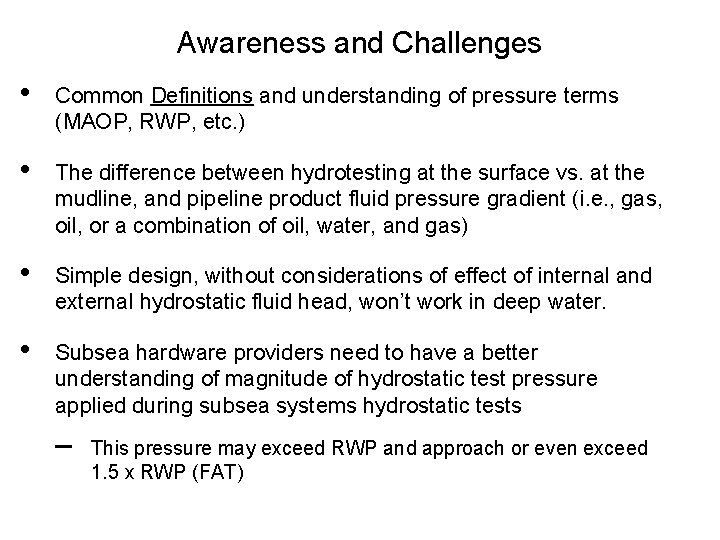
Awareness and Challenges • Common Definitions and understanding of pressure terms (MAOP, RWP, etc. ) • The difference between hydrotesting at the surface vs. at the mudline, and pipeline product fluid pressure gradient (i. e. , gas, oil, or a combination of oil, water, and gas) • Simple design, without considerations of effect of internal and external hydrostatic fluid head, won’t work in deep water. • Subsea hardware providers need to have a better understanding of magnitude of hydrostatic test pressure applied during subsea systems hydrostatic tests – This pressure may exceed RWP and approach or even exceed 1. 5 x RWP (FAT)