
API RP 754 Rev 3 September 9 2020

API RP 754 Rev. 3 September 9, 2020 GHS Statement Overlay Sub-Committee
GHS Statement Overlay Sub-Committee Eric Atkins (Olin) John Grabowski (Citgo) Marty Martin (Dow Chemical) Jim Muoio (Celanese – Representing American Chemistry Council) Bill Ralph (BP)
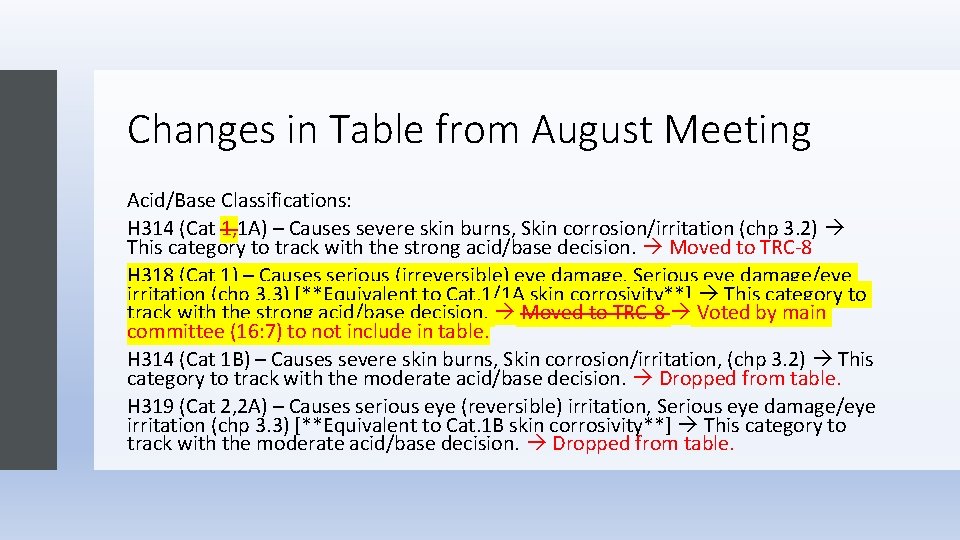
Changes in Table from August Meeting Acid/Base Classifications: H 314 (Cat 1, 1 A) – Causes severe skin burns, Skin corrosion/irritation (chp 3. 2) This category to track with the strong acid/base decision. Moved to TRC-8 H 318 (Cat 1) – Causes serious (irreversible) eye damage, Serious eye damage/eye irritation (chp 3. 3) [**Equivalent to Cat. 1/1 A skin corrosivity**] This category to track with the strong acid/base decision. Moved to TRC-8 Voted by main committee (16: 7) to not include in table. H 314 (Cat 1 B) – Causes severe skin burns, Skin corrosion/irritation, (chp 3. 2) This category to track with the moderate acid/base decision. Dropped from table. H 319 (Cat 2, 2 A) – Causes serious eye (reversible) irritation, Serious eye damage/eye irritation (chp 3. 3) [**Equivalent to Cat. 1 B skin corrosivity**] This category to track with the moderate acid/base decision. Dropped from table.
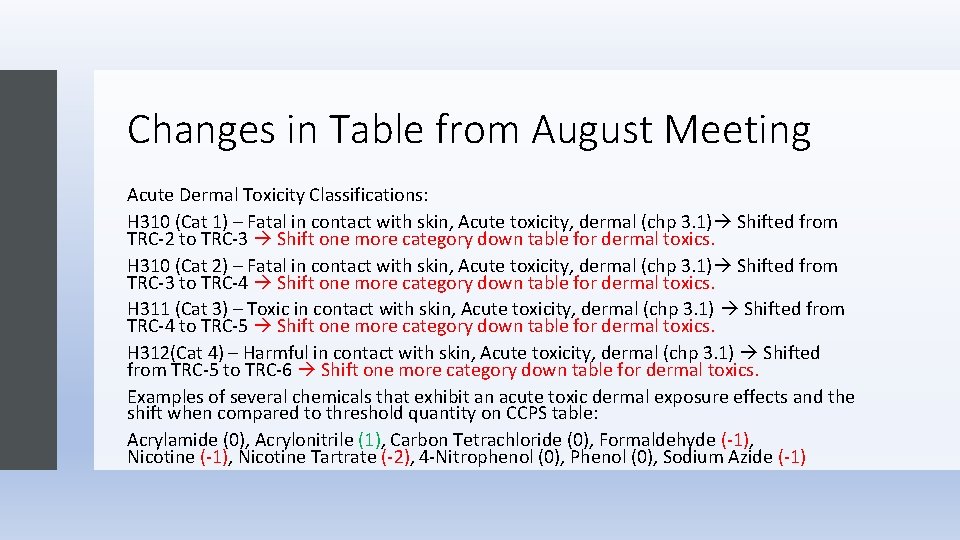
Changes in Table from August Meeting Acute Dermal Toxicity Classifications: H 310 (Cat 1) – Fatal in contact with skin, Acute toxicity, dermal (chp 3. 1) Shifted from TRC-2 to TRC-3 Shift one more category down table for dermal toxics. H 310 (Cat 2) – Fatal in contact with skin, Acute toxicity, dermal (chp 3. 1) Shifted from TRC-3 to TRC-4 Shift one more category down table for dermal toxics. H 311 (Cat 3) – Toxic in contact with skin, Acute toxicity, dermal (chp 3. 1) Shifted from TRC-4 to TRC-5 Shift one more category down table for dermal toxics. H 312(Cat 4) – Harmful in contact with skin, Acute toxicity, dermal (chp 3. 1) Shifted from TRC-5 to TRC-6 Shift one more category down table for dermal toxics. Examples of several chemicals that exhibit an acute toxic dermal exposure effects and the shift when compared to threshold quantity on CCPS table: Acrylamide (0), Acrylonitrile (1), Carbon Tetrachloride (0), Formaldehyde (-1), Nicotine Tartrate (-2), 4 -Nitrophenol (0), Phenol (0), Sodium Azide (-1)
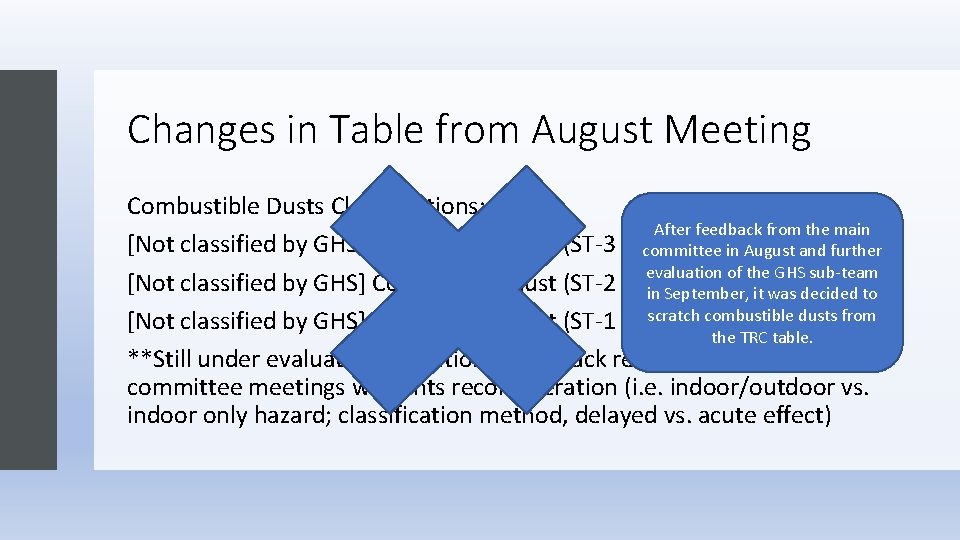
Changes in Table from August Meeting Combustible Dusts Classifications: After feedback from the main [Not classified by GHS] Combustible dust (ST-3 Class) committee. Added in Augustto and. TRC-5 further evaluation of the GHS sub-team [Not classified by GHS] Combustible dust (ST-2 Class) Added TRC-6 in September, it wasto decided to scratch combustible dusts from [Not classified by GHS] Combustible dust (ST-1 Class) Added to TRC-7 the TRC table. **Still under evaluation. Additional feedback received after subcommittee meetings warrants reconsideration (i. e. indoor/outdoor vs. indoor only hazard; classification method, delayed vs. acute effect)
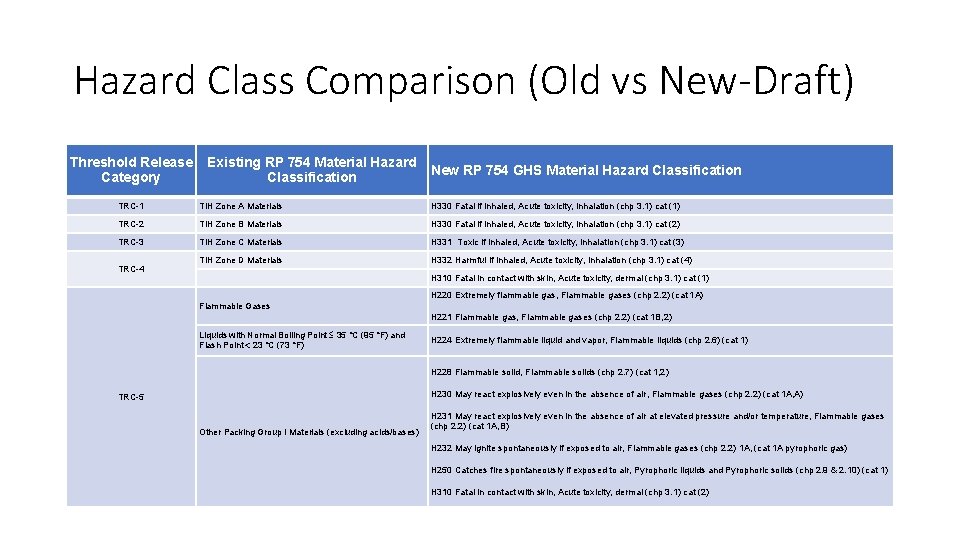
Hazard Class Comparison (Old vs New-Draft) Threshold Release Category Existing RP 754 Material Hazard Classification New RP 754 GHS Material Hazard Classification TRC-1 TIH Zone A Materials H 330 Fatal if inhaled, Acute toxicity, inhalation (chp 3. 1) cat (1) TRC-2 TIH Zone B Materials H 330 Fatal if inhaled, Acute toxicity, inhalation (chp 3. 1) cat (2) TRC-3 TIH Zone C Materials H 331 Toxic if inhaled, Acute toxicity, inhalation (chp 3. 1) cat (3) TIH Zone D Materials H 332 Harmful if inhaled, Acute toxicity, inhalation (chp 3. 1) cat (4) TRC-4 H 310 Fatal in contact with skin, Acute toxicity, dermal (chp 3. 1) cat (1) H 220 Extremely flammable gas, Flammable gases (chp 2. 2) (cat 1 A) Flammable Gases H 221 Flammable gas, Flammable gases (chp 2. 2) (cat 1 B, 2) Liquids with Normal Boiling Point £ 35 °C (95 °F) and Flash Point < 23 °C (73 °F) H 224 Extremely flammable liquid and vapor, Flammable liquids (chp 2. 6) (cat 1) H 228 Flammable solid, Flammable solids (chp 2. 7) (cat 1, 2) H 230 May react explosively even in the absence of air, Flammable gases (chp 2. 2) (cat 1 A, A) TRC-5 Other Packing Group I Materials (excluding acids/bases) H 231 May react explosively even in the absence of air at elevated pressure and/or temperature, Flammable gases (chp 2. 2) (cat 1 A, B) H 232 May ignite spontaneously if exposed to air, Flammable gases (chp 2. 2) 1 A, (cat 1 A pyrophoric gas) H 250 Catches fire spontaneously if exposed to air, Pyrophoric liquids and Pyrophoric solids (chp 2. 9 & 2. 10) (cat 1) H 310 Fatal in contact with skin, Acute toxicity, dermal (chp 3. 1) cat (2)
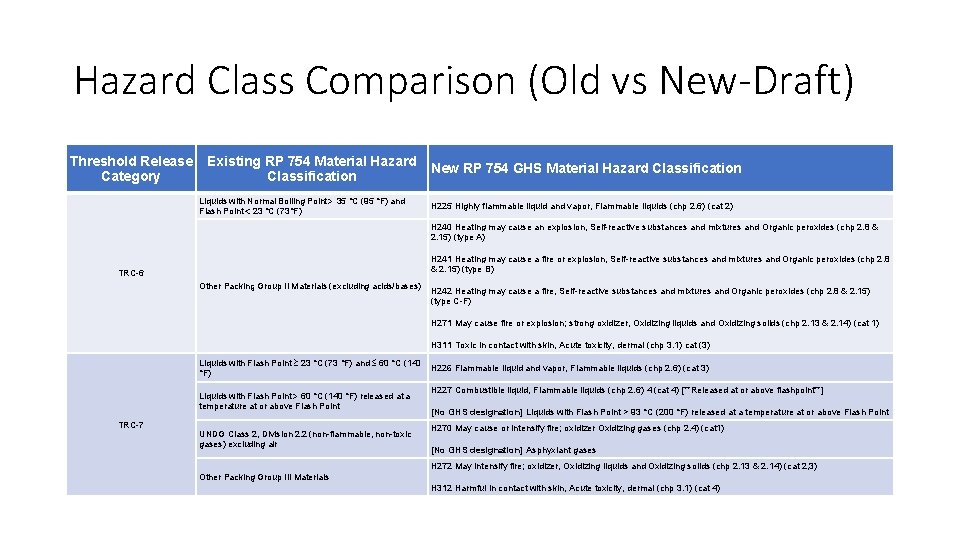
Hazard Class Comparison (Old vs New-Draft) Threshold Release Category Existing RP 754 Material Hazard Classification Liquids with Normal Boiling Point > 35 °C (95 °F) and Flash Point < 23 °C (73°F) New RP 754 GHS Material Hazard Classification H 225 Highly flammable liquid and vapor, Flammable liquids (chp 2. 6) (cat 2) H 240 Heating may cause an explosion, Self-reactive substances and mixtures and Organic peroxides (chp 2. 8 & 2. 15) (type A) H 241 Heating may cause a fire or explosion, Self-reactive substances and mixtures and Organic peroxides (chp 2. 8 & 2. 15) (type B) TRC-6 Other Packing Group II Materials (excluding acids/bases) H 242 Heating may cause a fire, Self-reactive substances and mixtures and Organic peroxides (chp 2. 8 & 2. 15) (type C-F) H 271 May cause fire or explosion; strong oxidizer, Oxidizing liquids and Oxidizing solids (chp 2. 13 & 2. 14) (cat 1) H 311 Toxic in contact with skin, Acute toxicity, dermal (chp 3. 1) cat (3) Liquids with Flash Point ³ 23 °C (73 °F) and £ 60 °C (140 °F) Liquids with Flash Point > 60 °C (140 °F) released at a temperature at or above Flash Point TRC-7 UNDG Class 2, Division 2. 2 (non-flammable, non-toxic gases) excluding air H 226 Flammable liquid and vapor, Flammable liquids (chp 2. 6) (cat 3) H 227 Combustible liquid, Flammable liquids (chp 2. 6) 4 (cat 4) [**Released at or above flashpoint**] [No GHS designation] Liquids with Flash Point > 93 °C (200 °F) released at a temperature at or above Flash Point H 270 May cause or intensify fire; oxidizer Oxidizing gases (chp 2. 4) (cat 1) [No GHS designation] Asphyxiant gases H 272 May intensify fire; oxidizer, Oxidizing liquids and Oxidizing solids (chp 2. 13 & 2. 14) (cat 2, 3) Other Packing Group III Materials H 312 Harmful in contact with skin, Acute toxicity, dermal (chp 3. 1) (cat 4)
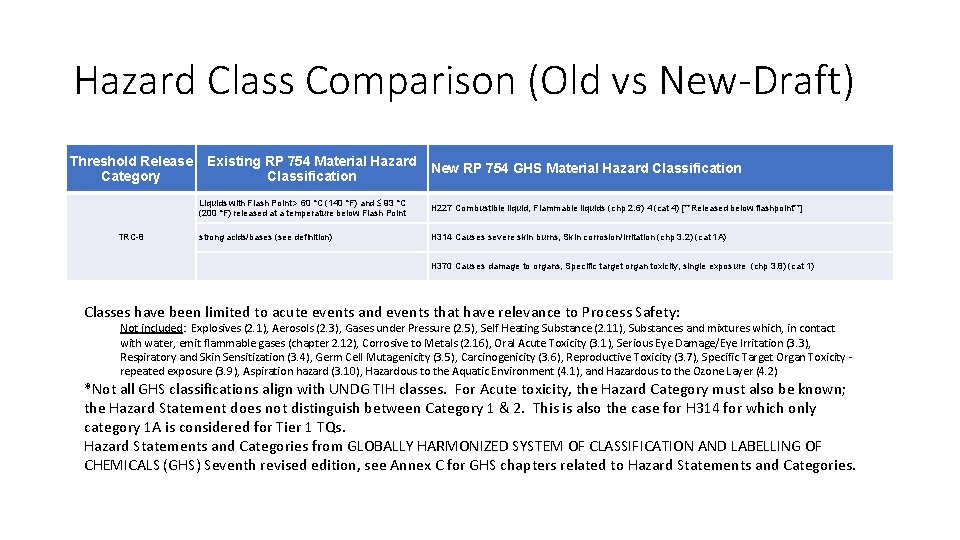
Hazard Class Comparison (Old vs New-Draft) Threshold Release Category TRC-8 Existing RP 754 Material Hazard Classification New RP 754 GHS Material Hazard Classification Liquids with Flash Point > 60 °C (140 °F) and £ 93 °C (200 °F) released at a temperature below Flash Point H 227 Combustible liquid, Flammable liquids (chp 2. 6) 4 (cat 4) [**Released below flashpoint**] strong acids/bases (see definition) H 314 Causes severe skin burns, Skin corrosion/irritation (chp 3. 2) (cat 1 A) H 370 Causes damage to organs, Specific target organ toxicity, single exposure (chp 3. 8) (cat 1) Classes have been limited to acute events and events that have relevance to Process Safety: Not included: Explosives (2. 1), Aerosols (2. 3), Gases under Pressure (2. 5), Self Heating Substance (2. 11), Substances and mixtures which, in contact with water, emit flammable gases (chapter 2. 12), Corrosive to Metals (2. 16), Oral Acute Toxicity (3. 1), Serious Eye Damage/Eye Irritation (3. 3), Respiratory and Skin Sensitization (3. 4), Germ Cell Mutagenicity (3. 5), Carcinogenicity (3. 6), Reproductive Toxicity (3. 7), Specific Target Organ Toxicity repeated exposure (3. 9), Aspiration hazard (3. 10), Hazardous to the Aquatic Environment (4. 1), and Hazardous to the Ozone Layer (4. 2) *Not all GHS classifications align with UNDG TIH classes. For Acute toxicity, the Hazard Category must also be known; the Hazard Statement does not distinguish between Category 1 & 2. This is also the case for H 314 for which only category 1 A is considered for Tier 1 TQs. Hazard Statements and Categories from GLOBALLY HARMONIZED SYSTEM OF CLASSIFICATION AND LABELLING OF CHEMICALS (GHS) Seventh revised edition, see Annex C for GHS chapters related to Hazard Statements and Categories.
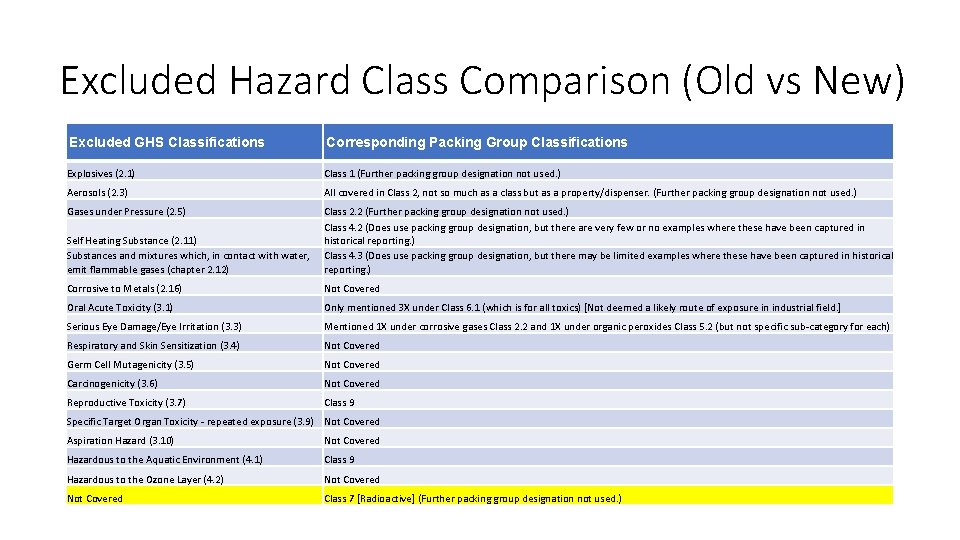
Excluded Hazard Class Comparison (Old vs New) Excluded GHS Classifications Corresponding Packing Group Classifications Explosives (2. 1) Class 1 (Further packing group designation not used. ) Aerosols (2. 3) All covered in Class 2, not so much as a class but as a property/dispenser. (Further packing group designation not used. ) Gases under Pressure (2. 5) Self Heating Substance (2. 11) Substances and mixtures which, in contact with water, emit flammable gases (chapter 2. 12) Class 2. 2 (Further packing group designation not used. ) Class 4. 2 (Does use packing group designation, but there are very few or no examples where these have been captured in historical reporting. ) Class 4. 3 (Does use packing group designation, but there may be limited examples where these have been captured in historical reporting. ) Corrosive to Metals (2. 16) Not Covered Oral Acute Toxicity (3. 1) Only mentioned 3 X under Class 6. 1 (which is for all toxics) [Not deemed a likely route of exposure in industrial field. ] Serious Eye Damage/Eye Irritation (3. 3) Mentioned 1 X under corrosive gases Class 2. 2 and 1 X under organic peroxides Class 5. 2 (but not specific sub-category for each) Respiratory and Skin Sensitization (3. 4) Not Covered Germ Cell Mutagenicity (3. 5) Not Covered Carcinogenicity (3. 6) Not Covered Reproductive Toxicity (3. 7) Class 9 Specific Target Organ Toxicity - repeated exposure (3. 9) Not Covered Aspiration Hazard (3. 10) Not Covered Hazardous to the Aquatic Environment (4. 1) Class 9 Hazardous to the Ozone Layer (4. 2) Not Covered Class 7 [Radioactive] (Further packing group designation not used. )
Next Steps Finalize hazard categorization • Work with Vito on TRC hierarchy based on exposure route • Request help for determining from AFPM/API historical events the number of times each excluded hazard class/packing group category has occurred to understand impact on historical performance. If approved, update API RP 754 document where TQ table changes modifies examples in Annexes.

Other Discussion: Q&A
- Slides: 11