
API 17 Y Subsea chemical injection system RP
API 17 Y Subsea chemical injection system RP for Design, Testing & Operation Task Group Status January , 11, 2017
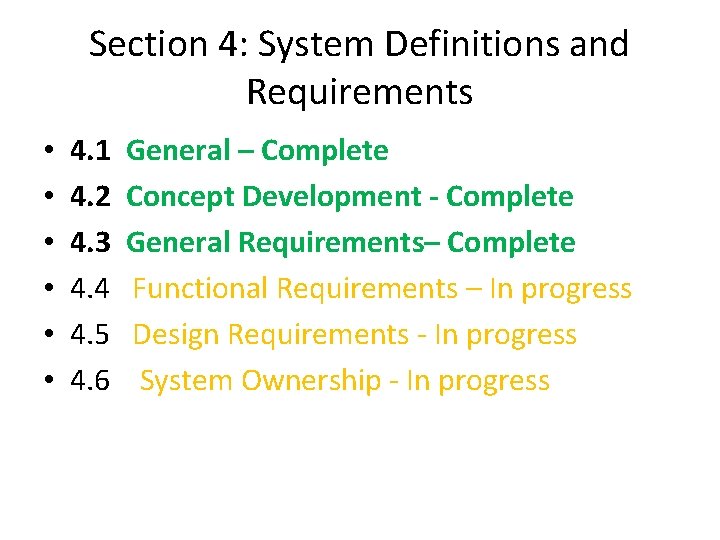
Section 4: System Definitions and Requirements • • • 4. 1 4. 2 4. 3 4. 4 4. 5 4. 6 General – Complete Concept Development - Complete General Requirements– Complete Functional Requirements – In progress Design Requirements - In progress System Ownership - In progress

Section 5: Interfaces • This section has 7 subsections – – – – 5. 1 General 5. 2 Engineering Design Interface 5. 3 Interface to Host Facility 5. 4 Interface to Subsea Equipment 5. 5 Interface to Downhole Equipment 5. 6 Interface to Workover Control System 5. 7 Interface to Subsea Control and Monitoring Device • The draft of the entire section is completed and provided to the task group for review
Section 6: Surface Equipment • The outline of this section is updated • BP provided an internal document to be used as the starting point to help the task group to progress • A document was drafted based on BP document that did not match well with the section outline • Several meetings are scheduled by the section lead but attendance by the task group is low • Schedule is behind the original timeline.
Section 7: Subsea Equipment • This section will only talk about chemical injection metering valves (CIMVs). • Other subsea equipment related to chemical injection systems are covered in other practices and will be referenced. • This session will focus on the specification, design, testing, commissioning, and operation of the CMIVs. • The draft is completed and is being reviewed by task group
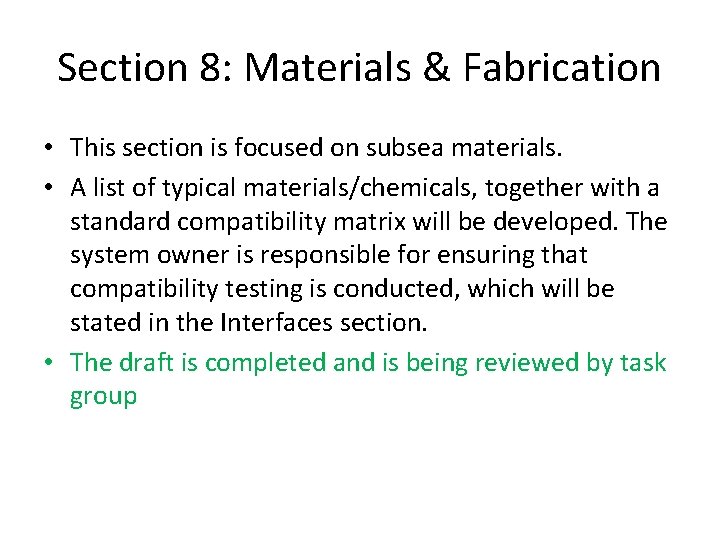
Section 8: Materials & Fabrication • This section is focused on subsea materials. • A list of typical materials/chemicals, together with a standard compatibility matrix will be developed. The system owner is responsible for ensuring that compatibility testing is conducted, which will be stated in the Interfaces section. • The draft is completed and is being reviewed by task group
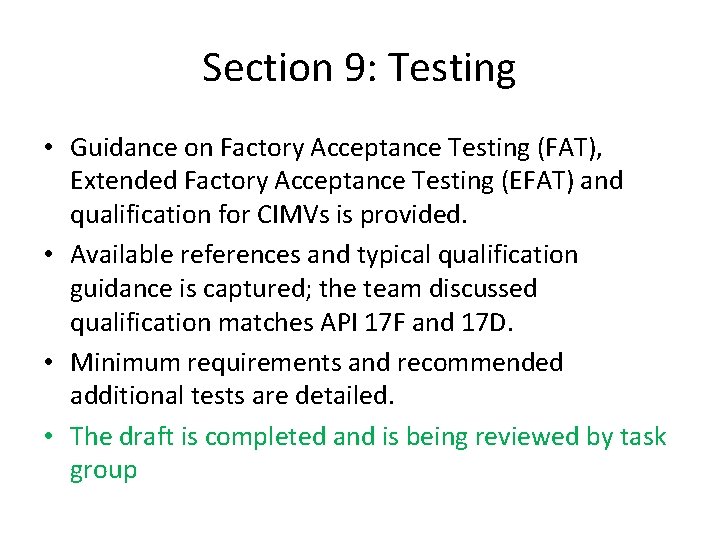
Section 9: Testing • Guidance on Factory Acceptance Testing (FAT), Extended Factory Acceptance Testing (EFAT) and qualification for CIMVs is provided. • Available references and typical qualification guidance is captured; the team discussed qualification matches API 17 F and 17 D. • Minimum requirements and recommended additional tests are detailed. • The draft is completed and is being reviewed by task group
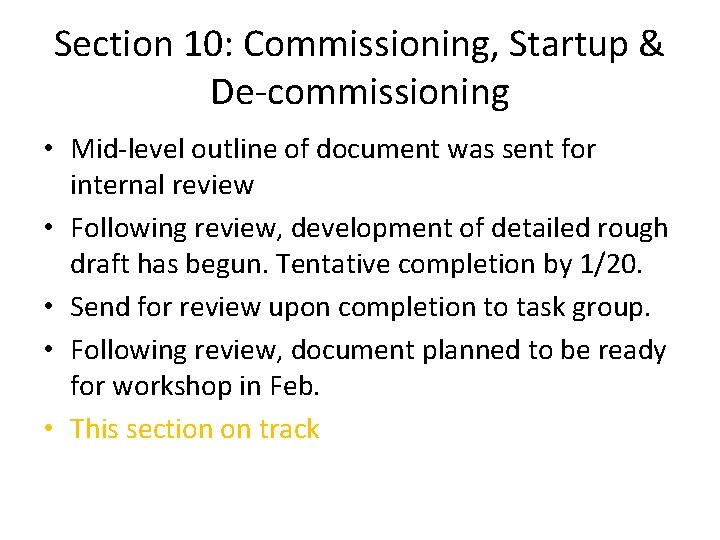
Section 10: Commissioning, Startup & De-commissioning • Mid-level outline of document was sent for internal review • Following review, development of detailed rough draft has begun. Tentative completion by 1/20. • Send for review upon completion to task group. • Following review, document planned to be ready for workshop in Feb. • This section on track
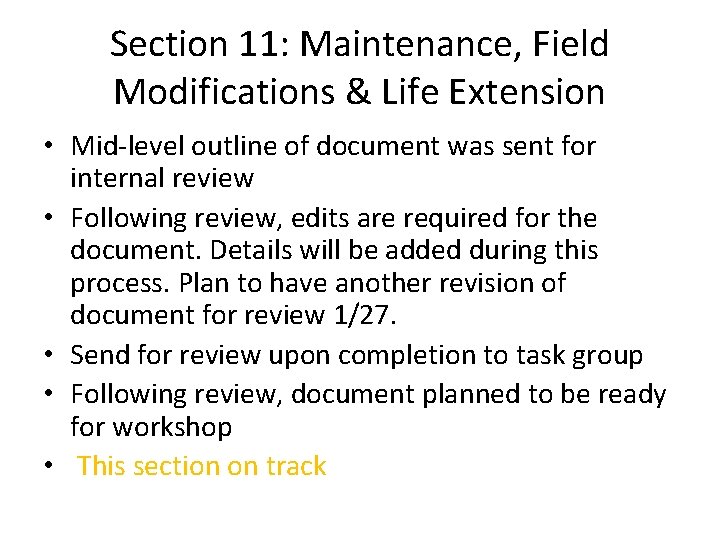
Section 11: Maintenance, Field Modifications & Life Extension • Mid-level outline of document was sent for internal review • Following review, edits are required for the document. Details will be added during this process. Plan to have another revision of document for review 1/27. • Send for review upon completion to task group • Following review, document planned to be ready for workshop • This section on track
Section 12: Chemical Management • This section had change of Lead two times; but current committee members are still targeting the agreed deadline. • High level descriptions of four subsections are discussed and agreed. • Schedule is behind the original timeline due to lack of support from the leader employer!
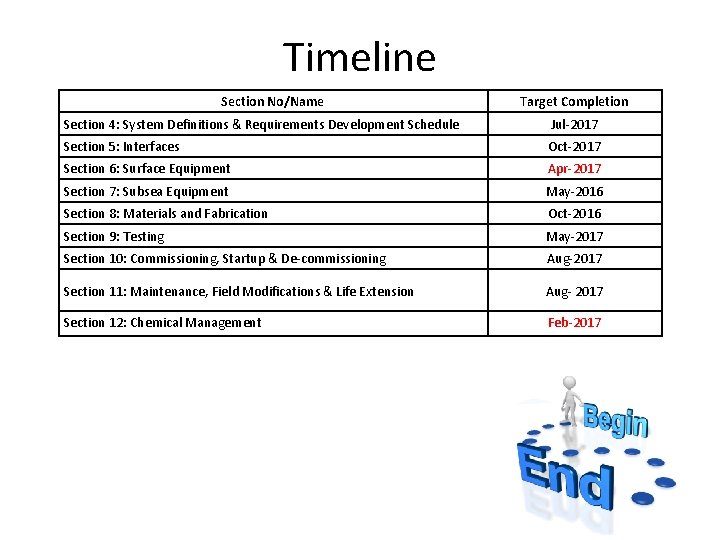
Timeline Section No/Name Target Completion Section 4: System Definitions & Requirements Development Schedule Jul-2017 Section 5: Interfaces Oct-2017 Section 6: Surface Equipment Apr-2017 Section 7: Subsea Equipment May-2016 Section 8: Materials and Fabrication Oct-2016 Section 9: Testing May-2017 Section 10: Commissioning, Startup & De-commissioning Aug-2017 Section 11: Maintenance, Field Modifications & Life Extension Aug- 2017 Section 12: Chemical Management Feb-2017
Risk to Delivery • Several committee members have been resigned due to other commitments, changing jobs or looking for new opportunities. • It is a challenge to keep the momentum when so many changes are happening in O&G industry.
Future Meetings • 1 st Workshop was found to be very beneficial to motivate session leaders & committee members to progress the sections; as well as ensuring seamless connection between sections. • A 2 nd workshop is scheduled for Feb 3 rd, 2017 • Continue to hold monthly meetings to review the progress on each section and discuss any issues raised.
- Slides: 13