
APHN ROLES ADVANCED PUBLIC HEALTH NURSING IN THE

APHN ROLES: ADVANCED PUBLIC HEALTH NURSING IN THE PUBLIC HEALTH SYSTEMS Shannon Haskett, RN, BSN Jacksonville State University NU 518 November 24, 2014
OBJECTIVES Describe various roles of the public health nurse in a local public health system. Describe various roles of the public health nurse in a state public health system. Describe various roles of the public health nurse in a federal public health system. Contrast the various roles between the local, state, and federal public health systems. Explain differences between the local, state, and federal public health systems.
INTRODUCTION According to Stanhope and Lancaster, public health is defined as “what we, as a society, do collectively to assure the conditions in which people can be healthy” (Stanhope and Lancaster, 2012, p. 7). Public health nursing is defined as “the practice of protecting and promoting the health of populations using knowledge from nursing, social, and public health sciences” (2012, p. 59). Public health nursing is a specialty composed of 5 subroles such as: � � � Clinician Manager Educator Consultant Researcher
8 PRINCIPLES OF PUBLIC HEALTH NURSING 1. 2. 3. 4. 5. 6. 7. 8. The client or “unit of care” is the population The primary obligation is to achieve the greatest good for the greatest number of people or the population as a whole. The processes used by public health nurses include working with the client as an equal partner. Primary prevention is the priority in selecting appropriate activities. Selecting strategies that create health environmental, social, and economic conditions in which populations may thrive is the focus. There is an obligation to actively reach out to all who might benefit from a specific activity or service. Optimal use of available resources to assure the best overall improvement in the health of the population is a key element of practice. Collaboration with a variety of other professions, organizations, and entities is the most effective way to promote and protect the health of the people. (Stanhope and Lancaster, 2012, p. 12, box 1 -5)
LOCAL APHN Roles for an Advanced Public Health Nurse in the Public Health System
LOCAL PUBLIC HEALTH SYSTEM Has direct responsibility to the people of the community Services and programs can be offered depending on health codes, needs in the community, funding, and resources. Provides sick care and primary care Provides programs for AIDs, hypertension, cancer, cholesterol screening, communicable diseases, dental, flu shots, Lyme disease, mental health, nursing home services, rabies, SARS, STDs, substance abuse, tuberculosis, West Nile virus, and workplace health information. (Stanhope and Lancaster, 2012, p. 59)
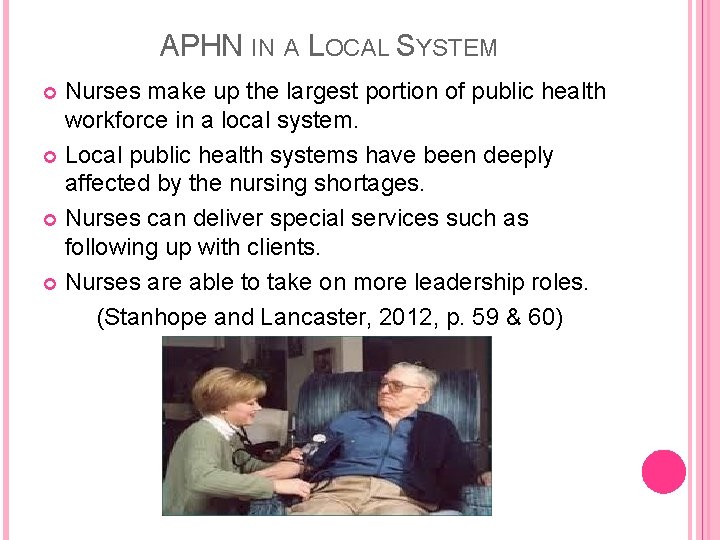
APHN IN A LOCAL SYSTEM Nurses make up the largest portion of public health workforce in a local system. Local public health systems have been deeply affected by the nursing shortages. Nurses can deliver special services such as following up with clients. Nurses are able to take on more leadership roles. (Stanhope and Lancaster, 2012, p. 59 & 60)
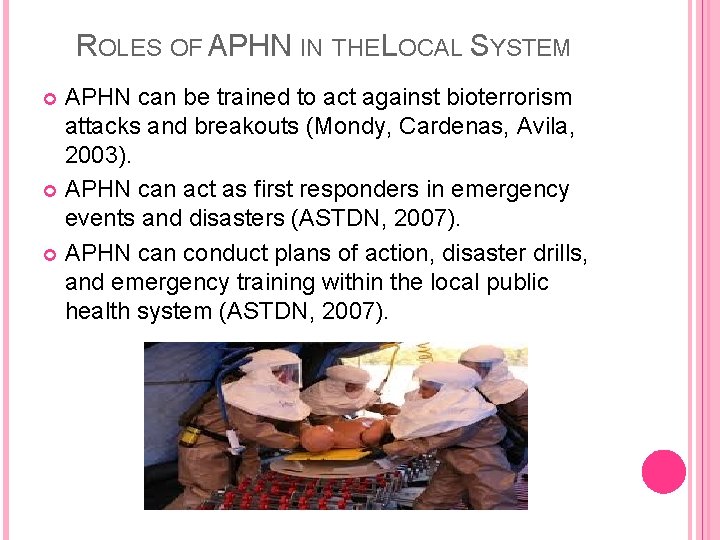
ROLES OF APHN IN THE LOCAL SYSTEM APHN can be trained to act against bioterrorism attacks and breakouts (Mondy, Cardenas, Avila, 2003). APHN can act as first responders in emergency events and disasters (ASTDN, 2007). APHN can conduct plans of action, disaster drills, and emergency training within the local public health system (ASTDN, 2007).

STATE APHN Roles for an Advanced Public Health Nurse in the Public Health System
STATE PUBLIC HEALTH SYSTEM Stands ready for disaster prevention or response. Responsible for the financing and administration for programs such as Medicaid. Provides mental health and professional education Establishes health codes Licenses facilities and personnel Regulates insurance industry Has a role in direct assistance to local health departments. Provides programs for epidemiology, environmental and occupation health, communicable disease, cancer, emergency response, AIDs/HIV, family health services, environmental labs, senior services, senior benefits, budget and finance, charity, information technology, vital statistic and registration. (Stanhope and Lancaster, 2012, p. 58)
APNH ROLES IN THE STATE SYSTEM Nurses can work in state health departments as consultants, direct service providers, researchers, teachers, and supervisors. Nurses participate in program development, planning, and evaluation of health programs. Every state has select nurses on the board of examiners. � The board of examiners are responsible for licensing and examination of registered nurses (RNs) and licensed practical nurses (LPNs); approves school nursing programs; revocation, suspension, or denial of licenses; and writing regulations about nursing practice and education. (Stanhope and Lancaster, 2012, p. 59)
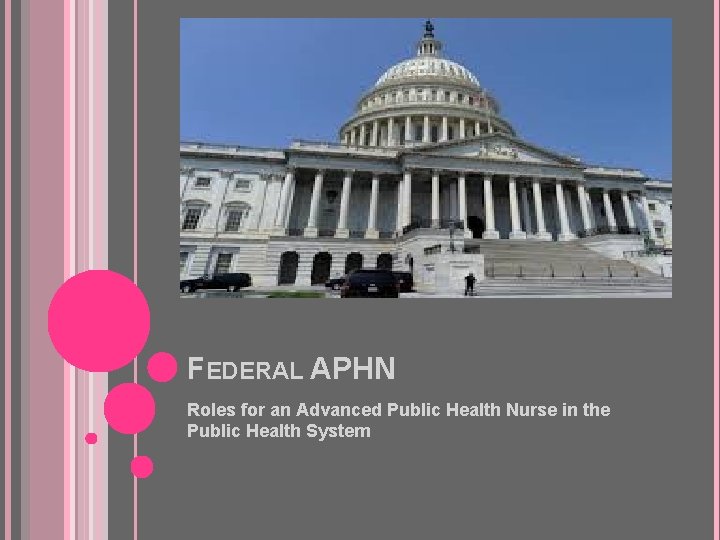
FEDERAL APHN Roles for an Advanced Public Health Nurse in the Public Health System
FEDERAL PUBLIC HEALTH SYSTEM The department of Health and Human Services (HHS) is mostly involved with the health and welfare of U. S. citizens. HHS regulates health care. HHS oversees health status of American citizens. (Stanhope and Lancaster, 2012, p. 56) According to the HHS website, a strategic plan FY 20142018 lays out goals for the federal public health system: Strengthen health care Advance scientific knowledge and innovation Advance the health, safety, and well-being of the American people � Ensure efficiency, transparency, accountability, and effectiveness of HHS programs (HHS. gov, 2014) � � �
FEDERAL PUBLIC HEALTH SYSTEM Center for Faith-Based and Neighborhood Partnerships � � Considered HHS’s liaison for community support. Goals set forth by Obama: Strengthen recovery and poverty reduction Reduce unintended pregnancies and support maternal and child health Promote responsible fatherhood and healthy families Foster interfaith dialogue and collaboration with leaders and scholars around the world, and at home (Stanhope and Lancaster, 2012, p. 56). Office of Public Health Preparedness � � Center for Disease Control and Prevention (CDC) “Leads the agency’s preparedness and response activities by providing strategic direction, support, and coordination for activities across CDC as well as with local, state, tribal, national, territorial, and international public health partners. ” (CDC, 2014)
FEDERAL PUBLIC HEALTH SYSTEM Office of Global Affairs � Represents the HHS internationally U. S. Public Health Service (PHS) � Consists of 8 agencies such as the Agency for Healthcare Research and Quality, Agency for Toxic Substances and Diseases Registry, Centers for Disease Control and Prevention, Food and Drug Administration, Health Resources and Services Administration, Indian Health Service, National Institutes of Health, Substance Abuse and Mental Health Services Administration (Stanhope and Lancaster, 2012, p. 56)
APHN ROLES IN THE FEDERAL SYSTEM Nurses can serve on boards and committees in such health program of the federal public health system and government. Nurses can be used as advocates for such programs. Nurses can obey federal government laws about health care.
COMPARE AND CONTRAST Differences in Roles of APHN in local, state, and federal public health systems
SIMILARITIES AMONG THE PUBLIC HEALTH SYSTEMS The big picture of all three public health systems and the APHN roles is the well-being of the U. S. citizens. The local, state, and federal public health systems want to prevent, know how to respond, intervene, and educate when it comes to emergencies, disasters, and epidemics. All three work together in order to do the greatest good for the greatest number of people.
DIFFERENCES AMONG THE PUBLIC HEALTH SYSTEMS The local public health systems primarily deal with the three levels of prevention in the city or community populations. The local APHN has smaller roles of leadership within the community such as educator or clinician. The state public health systems deal with each state as a whole separately. Different states have different health problems and emergencies. The roles for an APHN are more demanding since they are the ones setting the guidelines and laws for nurses and health care. The federal public health systems are more complicated. There are several laws, agencies, acts, services, and programs that do different things within the federal government. The federal public health systems rely on the government and its officials more than the other public health systems. The roles for and APHN in are even more advanced in the federal system because nurses can be placed in congress or on committees for certain agencies.
CONCLUSION In order for public health to continue to grow, more APHN are needed. With a nursing shortage in place, a strain is left on nurses in the community setting. It is important for APHN to not only rely on other APHN, but to get assistance from other health care disciplines, volunteers, or even retired nurses. APHN are the voices for our communities, states, and country for health promotion and prevention in the local, state, and federal governments.
REFERENCES Association of State and Territorial Directors of Nursing. (2007, October 29). The Role of Public Health Nurses in Emergency Preparedness and Response. Retrieved from http: //www. phnurse. org/docs/The_Role_Of_PHNs_in_Emerge ncy_Preparedness_&_Response_2007. pdf Center for Disease Control and Prevention. (2014). CDC Office of Public Health Preparedness and Response. Retrieved from http: //www. cdc. gov/phpr/ HHS. gov. (2014, March). Strategic Plan and Priorities | HHS. gov. Retrieved from http: //www. hhs. gov/strategicplan/priorities. html Mondy. , Cardenas. , & Avila. (2003). The Role of an Advanced Practice Public Health Nurse in Bioterrorism Preparedness. Retrieved from http: //www. ncbi. nlm. nih. gov/pubmed/14629673 Stanhope, M. , & Lancaster, J. (2012). Public Health Nursing Population-Centered Health Care in the Community (8 th ed. ). Maryland Heights, MO: Elsevier Mosby.
- Slides: 21