
Aphasia II Different types AIMS Outline models of
- Slides: 38
Aphasia II Different types AIMS • Outline models of single word comprehension and production • Describe types of aphasia in relation to these models • Briefly outline impairments of syntactic processing
IMPAIRMENTS OF WORD COMPREHENSION
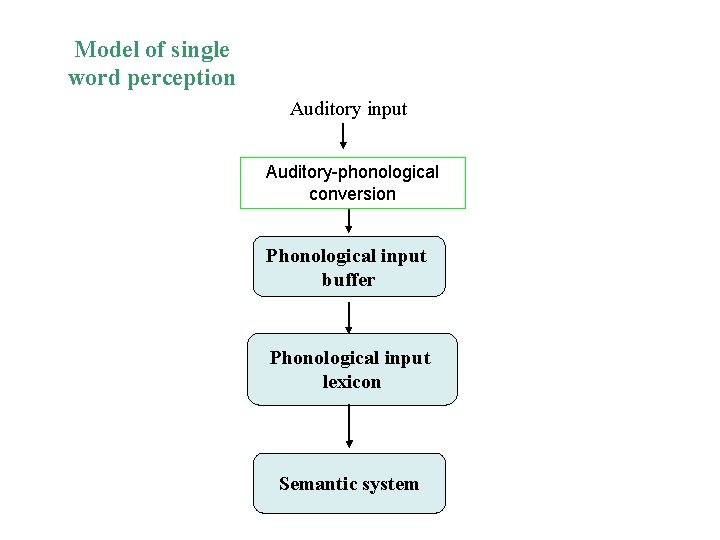
Model of single word perception Auditory input Auditory-phonological conversion Phonological input buffer Phonological input lexicon Semantic system
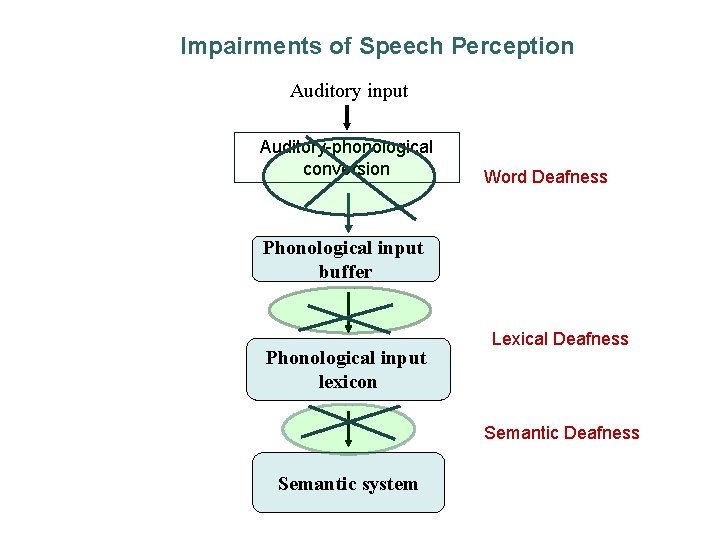
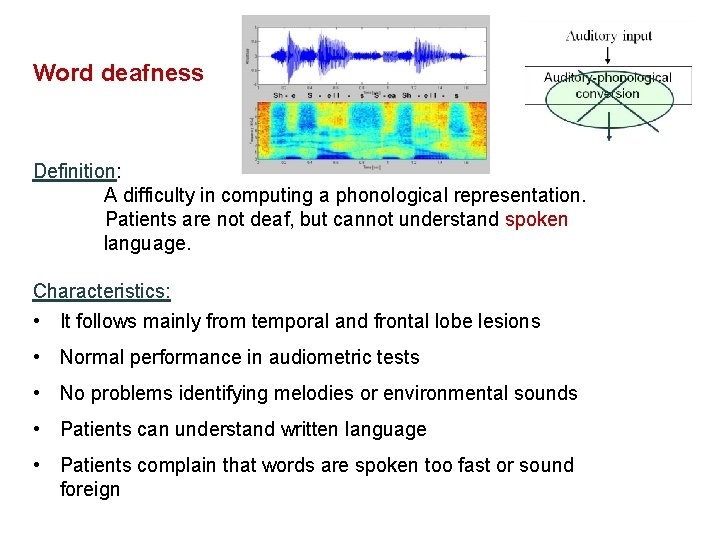
Impairments of Speech Perception Auditory input Auditory-phonological conversion Word Deafness Phonological input buffer Phonological input lexicon Lexical Deafness Semantic system
Word deafness Definition: A difficulty in computing a phonological representation. Patients are not deaf, but cannot understand spoken language. Characteristics: • It follows mainly from temporal and frontal lobe lesions • Normal performance in audiometric tests • No problems identifying melodies or environmental sounds • Patients can understand written language • Patients complain that words are spoken too fast or sound foreign
• Patients have problems when asked to repeat words/nonwords or asked to judge whether two words or syllables are the same or different. • Words in isolation are understood better than words in sentences. • Vowels are discriminated better than consonants which involve faster changes. • Deficit in the processing of rapidly changing non-speech stimuli (e. g. , distinguishing clicks).
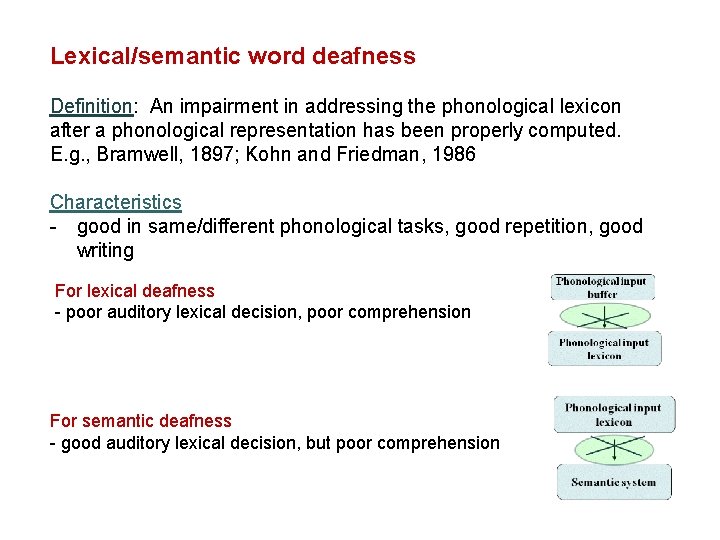
Lexical/semantic word deafness Definition: An impairment in addressing the phonological lexicon after a phonological representation has been properly computed. E. g. , Bramwell, 1897; Kohn and Friedman, 1986 Characteristics - good in same/different phonological tasks, good repetition, good writing For lexical deafness - poor auditory lexical decision, poor comprehension For semantic deafness - good auditory lexical decision, but poor comprehension
Semantic impairments (see previous lecture) They follow mainly from temporal lobe lesions. Defining characteristics: • Difficulties and semantic errors across input and output tasks (e. g. , Gainotti, 1977) • Semantic errors BUT an unusual semantic impairment: optic aphasia
IMPAIRMENTS OF WORD PRODUCTION
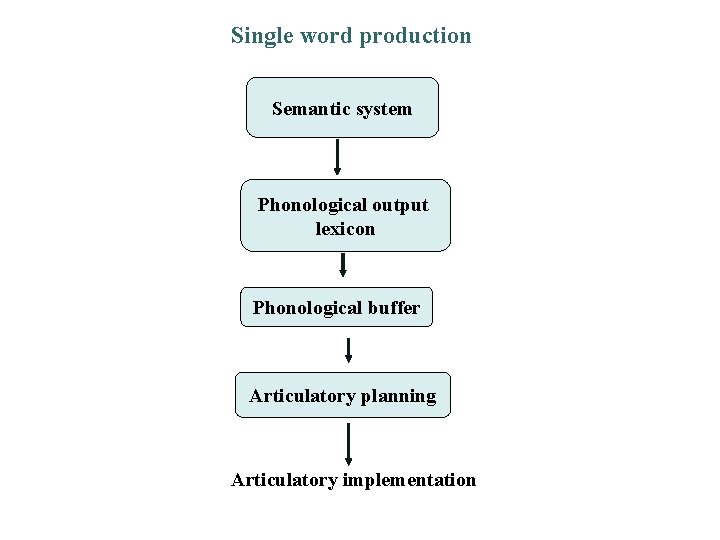
Single word production Semantic system Phonological output lexicon Phonological buffer Articulatory planning Articulatory implementation
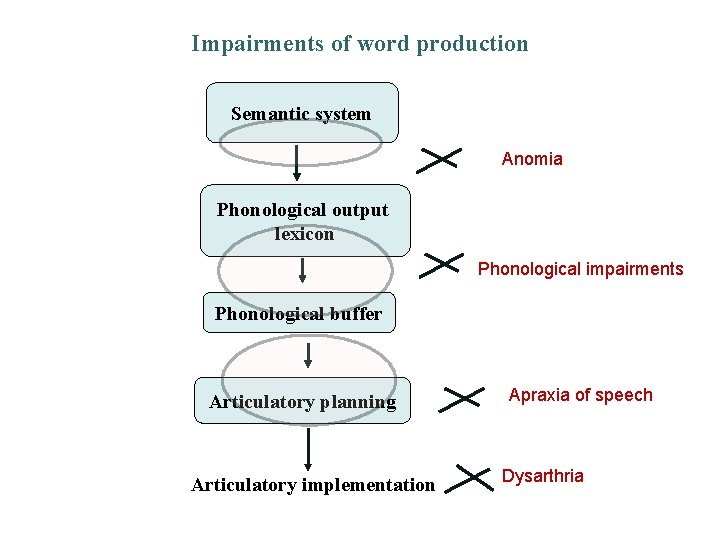
Impairments of word production Semantic system Anomia Phonological output lexicon Phonological impairments Phonological buffer Articulatory planning Articulatory implementation Apraxia of speech Dysarthria
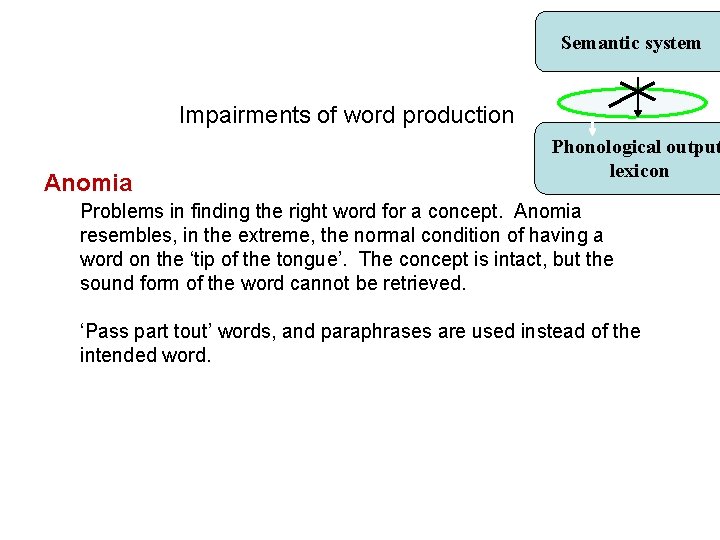
Semantic system Impairments of word production nerally involve more anterior lesions to Anomia Phonological output lexicon Problems in finding the right word for a concept. Anomia resembles, in the extreme, the normal condition of having a word on the ‘tip of the tongue’. The concept is intact, but the sound form of the word cannot be retrieved. ‘Pass part tout’ words, and paraphrases are used instead of the intended word.
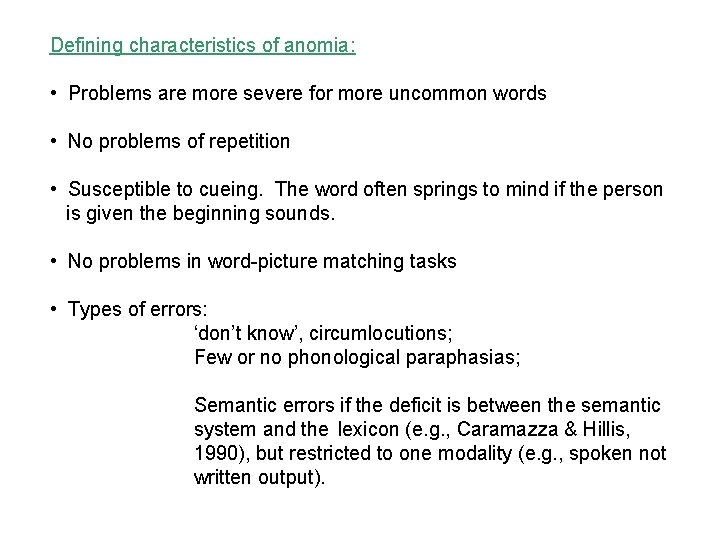
Defining characteristics of anomia: • Problems are more severe for more uncommon words • No problems of repetition • Susceptible to cueing. The word often springs to mind if the person is given the beginning sounds. • No problems in word-picture matching tasks • Types of errors: ‘don’t know’, circumlocutions; Few or no phonological paraphasias; Semantic errors if the deficit is between the semantic system and the lexicon (e. g. , Caramazza & Hillis, 1990), but restricted to one modality (e. g. , spoken not written output).
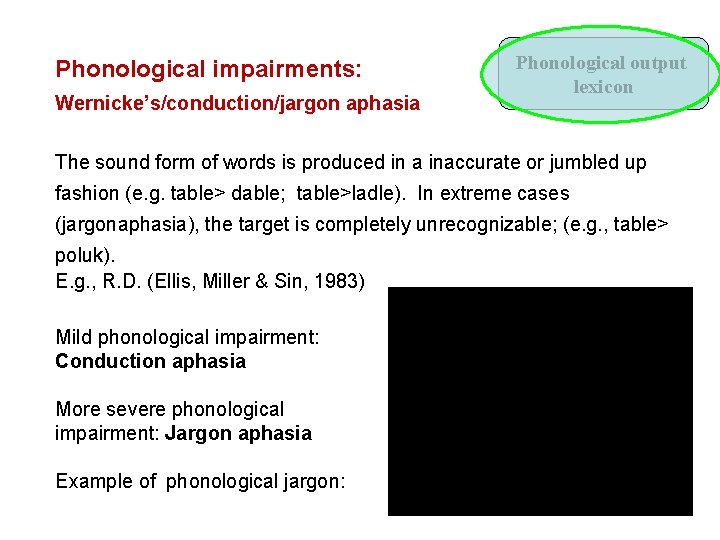
Phonological impairments: Wernicke’s/conduction/jargon aphasia Phonological output lexicon The sound form of words is produced in a inaccurate or jumbled up fashion (e. g. table> dable; table>ladle). In extreme cases (jargonaphasia), the target is completely unrecognizable; (e. g. , table> poluk). E. g. , R. D. (Ellis, Miller & Sin, 1983) Mild phonological impairment: Conduction aphasia More severe phonological impairment: Jargon aphasia Example of phonological jargon:
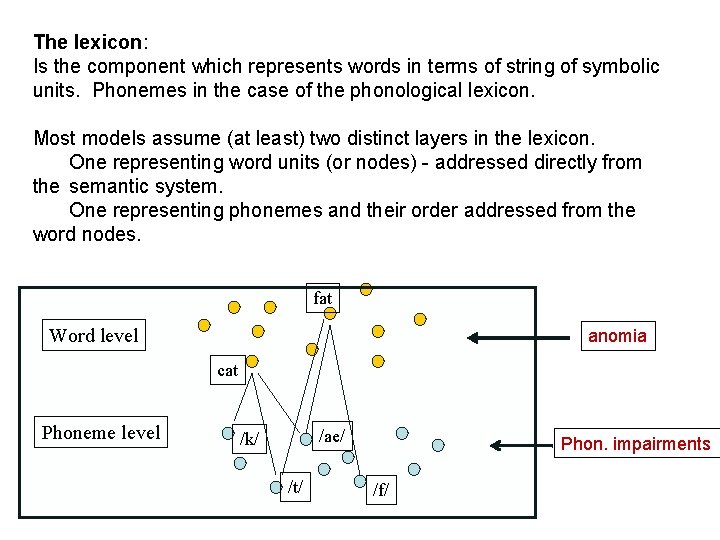
The lexicon: Is the component which represents words in terms of string of symbolic units. Phonemes in the case of the phonological lexicon. Most models assume (at least) two distinct layers in the lexicon. One representing word units (or nodes) - addressed directly from the semantic system. One representing phonemes and their order addressed from the word nodes. fat Word level anomia cat Phoneme level /ae/ /k/ /t/ Phon. impairments /f/
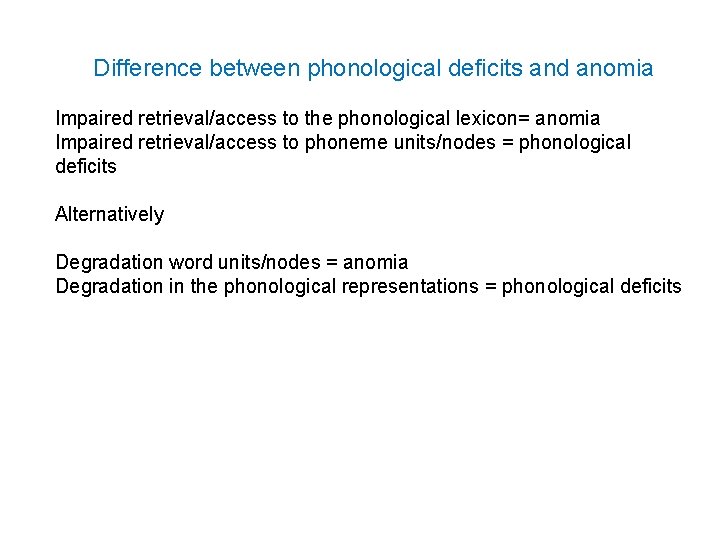
Difference between phonological deficits and anomia Impaired retrieval/access to the phonological lexicon= anomia Impaired retrieval/access to phoneme units/nodes = phonological deficits Alternatively Degradation word units/nodes = anomia Degradation in the phonological representations = phonological deficits
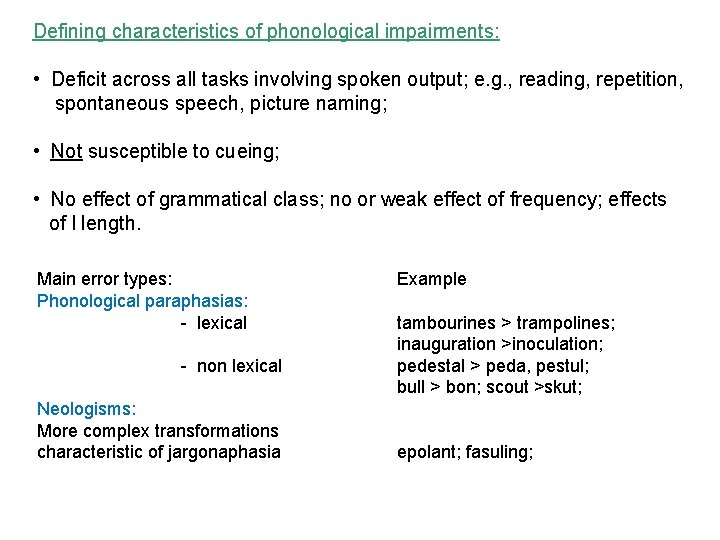
Defining characteristics of phonological impairments: • Deficit across all tasks involving spoken output; e. g. , reading, repetition, spontaneous speech, picture naming; • Not susceptible to cueing; • No effect of grammatical class; no or weak effect of frequency; effects of l length. Main error types: Phonological paraphasias: - lexical - non lexical Neologisms: More complex transformations characteristic of jargonaphasia Example tambourines > trampolines; inauguration >inoculation; pedestal > peda, pestul; bull > bon; scout >skut; epolant; fasuling;
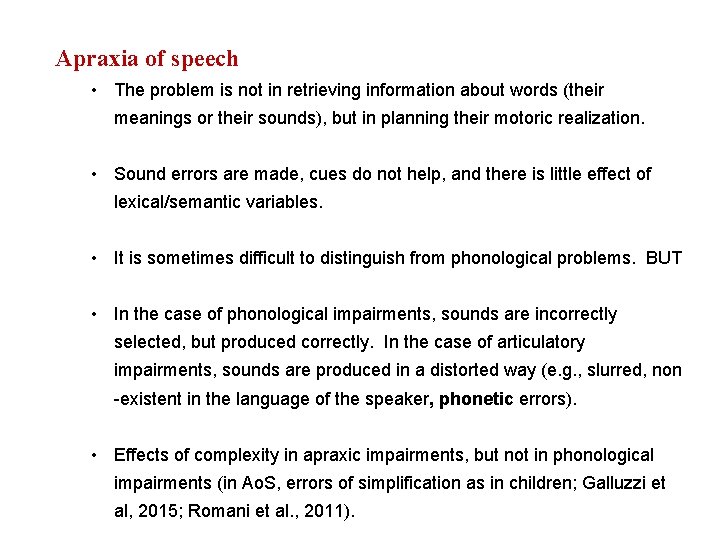
Apraxia of speech • The problem is not in retrieving information about words (their meanings or their sounds), but in planning their motoric realization. • Sound errors are made, cues do not help, and there is little effect of lexical/semantic variables. • It is sometimes difficult to distinguish from phonological problems. BUT • In the case of phonological impairments, sounds are incorrectly selected, but produced correctly. In the case of articulatory impairments, sounds are produced in a distorted way (e. g. , slurred, non -existent in the language of the speaker, phonetic errors). • Effects of complexity in apraxic impairments, but not in phonological impairments (in Ao. S, errors of simplification as in children; Galluzzi et al, 2015; Romani et al. , 2011).
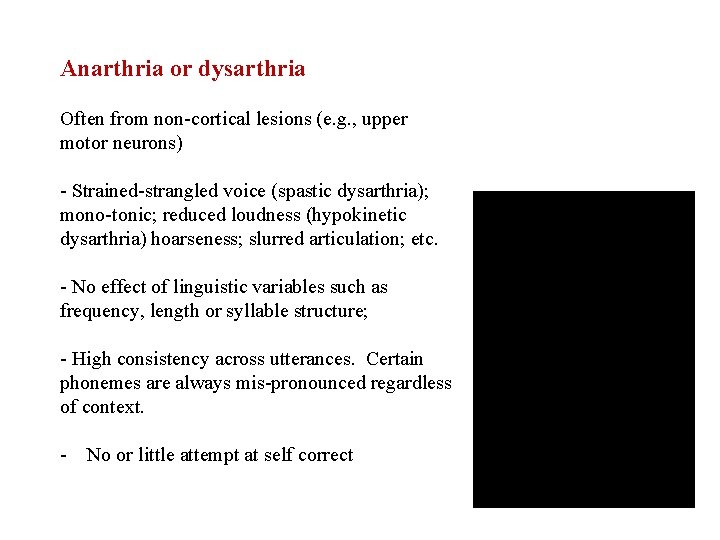
Anarthria or dysarthria Often from non-cortical lesions (e. g. , upper motor neurons) - Strained-strangled voice (spastic dysarthria); mono-tonic; reduced loudness (hypokinetic dysarthria) hoarseness; slurred articulation; etc. - No effect of linguistic variables such as frequency, length or syllable structure; - High consistency across utterances. Certain phonemes are always mis-pronounced regardless of context. - No or little attempt at self correct
IMPAIRMENTS OF SENTENCE PROCESSING
Impairments of sentence comprehension In order to understand a sentence, it is necessary not only to understand the meaning of individual words, but also to process word order, inflections and function words (prepositions, articles, pronouns). Compare: The boy is chasing the dog The boy is chased by the dog The dog is chasing the boy The dog is chased by the boy
Aphasics are often fine when comprehension depends solely on individual word meanings (e. g. , semantically irreversible sentences: The boy is eating the ice-cream). But not when comprehension requires processing grammatical information (e. g. , semantically reversible sentence: The boy is chasing the dog). This is called agrammatic comprehension.
Impairments of sentence production Sentences lack any grammatical structure. Inflections and function words are omitted. Thus, speech has a telegraphic quality (e. g. , boy…chase…squirrel). It is the opposite of anomia where the grammatical structure of the sentence is present, but content words are lacking (The, the …. is is … going after the…. animal). Content words Nouns (table, skirt, jealousy etc. ) Verbs (to love, to be etc. ) Adjectives (cute, nasty etc. ) Function words Prepositions (in, inside, for etc. ) Pronouns (I, me, them etc. ) Inflections (ed, ing, ness etc. )
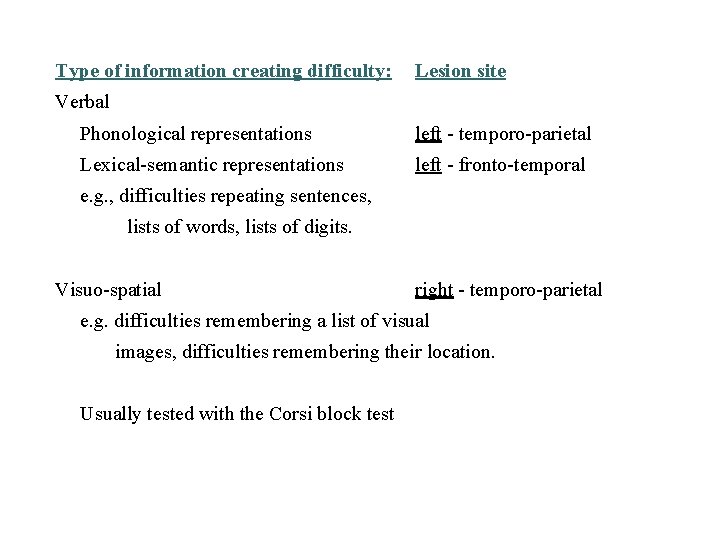
IMPAIRMENTS OF STM is the capacity to keep simultaneously in mind a certain amount of information. STM is also called working memory because the information is usually used to carry out a cognitive task (e. g. , spelling a word, performing a mental calculation etc. . ). Impairments can be specific for different types of information.
Type of information creating difficulty: Lesion site Verbal Phonological representations left - temporo-parietal Lexical-semantic representations left - fronto-temporal e. g. , difficulties repeating sentences, lists of words, lists of digits. Visuo-spatial right - temporo-parietal e. g. difficulties remembering a list of visual images, difficulties remembering their location. Usually tested with the Corsi block test
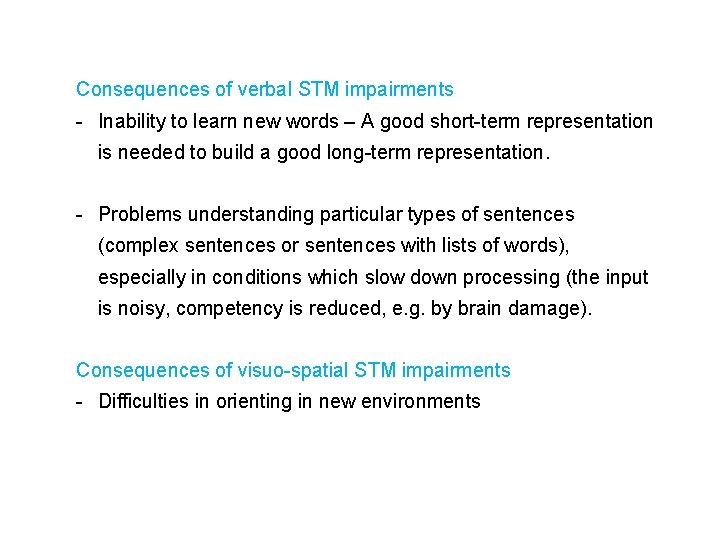
Consequences of verbal STM impairments - Inability to learn new words – A good short-term representation is needed to build a good long-term representation. - Problems understanding particular types of sentences (complex sentences or sentences with lists of words), especially in conditions which slow down processing (the input is noisy, competency is reduced, e. g. by brain damage). Consequences of visuo-spatial STM impairments - Difficulties in orienting in new environments
OPTIC APHASIA
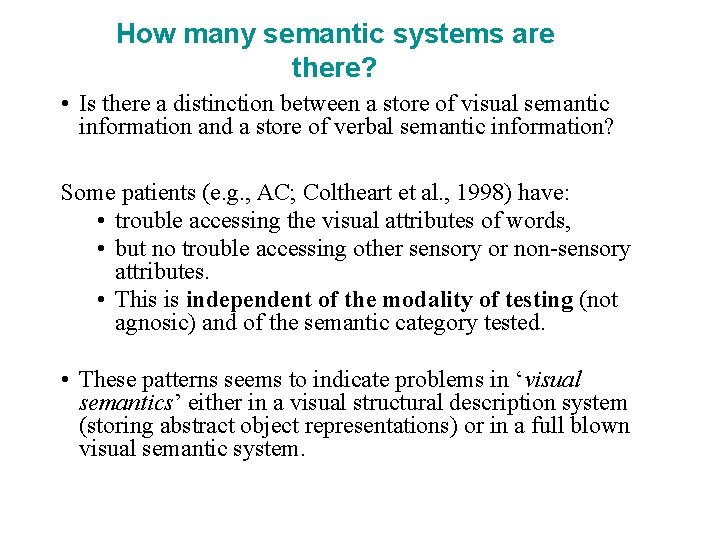
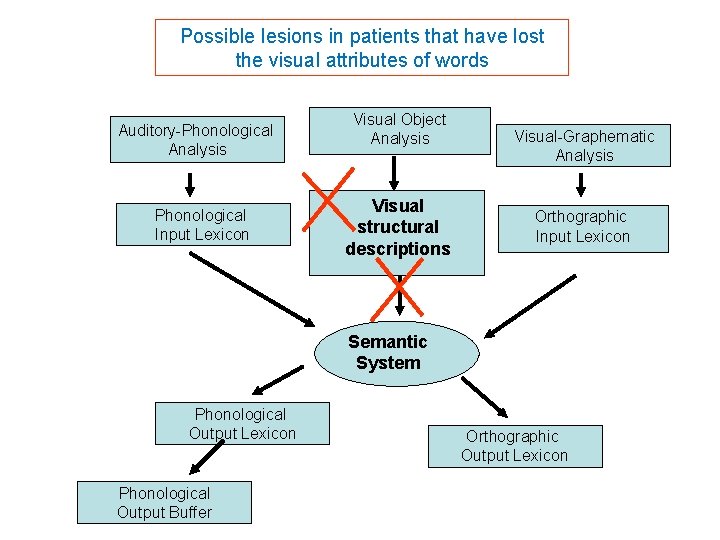
How many semantic systems are there? • Is there a distinction between a store of visual semantic information and a store of verbal semantic information? Some patients (e. g. , AC; Coltheart et al. , 1998) have: • trouble accessing the visual attributes of words, • but no trouble accessing other sensory or non-sensory attributes. • This is independent of the modality of testing (not agnosic) and of the semantic category tested. • These patterns seems to indicate problems in ‘visual semantics’ either in a visual structural description system (storing abstract object representations) or in a full blown visual semantic system.
Possible lesions in patients that have lost the visual attributes of words Auditory-Phonological Analysis Phonological Input Lexicon Visual Object Analysis Visual structural descriptions Visual-Graphematic Analysis Orthographic Input Lexicon Semantic System Phonological Output Lexicon Phonological Output Buffer Orthographic Output Lexicon
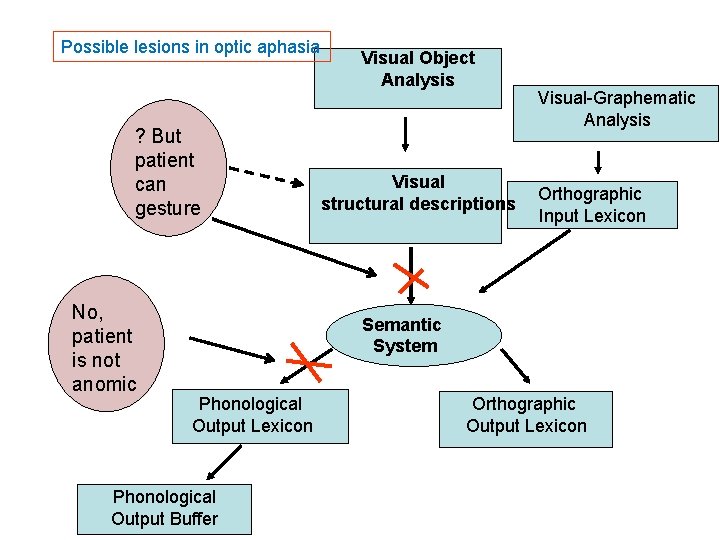
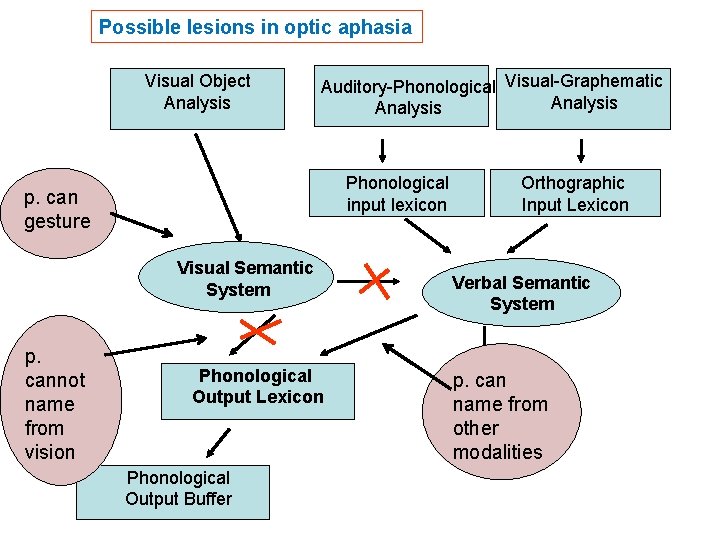
The puzzle of optic aphasia Optic aphasia – patients are unable to name objects when presented visually (but not in other modalities). However, they are still able to show that they recognize the object in other ways; e. g. , they are able to gesture appropriately. So these patients do not have visual agnosia and are not anomic. Why they cannot name visually presented objects?
Where would you put the damage in optic aphasia? Discuss in groups of three Patient characteristics: • cannot name from visual modality • but not from other modalities • knows about visual attribute + can gesture
Possible lesions in optic aphasia ? But patient can gesture No, patient is not anomic Visual Object Analysis Visual structural descriptions Visual-Graphematic Analysis Orthographic Input Lexicon Semantic System Phonological Output Lexicon Phonological Output Buffer Orthographic Output Lexicon
Possible lesions in optic aphasia Visual Object Analysis Auditory-Phonological Visual-Graphematic Analysis Phonological input lexicon p. can gesture Visual Semantic System p. cannot name from vision Phonological Output Lexicon Phonological Output Buffer Orthographic Input Lexicon Verbal Semantic System p. can name from other modalities
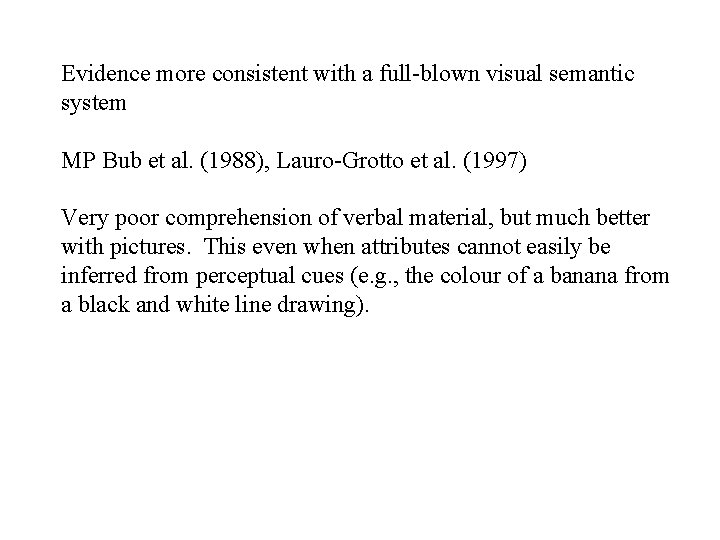
Evidence more consistent with a full-blown visual semantic system MP Bub et al. (1988), Lauro-Grotto et al. (1997) Very poor comprehension of verbal material, but much better with pictures. This even when attributes cannot easily be inferred from perceptual cues (e. g. , the colour of a banana from a black and white line drawing).
At the end of this lecture and after the related readings you should be able to: • Understand how models of speech comprehension and production provide a framework to identify different types of aphasic impairments • Be able to describe the main characteristics of aphasic impairments in light of these models • Be able to decide what type of assessment to use to distinguish different types of impairments
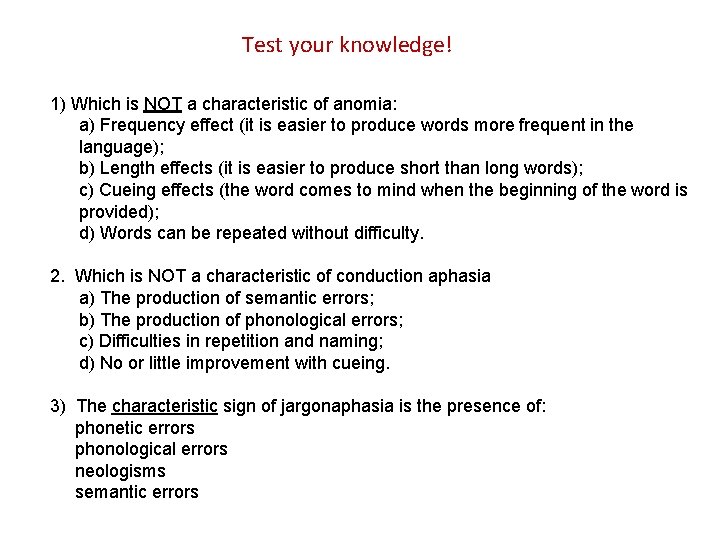
Test your knowledge! 1) Which is NOT a characteristic of anomia: a) Frequency effect (it is easier to produce words more frequent in the language); b) Length effects (it is easier to produce short than long words); c) Cueing effects (the word comes to mind when the beginning of the word is provided); d) Words can be repeated without difficulty. 2. Which is NOT a characteristic of conduction aphasia a) The production of semantic errors; b) The production of phonological errors; c) Difficulties in repetition and naming; d) No or little improvement with cueing. 3) The characteristic sign of jargonaphasia is the presence of: phonetic errors phonological errors neologisms semantic errors
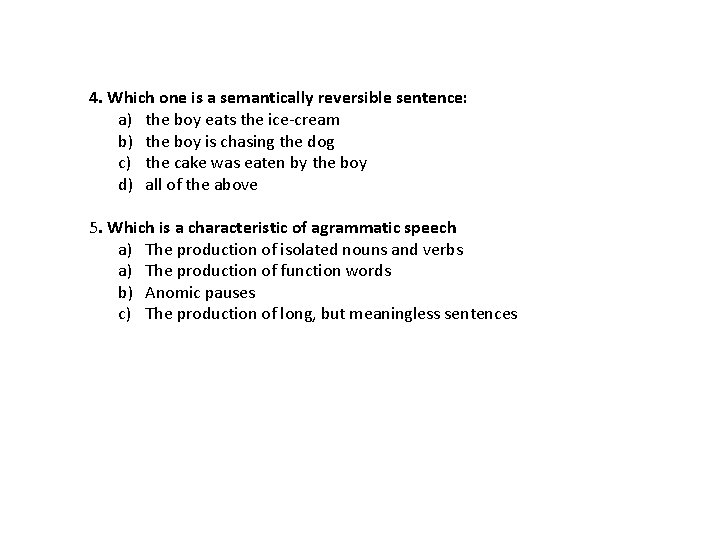
4. Which one is a semantically reversible sentence: a) the boy eats the ice-cream b) the boy is chasing the dog c) the cake was eaten by the boy d) all of the above 5. Which is a characteristic of agrammatic speech a) The production of isolated nouns and verbs a) The production of function words b) Anomic pauses c) The production of long, but meaningless sentences
Readings for this and previous lecture: Either: • Banich, M. , & Compton (2011). Chapter 9 – Language. • Kolb, B. , & Whishaw, Q. (2008). Chapter 15. 3, 19 - Language. • Ellis, A. W. , & Young, A. W. (1989). Chapters 1, 5, and 6. • Parkin, A. J. (1999). Chapter 7; Spoken Language impairments. Further readings: Prins, R. & Bastiaanse, R. (2006). History of Aphasia. The early history of aphasiology: From the Egyptian surgeons (c 1700 BC) to Broca (1961). Aphasiology, 20, 8, 762 -791. Rapp, B. (2001). The handbook of cognitive neuropsychology: What deficits reveal about the human mind. Philadelphia, Pa. ; Hove: Psychology Press. Chapter 12, Spoken word production. For optic aphasia (just look at a couple of articles): Sitton, M. , Mozer, M. C. , & Farah, M. J. (2000). Superadditive effects of multiple lesions in a connectivist architecture: Implications for the neuropsychology of optic aphasia. Psychological Review, 107(4), 709734. Hillis, A. E. , & Caramazza, A. (1995). Cognitive and neural mechanisms underlying visual and semantic processing: Implications from optic aphasia. Journal of Cognitive Neuroscience, 7(4), 457 -478. Davidoff, J & De Bleser, R. (1993). Optic aphasia: A review of past studies and reappraisal. Aphasiology, 7 (2), 135 -154. Riddoch, J. , & Humphreys, G. W. (1987). Visual object processing in optic aphasia: A case of semantic access agnosia. Cognitive Neuropsychology, 4 (2), 131 -185.