
APE group Status of the APEnet project davide
- Slides: 47
APE group Status of the APEnet+ project davide. rossetti@roma 1. infn. it Lattice 2011 Squaw Valley, Jul 10 -16, 2011
Index APE group • • GPU accelerated cluster and the APEnet+ interconnect Requirements from LQCD application(s) The platform constraints: PCIe, links Accelerating the accelerator Programming model The RDMA API CUOS Future devel Jul 11 th 2011 D. Rossetti, Lattice 2011 2
The APEnet+ History APE group • Custom HPC platform: APE (86), APE 100 (94), APEmille (99), ape. NEXT (04) • Cluster Interconnect: – 2003 -2004: APEnet V 3 – 2005: APEnet V 3+, same HW with RDMA API – 2006 -2009: DNP, or APEnet goes embedded – 2011: APEnet V 4 aka APEnet+ Jul 11 th 2011 D. Rossetti, Lattice 2011 3
Why a GPU cluster today APE group GPU cluster has: • Very good flops/$ W/$ ratios • Readily available • Developer friendly, same technology from laptop to cluster • Good support from industry • Active developments for LQCD Missing piece: a good network interconnect Jul 11 th 2011 D. Rossetti, Lattice 2011 4
APEnet+ HW APE group • Logic structure • Test card • Final card CAVEAT: immature situation, rapidly converging Very early figures, improving every day Releasing conservative assumptions Eg: in a few hours, from 30 us to 7 us latency Jul 11 th 2011 D. Rossetti, Lattice 2011 5
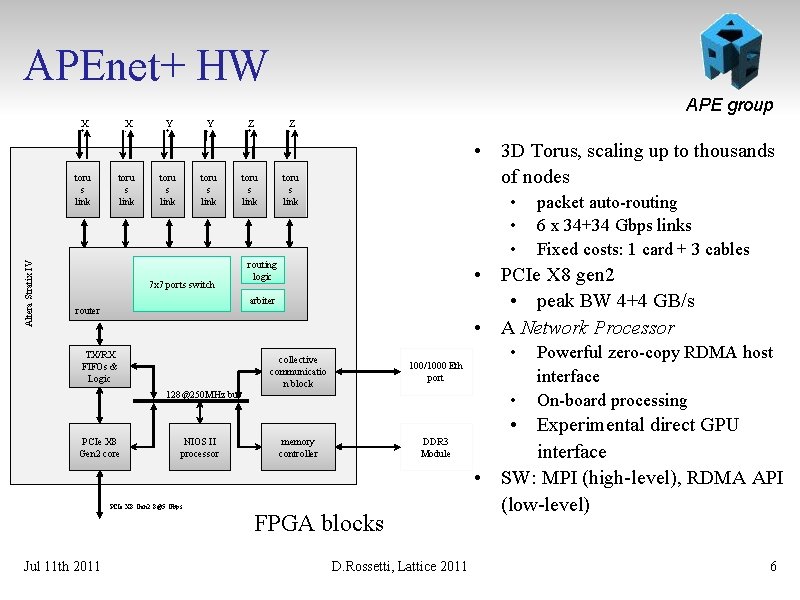
APEnet+ HW APE group X X + Altera Stratix IV toru s link - toru s link Y Y + Z - toru s link 7 x 7 ports switch • 3 D Torus, scaling up to thousands of nodes toru s link • • • routing logic TX/RX FIFOs & Logic 128@250 MHz bus PCIe X 8 Gen 2 core NIOS II processor PCIe X 8 Gen 2 8@5 Gbps packet auto-routing 6 x 34+34 Gbps links Fixed costs: 1 card + 3 cables • PCIe X 8 gen 2 • peak BW 4+4 GB/s • A Network Processor arbiter router Jul 11 th 2011 Z + collective communicatio n block 100/1000 Eth port • • memory controller DDR 3 Module FPGA blocks D. Rossetti, Lattice 2011 Powerful zero-copy RDMA host interface On-board processing • Experimental direct GPU interface • SW: MPI (high-level), RDMA API (low-level) 6
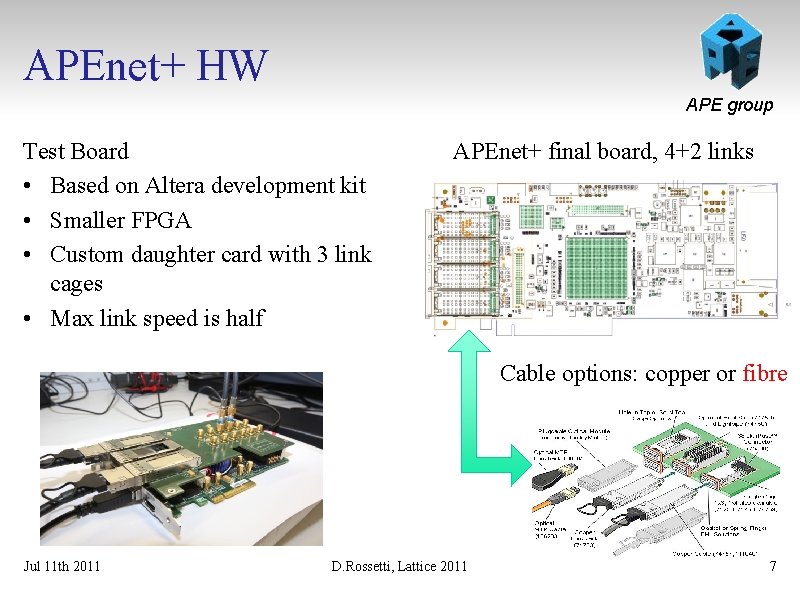
APEnet+ HW APE group Test Board • Based on Altera development kit • Smaller FPGA • Custom daughter card with 3 link cages • Max link speed is half APEnet+ final board, 4+2 links Cable options: copper or fibre Jul 11 th 2011 D. Rossetti, Lattice 2011 7
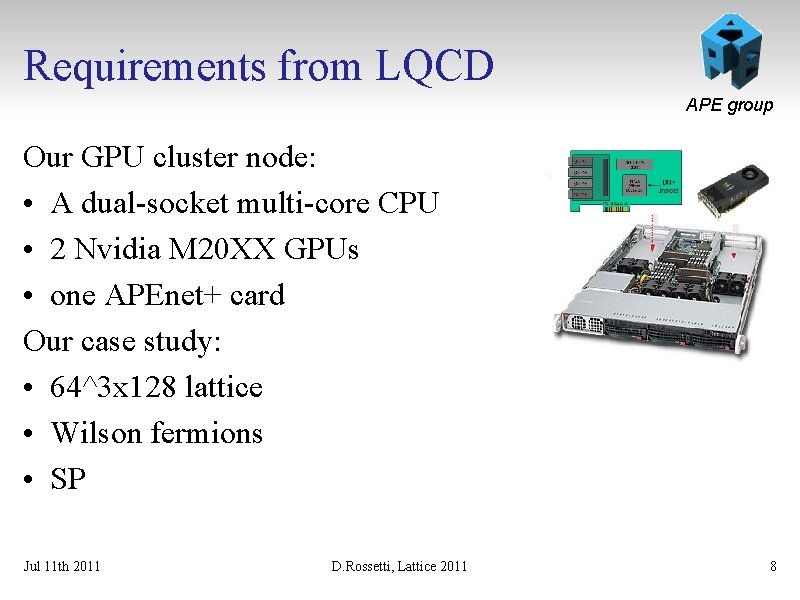
Requirements from LQCD APE group Our GPU cluster node: • A dual-socket multi-core CPU • 2 Nvidia M 20 XX GPUs • one APEnet+ card Our case study: • 64^3 x 128 lattice • Wilson fermions • SP Jul 11 th 2011 D. Rossetti, Lattice 2011 8
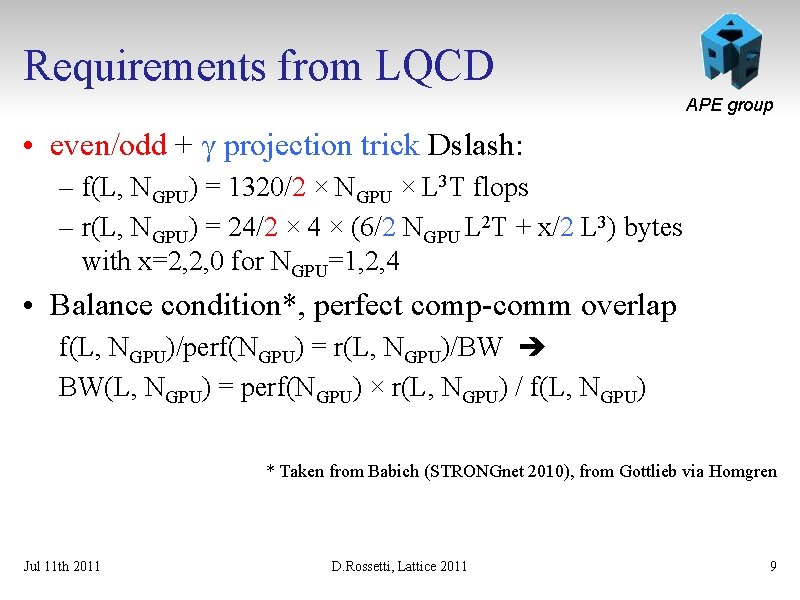
Requirements from LQCD APE group • even/odd + γ projection trick Dslash: – f(L, NGPU) = 1320/2 × NGPU × L 3 T flops – r(L, NGPU) = 24/2 × 4 × (6/2 NGPU L 2 T + x/2 L 3) bytes with x=2, 2, 0 for NGPU=1, 2, 4 • Balance condition*, perfect comp-comm overlap f(L, NGPU)/perf(NGPU) = r(L, NGPU)/BW BW(L, NGPU) = perf(NGPU) × r(L, NGPU) / f(L, NGPU) * Taken from Babich (STRONGnet 2010), from Gottlieb via Homgren Jul 11 th 2011 D. Rossetti, Lattice 2011 9
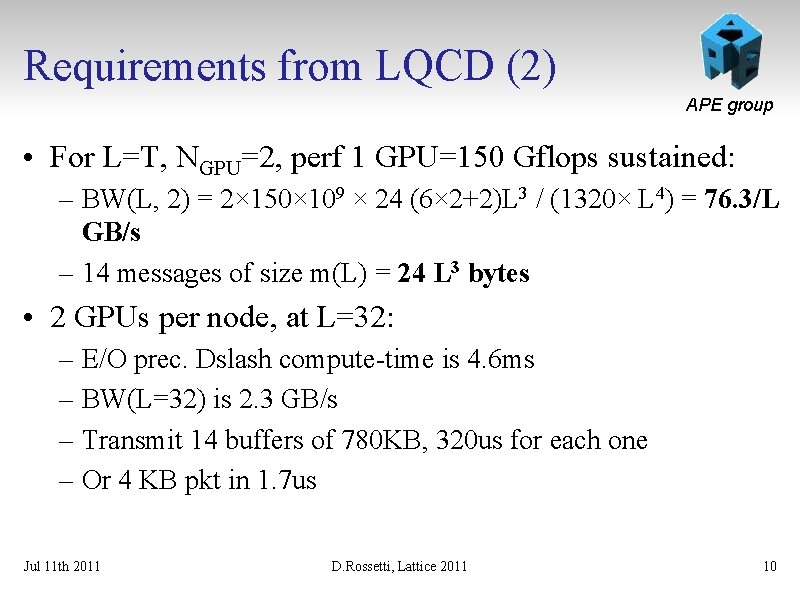
Requirements from LQCD (2) APE group • For L=T, NGPU=2, perf 1 GPU=150 Gflops sustained: – BW(L, 2) = 2× 150× 109 × 24 (6× 2+2)L 3 / (1320× L 4) = 76. 3/L GB/s – 14 messages of size m(L) = 24 L 3 bytes • 2 GPUs per node, at L=32: – E/O prec. Dslash compute-time is 4. 6 ms – BW(L=32) is 2. 3 GB/s – Transmit 14 buffers of 780 KB, 320 us for each one – Or 4 KB pkt in 1. 7 us Jul 11 th 2011 D. Rossetti, Lattice 2011 10
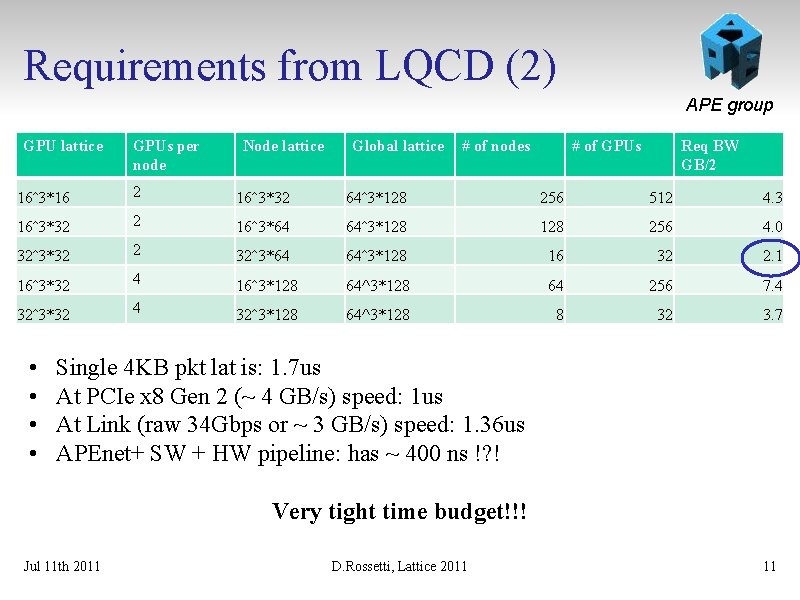
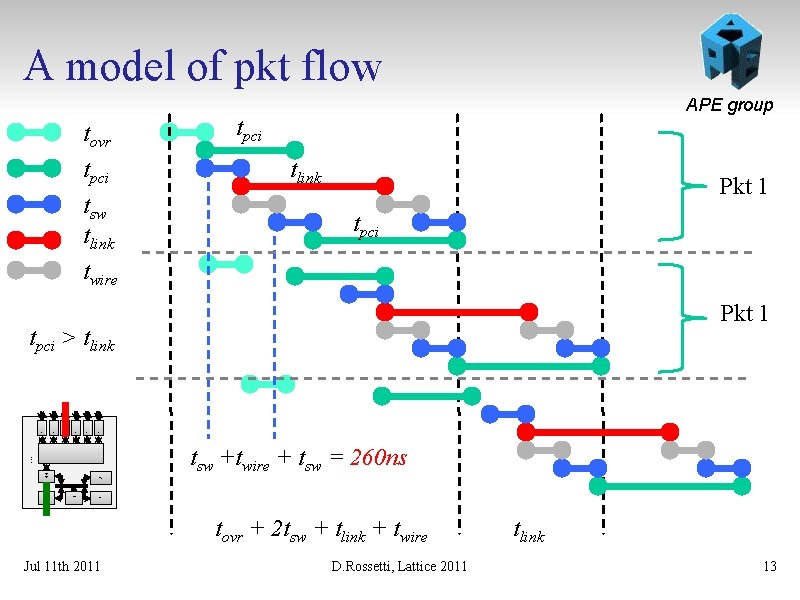
Requirements from LQCD (2) APE group GPU lattice GPUs per node Node lattice Global lattice # of nodes # of GPUs Req BW GB/2 16ˆ3*16 2 16ˆ3*32 64ˆ3*128 256 512 4. 3 16ˆ3*32 2 16ˆ3*64 64ˆ3*128 256 4. 0 32ˆ3*32 2 32ˆ3*64 64ˆ3*128 16 32 2. 1 16ˆ3*32 4 16ˆ3*128 64^3*128 64 256 7. 4 32ˆ3*32 4 32ˆ3*128 64^3*128 8 32 3. 7 • • Single 4 KB pkt lat is: 1. 7 us At PCIe x 8 Gen 2 (~ 4 GB/s) speed: 1 us At Link (raw 34 Gbps or ~ 3 GB/s) speed: 1. 36 us APEnet+ SW + HW pipeline: has ~ 400 ns !? ! Very tight time budget!!! Jul 11 th 2011 D. Rossetti, Lattice 2011 11
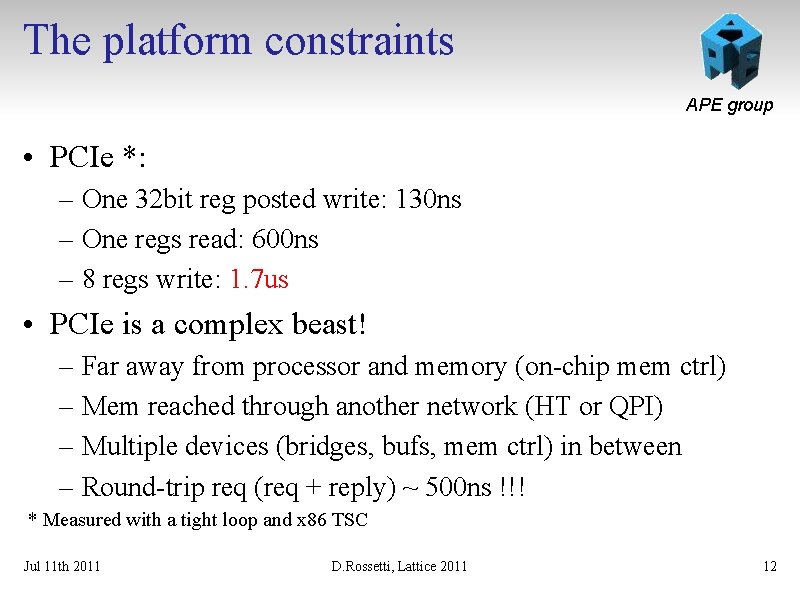
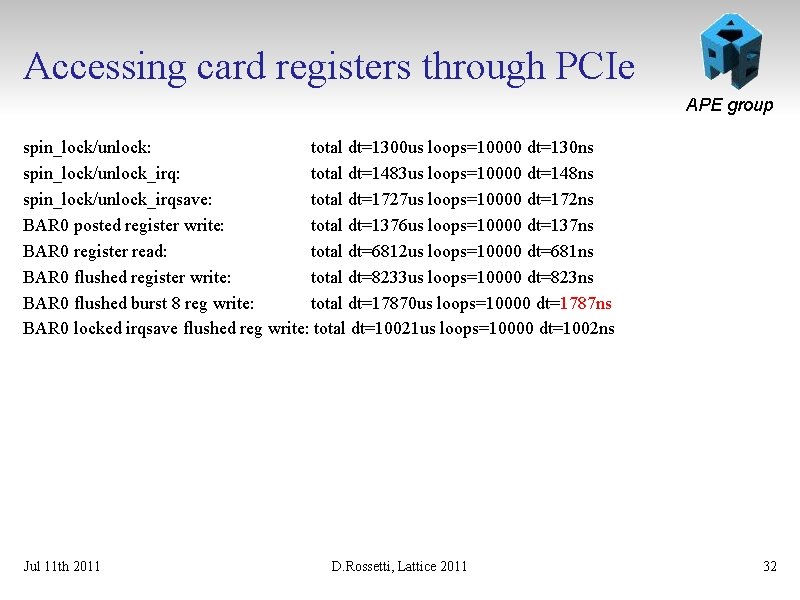
The platform constraints APE group • PCIe *: – One 32 bit reg posted write: 130 ns – One regs read: 600 ns – 8 regs write: 1. 7 us • PCIe is a complex beast! – Far away from processor and memory (on-chip mem ctrl) – Mem reached through another network (HT or QPI) – Multiple devices (bridges, bufs, mem ctrl) in between – Round-trip req (req + reply) ~ 500 ns !!! * Measured with a tight loop and x 86 TSC Jul 11 th 2011 D. Rossetti, Lattice 2011 12
A model of pkt flow tovr tpci tsw tlink twire APE group tpci tlink Pkt 1 tpci > tlink Altera Stratix IV t o r u s l i n k t o r u s l i n k tsw +twire + tsw = 260 ns router TX/R X FIFOs & Logic collective communicatio n block 128@250 MHz bus PCIe X 8 Gen 2 core NIOS II proce ssor memory controller tovr + 2 tsw + tlink + twire Jul 11 th 2011 D. Rossetti, Lattice 2011 tlink 13
Hard times APE group Two different traffic patterns: • Exchanging big messages is good – Multiple consecutive pkts – Hidden latencies – Every pkt latency (but the 1 st ) dominated by tlink • A classical latency test (ping-pong, single pkt, down to 1 byte payload) is really hard – Can’t neglect setup and teardown effects – Hit by full latency every time – Need very clever host-card HW interface Jul 11 th 2011 D. Rossetti, Lattice 2011 14
GPU support APE group Some HW features developed for GPU • P 2 P • Direct GPU Jul 11 th 2011 D. Rossetti, Lattice 2011 15
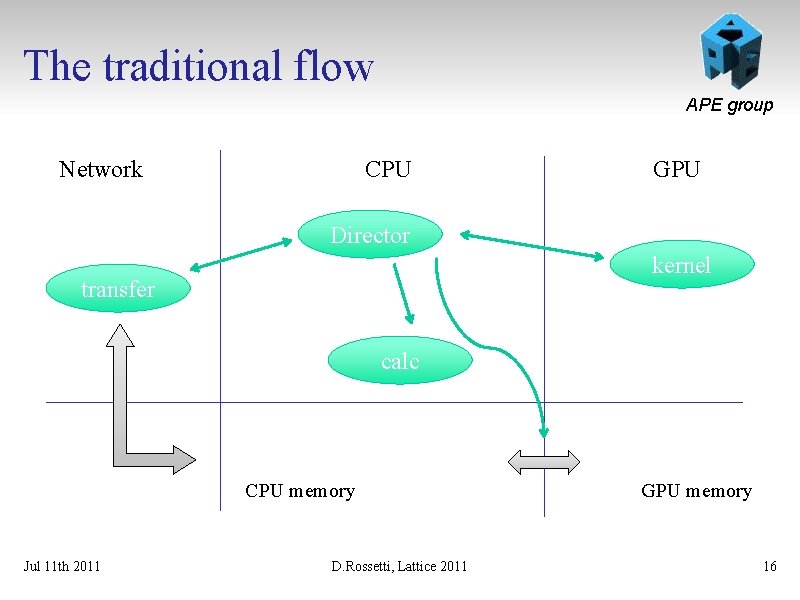
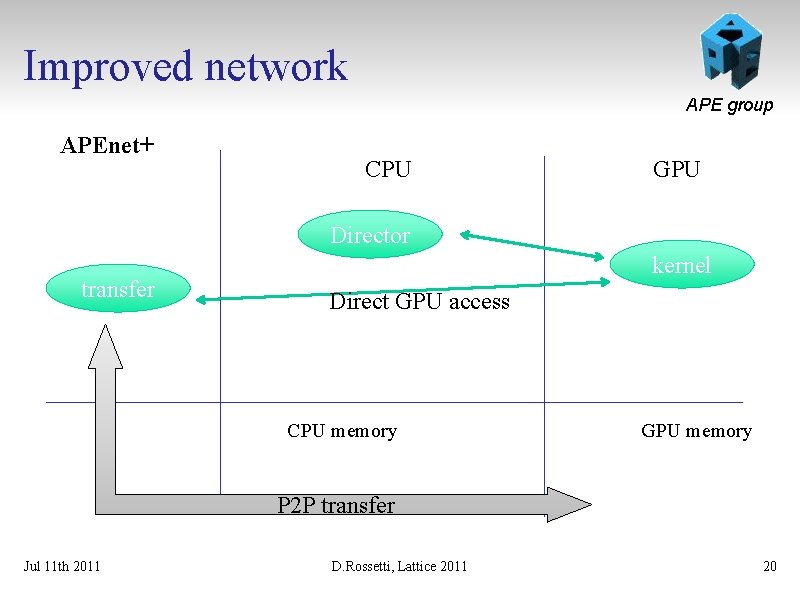
The traditional flow APE group Network CPU GPU Director kernel transfer calc CPU memory Jul 11 th 2011 D. Rossetti, Lattice 2011 GPU memory 16
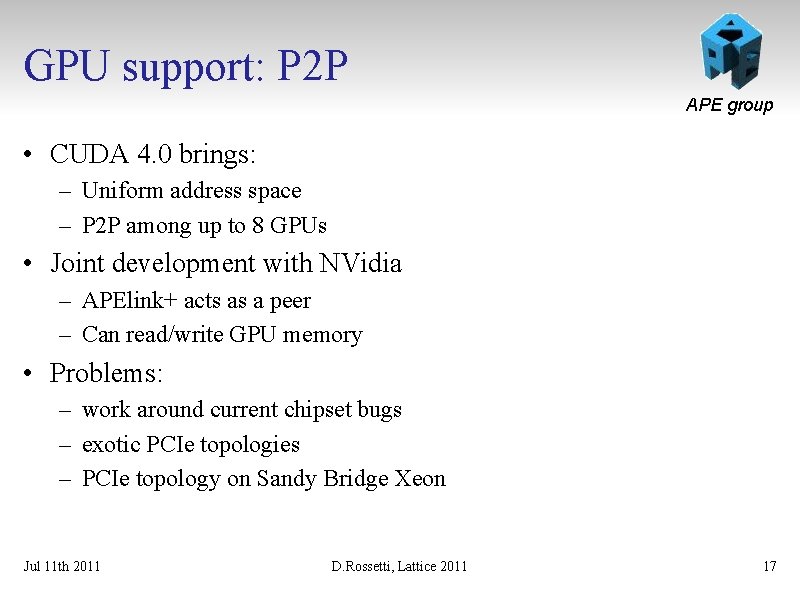
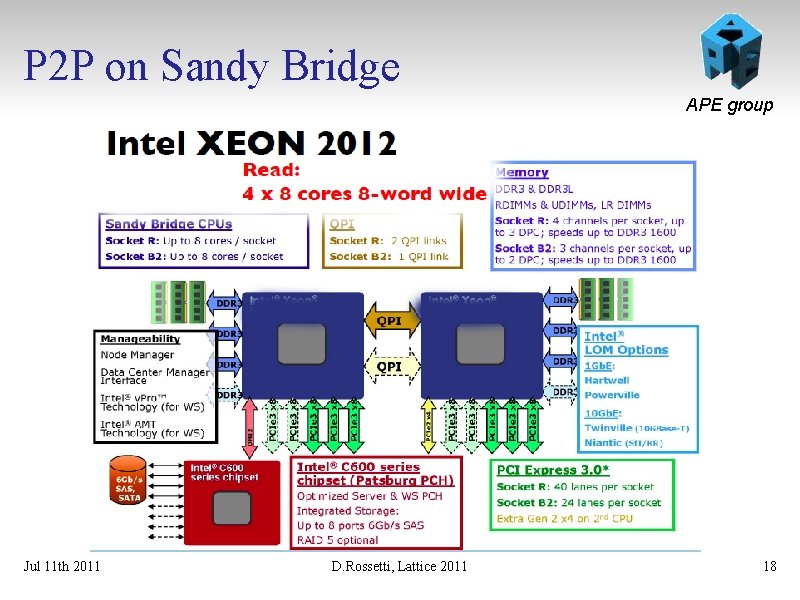
GPU support: P 2 P APE group • CUDA 4. 0 brings: – Uniform address space – P 2 P among up to 8 GPUs • Joint development with NVidia – APElink+ acts as a peer – Can read/write GPU memory • Problems: – work around current chipset bugs – exotic PCIe topologies – PCIe topology on Sandy Bridge Xeon Jul 11 th 2011 D. Rossetti, Lattice 2011 17
P 2 P on Sandy Bridge APE group Jul 11 th 2011 D. Rossetti, Lattice 2011 18
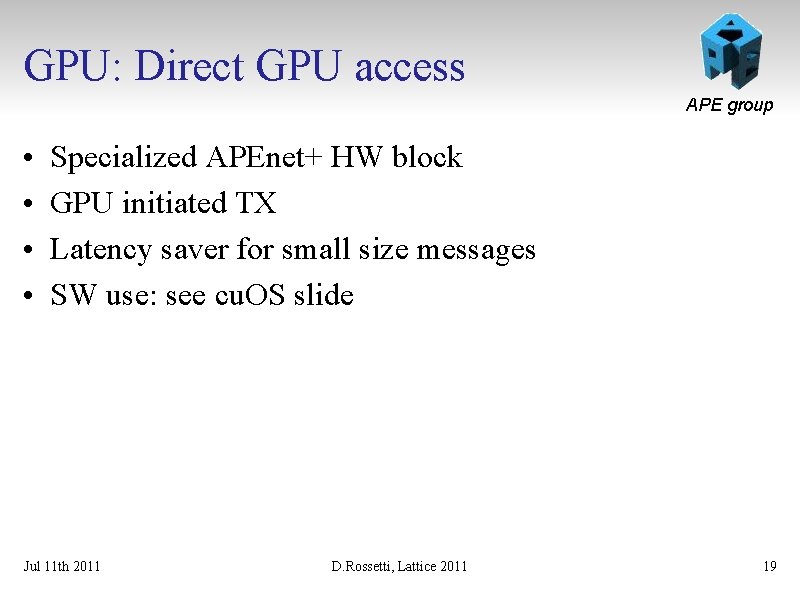
GPU: Direct GPU access APE group • • Specialized APEnet+ HW block GPU initiated TX Latency saver for small size messages SW use: see cu. OS slide Jul 11 th 2011 D. Rossetti, Lattice 2011 19
Improved network APE group APEnet+ CPU GPU Director transfer kernel Direct GPU access CPU memory GPU memory P 2 P transfer Jul 11 th 2011 D. Rossetti, Lattice 2011 20
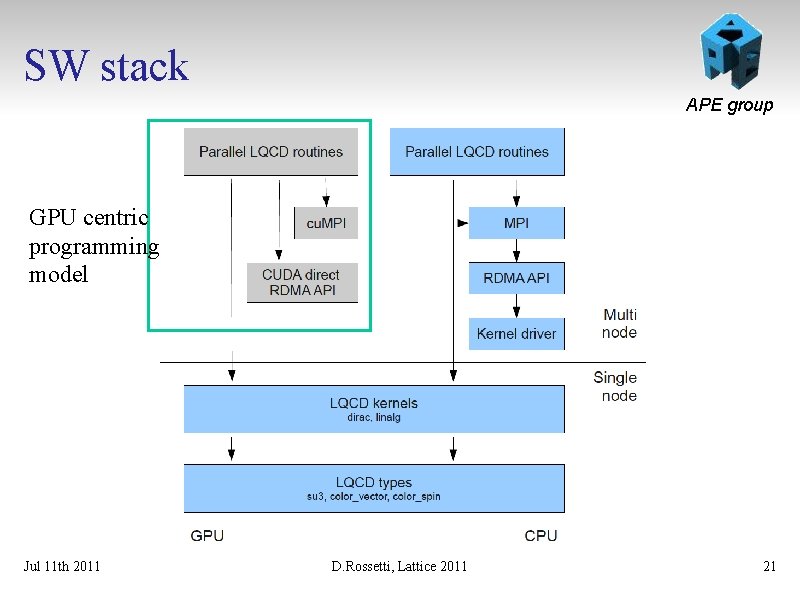
SW stack APE group GPU centric programming model Jul 11 th 2011 D. Rossetti, Lattice 2011 21
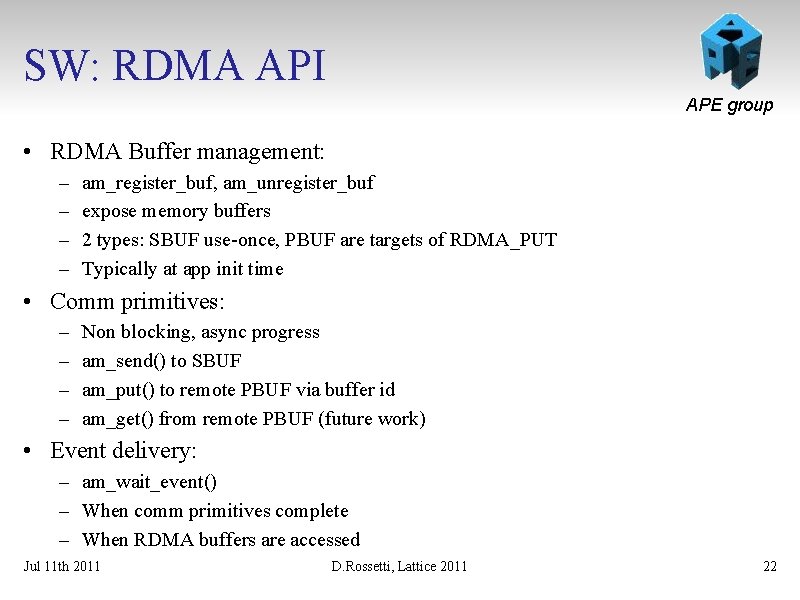
SW: RDMA API APE group • RDMA Buffer management: – – am_register_buf, am_unregister_buf expose memory buffers 2 types: SBUF use-once, PBUF are targets of RDMA_PUT Typically at app init time • Comm primitives: – – Non blocking, async progress am_send() to SBUF am_put() to remote PBUF via buffer id am_get() from remote PBUF (future work) • Event delivery: – am_wait_event() – When comm primitives complete – When RDMA buffers are accessed Jul 11 th 2011 D. Rossetti, Lattice 2011 22
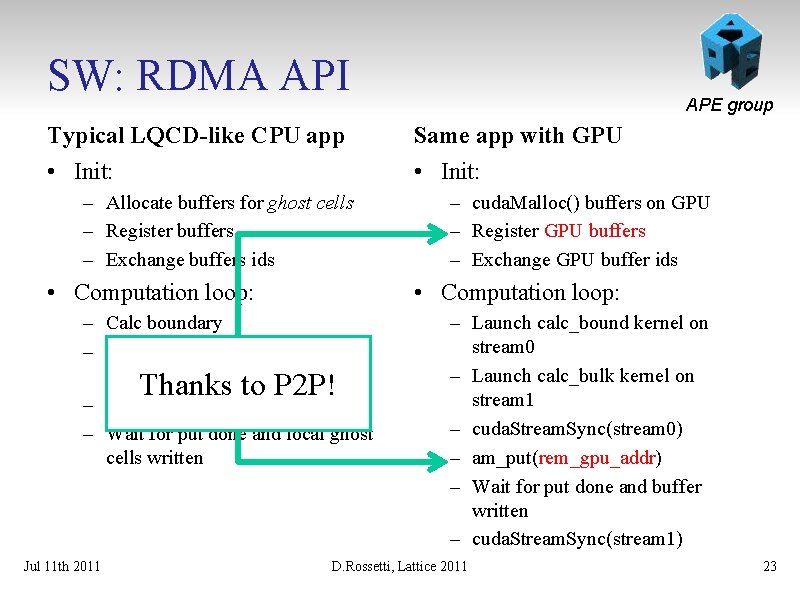
SW: RDMA API APE group Typical LQCD-like CPU app Same app with GPU • Init: – Allocate buffers for ghost cells – Register buffers – Exchange buffers ids • Computation loop: – Calc boundary – am_put boundary to neighbors buffers Thanks to P 2 P! – Calc bulk – Wait for put done and local ghost cells written Jul 11 th 2011 – cuda. Malloc() buffers on GPU – Register GPU buffers – Exchange GPU buffer ids – Launch calc_bound kernel on stream 0 – Launch calc_bulk kernel on stream 1 – cuda. Stream. Sync(stream 0) – am_put(rem_gpu_addr) – Wait for put done and buffer written – cuda. Stream. Sync(stream 1) D. Rossetti, Lattice 2011 23
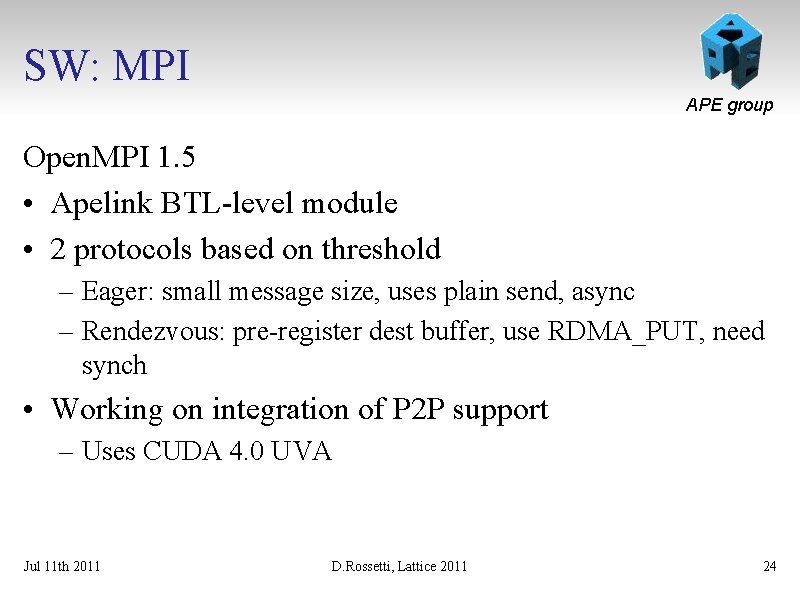
SW: MPI APE group Open. MPI 1. 5 • Apelink BTL-level module • 2 protocols based on threshold – Eager: small message size, uses plain send, async – Rendezvous: pre-register dest buffer, use RDMA_PUT, need synch • Working on integration of P 2 P support – Uses CUDA 4. 0 UVA Jul 11 th 2011 D. Rossetti, Lattice 2011 24
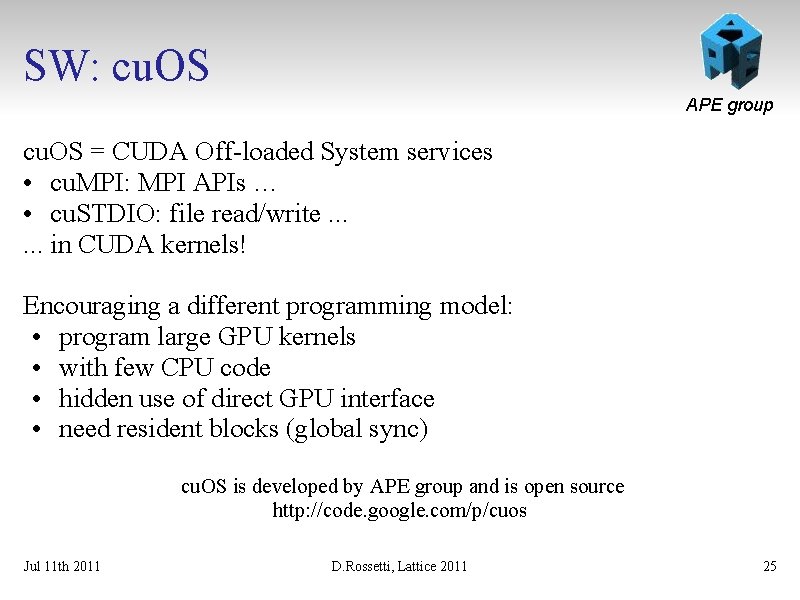
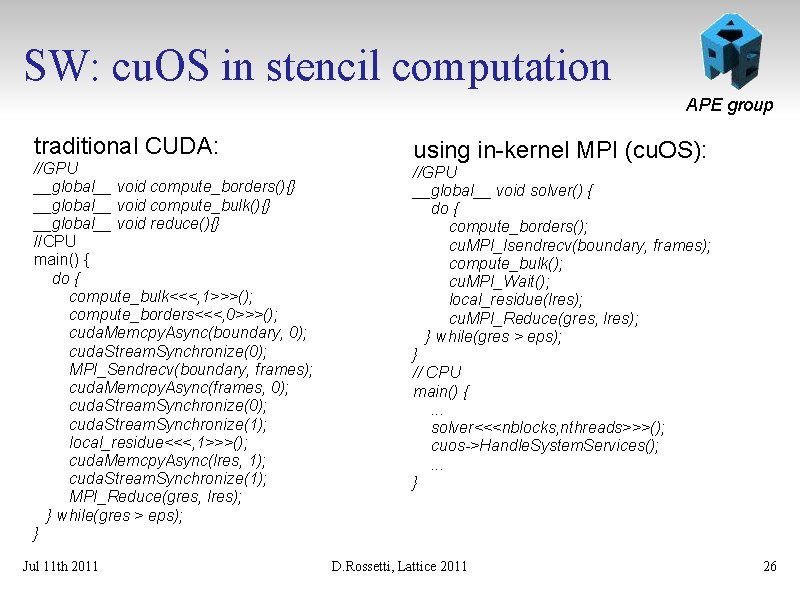
SW: cu. OS APE group cu. OS = CUDA Off-loaded System services • cu. MPI: MPI APIs … • cu. STDIO: file read/write. . . in CUDA kernels! Encouraging a different programming model: • program large GPU kernels • with few CPU code • hidden use of direct GPU interface • need resident blocks (global sync) cu. OS is developed by APE group and is open source http: //code. google. com/p/cuos Jul 11 th 2011 D. Rossetti, Lattice 2011 25
SW: cu. OS in stencil computation APE group traditional CUDA: //GPU __global__ void compute_borders(){} __global__ void compute_bulk(){} __global__ void reduce(){} //CPU main() { do { compute_bulk<<<, 1>>>(); compute_borders<<<, 0>>>(); cuda. Memcpy. Async(boundary, 0); cuda. Stream. Synchronize(0); MPI_Sendrecv(boundary, frames); cuda. Memcpy. Async(frames, 0); cuda. Stream. Synchronize(1); local_residue<<<, 1>>>(); cuda. Memcpy. Async(lres, 1); cuda. Stream. Synchronize(1); MPI_Reduce(gres, lres); } while(gres > eps); } Jul 11 th 2011 using in-kernel MPI (cu. OS): //GPU __global__ void solver() { do { compute_borders(); cu. MPI_Isendrecv(boundary, frames); compute_bulk(); cu. MPI_Wait(); local_residue(lres); cu. MPI_Reduce(gres, lres); } while(gres > eps); } // CPU main() { . . . solver<<<nblocks, nthreads>>>(); cuos->Handle. System. Services(); . . . } D. Rossetti, Lattice 2011 26
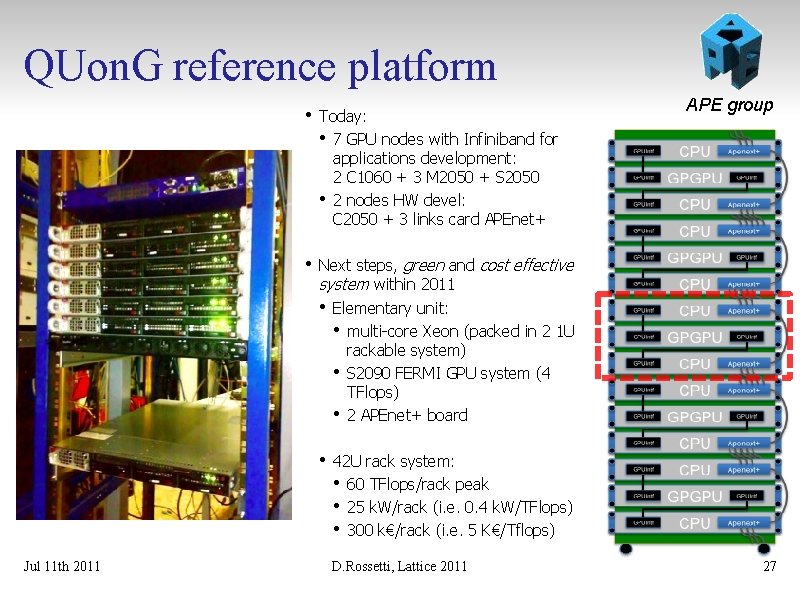
QUon. G reference platform • Today: • 7 GPU nodes with Infiniband for applications development: 2 C 1060 + 3 M 2050 + S 2050 • 2 nodes HW devel: C 2050 + 3 links card APEnet+ • Next steps, green and cost effective system within 2011 • Elementary unit: • multi-core Xeon (packed in 2 1 U rackable system) • S 2090 FERMI GPU system (4 TFlops) • 2 APEnet+ board • Jul 11 th 2011 APE group 42 U rack system: • 60 TFlops/rack peak • 25 k. W/rack (i. e. 0. 4 k. W/TFlops) • 300 k€/rack (i. e. 5 K€/Tflops) D. Rossetti, Lattice 2011 27
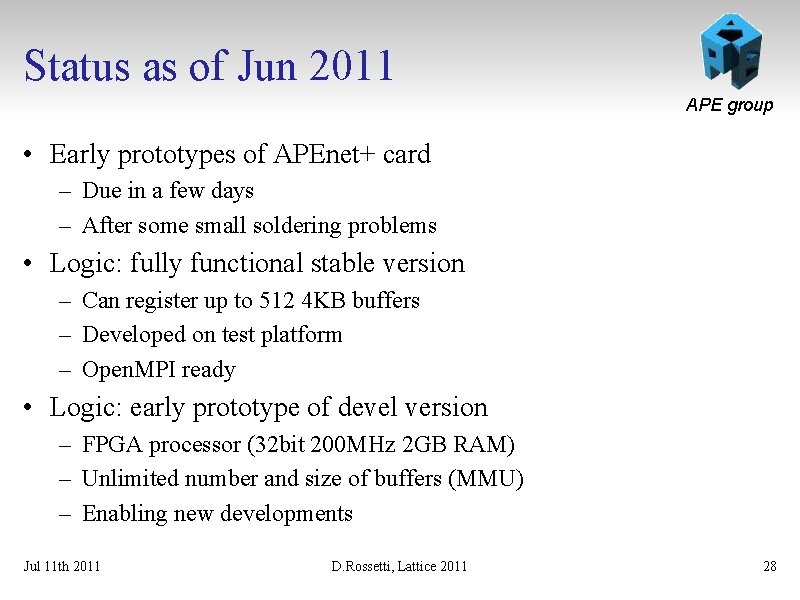
Status as of Jun 2011 APE group • Early prototypes of APEnet+ card – Due in a few days – After some small soldering problems • Logic: fully functional stable version – Can register up to 512 4 KB buffers – Developed on test platform – Open. MPI ready • Logic: early prototype of devel version – FPGA processor (32 bit 200 MHz 2 GB RAM) – Unlimited number and size of buffers (MMU) – Enabling new developments Jul 11 th 2011 D. Rossetti, Lattice 2011 28
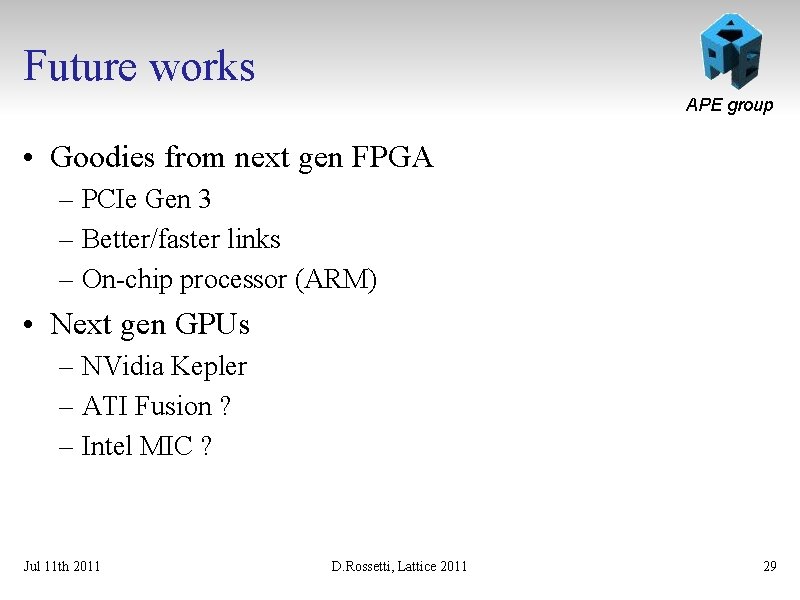
Future works APE group • Goodies from next gen FPGA – PCIe Gen 3 – Better/faster links – On-chip processor (ARM) • Next gen GPUs – NVidia Kepler – ATI Fusion ? – Intel MIC ? Jul 11 th 2011 D. Rossetti, Lattice 2011 29
Game over… APE group Let’s collaborate… we need you!!! Proposal to people interested in GPU for LQCD Why don’t me meet together, ½ hour, here in Squaw Valley ? ? ? Jul 11 th 2011 D. Rossetti, Lattice 2011 30
APE group Back up slides Jul 11 th 2011 D. Rossetti, Lattice 2011 31
Accessing card registers through PCIe APE group spin_lock/unlock: total dt=1300 us loops=10000 dt=130 ns spin_lock/unlock_irq: total dt=1483 us loops=10000 dt=148 ns spin_lock/unlock_irqsave: total dt=1727 us loops=10000 dt=172 ns BAR 0 posted register write: total dt=1376 us loops=10000 dt=137 ns BAR 0 register read: total dt=6812 us loops=10000 dt=681 ns BAR 0 flushed register write: total dt=8233 us loops=10000 dt=823 ns BAR 0 flushed burst 8 reg write: total dt=17870 us loops=10000 dt=1787 ns BAR 0 locked irqsave flushed reg write: total dt=10021 us loops=10000 dt=1002 ns Jul 11 th 2011 D. Rossetti, Lattice 2011 32
LQCD requirements (3) APE group • Report 2 and 4 GPUS per node • L=16, 24, 32 Jul 11 th 2011 D. Rossetti, Lattice 2011 33
APE group Jul 11 th 2011 D. Rossetti, Lattice 2011 34
APE group Jul 11 th 2011 D. Rossetti, Lattice 2011 35
APE group Jul 11 th 2011 D. Rossetti, Lattice 2011 36
APE group Jul 11 th 2011 D. Rossetti, Lattice 2011 37
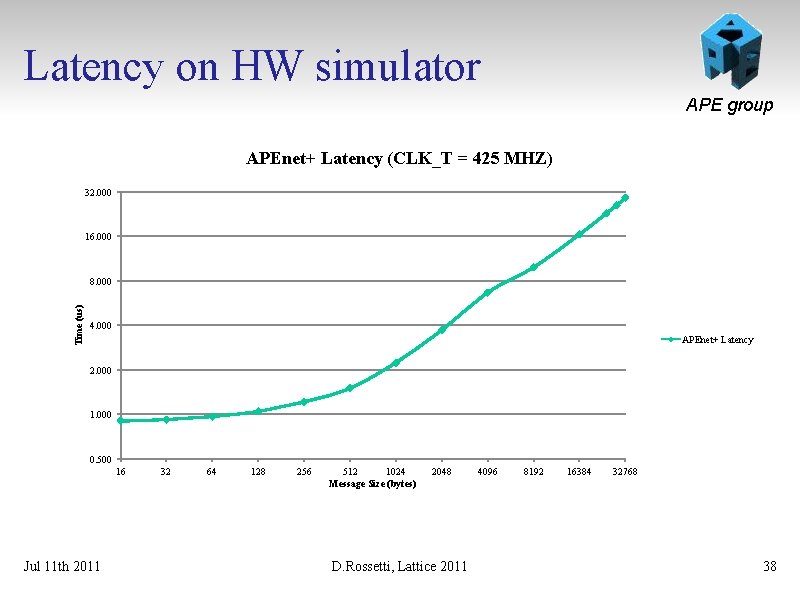
Latency on HW simulator APE group APEnet+ Latency (CLK_T = 425 MHZ) 32. 000 16. 000 Time (us) 8. 000 4. 000 APEnet+ Latency 2. 000 1. 000 0. 500 16 Jul 11 th 2011 32 64 128 256 512 1024 Message Size (bytes) 2048 D. Rossetti, Lattice 2011 4096 8192 16384 32768 38
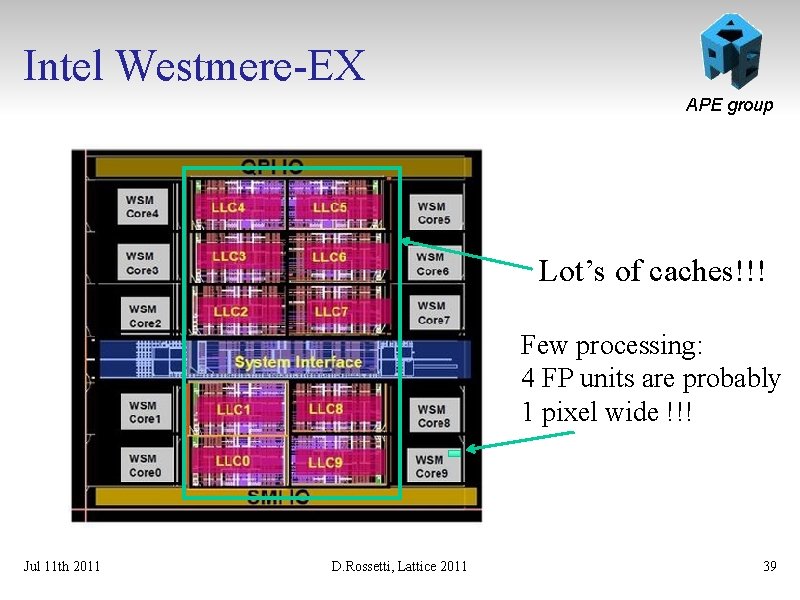
Intel Westmere-EX APE group Lot’s of caches!!! Few processing: 4 FP units are probably 1 pixel wide !!! Jul 11 th 2011 D. Rossetti, Lattice 2011 39
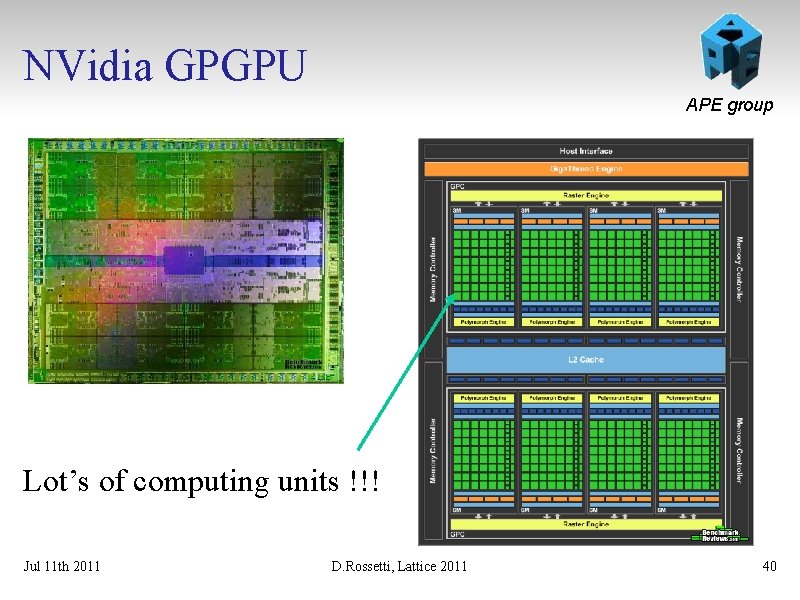
NVidia GPGPU APE group Lot’s of computing units !!! Jul 11 th 2011 D. Rossetti, Lattice 2011 40
So what ? APE group • What are the differences ? • Why should we bother ? They show different trade-offs !! And theory is…. . Jul 11 th 2011 D. Rossetti, Lattice 2011 41
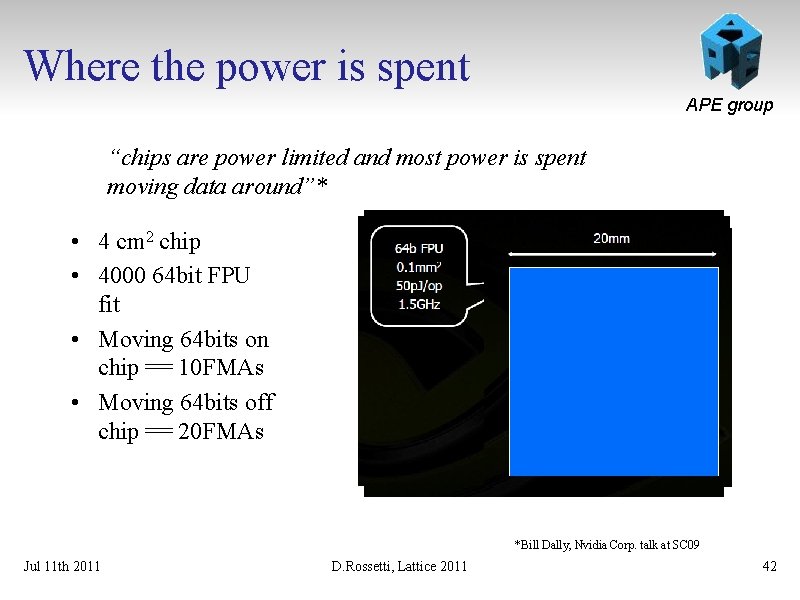
Where the power is spent APE group “chips are power limited and most power is spent moving data around”* • 4 cm 2 chip • 4000 64 bit FPU fit • Moving 64 bits on chip == 10 FMAs • Moving 64 bits off chip == 20 FMAs *Bill Dally, Nvidia Corp. talk at SC 09 Jul 11 th 2011 D. Rossetti, Lattice 2011 42
So what ? APE group • What are the differences? • Why should we bother? Today: at least a factor 2 in perf/price ratio Tomorrow: CPU & GPU converging, see current ATI Fusion Jul 11 th 2011 D. Rossetti, Lattice 2011 43
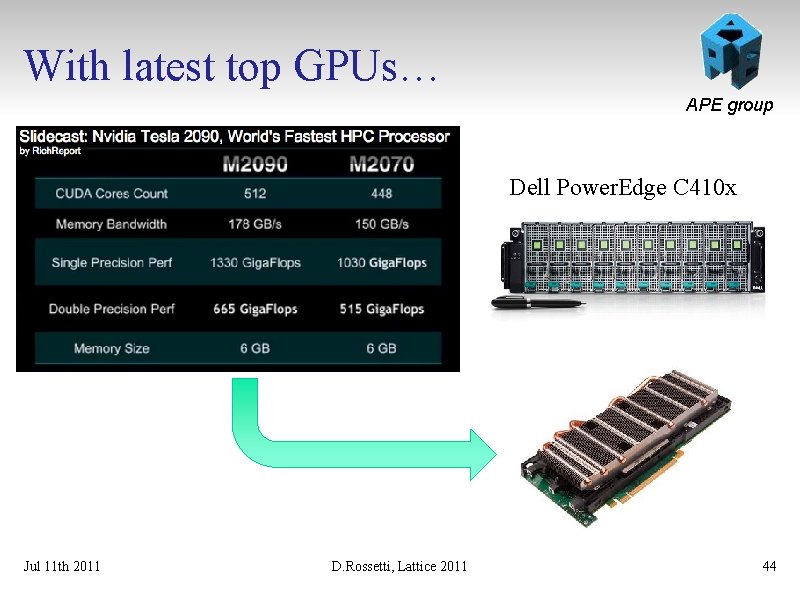
With latest top GPUs… APE group Dell Power. Edge C 410 x Jul 11 th 2011 D. Rossetti, Lattice 2011 44
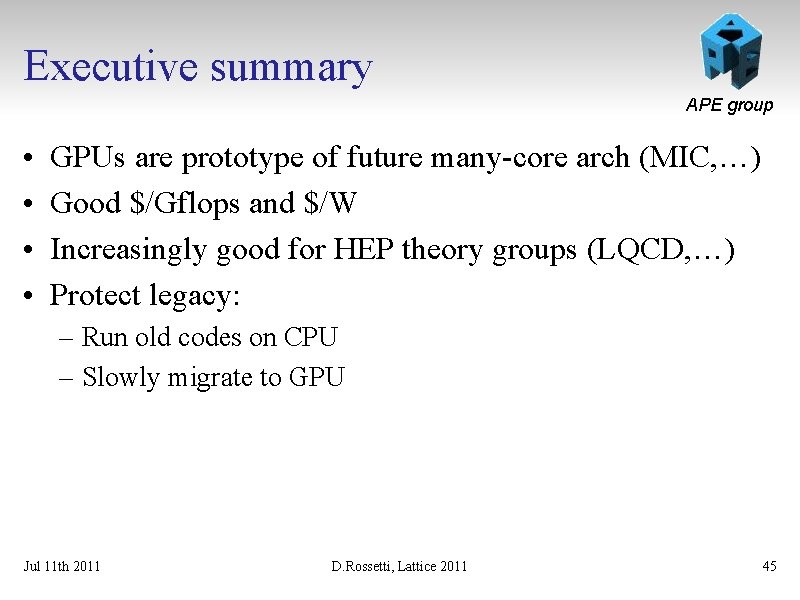
Executive summary APE group • • GPUs are prototype of future many-core arch (MIC, …) Good $/Gflops and $/W Increasingly good for HEP theory groups (LQCD, …) Protect legacy: – Run old codes on CPU – Slowly migrate to GPU Jul 11 th 2011 D. Rossetti, Lattice 2011 45
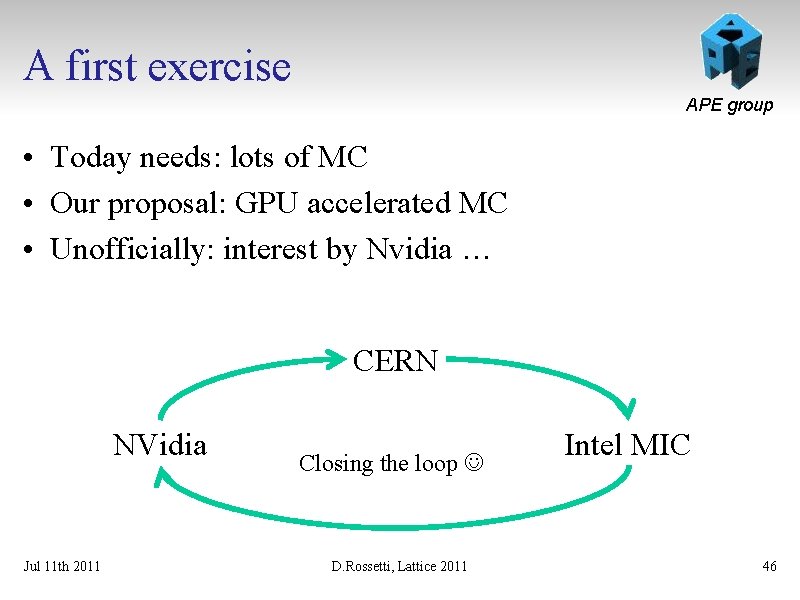
A first exercise APE group • Today needs: lots of MC • Our proposal: GPU accelerated MC • Unofficially: interest by Nvidia … CERN NVidia Jul 11 th 2011 Closing the loop D. Rossetti, Lattice 2011 Intel MIC 46
Final question APE group A GPU and Network accelerated cluster: Could it be the prototype of the Super. B computing platform ? Jul 11 th 2011 D. Rossetti, Lattice 2011 47