
APCS Principles www csprinciples org CS Principles Snowbird
APCS Principles www. csprinciples. org CS Principles, Snowbird 1
What? A new first course in computer science Designed to be an AP course: credit/placement Collaborative: College. Board, NSF, Academia (6 -12/University) Alternative to CS 1, not replacement CS Principles, Snowbird 2
Process and Content • How are we designing and building this course? – Who is behind the development – What is the process used • What will be in this course? – Content – Skills – Pedagogy CS Principles, Snowbird 3
Toward another first course • • Harvard CS 50, CS 1 Stanford CS 106 A, CS 105 Princeton COS 126, 116/109 Berkeley CS 61 A, CS 10 Texas, CS 305 J, CS 302 Wisconsin, CS 302, CS 250/202 Colorado CSCI 1300, 1220/1000 CS Principles, Snowbird 4
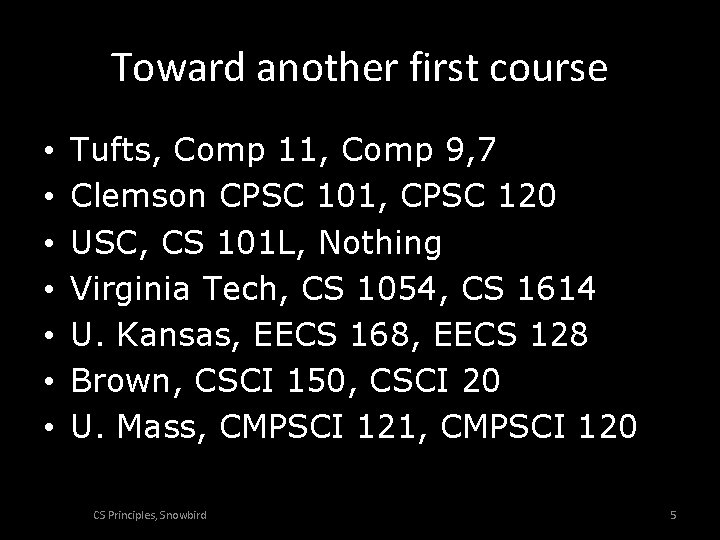
Toward another first course • • Tufts, Comp 11, Comp 9, 7 Clemson CPSC 101, CPSC 120 USC, CS 101 L, Nothing Virginia Tech, CS 1054, CS 1614 U. Kansas, EECS 168, EECS 128 Brown, CSCI 150, CSCI 20 U. Mass, CMPSCI 121, CMPSCI 120 CS Principles, Snowbird 5

Who? CS Principles, Snowbird 6
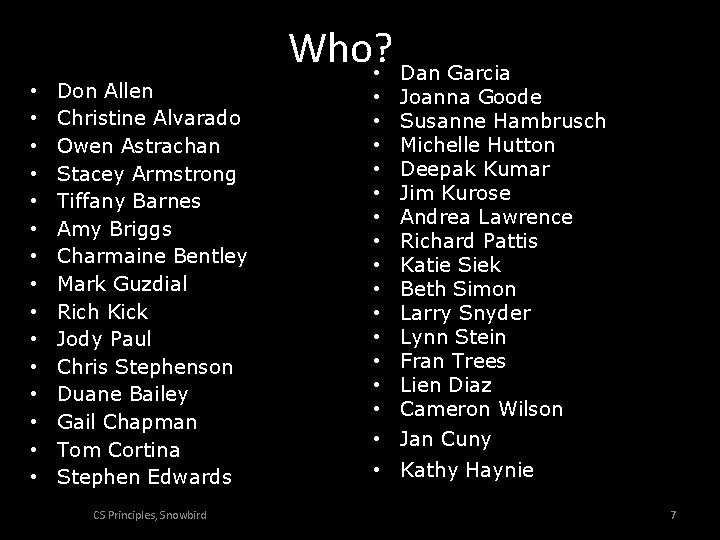
• • • • Don Allen Christine Alvarado Owen Astrachan Stacey Armstrong Tiffany Barnes Amy Briggs Charmaine Bentley Mark Guzdial Rich Kick Jody Paul Chris Stephenson Duane Bailey Gail Chapman Tom Cortina Stephen Edwards CS Principles, Snowbird Who? • Dan Garcia • • • • Joanna Goode Susanne Hambrusch Michelle Hutton Deepak Kumar Jim Kurose Andrea Lawrence Richard Pattis Katie Siek Beth Simon Larry Snyder Lynn Stein Fran Trees Lien Diaz Cameron Wilson Jan Cuny • Kathy Haynie 7
Engineering a Course and Exam CS Principles, Snowbird 8
Foundation of Course/Exam • Commission convened to use College Board framework and methodology to build course/exam – Evidence-centered design – Claim: student has knowledge or skill – Evidence: behavior/performance that the skill/knowledge has been achieved • Drafted Seven Big Ideas CS Principles, Snowbird 9
Commission and Advisory Board • Commission has task of delivering framework for course/exam using evidence centered design • Advisory board provides feedback, guidelines, advice to commission – Advisory board actually advises CS Principles, Snowbird 10
Timeline • 2009 -2010 – Big Ideas, Practices, Claims/Evidence • 2010 -11 – Pilot I: Five colleges – Draft College Survey – Test item prototype • 2011 -12 – Pilot II: 10+ colleges, 10+ high schools CS Principles, Snowbird 11
Possible Next Timeline • Necessary and sufficient conditions to continue – How do we ensure “substantial” buy-in? • 2012 -2013 – Curricular framework finalized? – Exam format identified • Deploy exam and course – 201? • 2 CS Principles, Snowbird 12
From Process to Product • What will be in this course? – Pilot courses are exemplars – Seven big ideas – Six computational thinking practices – 200 claims and evidence statements • From bits to NP to modeling to … CS Principles, Snowbird 13
![Where’s the Programming? • To that end [solving computational problems and exploring creative endeavors],](http://slidetodoc.com/presentation_image_h/1279e3476b9e3f7a8b4307e4cb78d7eb/image-14.jpg "Where’s the Programming? • To that end [solving computational problems and exploring creative endeavors],")
Where’s the Programming? • To that end [solving computational problems and exploring creative endeavors], the course highlights programming as one of the seven big ideas of computer science, because programming is among the creative processes that help transform ideas into reality. CS Principles, Snowbird 14
Big Ideas 1. Computing is a creative human activity that engenders innovation and promotes exploration. 2. Abstraction reduces information and detail to focus on concepts relevant to understanding and solving problems. CS Principles, Snowbird 15
Big Ideas Continued 3. Data and information facilitate the creation of knowledge. 4. Algorithms are tools for developing and expressing solutions to computational problems. CS Principles, Snowbird 16
Big Ideas Continued 5. Programming is a creative process that produces computational artifacts. 6. Digital devices, systems, and the networks that interconnect them enable and foster computational approaches to solving problems. CS Principles, Snowbird 17
Big Ideas 7. Computing enables innovation in other fields including science, social science, humanities, arts, medicine, engineering, and business. CS Principles, Snowbird 18
Computational Thinking Practices(Draft) 1. Analyzing problems, artifacts, and effects of computation 2. Creating and using computational artifacts, computational models 3. Communicating processes and results 4. Connecting computation with mathematics, science, engineering 5. Work effectively in teams CS Principles, Snowbird 19
What will students do? What problems will they solve? Stories motivate computational examples CS Principles, Snowbird 20
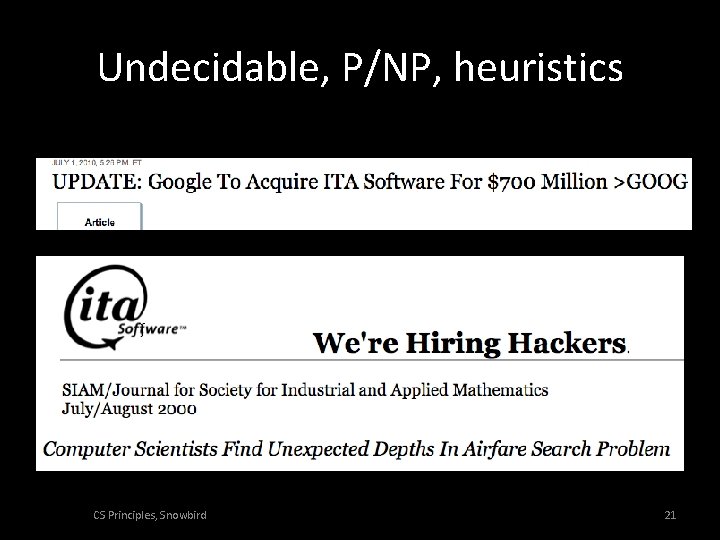
Undecidable, P/NP, heuristics CS Principles, Snowbird 21
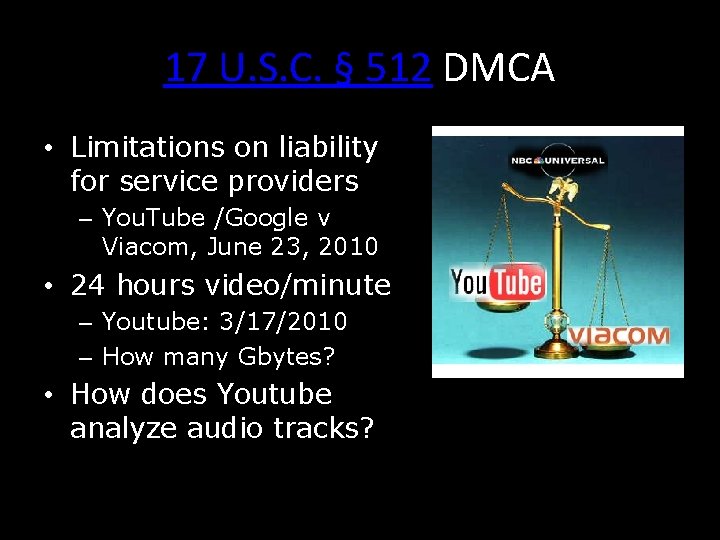
17 U. S. C. § 512 DMCA • Limitations on liability for service providers – You. Tube /Google v Viacom, June 23, 2010 • 24 hours video/minute – Youtube: 3/17/2010 – How many Gbytes? • How does Youtube analyze audio tracks?
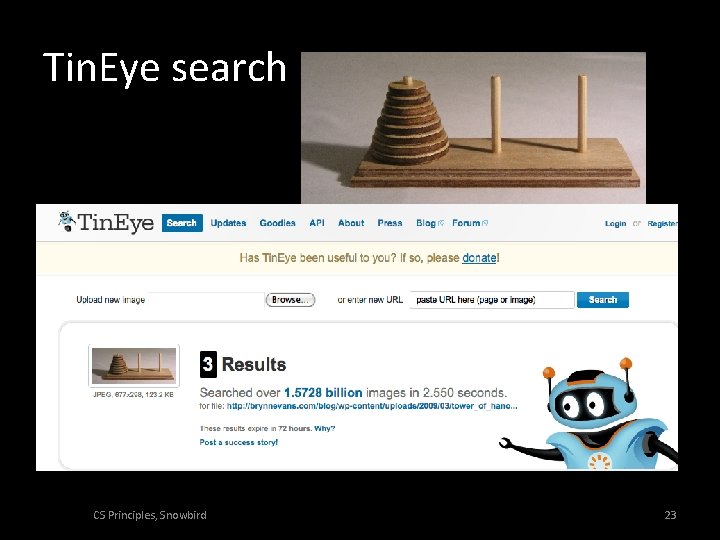
Tin. Eye search CS Principles, Snowbird 23
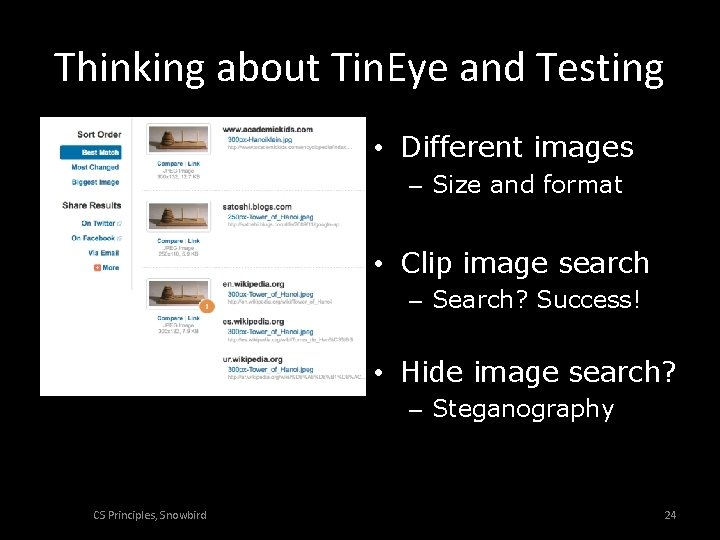
Thinking about Tin. Eye and Testing • Different images – Size and format • Clip image search – Search? Success! • Hide image search? – Steganography CS Principles, Snowbird 24
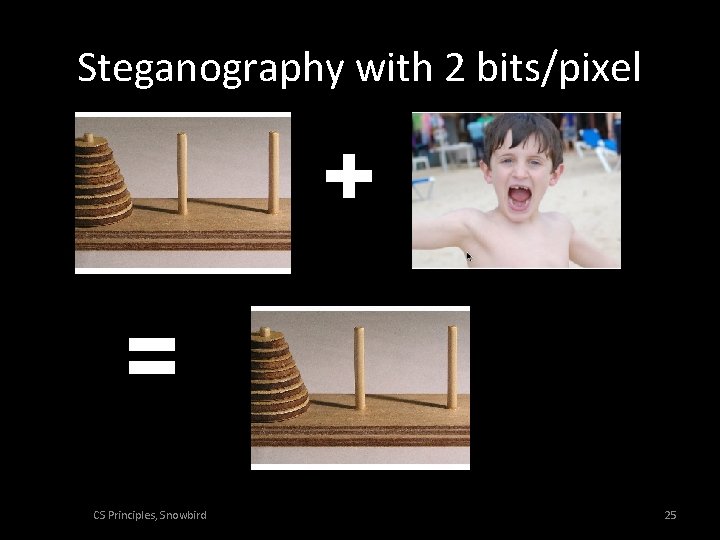
Steganography with 2 bits/pixel CS Principles, Snowbird 25
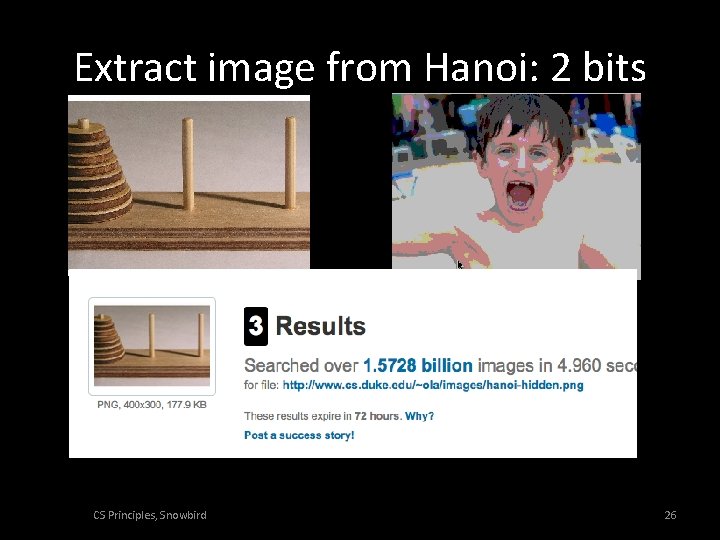
Extract image from Hanoi: 2 bits CS Principles, Snowbird 26
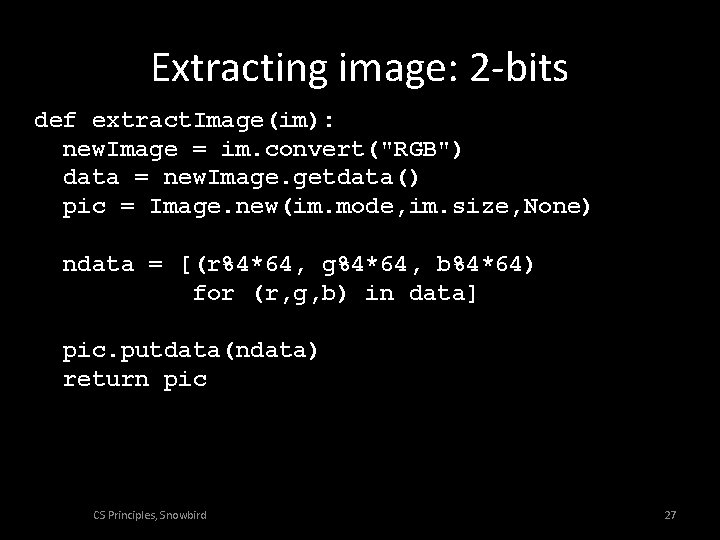
Extracting image: 2 -bits def extract. Image(im): new. Image = im. convert("RGB") data = new. Image. getdata() pic = Image. new(im. mode, im. size, None) ndata = [(r%4*64, g%4*64, b%4*64) for (r, g, b) in data] pic. putdata(ndata) return pic CS Principles, Snowbird 27
Future work • Oversee pilot courses, analyze the outcomes of the pilots, prepare for next, larger pilot • Gain consensus on claims and evidence (from 500+ to ~128) • Develop prototype exam questions • Gather support for next phase of project CS Principles, Snowbird 28
- Slides: 28