
Apache Spark Kishore Pusukuri Spring 2018 HTTP WWW
- Slides: 66
Apache Spark Kishore Pusukuri, Spring 2018 HTTP: //WWW. CS. CORNELL. EDU/COURSES/CS 5412/2018 SP 1
Recap Map. Reduce • For easily writing applications to process vast amounts of data inparallel on large clusters in a reliable, fault-tolerant manner • Takes care of scheduling tasks, monitoring them and re-executes the failed tasks HDFS & Map. Reduce: Running on the same set of nodes compute nodes and storage nodes same (keeping data close to the computation) very high throughput YARN & Map. Reduce: A single master resource manager, one slave node manager per node, and App. Master per application 2
Today’s Topics • Motivation • Spark Basics • Spark Programming 3
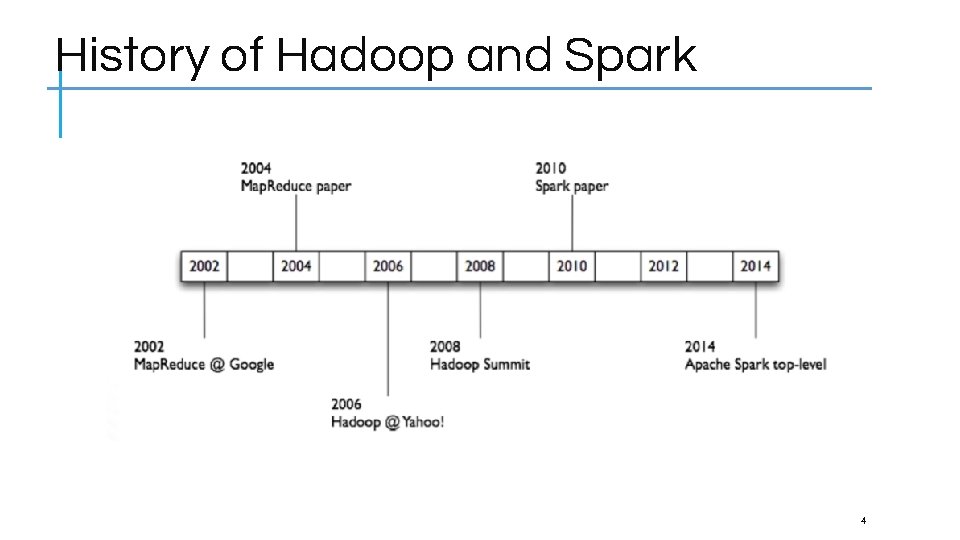
History of Hadoop and Spark 4
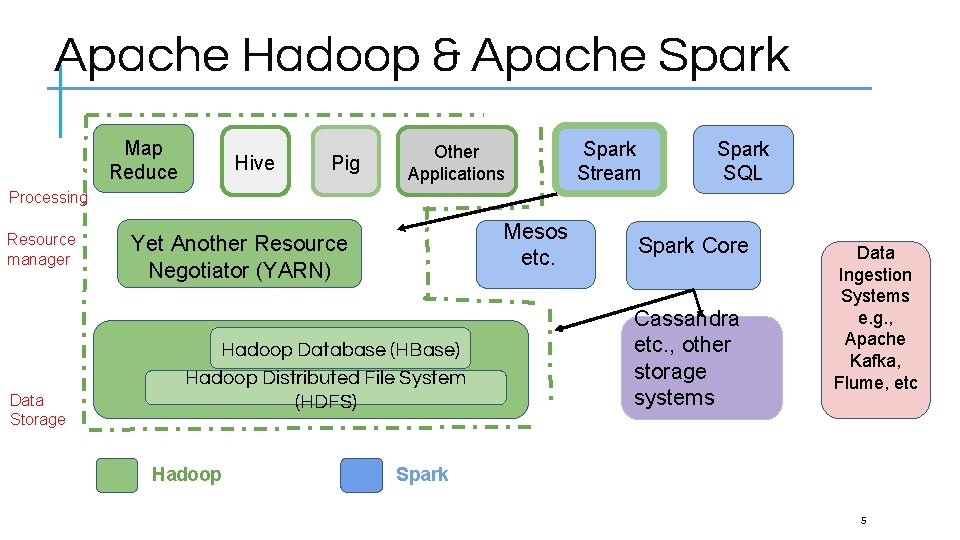
Apache Hadoop & Apache Spark Map Reduce Hive Pig Other Applications Spark Stream Spark SQL Processing Resource manager Data Storage Mesos etc. Yet Another Resource Negotiator (YARN) Hadoop Database (HBase) Hadoop Distributed File System (HDFS) Hadoop Spark Core Cassandra etc. , other storage systems Data Ingestion Systems e. g. , Apache Kafka, Flume, etc Spark 5
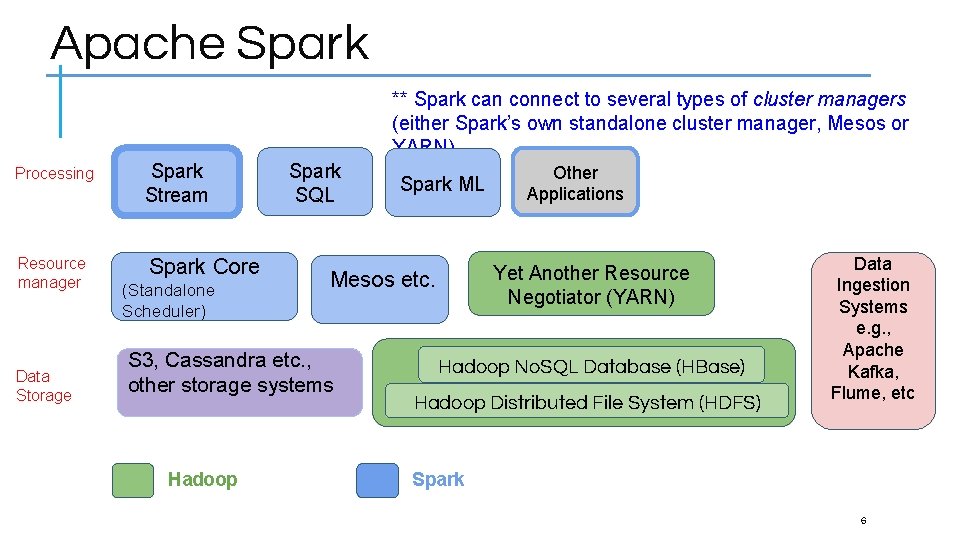
Apache Spark ** Spark can connect to several types of cluster managers (either Spark’s own standalone cluster manager, Mesos or YARN) Processing Spark Stream Resource manager Spark Core Data Storage (Standalone Scheduler) Spark SQL Other Applications Yet Another Resource Negotiator (YARN) Mesos etc. S 3, Cassandra etc. , other storage systems Hadoop Spark ML Hadoop No. SQL Database (HBase) Hadoop Distributed File System (HDFS) Data Ingestion Systems e. g. , Apache Kafka, Flume, etc Spark 6
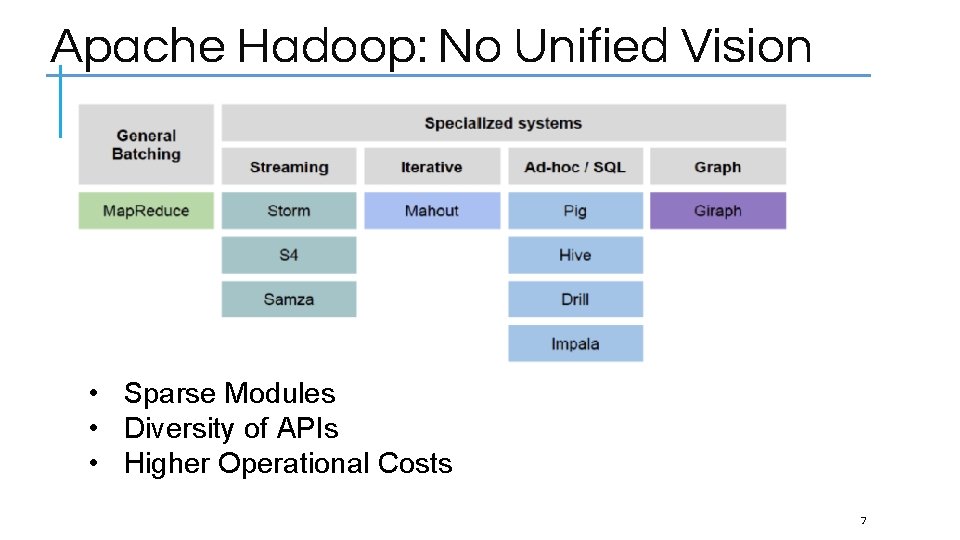
Apache Hadoop: No Unified Vision • Sparse Modules • Diversity of APIs • Higher Operational Costs 7
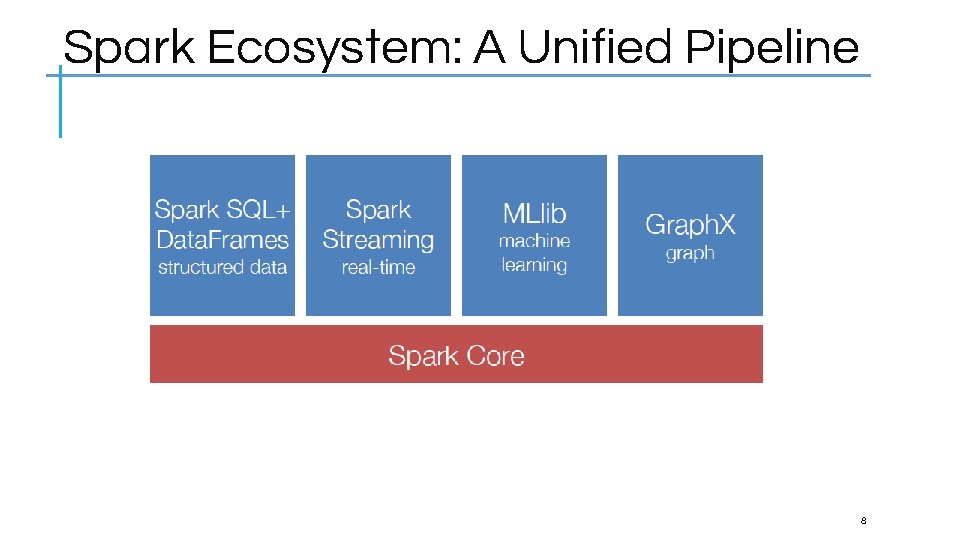
Spark Ecosystem: A Unified Pipeline 8
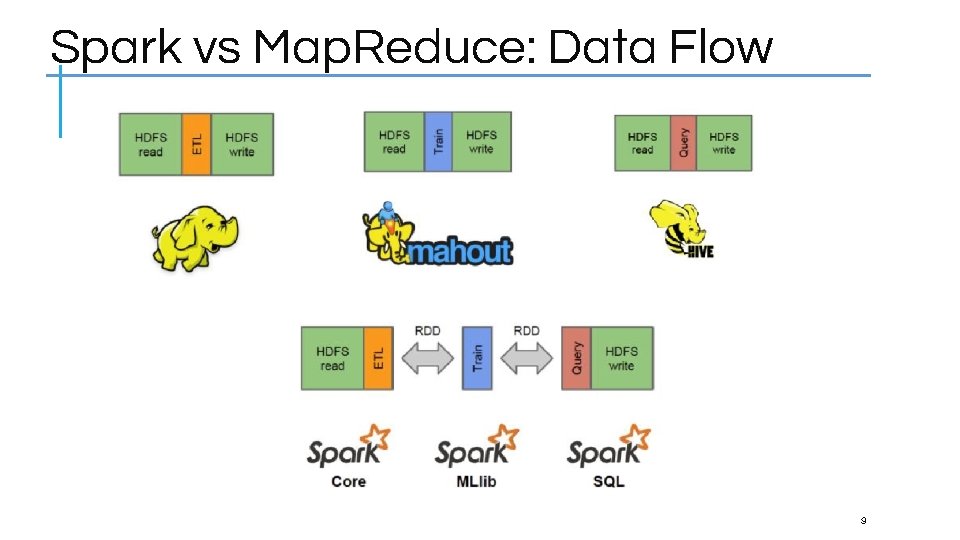
Spark vs Map. Reduce: Data Flow 9
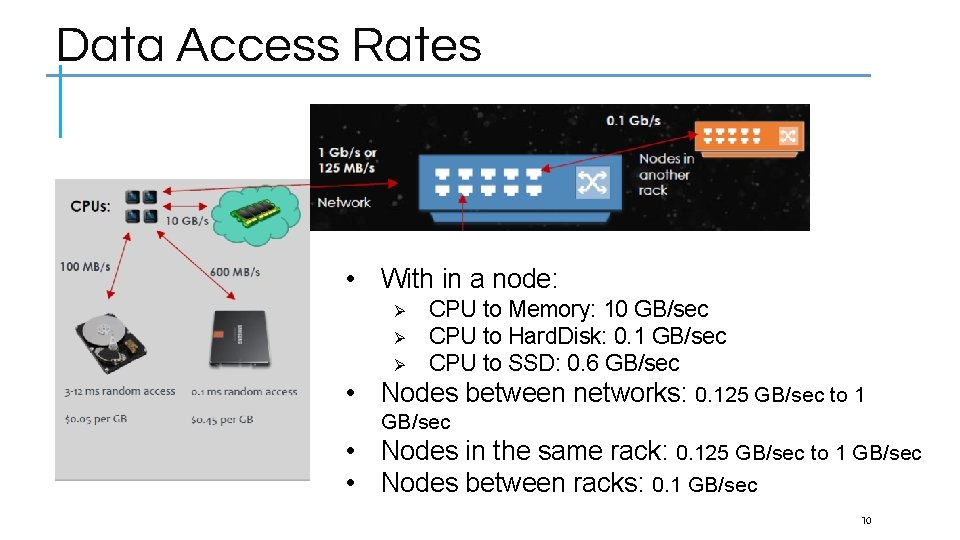
Data Access Rates • With in a node: Ø Ø Ø CPU to Memory: 10 GB/sec CPU to Hard. Disk: 0. 1 GB/sec CPU to SSD: 0. 6 GB/sec • Nodes between networks: 0. 125 GB/sec to 1 GB/sec • Nodes in the same rack: 0. 125 GB/sec to 1 GB/sec • Nodes between racks: 0. 1 GB/sec 10
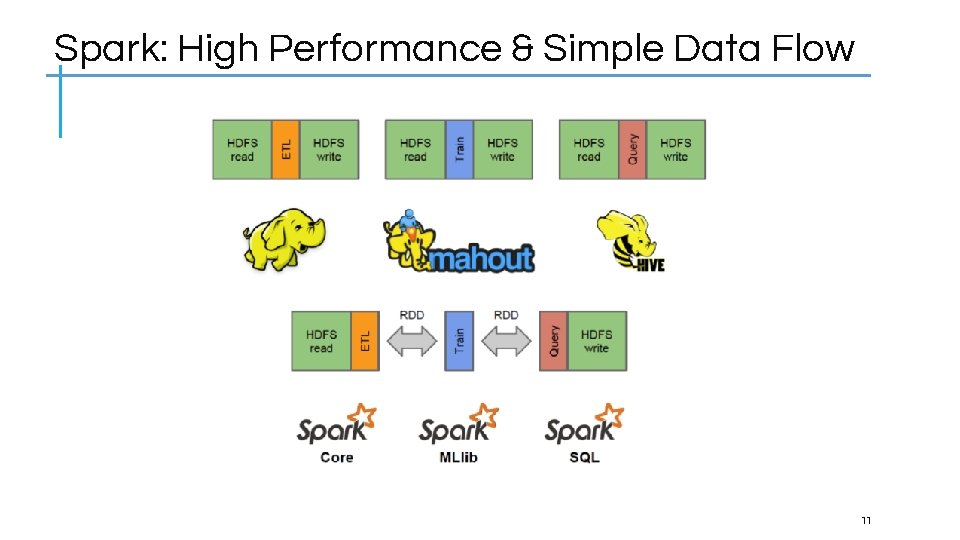
Spark: High Performance & Simple Data Flow 11
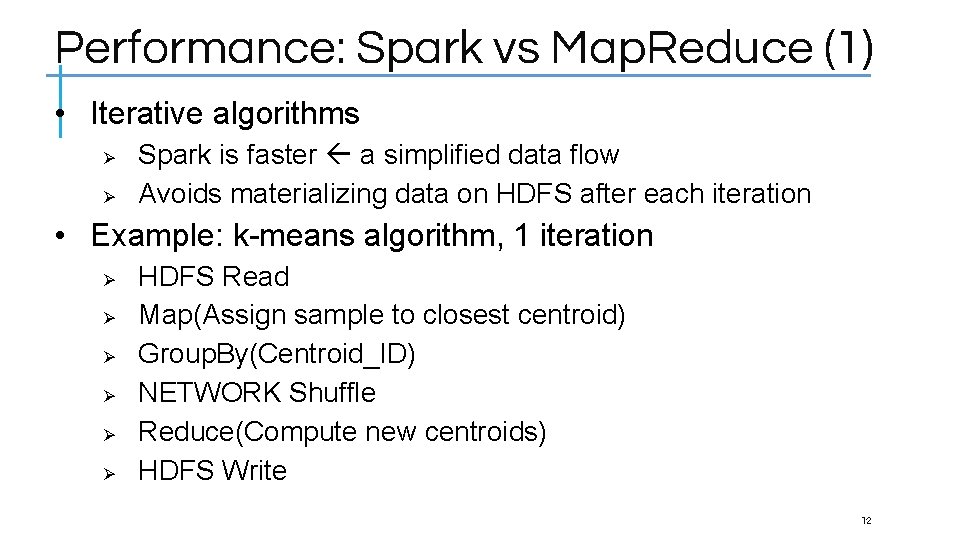
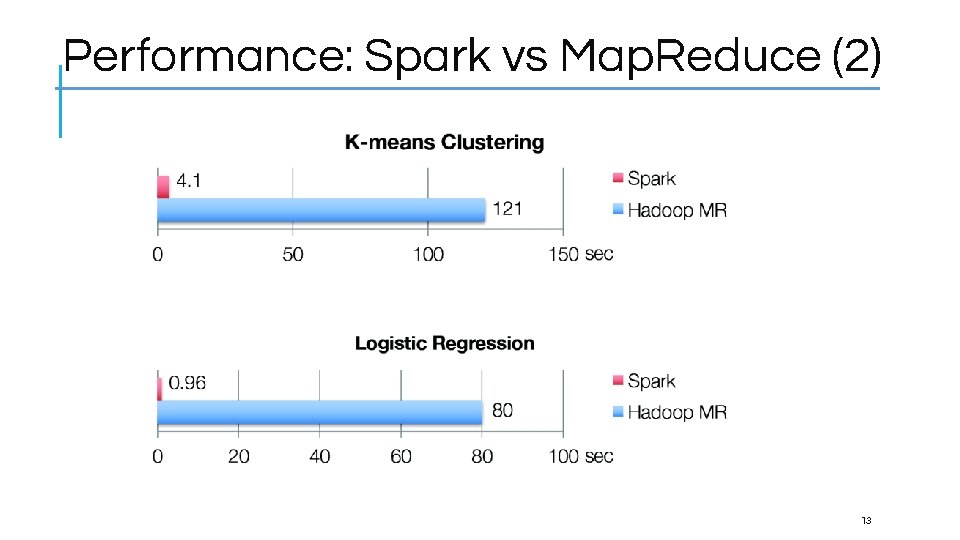
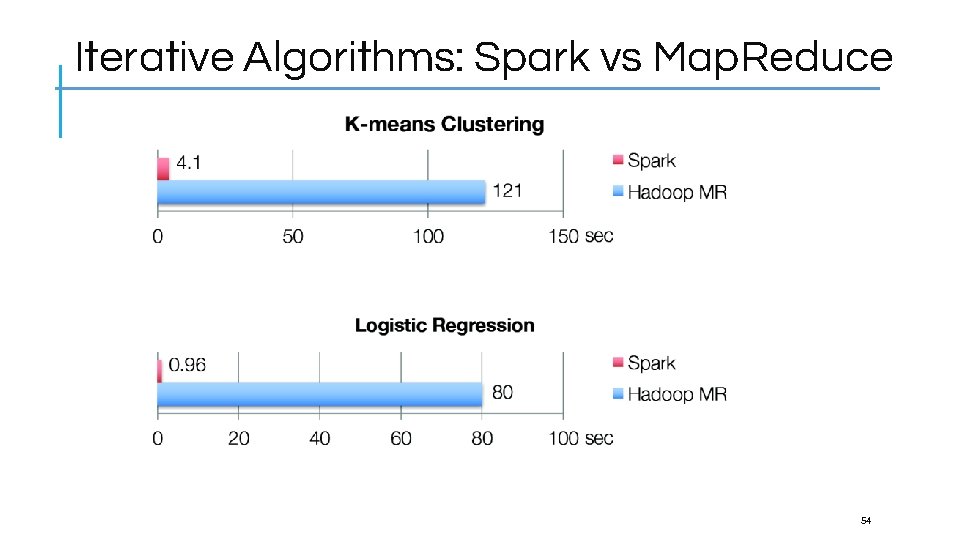
Performance: Spark vs Map. Reduce (1) • Iterative algorithms Ø Ø Spark is faster a simplified data flow Avoids materializing data on HDFS after each iteration • Example: k-means algorithm, 1 iteration Ø Ø Ø HDFS Read Map(Assign sample to closest centroid) Group. By(Centroid_ID) NETWORK Shuffle Reduce(Compute new centroids) HDFS Write 12
Performance: Spark vs Map. Reduce (2) 13
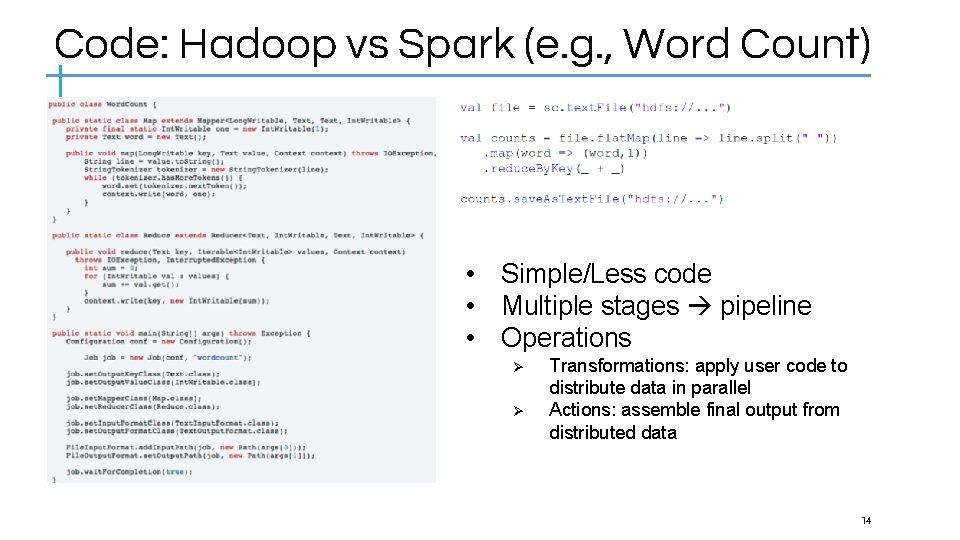
Code: Hadoop vs Spark (e. g. , Word Count) • Simple/Less code • Multiple stages pipeline • Operations Ø Ø Transformations: apply user code to distribute data in parallel Actions: assemble final output from distributed data 14
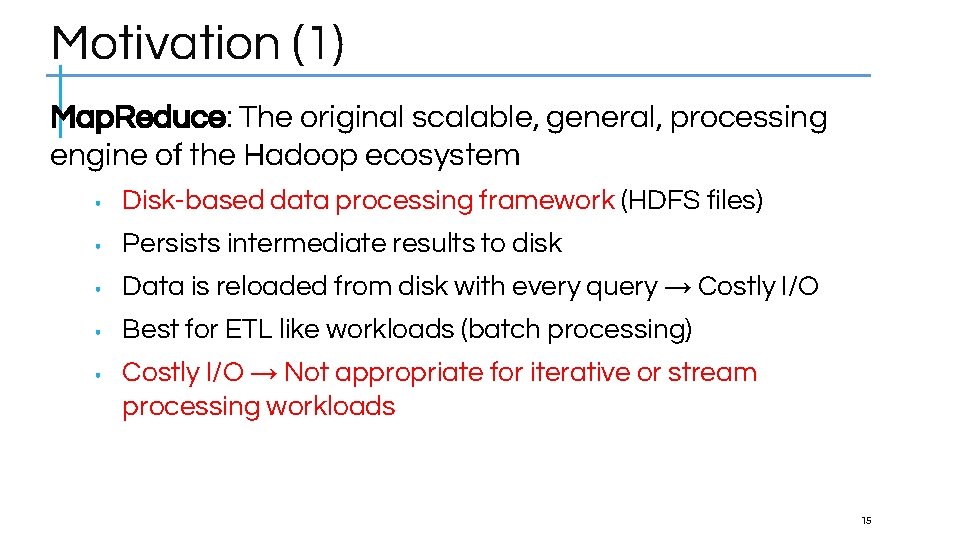
Motivation (1) Map. Reduce: The original scalable, general, processing engine of the Hadoop ecosystem • Disk-based data processing framework (HDFS files) • Persists intermediate results to disk • Data is reloaded from disk with every query → Costly I/O • Best for ETL like workloads (batch processing) • Costly I/O → Not appropriate for iterative or stream processing workloads 15
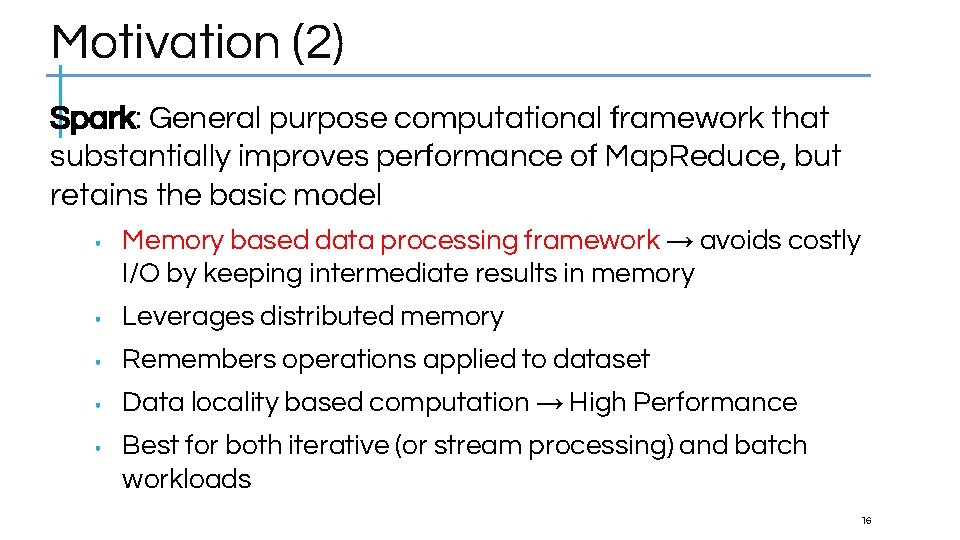
Motivation (2) Spark: General purpose computational framework that substantially improves performance of Map. Reduce, but retains the basic model • Memory based data processing framework → avoids costly I/O by keeping intermediate results in memory • Leverages distributed memory • Remembers operations applied to dataset • Data locality based computation → High Performance • Best for both iterative (or stream processing) and batch workloads 16
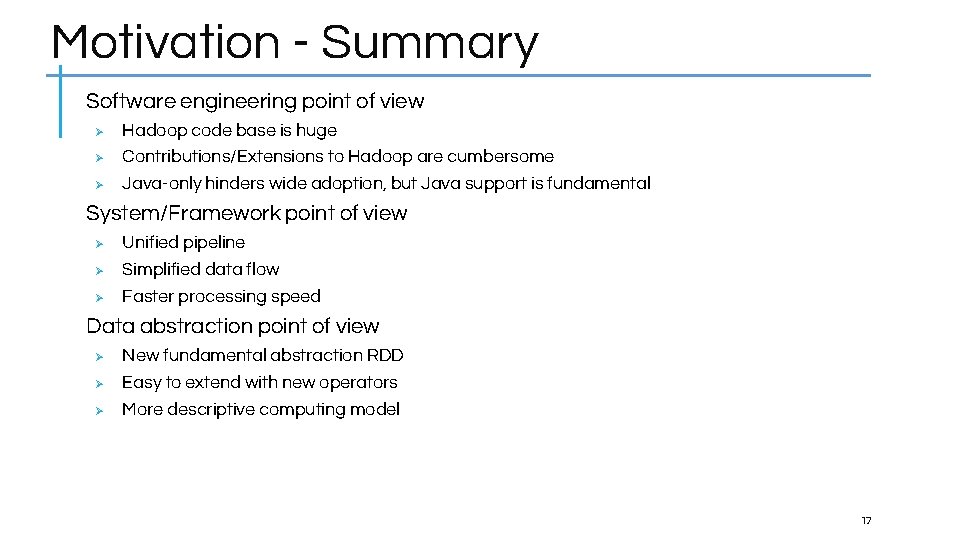
Motivation - Summary Software engineering point of view Ø Ø Ø Hadoop code base is huge Contributions/Extensions to Hadoop are cumbersome Java-only hinders wide adoption, but Java support is fundamental System/Framework point of view Ø Ø Ø Unified pipeline Simplified data flow Faster processing speed Data abstraction point of view Ø Ø Ø New fundamental abstraction RDD Easy to extend with new operators More descriptive computing model 17
Today’s Topics • Motivation • Spark Basics • Spark Programming 18
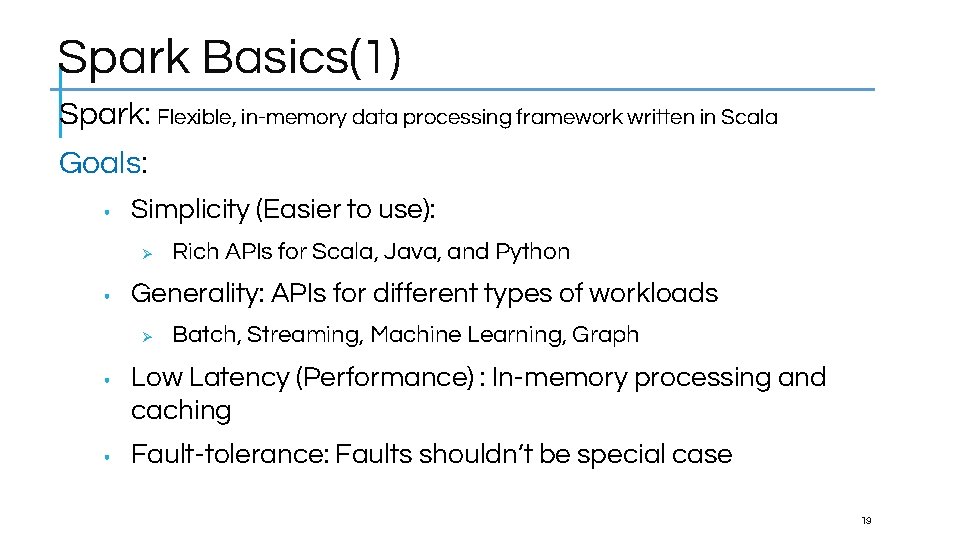
Spark Basics(1) Spark: Flexible, in-memory data processing framework written in Scala Goals: • Simplicity (Easier to use): Ø • Rich APIs for Scala, Java, and Python Generality: APIs for different types of workloads Ø Batch, Streaming, Machine Learning, Graph • Low Latency (Performance) : In-memory processing and caching • Fault-tolerance: Faults shouldn’t be special case 19
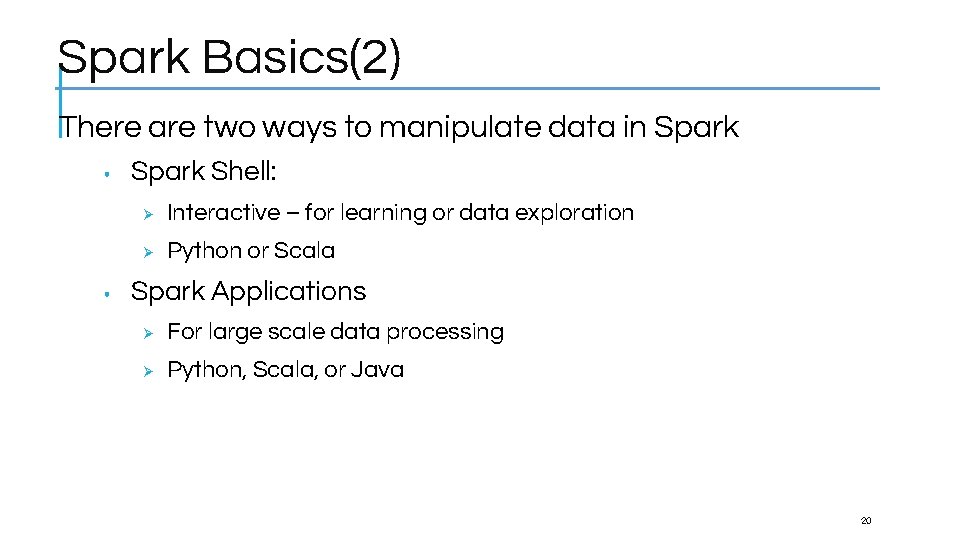
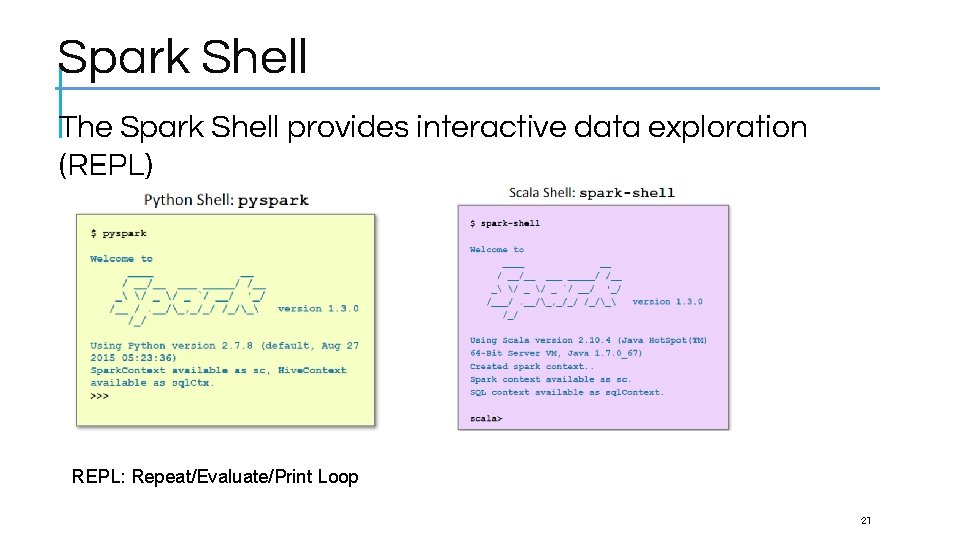
Spark Basics(2) There are two ways to manipulate data in Spark • • Spark Shell: Ø Interactive – for learning or data exploration Ø Python or Scala Spark Applications Ø For large scale data processing Ø Python, Scala, or Java 20
Spark Shell The Spark Shell provides interactive data exploration (REPL) REPL: Repeat/Evaluate/Print Loop 21
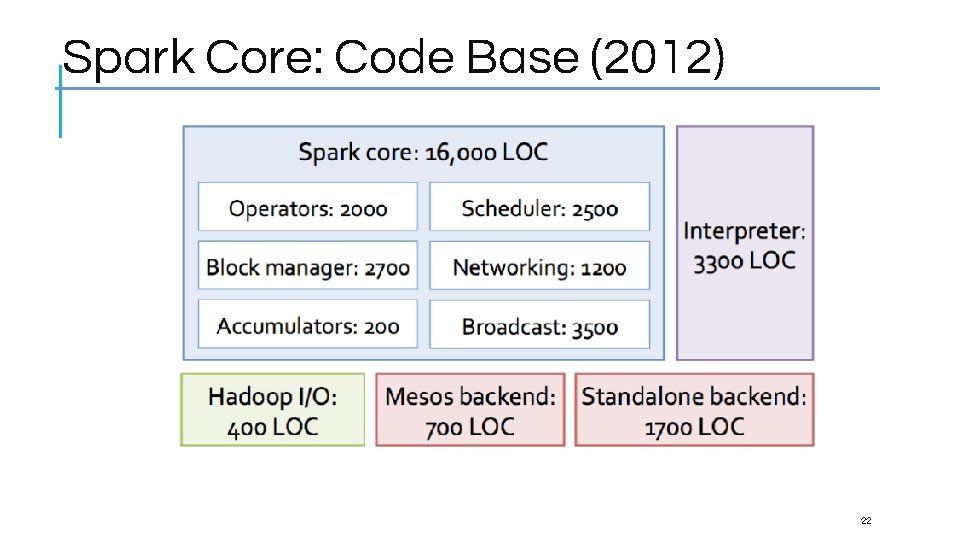
Spark Core: Code Base (2012) 22
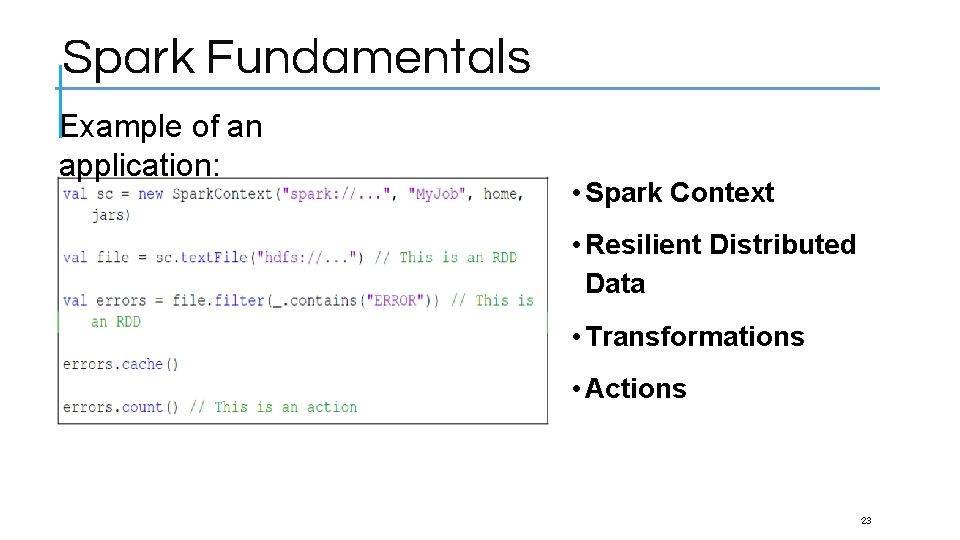
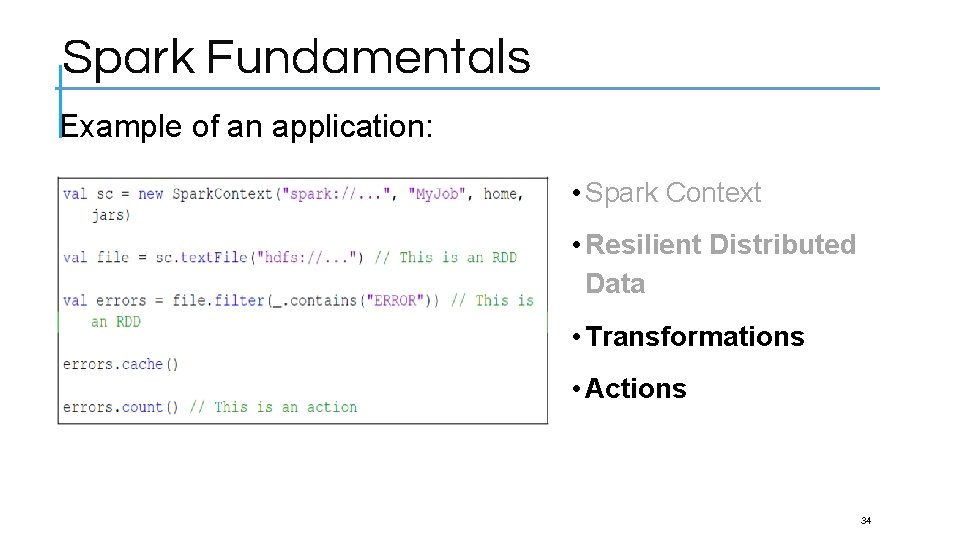
Spark Fundamentals Example of an application: • Spark Context • Resilient Distributed Data • Transformations • Actions 23
Spark: Fundamentals Spark Context Resilient Distributed Datasets (RDDs) Transformations Actions 24
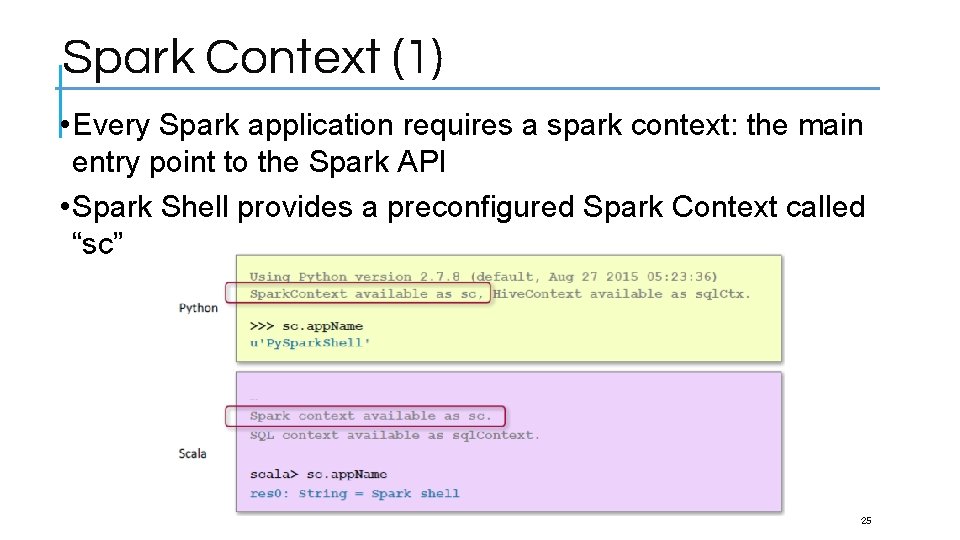
Spark Context (1) • Every Spark application requires a spark context: the main entry point to the Spark API • Spark Shell provides a preconfigured Spark Context called “sc” 25
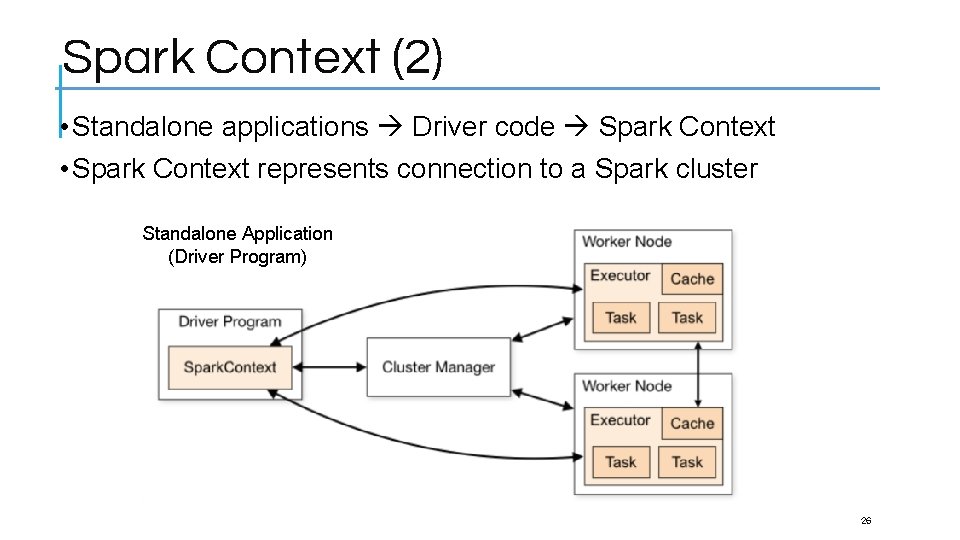
Spark Context (2) • Standalone applications Driver code Spark Context • Spark Context represents connection to a Spark cluster Standalone Application (Driver Program) 26
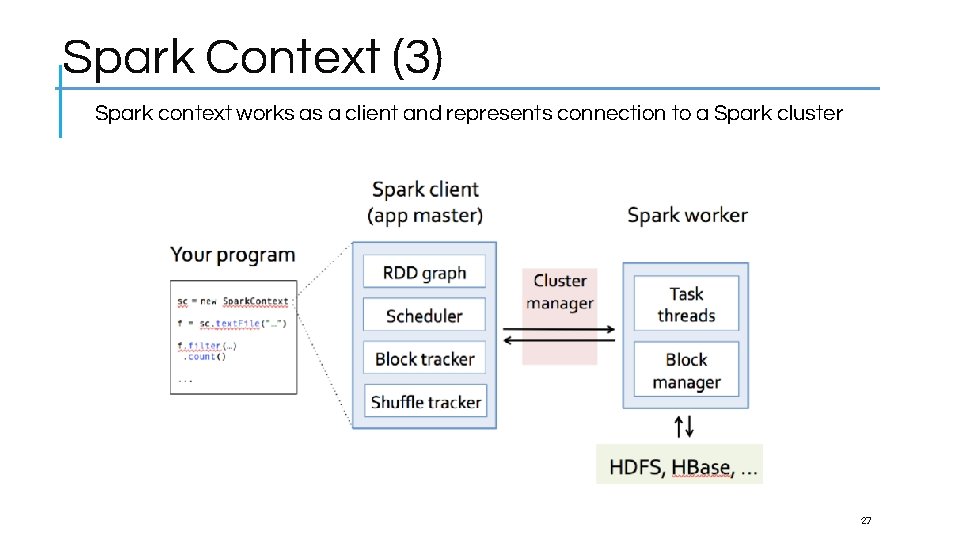
Spark Context (3) Spark context works as a client and represents connection to a Spark cluster 27
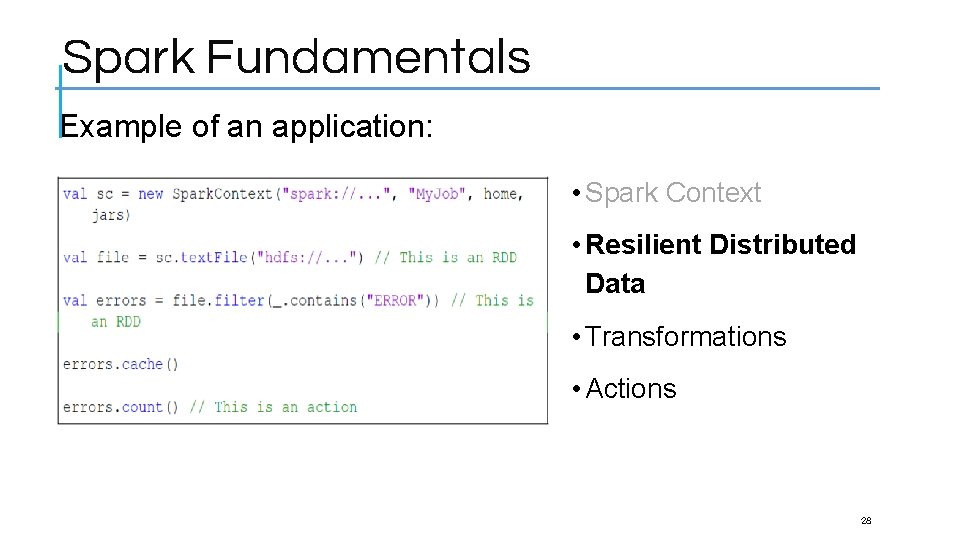
Spark Fundamentals Example of an application: • Spark Context • Resilient Distributed Data • Transformations • Actions 28
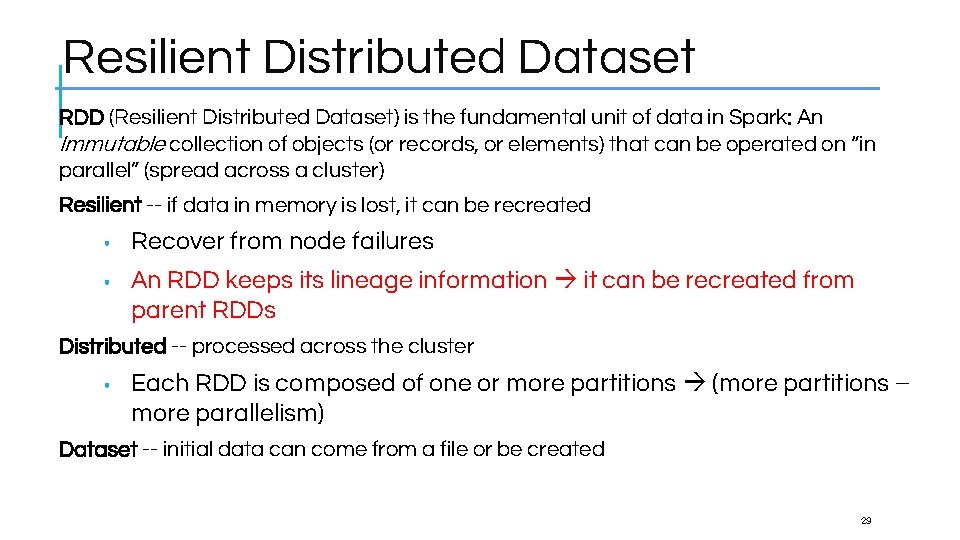
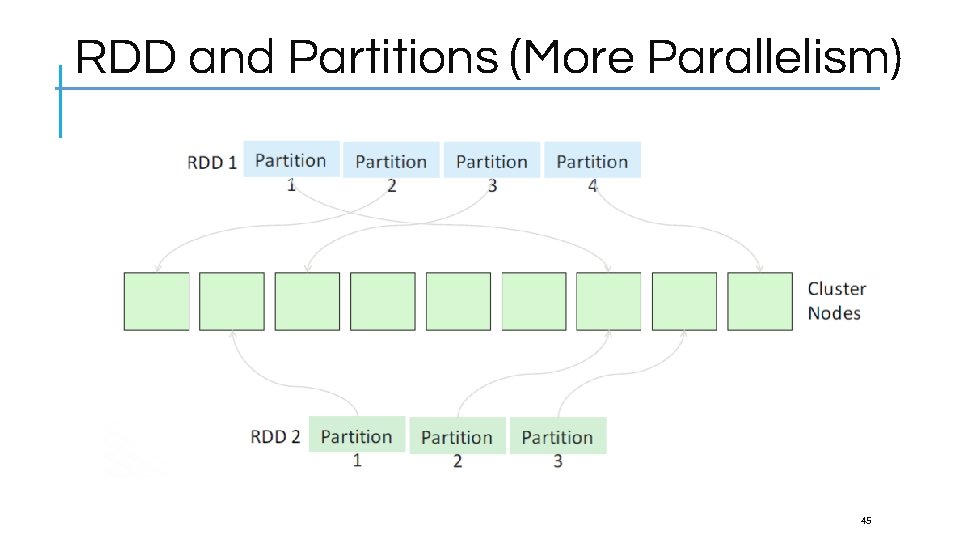
Resilient Distributed Dataset RDD (Resilient Distributed Dataset) is the fundamental unit of data in Spark: An Immutable collection of objects (or records, or elements) that can be operated on “in parallel” (spread across a cluster) Resilient -- if data in memory is lost, it can be recreated • Recover from node failures • An RDD keeps its lineage information it can be recreated from parent RDDs Distributed -- processed across the cluster • Each RDD is composed of one or more partitions (more partitions – more parallelism) Dataset -- initial data can come from a file or be created 29
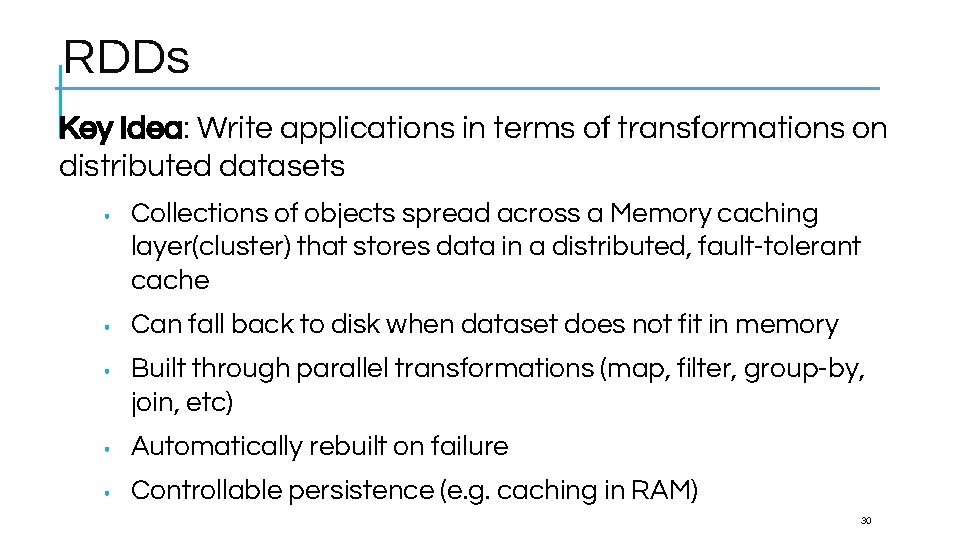
RDDs Key Idea: Write applications in terms of transformations on distributed datasets • Collections of objects spread across a Memory caching layer(cluster) that stores data in a distributed, fault-tolerant cache • Can fall back to disk when dataset does not fit in memory • Built through parallel transformations (map, filter, group-by, join, etc) • Automatically rebuilt on failure • Controllable persistence (e. g. caching in RAM) 30
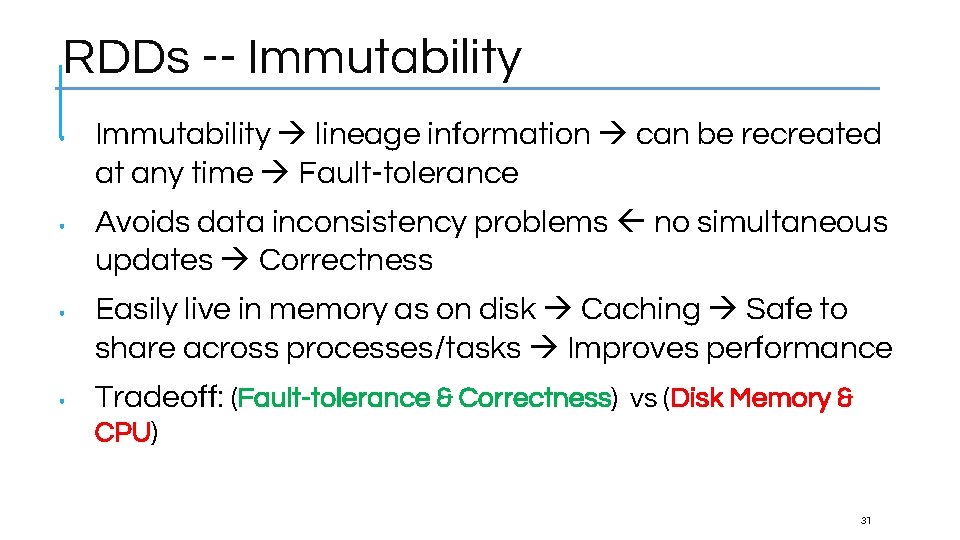
RDDs -- Immutability • • Immutability lineage information can be recreated at any time Fault-tolerance Avoids data inconsistency problems no simultaneous updates Correctness Easily live in memory as on disk Caching Safe to share across processes/tasks Improves performance Tradeoff: (Fault-tolerance & Correctness) vs (Disk Memory & CPU) 31
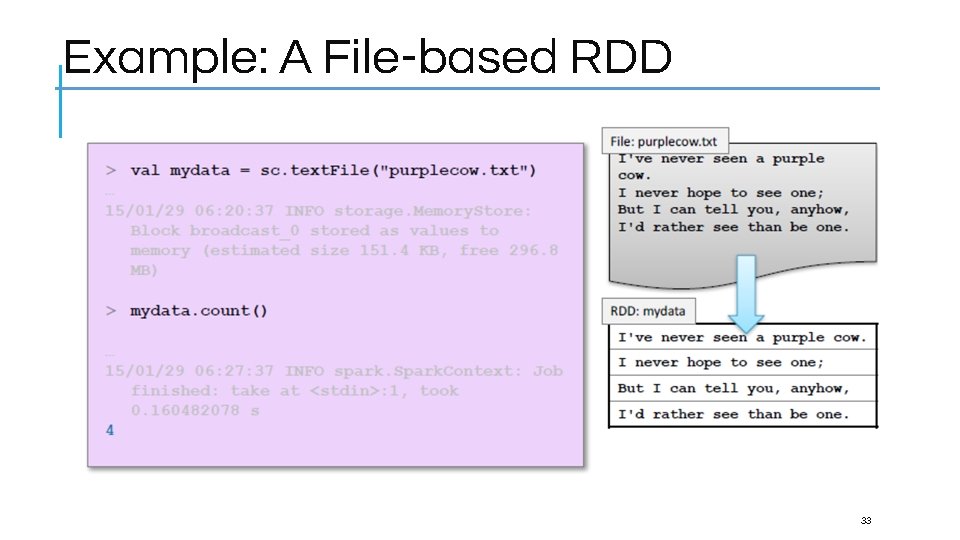
Creating a RDD Three ways to create a RDD • From a file or set of files • From data in memory • From another RDD 32
Example: A File-based RDD 33
Spark Fundamentals Example of an application: • Spark Context • Resilient Distributed Data • Transformations • Actions 34
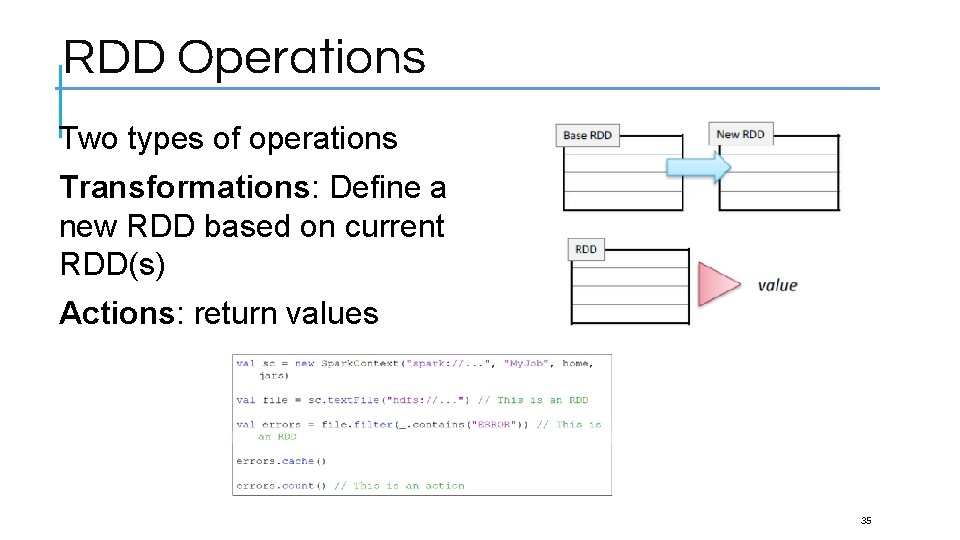
RDD Operations Two types of operations Transformations: Define a new RDD based on current RDD(s) Actions: return values 35
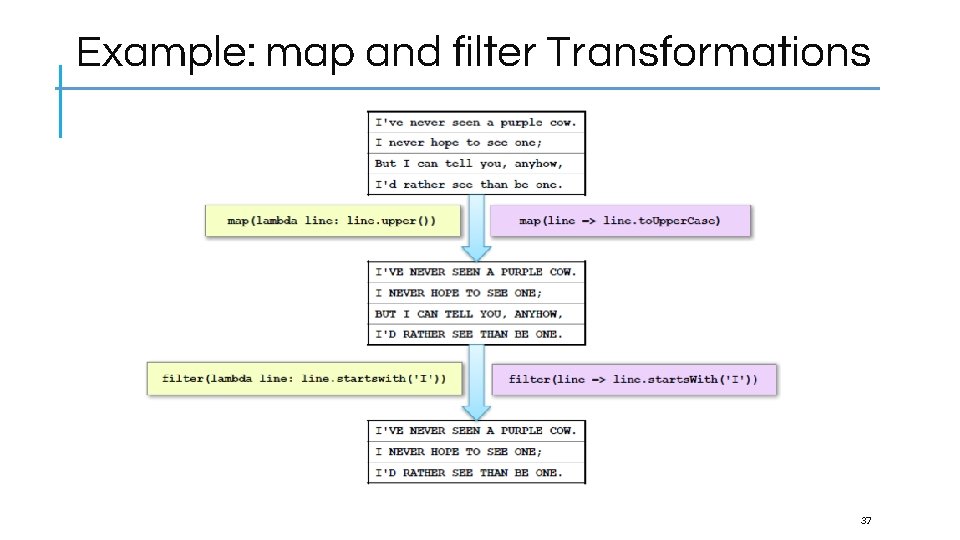
RDD Transformations • Set of operations on a RDD that define how they should be transformed • As in relational algebra, the application of a transformation to an RDD yields a new RDD (because RDD are immutable) • Transformations are lazily evaluated, which allow for optimizations to take place before execution • Examples: map(), filter(), group. By. Key(), sort. By. Key(), etc. 36
Example: map and filter Transformations 37
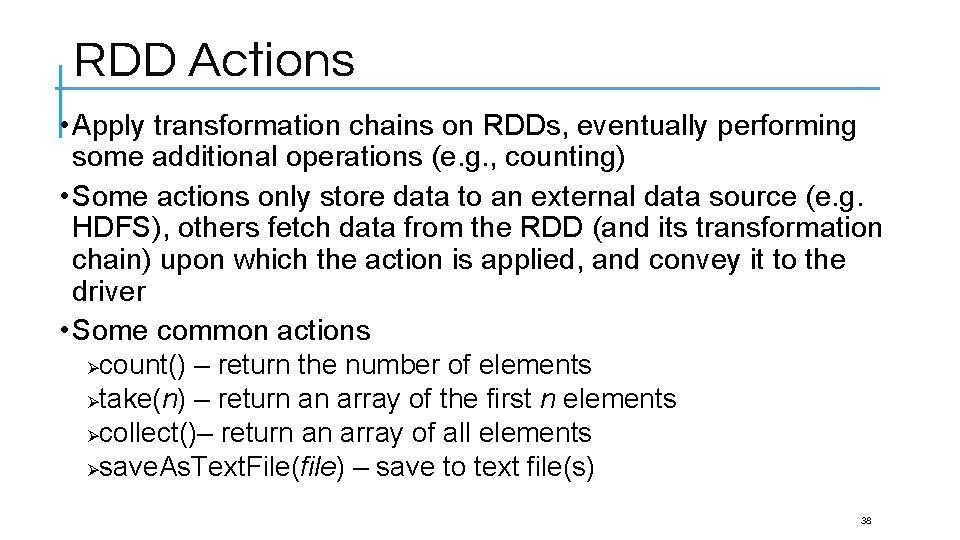
RDD Actions • Apply transformation chains on RDDs, eventually performing some additional operations (e. g. , counting) • Some actions only store data to an external data source (e. g. HDFS), others fetch data from the RDD (and its transformation chain) upon which the action is applied, and convey it to the driver • Some common actions count() – return the number of elements Øtake(n) – return an array of the first n elements Øcollect()– return an array of all elements Øsave. As. Text. File(file) – save to text file(s) Ø 38
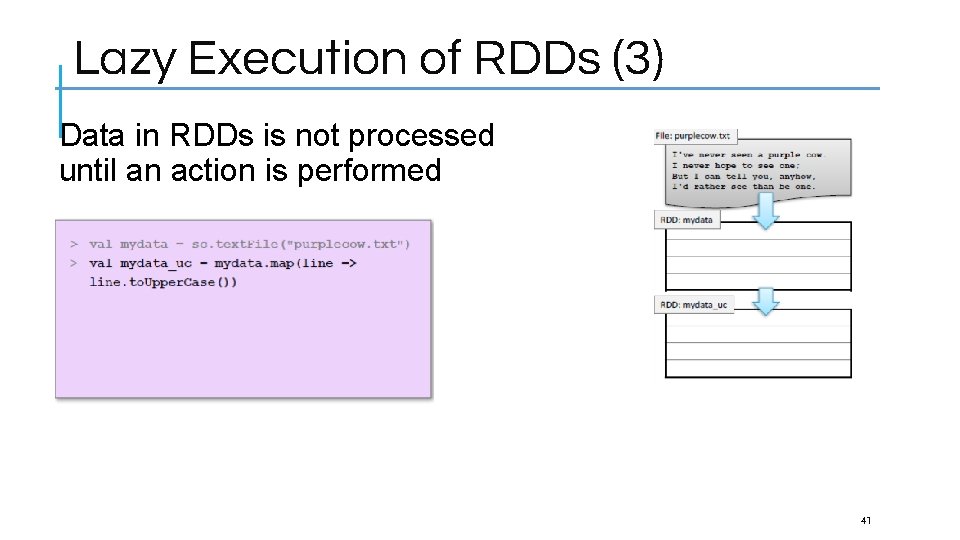
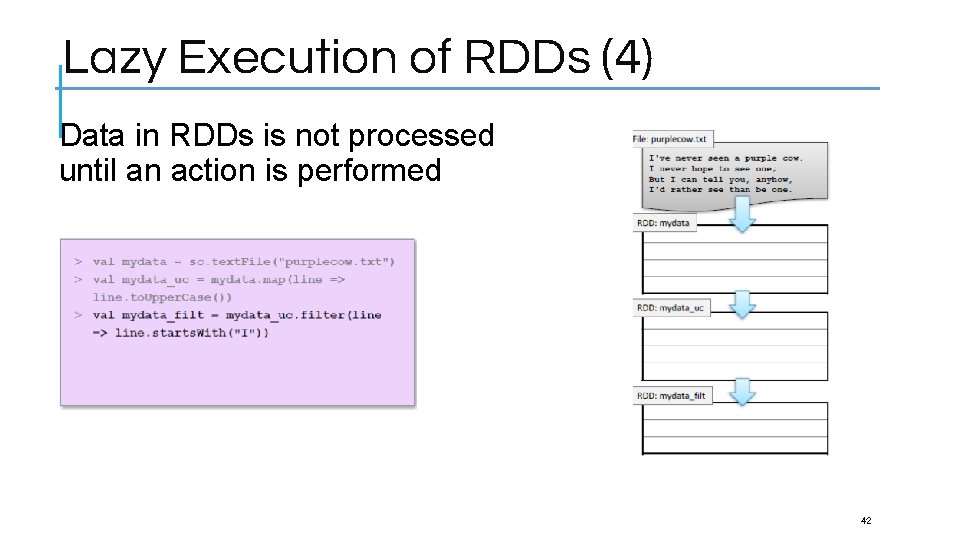
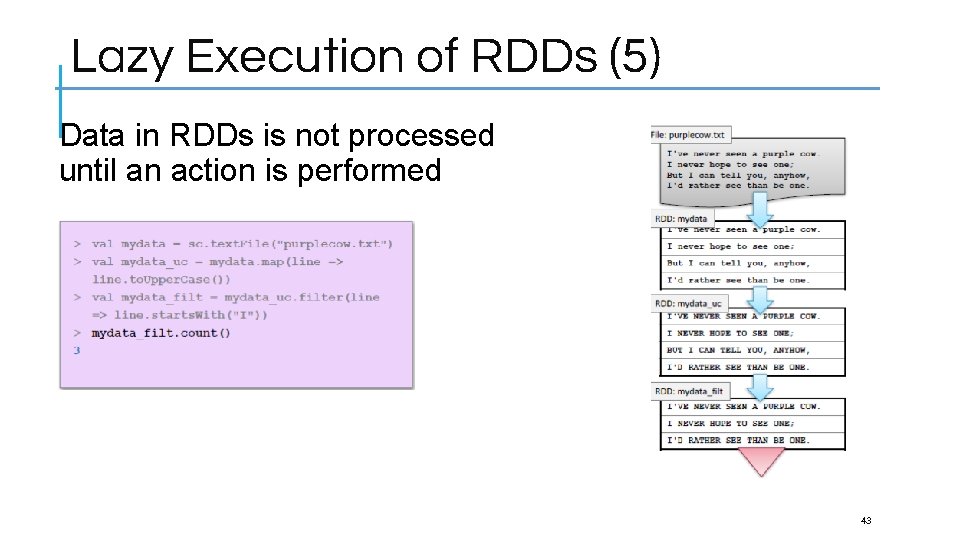
Lazy Execution of RDDs (1) Data in RDDs is not processed until an action is performed 39
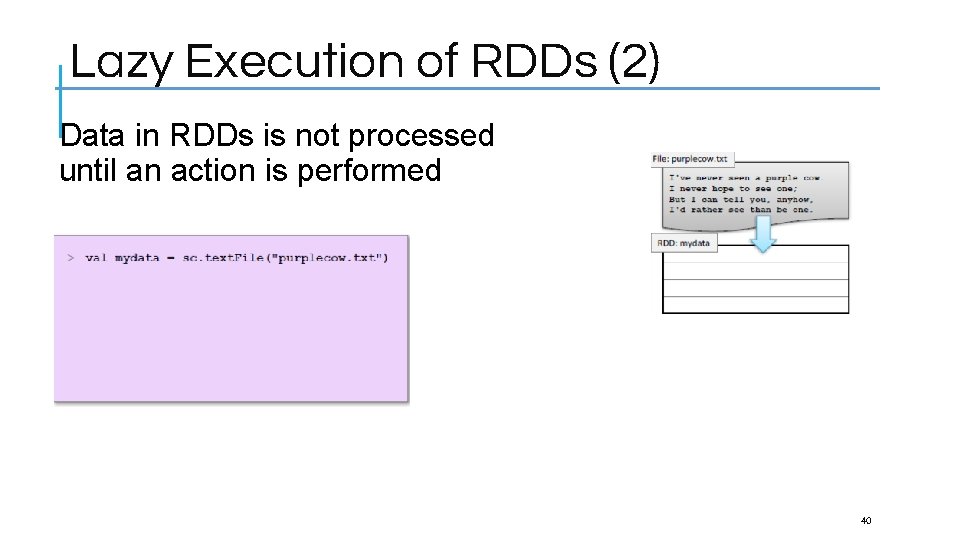
Lazy Execution of RDDs (2) Data in RDDs is not processed until an action is performed 40
Lazy Execution of RDDs (3) Data in RDDs is not processed until an action is performed 41
Lazy Execution of RDDs (4) Data in RDDs is not processed until an action is performed 42
Lazy Execution of RDDs (5) Data in RDDs is not processed until an action is performed 43
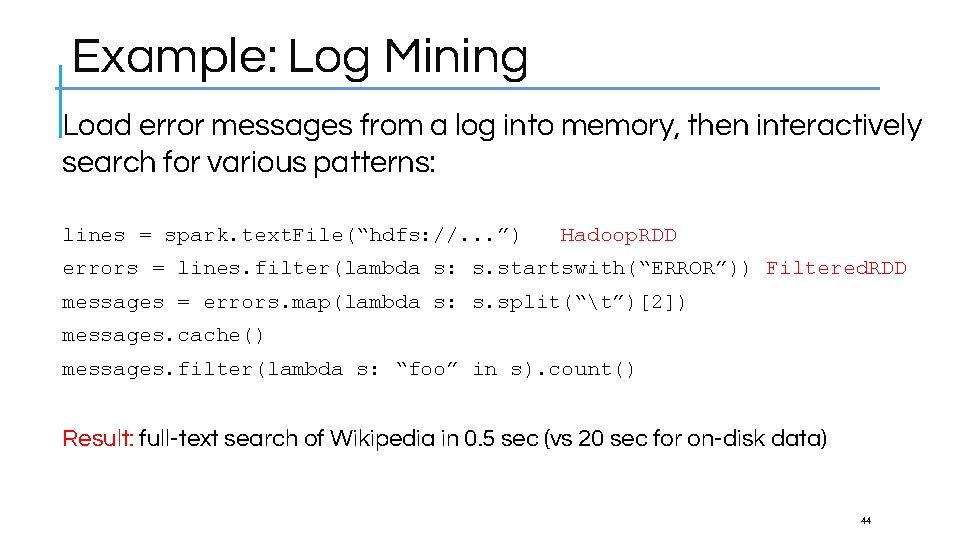
Example: Log Mining Load error messages from a log into memory, then interactively search for various patterns: lines = spark. text. File(“hdfs: //. . . ”) Hadoop. RDD errors = lines. filter(lambda s: s. startswith(“ERROR”)) Filtered. RDD messages = errors. map(lambda s: s. split(“t”)[2]) messages. cache() messages. filter(lambda s: “foo” in s). count() Result: full-text search of Wikipedia in 0. 5 sec (vs 20 sec for on-disk data) 44
RDD and Partitions (More Parallelism) 45
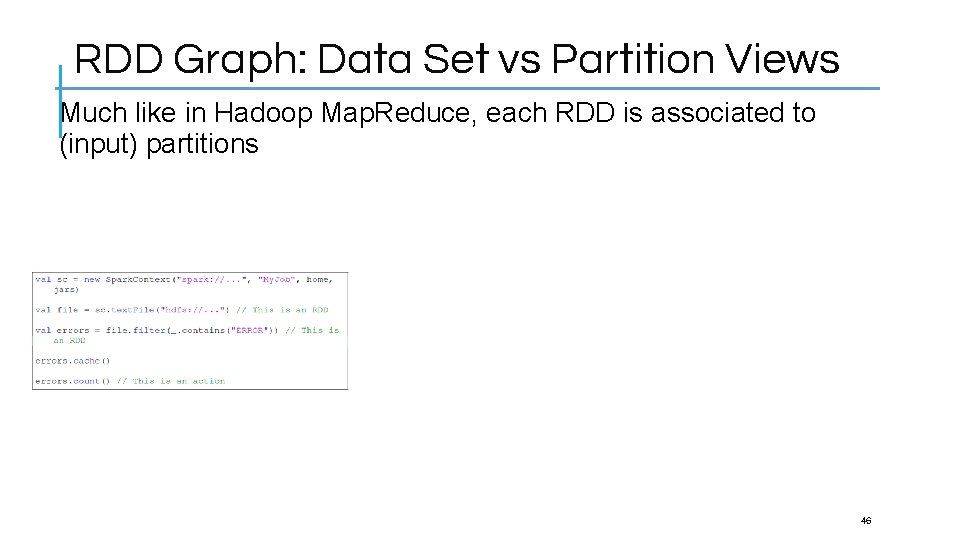
RDD Graph: Data Set vs Partition Views Much like in Hadoop Map. Reduce, each RDD is associated to (input) partitions 46
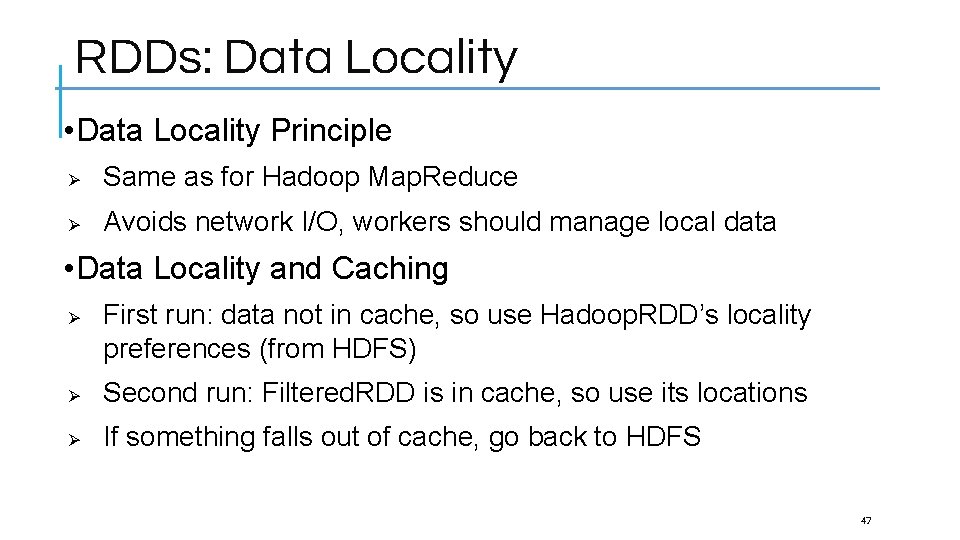
RDDs: Data Locality • Data Locality Principle Ø Same as for Hadoop Map. Reduce Ø Avoids network I/O, workers should manage local data • Data Locality and Caching Ø First run: data not in cache, so use Hadoop. RDD’s locality preferences (from HDFS) Ø Second run: Filtered. RDD is in cache, so use its locations Ø If something falls out of cache, go back to HDFS 47
RDDs -- Summary RDD are partitioned, locality aware, distributed collections Ø RDD are immutable RDD are data structures that: Ø Ø Either point to a direct data source (e. g. HDFS) Apply some transformations to its parent RDD(s) to generate new data elements Computations on RDDs Ø Represented by lazily evaluated lineage DAGs composed by chained RDDs 48
Lifetime of a Job in Spark 49
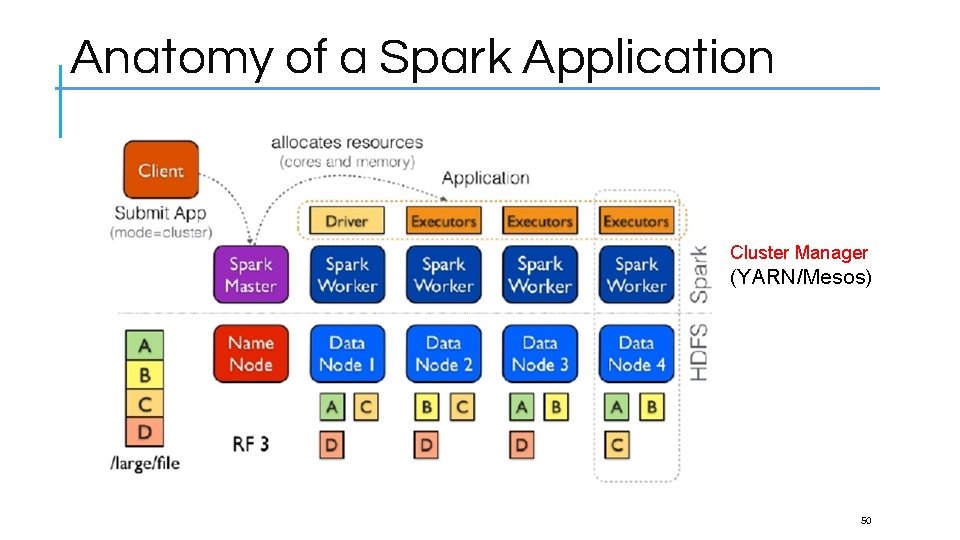
Anatomy of a Spark Application Cluster Manager (YARN/Mesos) 50
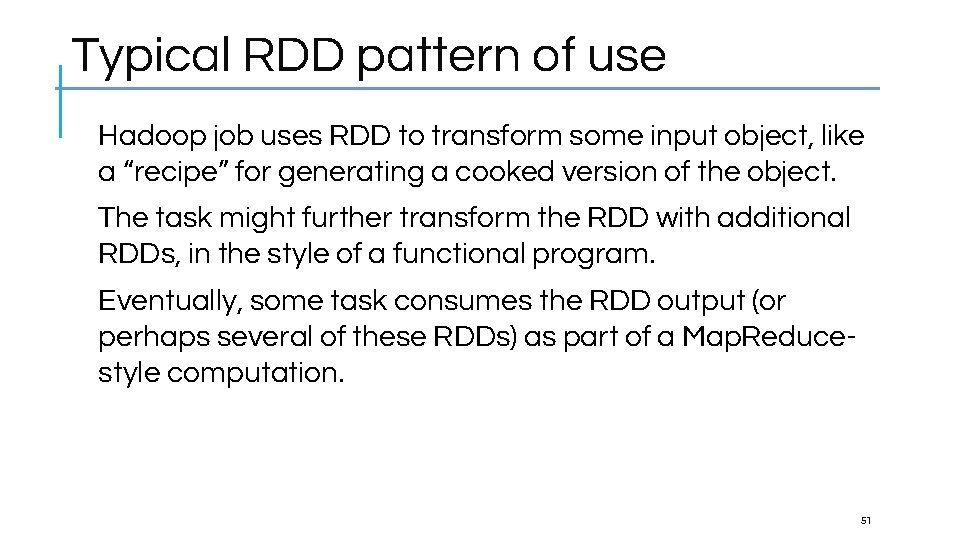
Typical RDD pattern of use Hadoop job uses RDD to transform some input object, like a “recipe” for generating a cooked version of the object. The task might further transform the RDD with additional RDDs, in the style of a functional program. Eventually, some task consumes the RDD output (or perhaps several of these RDDs) as part of a Map. Reducestyle computation. 51
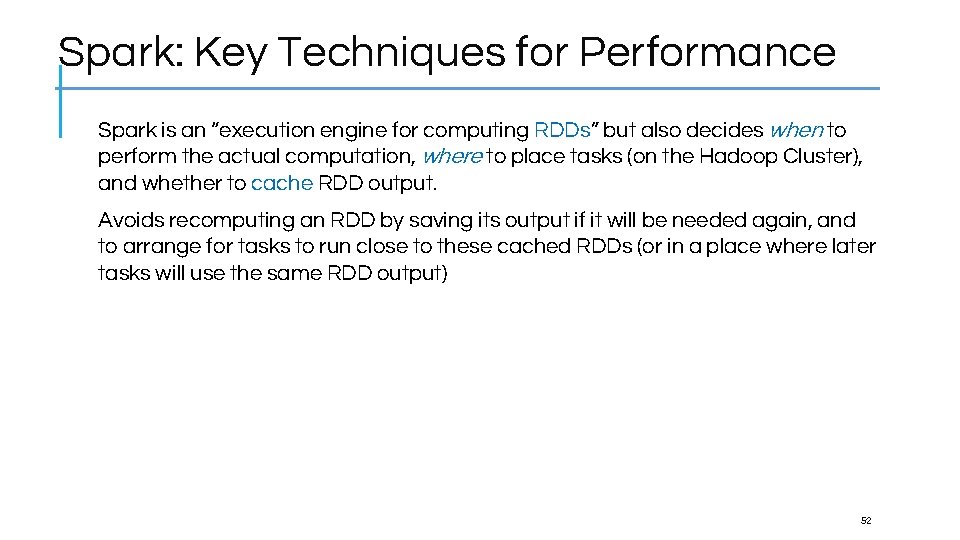
Spark: Key Techniques for Performance Spark is an “execution engine for computing RDDs” but also decides when to perform the actual computation, where to place tasks (on the Hadoop Cluster), and whether to cache RDD output. Avoids recomputing an RDD by saving its output if it will be needed again, and to arrange for tasks to run close to these cached RDDs (or in a place where later tasks will use the same RDD output) 52
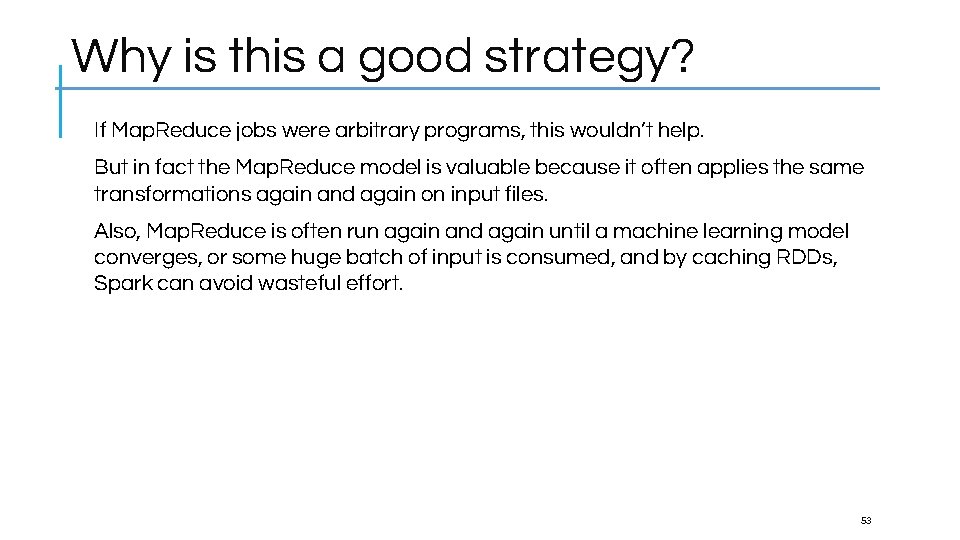
Why is this a good strategy? If Map. Reduce jobs were arbitrary programs, this wouldn’t help. But in fact the Map. Reduce model is valuable because it often applies the same transformations again and again on input files. Also, Map. Reduce is often run again and again until a machine learning model converges, or some huge batch of input is consumed, and by caching RDDs, Spark can avoid wasteful effort. 53
Iterative Algorithms: Spark vs Map. Reduce 54
Today’s Topics • Motivation • Spark Basics • Spark Programming 55
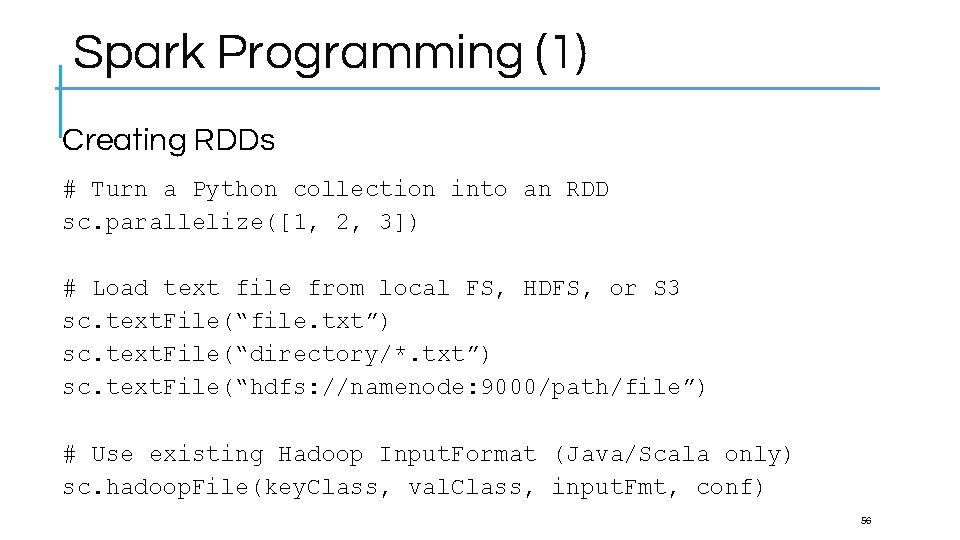
Spark Programming (1) Creating RDDs # Turn a Python collection into an RDD sc. parallelize([1, 2, 3]) # Load text file from local FS, HDFS, or S 3 sc. text. File(“file. txt”) sc. text. File(“directory/*. txt”) sc. text. File(“hdfs: //namenode: 9000/path/file”) # Use existing Hadoop Input. Format (Java/Scala only) sc. hadoop. File(key. Class, val. Class, input. Fmt, conf) 56
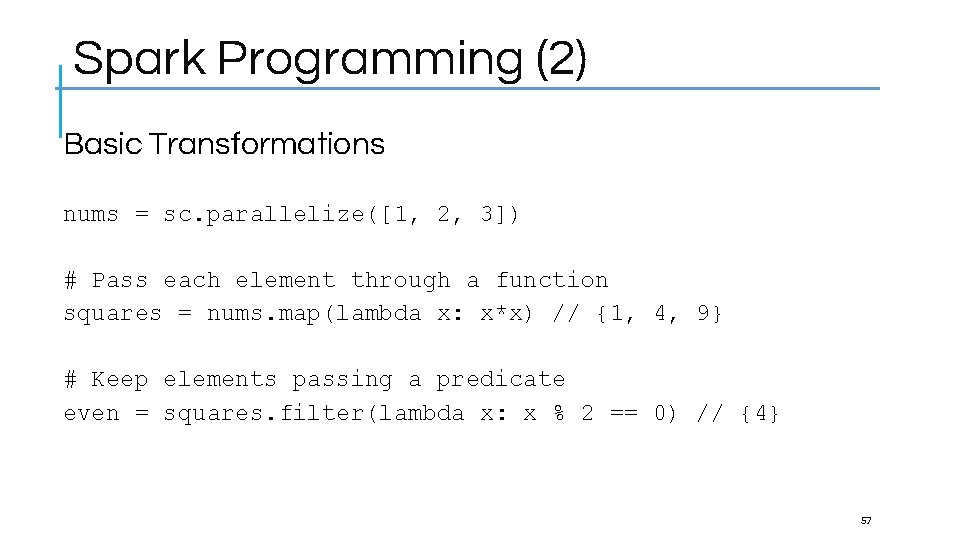
Spark Programming (2) Basic Transformations nums = sc. parallelize([1, 2, 3]) # Pass each element through a function squares = nums. map(lambda x: x*x) // {1, 4, 9} # Keep elements passing a predicate even = squares. filter(lambda x: x % 2 == 0) // {4} 57
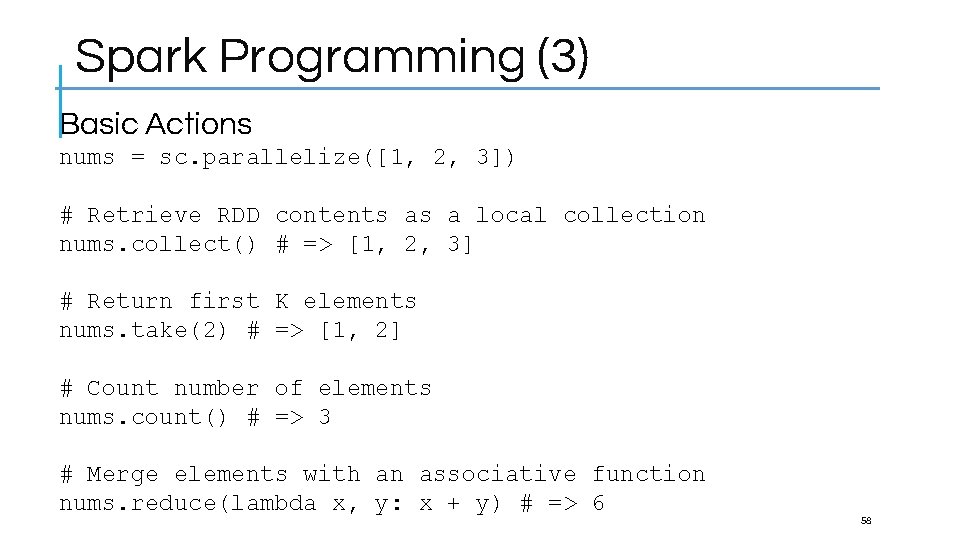
Spark Programming (3) Basic Actions nums = sc. parallelize([1, 2, 3]) # Retrieve RDD contents as a local collection nums. collect() # => [1, 2, 3] # Return first K elements nums. take(2) # => [1, 2] # Count number of elements nums. count() # => 3 # Merge elements with an associative function nums. reduce(lambda x, y: x + y) # => 6 58
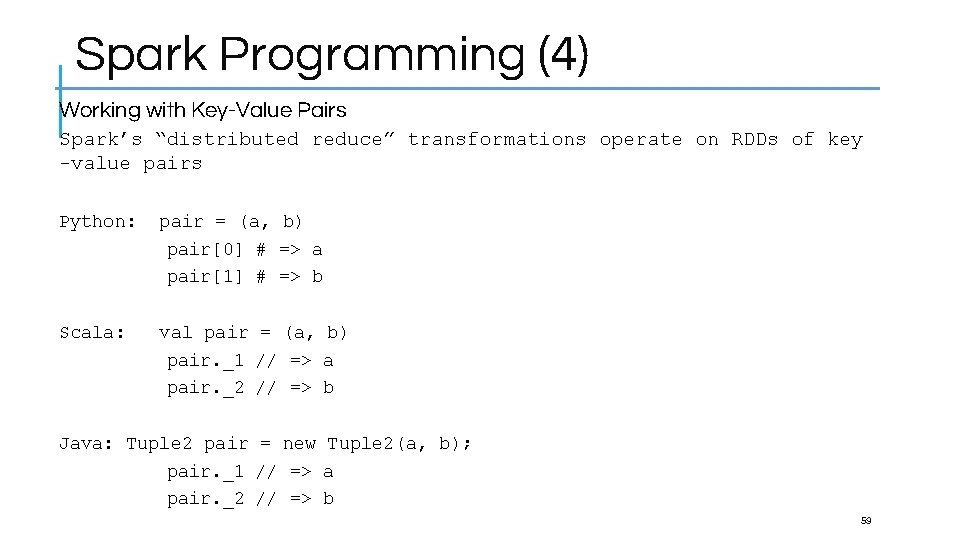
Spark Programming (4) Working with Key-Value Pairs Spark’s “distributed reduce” transformations operate on RDDs of key -value pairs Python: pair = (a, b) pair[0] # => a pair[1] # => b Scala: val pair = (a, b) pair. _1 // => a pair. _2 // => b Java: Tuple 2 pair = new Tuple 2(a, b); pair. _1 // => a pair. _2 // => b 59
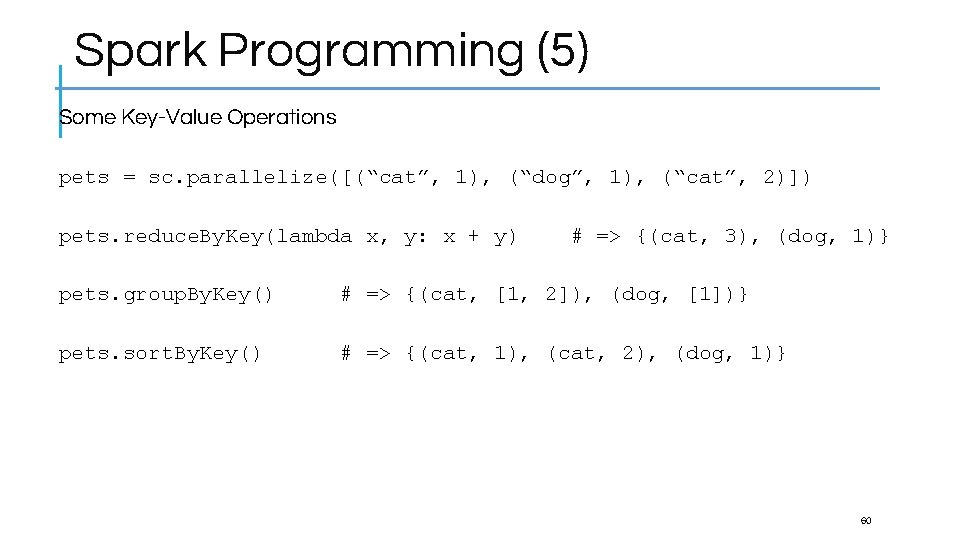
Spark Programming (5) Some Key-Value Operations pets = sc. parallelize([(“cat”, 1), (“dog”, 1), (“cat”, 2)]) pets. reduce. By. Key(lambda x, y: x + y) # => {(cat, 3), (dog, 1)} pets. group. By. Key() # => {(cat, [1, 2]), (dog, [1])} pets. sort. By. Key() # => {(cat, 1), (cat, 2), (dog, 1)} 60
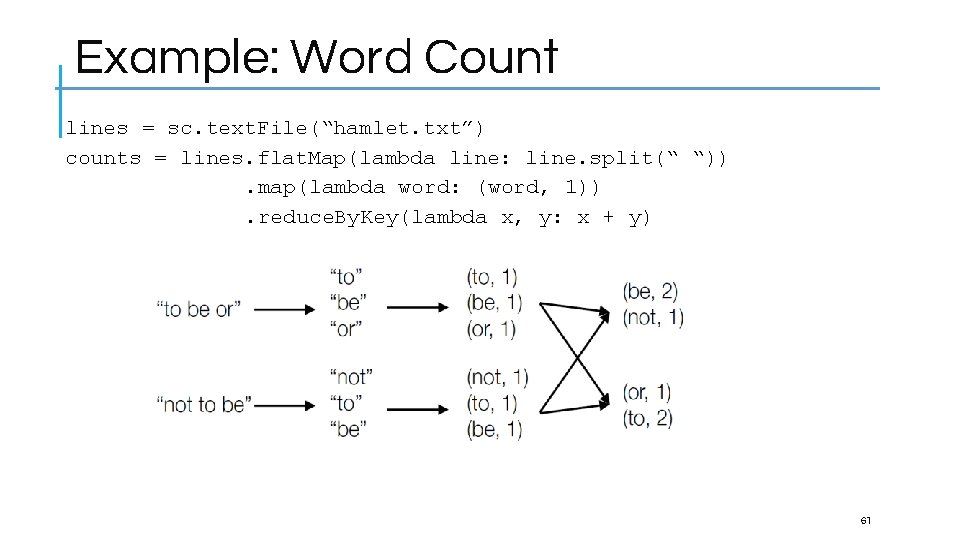
Example: Word Count lines = sc. text. File(“hamlet. txt”) counts = lines. flat. Map(lambda line: line. split(“ “)). map(lambda word: (word, 1)). reduce. By. Key(lambda x, y: x + y) 61
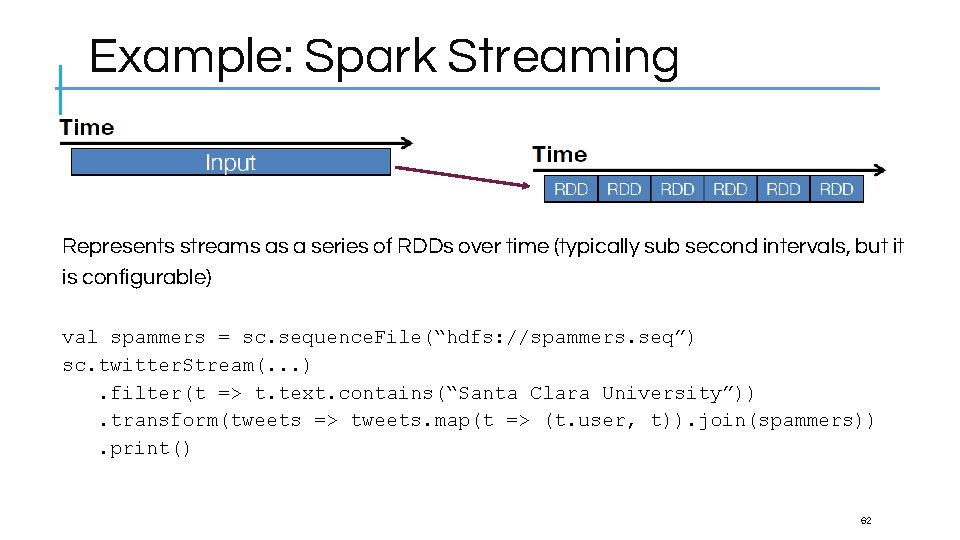
Example: Spark Streaming Represents streams as a series of RDDs over time (typically sub second intervals, but it is configurable) val spammers = sc. sequence. File(“hdfs: //spammers. seq”) sc. twitter. Stream(. . . ). filter(t => t. text. contains(“Santa Clara University”)). transform(tweets => tweets. map(t => (t. user, t)). join(spammers)). print() 62
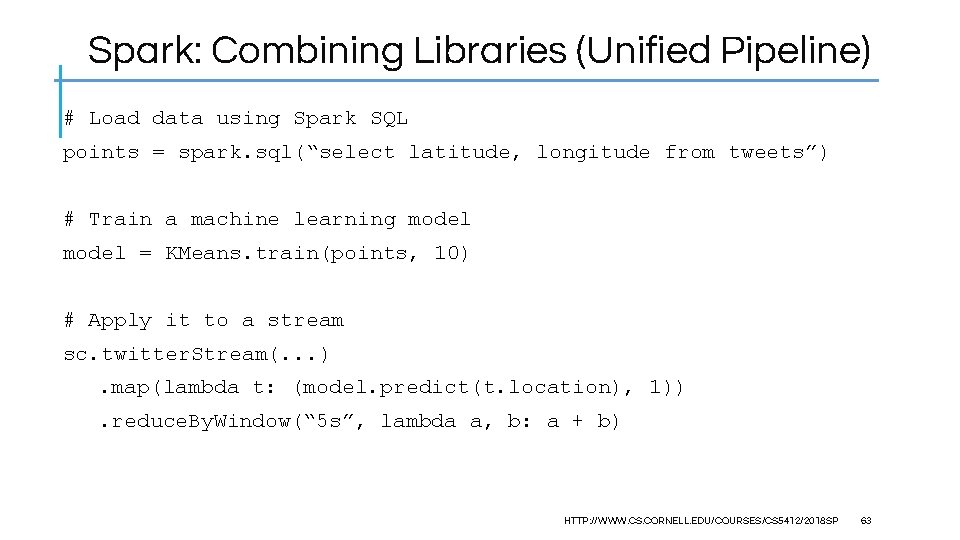
Spark: Combining Libraries (Unified Pipeline) # Load data using Spark SQL points = spark. sql(“select latitude, longitude from tweets”) # Train a machine learning model = KMeans. train(points, 10) # Apply it to a stream sc. twitter. Stream(. . . ). map(lambda t: (model. predict(t. location), 1)). reduce. By. Window(“ 5 s”, lambda a, b: a + b) HTTP: //WWW. CS. CORNELL. EDU/COURSES/CS 5412/2018 SP 63
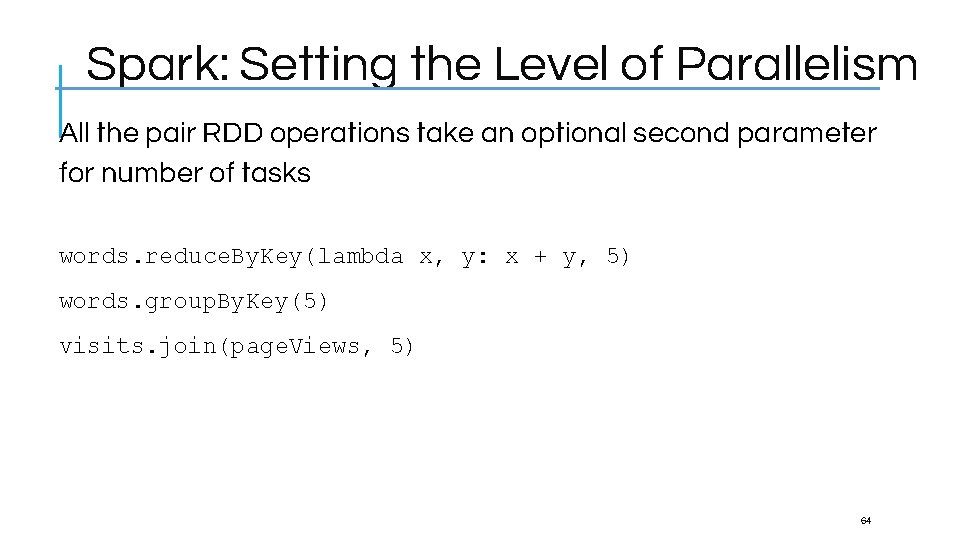
Spark: Setting the Level of Parallelism All the pair RDD operations take an optional second parameter for number of tasks words. reduce. By. Key(lambda x, y: x + y, 5) words. group. By. Key(5) visits. join(page. Views, 5) 64
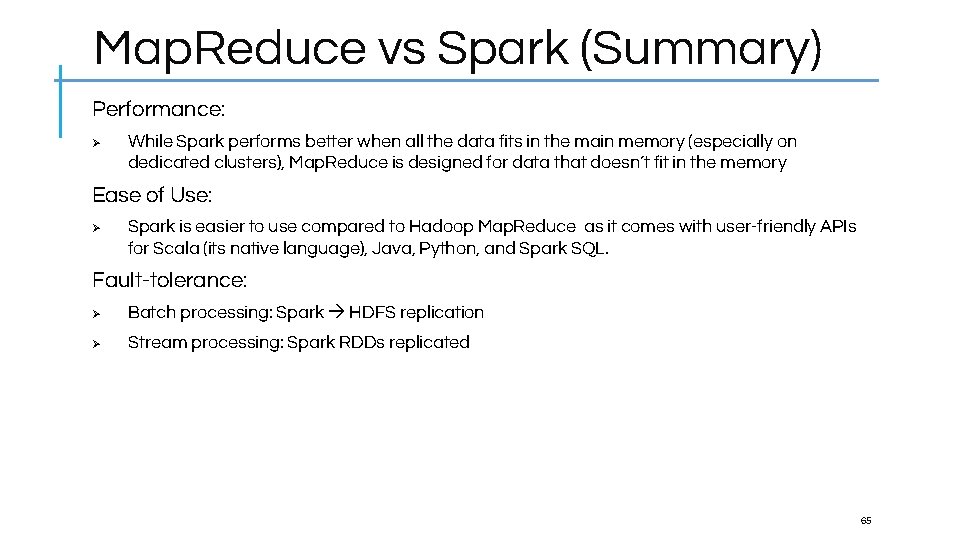
Map. Reduce vs Spark (Summary) Performance: Ø While Spark performs better when all the data fits in the main memory (especially on dedicated clusters), Map. Reduce is designed for data that doesn’t fit in the memory Ease of Use: Ø Spark is easier to use compared to Hadoop Map. Reduce as it comes with user-friendly APIs for Scala (its native language), Java, Python, and Spark SQL. Fault-tolerance: Ø Batch processing: Spark HDFS replication Ø Stream processing: Spark RDDs replicated 65
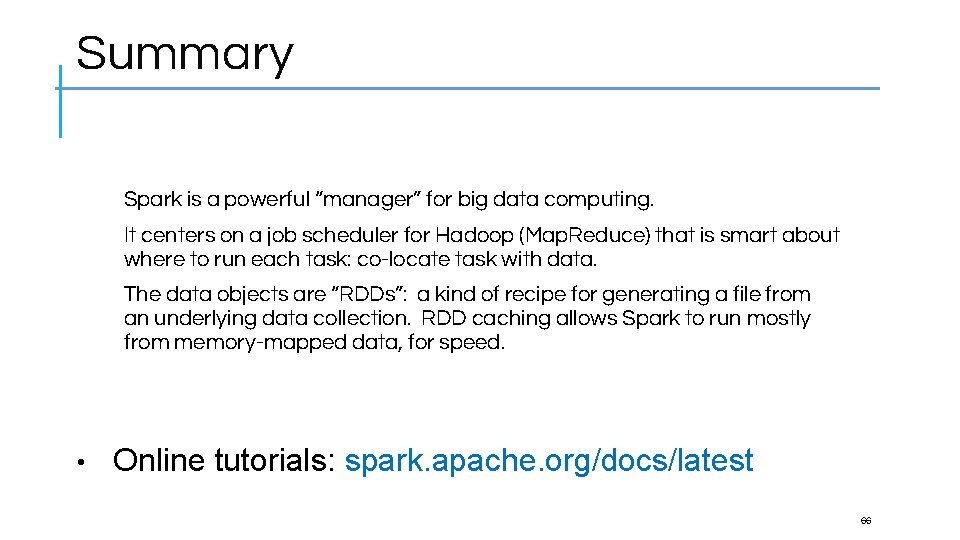
Summary Spark is a powerful “manager” for big data computing. It centers on a job scheduler for Hadoop (Map. Reduce) that is smart about where to run each task: co-locate task with data. The data objects are “RDDs”: a kind of recipe for generating a file from an underlying data collection. RDD caching allows Spark to run mostly from memory-mapped data, for speed. • Online tutorials: spark. apache. org/docs/latest 66