
APA PRACTICE GUIDELINE ON THE USE OF ANTIPSYCHOTICS

- Slides: 42
APA PRACTICE GUIDELINE ON THE USE OF ANTIPSYCHOTICS TO TREAT AGITATION OR PSYCHOSIS IN PATIENTS WITH DEMENTIA Laura J. Fochtmann, MD, MBI Distinguished Service Professor, Departments of Psychiatry, Pharmacological Sciences and Biomedical Informatics, Stony Brook University Medical Editor, Practice Guidelines American Psychiatric Association No industry relationships August 2017 © 2017 American Psychiatric Association. All rights reserved.
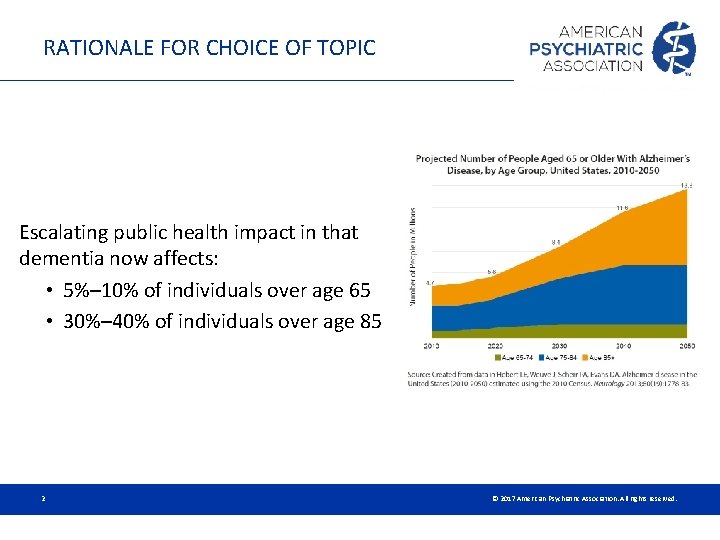
RATIONALE FOR CHOICE OF TOPIC Escalating public health impact in that dementia now affects: • 5%– 10% of individuals over age 65 • 30%– 40% of individuals over age 85 2 © 2017 American Psychiatric Association. All rights reserved.
RATIONALE FOR CHOICE OF TOPIC • Agitation and psychotic symptoms are common with dementia – Affects quality of life for patients and for caregivers – Increases likelihood of long-term care • Current treatment practices vary suggesting a need for guidance to clinicians • Modest evidence of short-term efficacy of antipsychotic medications, but increasing evidence of associated risks has contributed to increasingly complex decisions for patients, families, and clinicians 3 © 2017 American Psychiatric Association. All rights reserved.
GOAL OF GUIDELINE • To improve the care of patients with dementia who are experiencing agitation or psychosis, focusing on the judicious use of antipsychotic medications • Guidelines are: – Assessments of current scientific and clinical information – Not inclusive of all proper treatments – Should not serve as a comprehensive standard of care – Do not account for individual variation – Not intended to replace independent clinical judgment 4 © 2017 American Psychiatric Association. All rights reserved.
STEPS IN GUIDELINE DEVELOPMENT • Expert survey • Systematic review of available evidence (by AHRQ for this guideline) • Ratings of risk of bias (for individual studies) and strength of research evidence (overall for specific benefits/harms) • Generate guideline statements (recommendations or suggestions) based upon the relative balance of benefits and harms of the assessment or intervention • Modified Delphi approach to achieve group consensus • External review by stakeholders • Approval by Assembly and APA Board of Trustees 5 © 2017 American Psychiatric Association. All rights reserved.
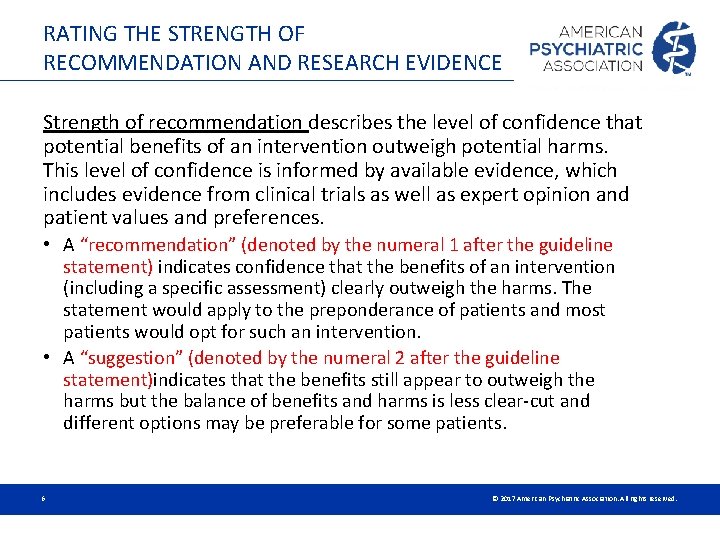
RATING THE STRENGTH OF RECOMMENDATION AND RESEARCH EVIDENCE Strength of recommendation describes the level of confidence that potential benefits of an intervention outweigh potential harms. This level of confidence is informed by available evidence, which includes evidence from clinical trials as well as expert opinion and patient values and preferences. • A “recommendation” (denoted by the numeral 1 after the guideline statement) indicates confidence that the benefits of an intervention (including a specific assessment) clearly outweigh the harms. The statement would apply to the preponderance of patients and most patients would opt for such an intervention. • A “suggestion” (denoted by the numeral 2 after the guideline statement)indicates that the benefits still appear to outweigh the harms but the balance of benefits and harms is less clear-cut and different options may be preferable for some patients. 6 © 2017 American Psychiatric Association. All rights reserved.
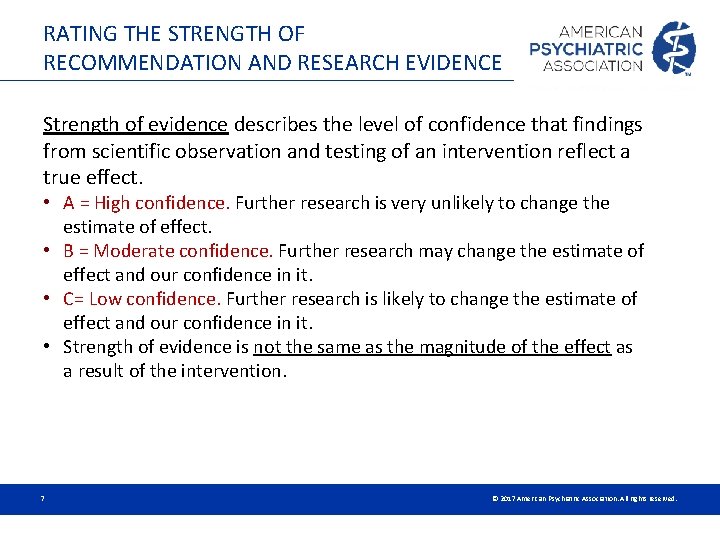
RATING THE STRENGTH OF RECOMMENDATION AND RESEARCH EVIDENCE Strength of evidence describes the level of confidence that findings from scientific observation and testing of an intervention reflect a true effect. • A = High confidence. Further research is very unlikely to change the estimate of effect. • B = Moderate confidence. Further research may change the estimate of effect and our confidence in it. • C= Low confidence. Further research is likely to change the estimate of effect and our confidence in it. • Strength of evidence is not the same as the magnitude of the effect as a result of the intervention. 7 © 2017 American Psychiatric Association. All rights reserved.
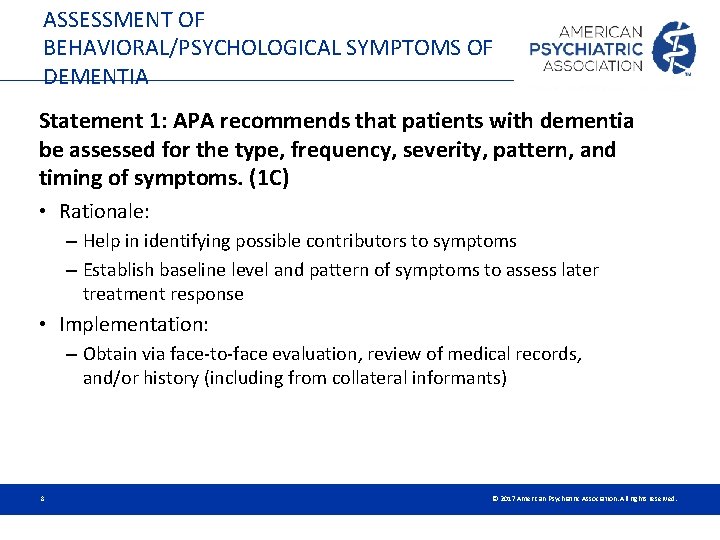
ASSESSMENT OF BEHAVIORAL/PSYCHOLOGICAL SYMPTOMS OF DEMENTIA Statement 1: APA recommends that patients with dementia be assessed for the type, frequency, severity, pattern, and timing of symptoms. (1 C) • Rationale: – Help in identifying possible contributors to symptoms – Establish baseline level and pattern of symptoms to assess later treatment response • Implementation: – Obtain via face-to-face evaluation, review of medical records, and/or history (including from collateral informants) 8 © 2017 American Psychiatric Association. All rights reserved.
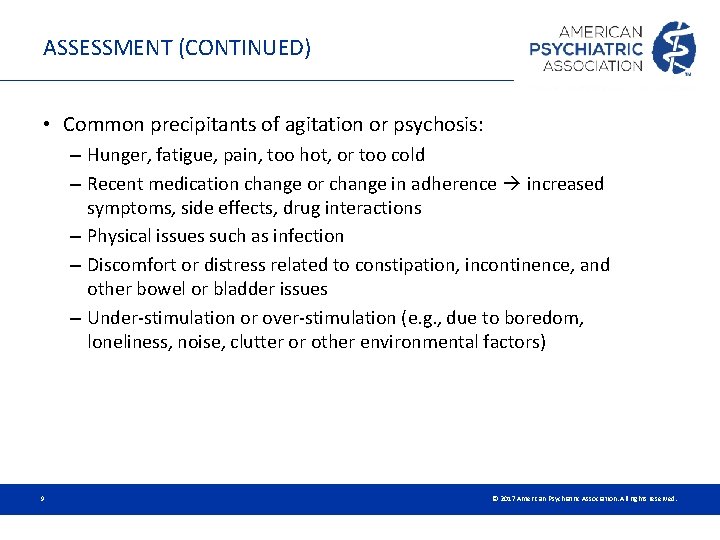
ASSESSMENT (CONTINUED) • Common precipitants of agitation or psychosis: – Hunger, fatigue, pain, too hot, or too cold – Recent medication change or change in adherence increased symptoms, side effects, drug interactions – Physical issues such as infection – Discomfort or distress related to constipation, incontinence, and other bowel or bladder issues – Under-stimulation or over-stimulation (e. g. , due to boredom, loneliness, noise, clutter or other environmental factors) 9 © 2017 American Psychiatric Association. All rights reserved.
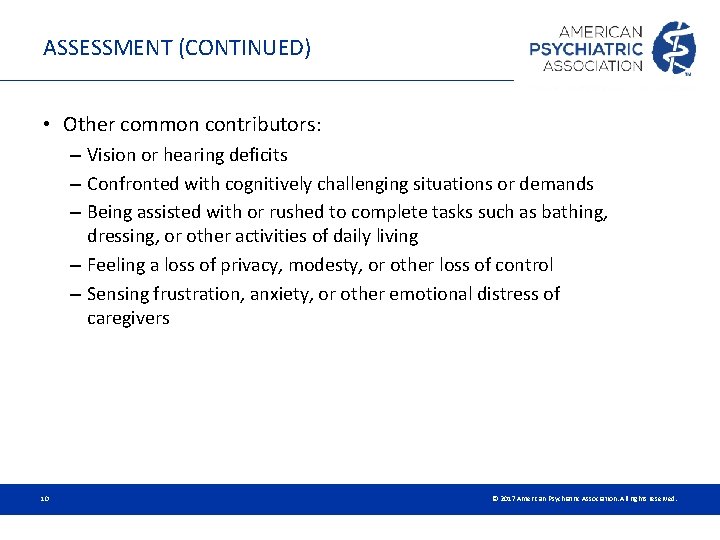
ASSESSMENT (CONTINUED) • Other common contributors: – Vision or hearing deficits – Confronted with cognitively challenging situations or demands – Being assisted with or rushed to complete tasks such as bathing, dressing, or other activities of daily living – Feeling a loss of privacy, modesty, or other loss of control – Sensing frustration, anxiety, or other emotional distress of caregivers 10 © 2017 American Psychiatric Association. All rights reserved.
ASSESSMENT (CONTINUED) Statement 2: APA recommends that patients with dementia be assessed for pain and other potentially modifiable contributors to symptoms as well as for factors, such as subtype of dementia, that may influence choices of treatment. (1 C) • Rationale: – Help in identifying possible contributors to symptoms, including those that may be modifiable by treatment – Need to establish diagnosis, which can affect treatment choice (e. g. , greater risk of antipsychotic side effects with some types of dementia) 11 © 2017 American Psychiatric Association. All rights reserved.
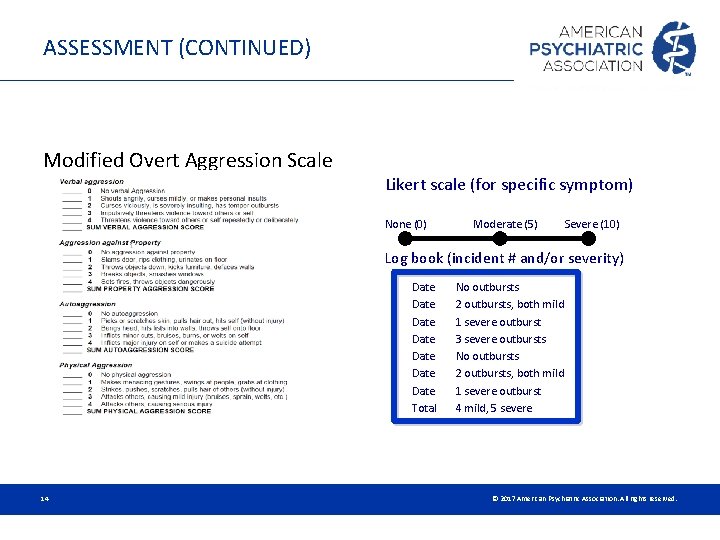
ASSESSMENT (CONTINUED) Statement 3: APA recommends that in patients with dementia with agitation or psychosis, response to treatment be assessed with a quantitative measure. (1 C) • Rationale: – Establish baseline level of symptoms to assess later treatment response – Systematic assessment reduces risk of recall bias • Implementation: – Can use formal rating scale (e. g. , NPI-Q, BPRS, CMAI, MOAS), Likert scale, or log of behaviors 12 © 2017 American Psychiatric Association. All rights reserved.
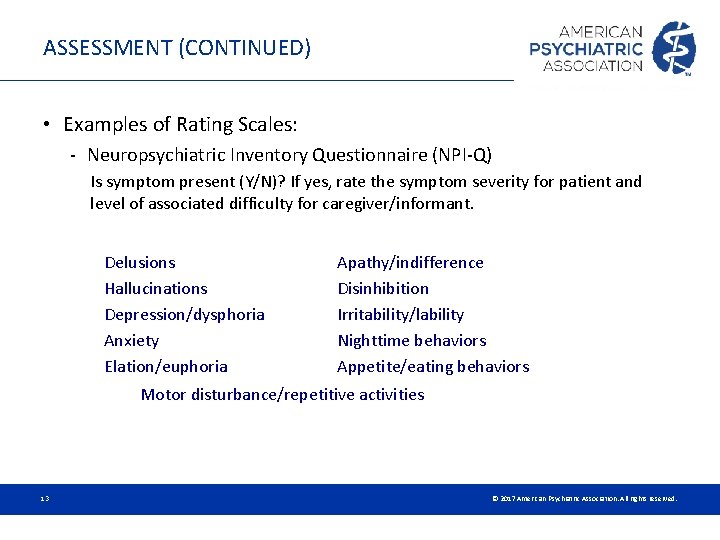
ASSESSMENT (CONTINUED) • Examples of Rating Scales: - Neuropsychiatric Inventory Questionnaire (NPI-Q) Is symptom present (Y/N)? If yes, rate the symptom severity for patient and level of associated difficulty for caregiver/informant. Delusions Hallucinations Depression/dysphoria Anxiety Elation/euphoria Apathy/indifference Disinhibition Irritability/lability Nighttime behaviors Appetite/eating behaviors Motor disturbance/repetitive activities 13 © 2017 American Psychiatric Association. All rights reserved.
ASSESSMENT (CONTINUED) Modified Overt Aggression Scale Likert scale (for specific symptom) None (0) Moderate (5) Severe (10) Log book (incident # and/or severity) Date Date Total 14 No outbursts 2 outbursts, both mild 1 severe outburst 3 severe outbursts No outbursts 2 outbursts, both mild 1 severe outburst 4 mild, 5 severe © 2017 American Psychiatric Association. All rights reserved.
DEVELOPMENT OF A COMPREHENSIVE TREATMENT PLAN Statement 4: APA recommends that patients with dementia have a comprehensive treatment plan that includes appropriate person-centered nonpharmacological and pharmacological interventions, as indicated. (1 C) • Rationale: – Although evidence for non-pharmacological interventions was not reviewed, harms of such approaches are minimal – Good clinical practice suggests value of a thoughtfully constructed treatment plan (which can be part of a progress note) that targets specific signs and symptoms as well as unique aspects, values, and preferences of an individual • NOTE: Other pharmacotherapies were not reviewed in this guideline. 15 © 2017 American Psychiatric Association. All rights reserved.
COMPREHENSIVE TREATMENT PLAN (CONTINUED) • Possible non-pharmacological approaches: – Reduce environmental clutter and noise – Remove items that could be thrown or that upset patient – Optimize lighting and give cues to heighten orientation – Provide eyeglasses, hearing aids, mobility support, etc. – Consider approaches based on patient history/preferences: hand massage, pet therapy, music listening – Caregiver education: reflective practice, skills targeting behavioral challenges, and enhancing coping techniques 16 © 2017 American Psychiatric Association. All rights reserved.
ASSESSMENT OF BENEFITS AND RISKS OF ANTIPSYCHOTIC TREATMENT FOR THE PATIENT Statement 5: APA recommends that nonemergency antipsychotic medication should only be used for the treatment of agitation or psychosis in patients with dementia when symptoms are severe, dangerous, and/or cause significant distress to the patient. (1 B) • Rationale: – Except in an emergency when acute use of an antipsychotic may be indicated, possible risks of chronic antipsychotic use must be balanced against benefits – Because harms do exist, use can only be justified if symptom is significant 17 © 2017 American Psychiatric Association. All rights reserved.
ASSESSMENT OF BENEFITS AND RISKS (CONTINUED) Statement 6: APA recommends reviewing the clinical response to nonpharmacologic interventions prior to nonemergency use of an antipsychotic medication to treat agitation or psychosis in patients with dementia. (1 C) • Rationale: – Both types of treatments have only modest benefits – Limited harms of nonpharmacological interventions suggest trying such approaches first, except in emergencies – Review of response can help identify if nonpharmacological approaches have been tried or whether adjustments to interventions may be indicated prior to antipsychotic use 18 © 2017 American Psychiatric Association. All rights reserved.
ASSESSMENT OF BENEFITS AND RISKS (CONTINUED) Statement 7: APA recommends that, before nonemergency treatment with an antipsychotic is initiated in patients with dementia, the potential risks and benefits from antipsychotic medication be assessed by the clinician and discussed with the patient (if clinically feasible) as well as with the patient’s surrogate decision maker (if relevant), with input from family or others involved with the patient. (1 C) • Rationale: – Such discussions are a part of good clinical practice 19 © 2017 American Psychiatric Association. All rights reserved.
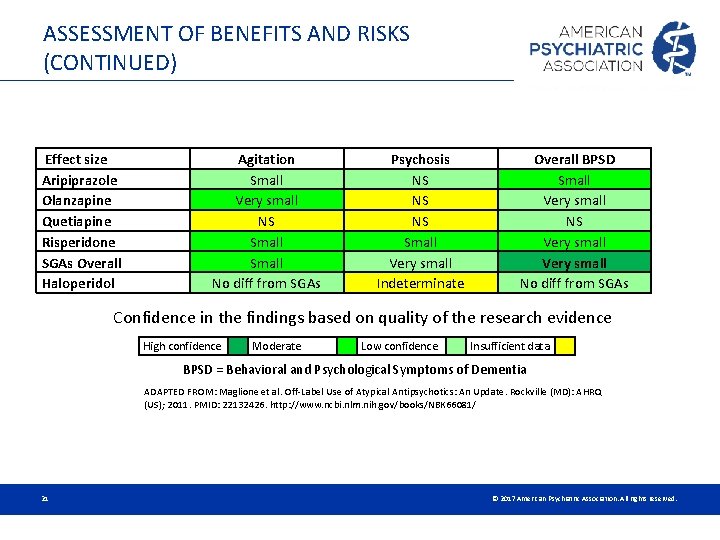
ASSESSMENT OF BENEFITS AND RISKS (CONTINUED) • Expert consensus suggests that antipsychotics can be used appropriately in patients with dementia in the context of dangerous agitation or psychosis to: – improve patient's quality of life – reduce patient distress – reduce the risk of violence – decrease caregiver burden • Randomized placebo-controlled trials suggest some efficacy for risperidone in treating psychosis and for risperidone, olanzapine, and aripiprazole in agitation 20 © 2017 American Psychiatric Association. All rights reserved.
ASSESSMENT OF BENEFITS AND RISKS (CONTINUED) Effect size Aripiprazole Olanzapine Quetiapine Risperidone SGAs Overall Haloperidol Agitation Small Very small NS Small No diff from SGAs Psychosis NS NS NS Small Very small Indeterminate Overall BPSD Small Very small NS Very small No diff from SGAs Confidence in the findings based on quality of the research evidence High confidence Moderate Low confidence Insufficient data BPSD = Behavioral and Psychological Symptoms of Dementia ADAPTED FROM: Maglione et al. Off-Label Use of Atypical Antipsychotics: An Update. Rockville (MD): AHRQ (US); 2011. PMID: 22132426. http: //www. ncbi. nlm. nih. gov/books/NBK 66081/ 21 © 2017 American Psychiatric Association. All rights reserved.
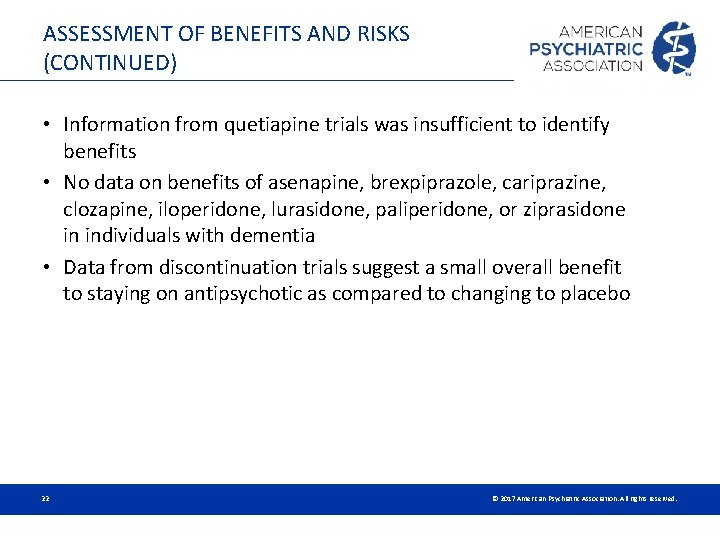
ASSESSMENT OF BENEFITS AND RISKS (CONTINUED) • Information from quetiapine trials was insufficient to identify benefits • No data on benefits of asenapine, brexpiprazole, cariprazine, clozapine, iloperidone, lurasidone, paliperidone, or ziprasidone in individuals with dementia • Data from discontinuation trials suggest a small overall benefit to staying on antipsychotic as compared to changing to placebo 22 © 2017 American Psychiatric Association. All rights reserved.
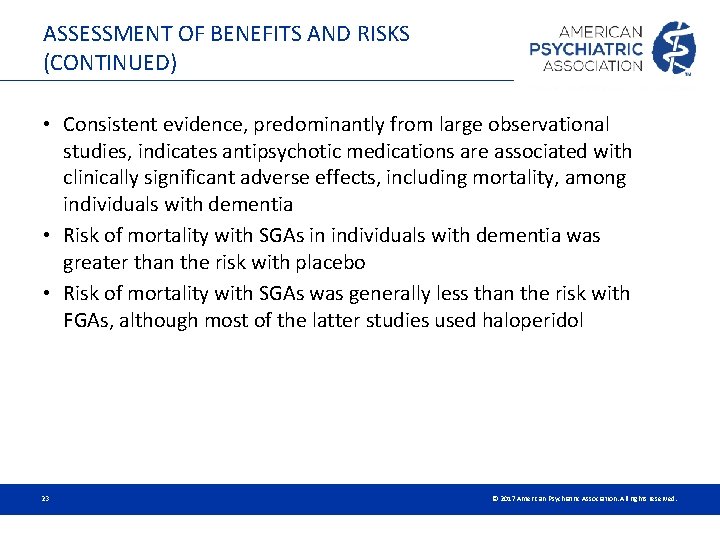
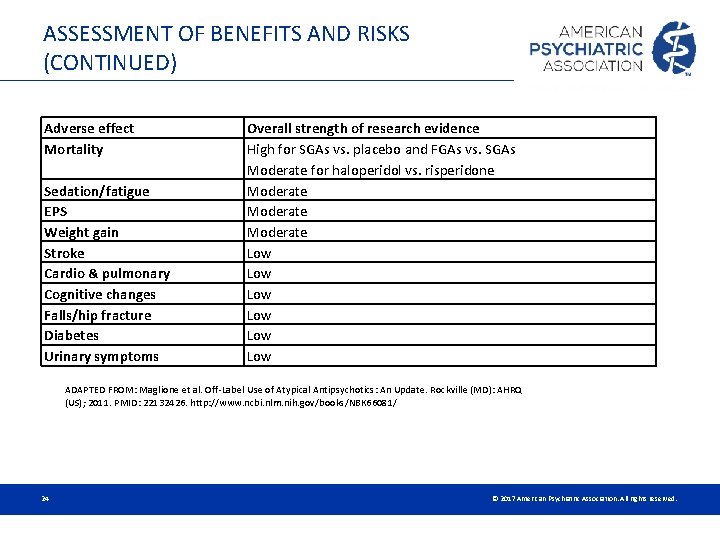
ASSESSMENT OF BENEFITS AND RISKS (CONTINUED) • Consistent evidence, predominantly from large observational studies, indicates antipsychotic medications are associated with clinically significant adverse effects, including mortality, among individuals with dementia • Risk of mortality with SGAs in individuals with dementia was greater than the risk with placebo • Risk of mortality with SGAs was generally less than the risk with FGAs, although most of the latter studies used haloperidol 23 © 2017 American Psychiatric Association. All rights reserved.
ASSESSMENT OF BENEFITS AND RISKS (CONTINUED) Adverse effect Mortality Sedation/fatigue EPS Weight gain Stroke Cardio & pulmonary Cognitive changes Falls/hip fracture Diabetes Urinary symptoms Overall strength of research evidence High for SGAs vs. placebo and FGAs vs. SGAs Moderate for haloperidol vs. risperidone Moderate Low Low Low ADAPTED FROM: Maglione et al. Off-Label Use of Atypical Antipsychotics: An Update. Rockville (MD): AHRQ (US); 2011. PMID: 22132426. http: //www. ncbi. nlm. nih. gov/books/NBK 66081/ 24 © 2017 American Psychiatric Association. All rights reserved.
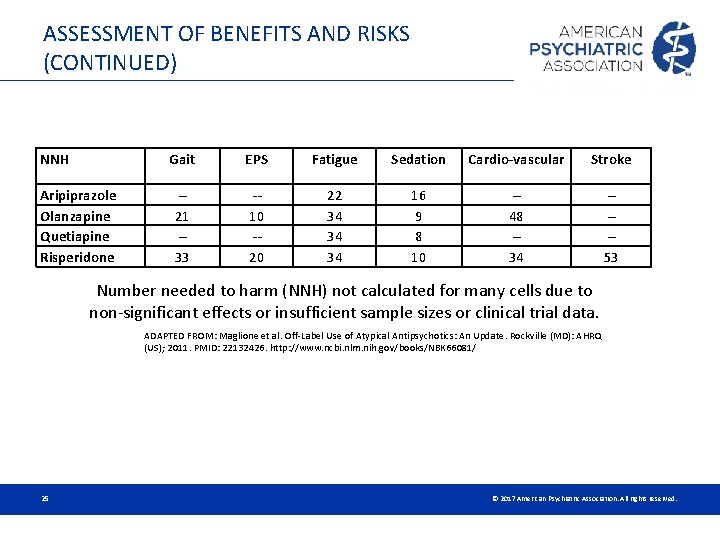
ASSESSMENT OF BENEFITS AND RISKS (CONTINUED) NNH Aripiprazole Olanzapine Quetiapine Risperidone Gait EPS Fatigue Sedation Cardio-vascular Stroke -21 -33 -10 -20 22 34 34 34 16 9 8 10 -48 -34 ---53 Number needed to harm (NNH) not calculated for many cells due to non-significant effects or insufficient sample sizes or clinical trial data. ADAPTED FROM: Maglione et al. Off-Label Use of Atypical Antipsychotics: An Update. Rockville (MD): AHRQ (US); 2011. PMID: 22132426. http: //www. ncbi. nlm. nih. gov/books/NBK 66081/ 25 © 2017 American Psychiatric Association. All rights reserved.
ASSESSMENT OF BENEFITS AND RISKS (CONTINUED) • There may be differences in mortality risk between individual second generation antipsychotic agents, but confidence intervals are overlapping and effects are dose dependent • Samples with aripiprazole were small • No information about the harms of asenapine, brexpiprazole, cariprazine, clozapine, iloperidone, lurasidone, paliperidone, or ziprasidone in individuals with dementia 26 © 2017 American Psychiatric Association. All rights reserved.
CONSIDERATIONS IN MEDICATION SELECTION • What benefits did specific medications show for the target symptom (e. g. , agitation, psychosis) in clinical trials? • What is the side effect profile of the medication? • Does the patient have co-occurring physical conditions that would influence medication tolerability or potential for side effects? • Are there relevant pharmacokinetic considerations (e. g. , drug interactions, active metabolites)? 27 © 2017 American Psychiatric Association. All rights reserved.
CONSIDERATIONS IN MEDICATION SELECTION • What formulations of the medication are available that may assist with patient adherence? • Are there any barriers to use of a specific medication (e. g. , regulatory stipulations, cost considerations, formulary coverage, preauthorization requirements)? • Does the patient or family have a stated preference for a specific medication? 28 © 2017 American Psychiatric Association. All rights reserved.
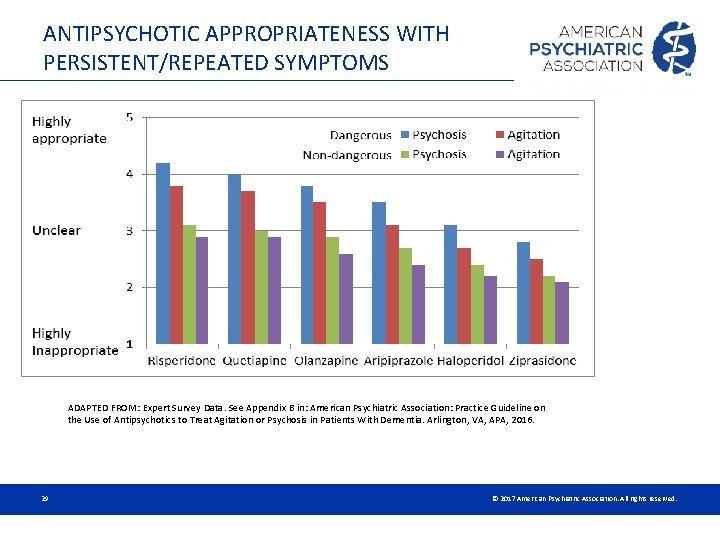
ANTIPSYCHOTIC APPROPRIATENESS WITH PERSISTENT/REPEATED SYMPTOMS ADAPTED FROM: Expert Survey Data. See Appendix B in: American Psychiatric Association: Practice Guideline on the Use of Antipsychotics to Treat Agitation or Psychosis in Patients With Dementia. Arlington, VA, APA, 2016. 29 © 2017 American Psychiatric Association. All rights reserved.
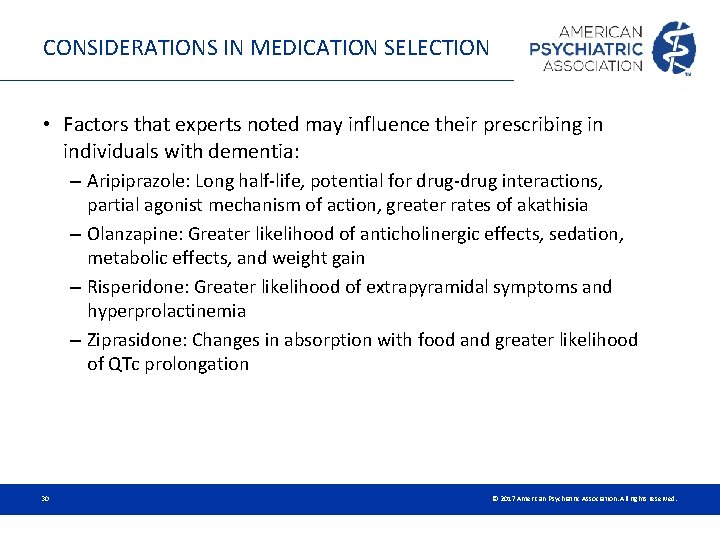
CONSIDERATIONS IN MEDICATION SELECTION • Factors that experts noted may influence their prescribing in individuals with dementia: – Aripiprazole: Long half-life, potential for drug-drug interactions, partial agonist mechanism of action, greater rates of akathisia – Olanzapine: Greater likelihood of anticholinergic effects, sedation, metabolic effects, and weight gain – Risperidone: Greater likelihood of extrapyramidal symptoms and hyperprolactinemia – Ziprasidone: Changes in absorption with food and greater likelihood of QTc prolongation 30 © 2017 American Psychiatric Association. All rights reserved.
CONSIDERATIONS IN MEDICATION SELECTION Statement 14: APA recommends that in the absence of delirium, if nonemergency antipsychotic medication treatment is indicated, haloperidol should not be used as a first-line agent. (1 B) • Rationale: – Comparison data showed no superiority of haloperidol compared to SGAs in treating agitation or psychosis – Some harms appeared to have a greater likelihood of occurrence with haloperidol vs. SGAs (mortality, EPS) – Parenteral availability of haloperidol may still warrant short-term use in emergencies 31 © 2017 American Psychiatric Association. All rights reserved.
CONSIDERATIONS IN MEDICATION SELECTION Statement 15: APA recommends that in patients with dementia with agitation or psychosis, a long-acting injectable antipsychotic medication should not be utilized unless it is otherwise indicated for a co-occurring chronic psychotic disorder. (1 B) • Rationale: – Given potential harms of antipsychotic medication and pharmacokinetic factors in older patients that may further prolong the duration of action, the risks of long-acting agents seemed greater than benefits for most patients 32 © 2017 American Psychiatric Association. All rights reserved.
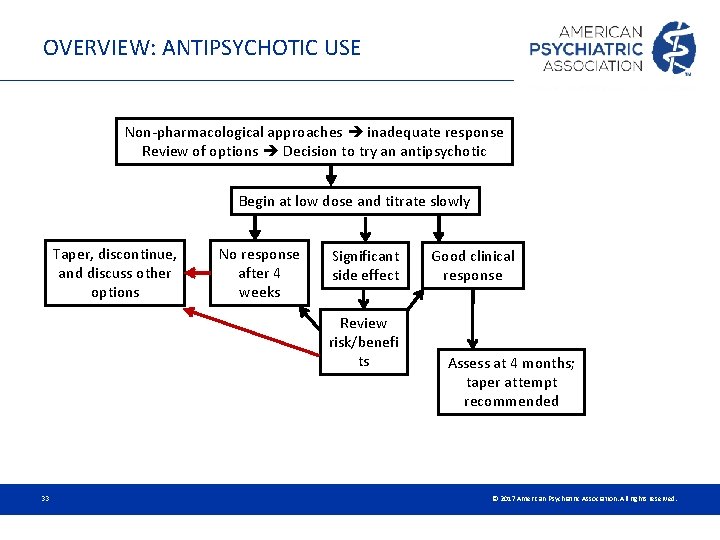
OVERVIEW: ANTIPSYCHOTIC USE Non-pharmacological approaches inadequate response Review of options Decision to try an antipsychotic Begin at low dose and titrate slowly Taper, discontinue, and discuss other options No response after 4 weeks Significant side effect Review risk/benefi ts 33 Good clinical response Assess at 4 months; taper attempt recommended © 2017 American Psychiatric Association. All rights reserved.
DOSING, DURATION, AND MONITORING OF ANTIPSYCHOTIC TREATMENT Statement 8: APA recommends that if a risk/benefit assessment favors the use of an antipsychotic for behavioral/psychological symptoms in patients with dementia, treatment should be initiated at a low dose to be titrated up to the minimum effective dose as tolerated. (1 B) • Rationale: – Good clinical practice particularly in older individuals, rooted in pharmacokinetic considerations • Metabolism, excretion, interactions with other medications longer time to reach steady state levels and greater issues with tolerability 34 © 2017 American Psychiatric Association. All rights reserved.
DOSING, DURATION, AND MONITORING Statement 9: APA recommends that if a patient with dementia experiences a clinically significant side effect of antipsychotic treatment, the potential risks and benefits of antipsychotic medication should be reviewed by the clinician to determine if tapering and discontinuing of the medication is indicated. (1 C) • Rationale: – Such a review is part of good clinical practice although often done informally – Occurrence of a significant side effect could change prior benefit/risk considerations for antipsychotic treatment 35 © 2017 American Psychiatric Association. All rights reserved.
DOSING, DURATION, AND MONITORING Statement 10: APA recommends that in patients with dementia with agitation or psychosis, if there is no clinically significant response after a 4 -week trial of an adequate dose of an antipsychotic drug, the medication should be tapered and withdrawn. (1 B) • Rationale: – In the absence of benefit, exposure to ongoing risks of antipsychotic would be unwarranted 36 © 2017 American Psychiatric Association. All rights reserved.
DOSING, DURATION, AND MONITORING Statement 11: APA recommends that in a patient who has shown a positive response to treatment, decision-making about possible tapering of antipsychotic medication should be accompanied by a discussion with the patient (if clinically feasible) as well as with the patient’s surrogate decision maker (if relevant) with input from family or others involved with the patient. The aim of such a discussion is to elicit their preferences and concerns and to review the initial goals, observed benefits and side effects of antipsychotic treatment, and potential risks of continued exposure to antipsychotics, as well as past experience with antipsychotic medication trials and tapering attempts. (1 C) 37 © 2017 American Psychiatric Association. All rights reserved.
DOSING, DURATION, AND MONITORING Statement 12: APA recommends that in patients with dementia who show adequate response of behavioral/psychological symptoms to treatment with an antipsychotic drug, an attempt to taper and withdraw the drug should be made within 4 months of initiation, unless the patient experienced a recurrence of symptoms with prior attempts of tapering of antipsychotic medication. (1 C) • Rationale: – A substantial fraction of individuals can have antipsychotics tapered without recurrent symptoms, reducing potential harms of medication 38 © 2017 American Psychiatric Association. All rights reserved.
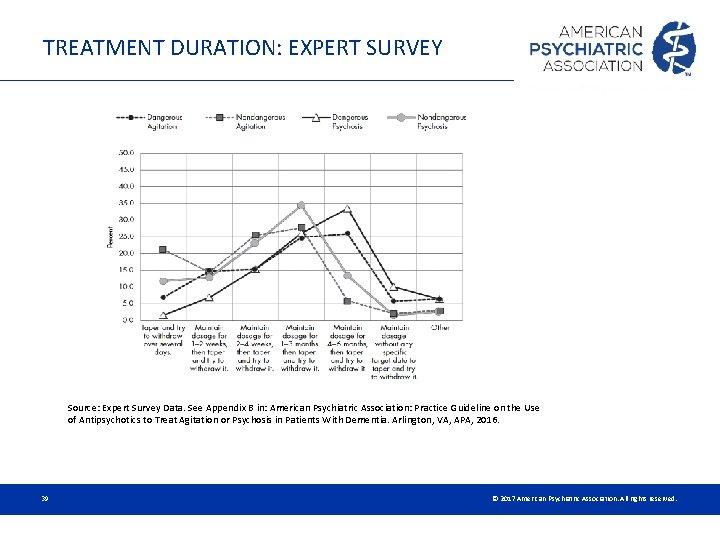
TREATMENT DURATION: EXPERT SURVEY Source: Expert Survey Data. See Appendix B in: American Psychiatric Association: Practice Guideline on the Use of Antipsychotics to Treat Agitation or Psychosis in Patients With Dementia. Arlington, VA, APA, 2016. 39 © 2017 American Psychiatric Association. All rights reserved.
DOSING, DURATION, AND MONITORING Statement 13: APA recommends that in patients with dementia whose antipsychotic medication is being tapered, assessment of symptoms should occur at least monthly during the taper and for at least 4 months after medication discontinuation to identify signs of recurrence and trigger a reassessment of the benefits and risks of antipsychotic treatment. (1 C) • Rationale: – Careful monitoring for recurrence could minimize potential risks of tapering and allow early intervention/resumption 40 © 2017 American Psychiatric Association. All rights reserved.
ADDITIONAL RESOURCES • Full guideline text available for free: http: //psychiatryonline. org/doi/book/10. 1176/appi. books. 9780890426807 • To purchase a hard copy of the guideline: https: //www. appi. org/Course/Book/Subscription/Journal. Subscription/id 3476/The_American_Psychiatric_Association_Practice_Guideline_on_the_Use _of_Antipsychotics_to_Treat_Agitation_or_Psychosis_in_Patients_With_Deme ntia • CME course (half price for residents): http: //education. psychiatry. org/Users/Product. Details. aspx? Activity. ID=3584&_ ga=2. 112758210. 772612044. 1502717244 -631082871. 1502398049 – In this interactive online course, the case of a patient with dementia is presented with examples of how the guideline recommendations would be integrated into practice. 41 © 2017 American Psychiatric Association. All rights reserved.
ACKNOWLEDGEMENTS Guideline Writing Group • • • 42 Victor Reus, MD, Chair Laura Fochtmann, MD, MBI, Vice-Chair A. Evan Eyler, MD, MPH Donald M. Hilty, MD Marcela Horvitz-Lennon, MD, MPH Michael D. Jibson, Ph. D, MD Oscar L. Lopez, MD Jane Mahoney, Ph. D, RN Jagoda Pasic, MD, Ph. D Zaldy S. Tan, MD, MPH Cheryl D. Wills, MD Systematic Review Group • • • Laura Fochtmann, MD, MBI Richard Rhoads, MD Joel Yager, MD APA Staff • • Robert Kunkle Seung-Hee Hong Karen Kanefield Kristin Kroeger Ptakowski Committee on Practice Guidelines • • Michael Vergare, MD, Chair Dan Anzia, MD, Vice-chair © 2017 American Psychiatric Association. All rights reserved.