
APA FORMAT AND DOCUMENTATION GUIDELINES ACADEMIC RESOURCE CENTER






- Slides: 15
APA FORMAT AND DOCUMENTATION GUIDELINES ACADEMIC RESOURCE CENTER
v. Use white 8 ½ x 11” paper. v. Make 1 inch margins on the top, bottom, and sides v. The first word in every paragraph should be indented one half inch. v. APA recommends using Times New Roman font, size 12. v. Double space the entire research paper GENERAL GUIDELIN ES v. Include a page header known as the “running head” at the top of every page. (To make this process easier, set your word processor to automatically add these components onto each page) v. To create the running head/page header, insert page numbers justified to the righthand side of the paper (do not put p. or pg. in front of page numbers) v. Then type “TITLE OF YOUR PAPER” justified to the left using all capital letters v. If your title is long, this running head title should be a shortened version of the title of your entire paper
APA PAPER COMPONENTS Your essay should include these four major sections: v. Title Page v. Abstract v. Main Body v. References
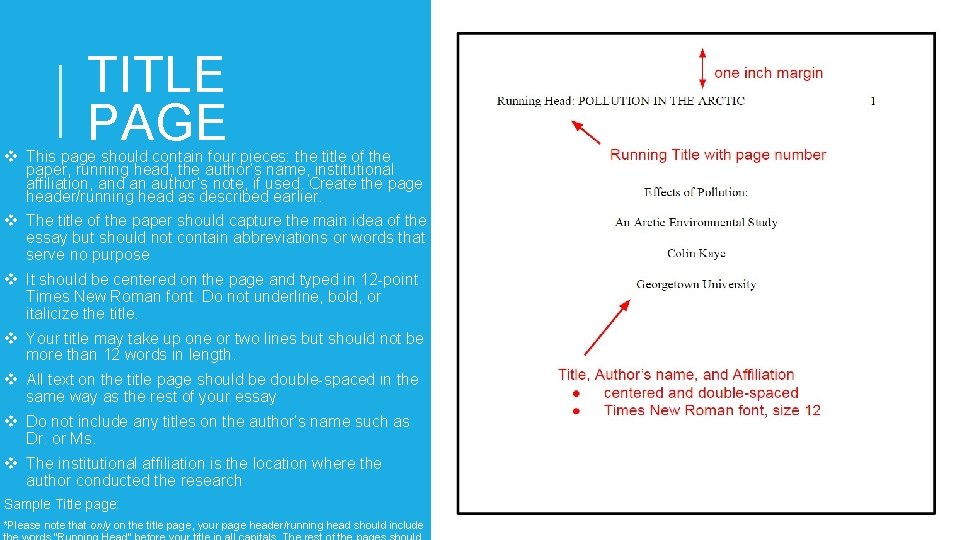
TITLE PAGE v This page should contain four pieces: the title of the paper, running head, the author’s name, institutional affiliation, and an author’s note, if used. Create the page header/running head as described earlier. v The title of the paper should capture the main idea of the essay but should not contain abbreviations or words that serve no purpose v It should be centered on the page and typed in 12 -point Times New Roman font. Do not underline, bold, or italicize the title. v Your title may take up one or two lines but should not be more than 12 words in length. v All text on the title page should be double-spaced in the same way as the rest of your essay v Do not include any titles on the author’s name such as Dr. or Ms. v The institutional affiliation is the location where the author conducted the research Sample Title page: *Please note that only on the title page, your page header/running head should include
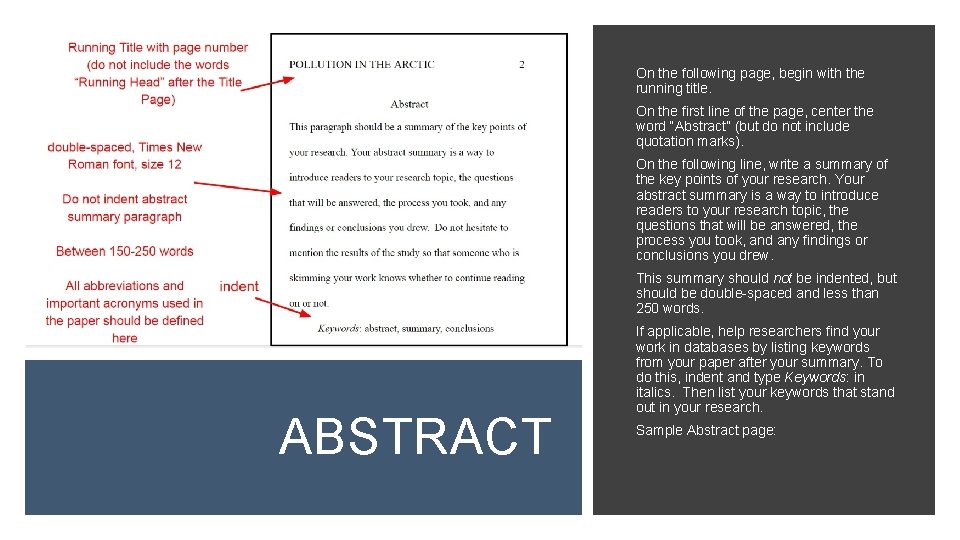
On the following page, begin with the running title. On the first line of the page, center the word “Abstract” (but do not include quotation marks). On the following line, write a summary of the key points of your research. Your abstract summary is a way to introduce readers to your research topic, the questions that will be answered, the process you took, and any findings or conclusions you drew. This summary should not be indented, but should be double-spaced and less than 250 words. ABSTRACT If applicable, help researchers find your work in databases by listing keywords from your paper after your summary. To do this, indent and type Keywords: in italics. Then list your keywords that stand out in your research. Sample Abstract page:
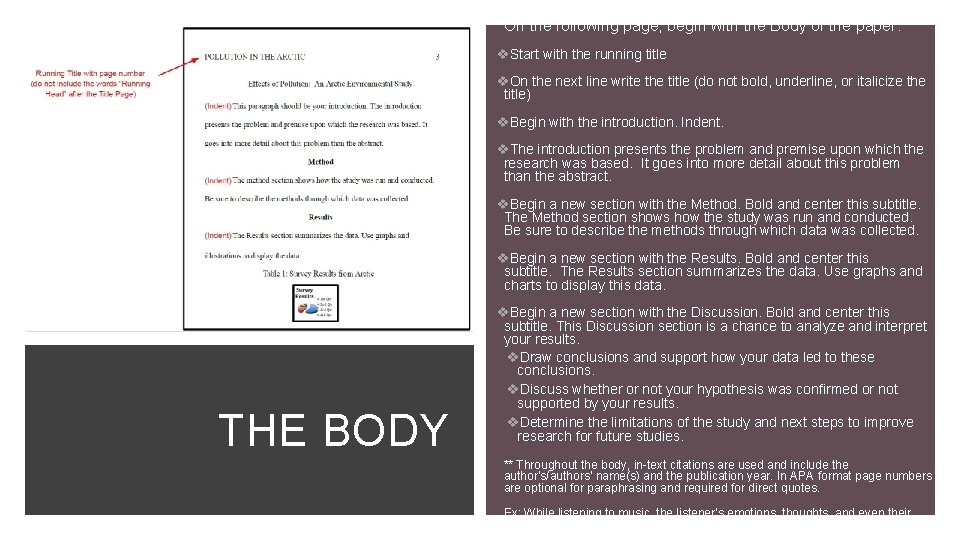
On the following page, begin with the Body of the paper. v. Start with the running title v. On the next line write the title (do not bold, underline, or italicize the title) v. Begin with the introduction. Indent. v. The introduction presents the problem and premise upon which the research was based. It goes into more detail about this problem than the abstract. v. Begin a new section with the Method. Bold and center this subtitle. The Method section shows how the study was run and conducted. Be sure to describe the methods through which data was collected. v. Begin a new section with the Results. Bold and center this subtitle. The Results section summarizes the data. Use graphs and charts to display this data. THE BODY v. Begin a new section with the Discussion. Bold and center this subtitle. This Discussion section is a chance to analyze and interpret your results. v. Draw conclusions and support how your data led to these conclusions. v. Discuss whether or not your hypothesis was confirmed or not supported by your results. v. Determine the limitations of the study and next steps to improve research for future studies. ** Throughout the body, in-text citations are used and include the author’s/authors’ name(s) and the publication year. In APA format page numbers are optional for paraphrasing and required for direct quotes. Ex: While listening to music, the listener’s emotions, thoughts, and even their pulse are all set to synchronize with that of the musician (Howes, 1970).
(optional). IN TEXT CITATIONS
BASIC RULES • Always capitalize proper nouns, including author names and initials: D. Jones. • If you refer to the title of a source within your paper, capitalize all words that are four letters long or greater within the title of a source: Permanence and Change. Exceptions may apply to short words: Writing New Media, There is Nothing Left to Lose. (Note: in your References list, only the first word of a title will be capitalized: Writing new media. ) • When capitalizing titles, capitalize both words in a hyphenated compound word: Natural-Born Cyborgs. • Capitalize the first word after a dash or colon: "Defining Film Rhetoric: The Case of Hitchcock's Vertigo. " • Italicize the titles of longer works such as books, edited collections, movies, television series, documentaries, or albums: The Closing of the American Mind; The Wizard of Oz; Friends when they are referred to in the body of the paper, AND on the Reference page. • Put quotation marks around the titles of shorter works such as journal articles, articles from edited collections, television series episodes, and song titles: "Multimedia Narration: Constructing Possible Worlds; " "The One Where Chandler Can't Cry“ only when they are referred to in the body of the paper, NOT on the Reference page.
QUOTING TEXT: IDEAS OR QUOTES WITHIN ONE SENTENCE Ex 1: In Tale of Two Cities, Dickens uses different natural elements to represent character personality, emotions, and actions; such as Sydney saying, “you have kindled me, heap of ashes that I am, into fire” (p. 265), and when Madame Defarge commanded “Then tell Wind and Fire where to stop, but don’t tell me!” (p. 497). Ex 2: The two classes of people, oppressed and oppressor, have been in a constant battle throughout history and has often made itself apparent but can also be hidden within the norms of society (Marx, 1847). NOTE: If you are referring to an idea from another work but NOT directly quoting the material, or referring to an entire book, article or other work, you only have to make reference to the author and year of publication and not the page number in your in-text reference. All sources that are cited in the text must appear in the reference list at the end of the paper. Page numbers only have to be included if you use a direct quote.
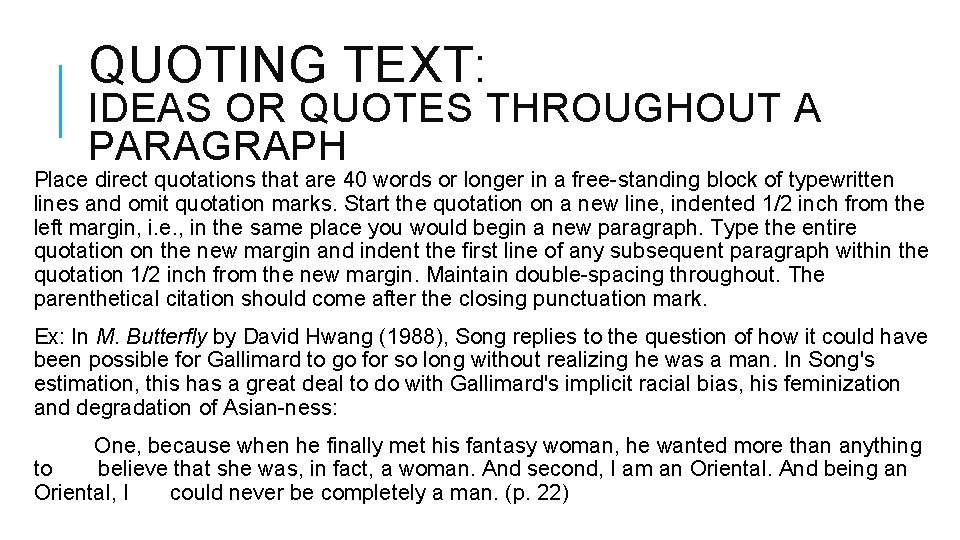
QUOTING TEXT: IDEAS OR QUOTES THROUGHOUT A PARAGRAPH Place direct quotations that are 40 words or longer in a free-standing block of typewritten lines and omit quotation marks. Start the quotation on a new line, indented 1/2 inch from the left margin, i. e. , in the same place you would begin a new paragraph. Type the entire quotation on the new margin and indent the first line of any subsequent paragraph within the quotation 1/2 inch from the new margin. Maintain double-spacing throughout. The parenthetical citation should come after the closing punctuation mark. Ex: In M. Butterfly by David Hwang (1988), Song replies to the question of how it could have been possible for Gallimard to go for so long without realizing he was a man. In Song's estimation, this has a great deal to do with Gallimard's implicit racial bias, his feminization and degradation of Asian-ness: One, because when he finally met his fantasy woman, he wanted more than anything to believe that she was, in fact, a woman. And second, I am an Oriental. And being an Oriental, I could never be completely a man. (p. 22)
REFERENCE S Citation Format
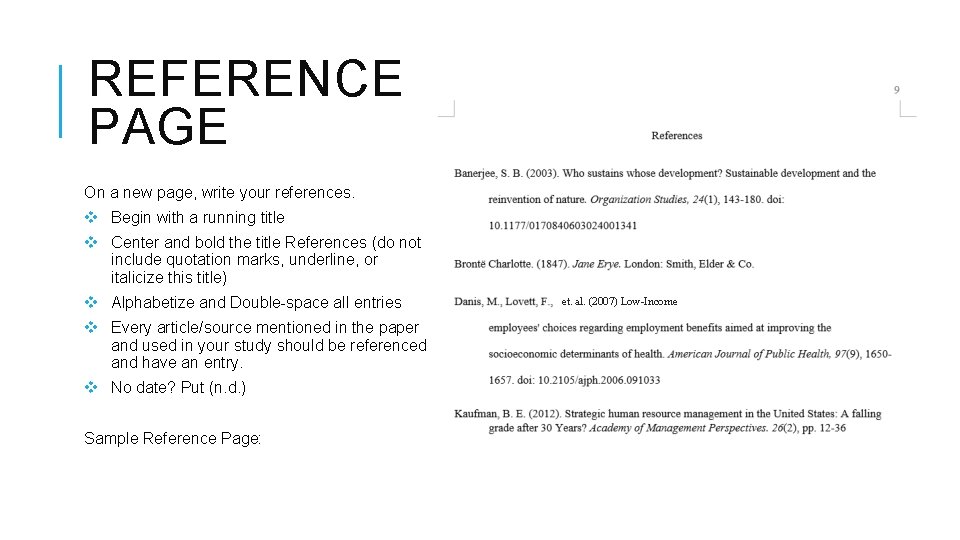
REFERENCE PAGE On a new page, write your references. v Begin with a running title v Center and bold the title References (do not include quotation marks, underline, or italicize this title) v Alphabetize and Double-space all entries v Every article/source mentioned in the paper and used in your study should be referenced and have an entry. v No date? Put (n. d. ) Sample Reference Page: et. al. (2007) Low-Income
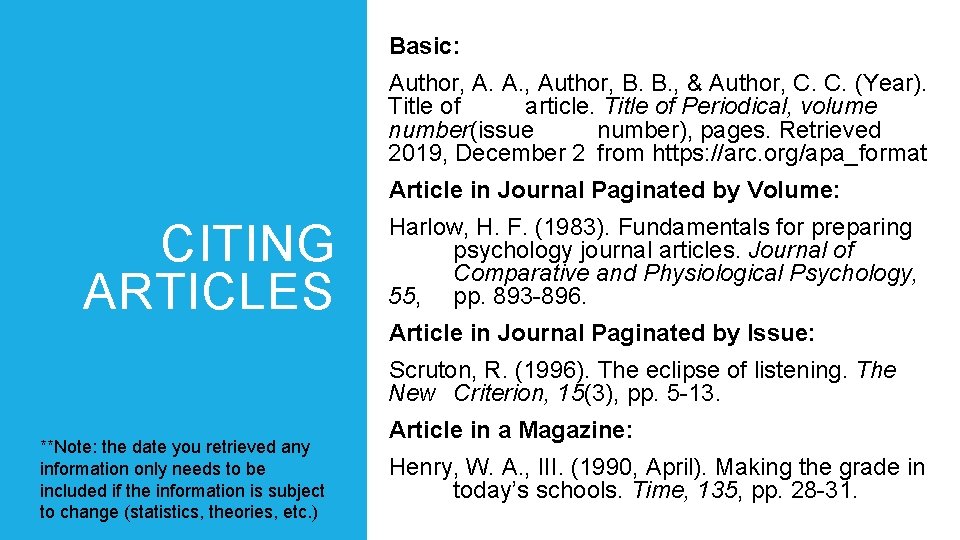
Basic: Author, A. A. , Author, B. B. , & Author, C. C. (Year). Title of article. Title of Periodical, volume number(issue number), pages. Retrieved 2019, December 2 from https: //arc. org/apa_format Article in Journal Paginated by Volume: CITING ARTICLES Harlow, H. F. (1983). Fundamentals for preparing psychology journal articles. Journal of Comparative and Physiological Psychology, 55, pp. 893 -896. Article in Journal Paginated by Issue: Scruton, R. (1996). The eclipse of listening. The New Criterion, 15(3), pp. 5 -13. **Note: the date you retrieved any information only needs to be included if the information is subject to change (statistics, theories, etc. ) Article in a Magazine: Henry, W. A. , III. (1990, April). Making the grade in today’s schools. Time, 135, pp. 28 -31.
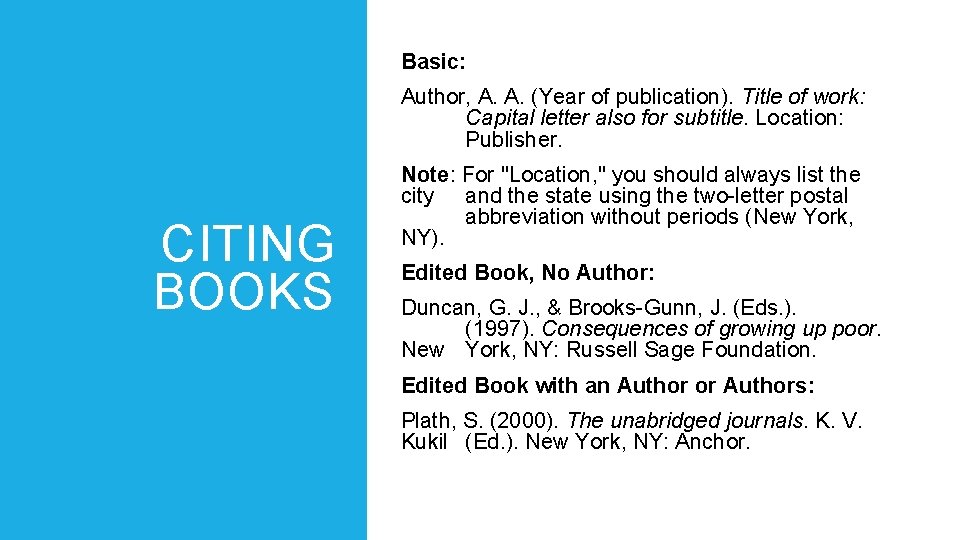
Basic: Author, A. A. (Year of publication). Title of work: Capital letter also for subtitle. Location: Publisher. CITING BOOKS Note: For "Location, " you should always list the city and the state using the two-letter postal abbreviation without periods (New York, NY). Edited Book, No Author: Duncan, G. J. , & Brooks-Gunn, J. (Eds. ). (1997). Consequences of growing up poor. New York, NY: Russell Sage Foundation. Edited Book with an Author or Authors: Plath, S. (2000). The unabridged journals. K. V. Kukil (Ed. ). New York, NY: Anchor.
STILL HAVE QUESTIONS? Email the Academic Resource Center for more information: Director: Dr. Jenny Joczik vjoczik@marybaldwin. edu Graduate Assistant: Shaina Riddle riddlese 7351@marybaldwin. edu Or make an appointment with one of our writing tutors: https: //tutortrac. marybaldwin. edu/