
AP World History Review HISTORICAL GEOGRAPHY TO KNOW

- Slides: 26
AP World History Review
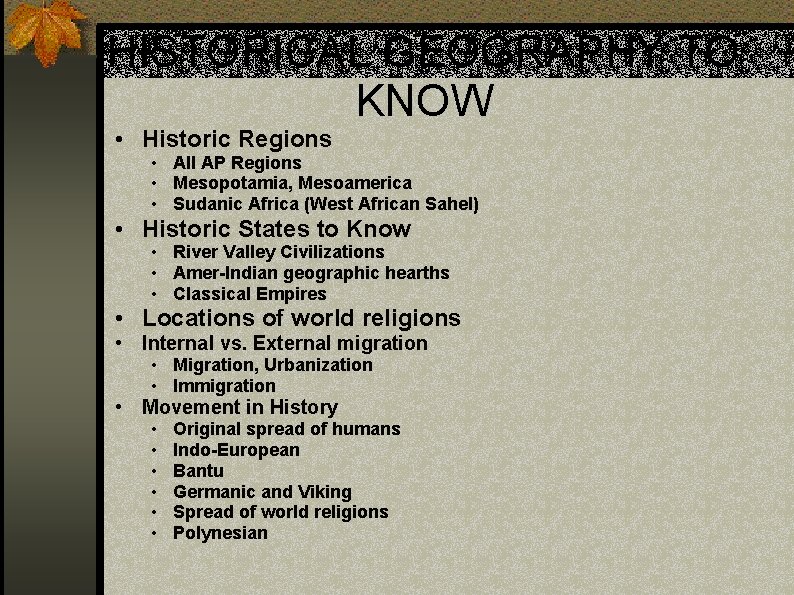
HISTORICAL GEOGRAPHY TO KNOW • Historic Regions • All AP Regions • Mesopotamia, Mesoamerica • Sudanic Africa (West African Sahel) • Historic States to Know • River Valley Civilizations • Amer-Indian geographic hearths • Classical Empires • Locations of world religions • Internal vs. External migration • Migration, Urbanization • Immigration • Movement in History • • • Original spread of humans Indo-European Bantu Germanic and Viking Spread of world religions Polynesian
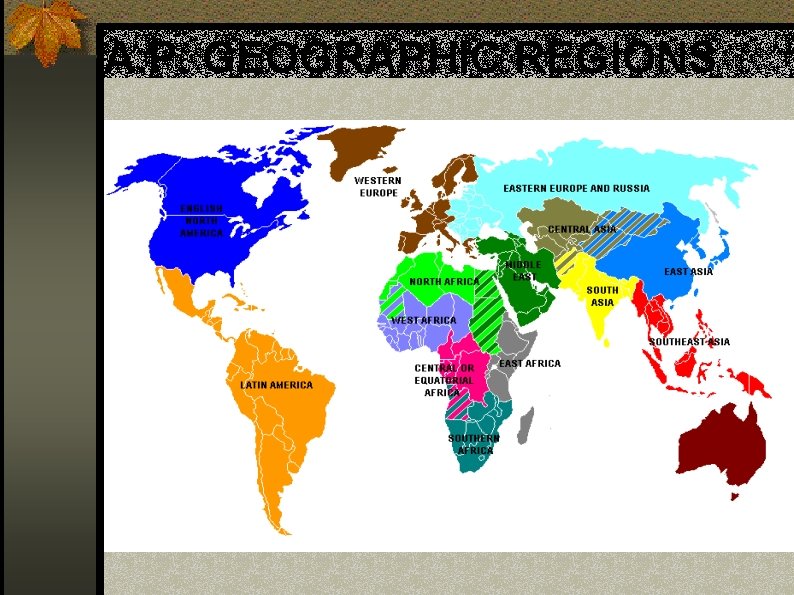
A. P. GEOGRAPHIC REGIONS
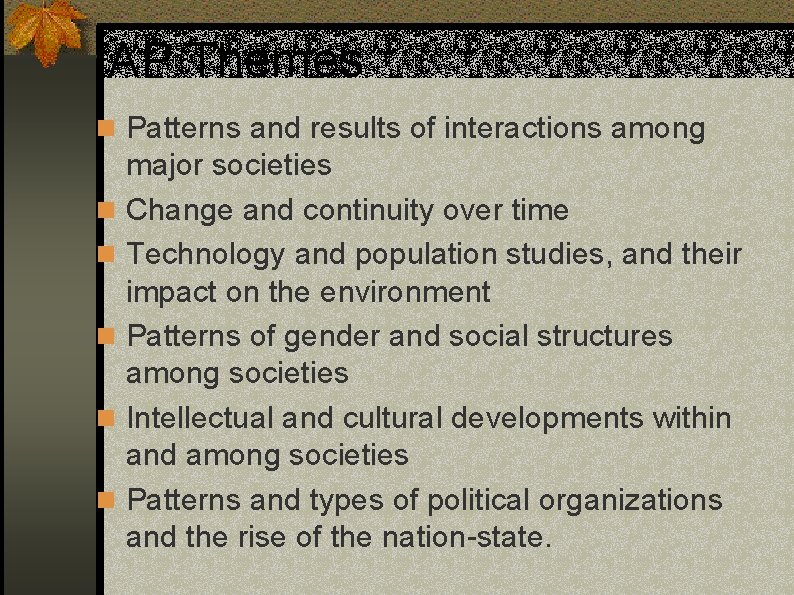
AP Themes n Patterns and results of interactions among n n n major societies Change and continuity over time Technology and population studies, and their impact on the environment Patterns of gender and social structures among societies Intellectual and cultural developments within and among societies Patterns and types of political organizations and the rise of the nation-state.
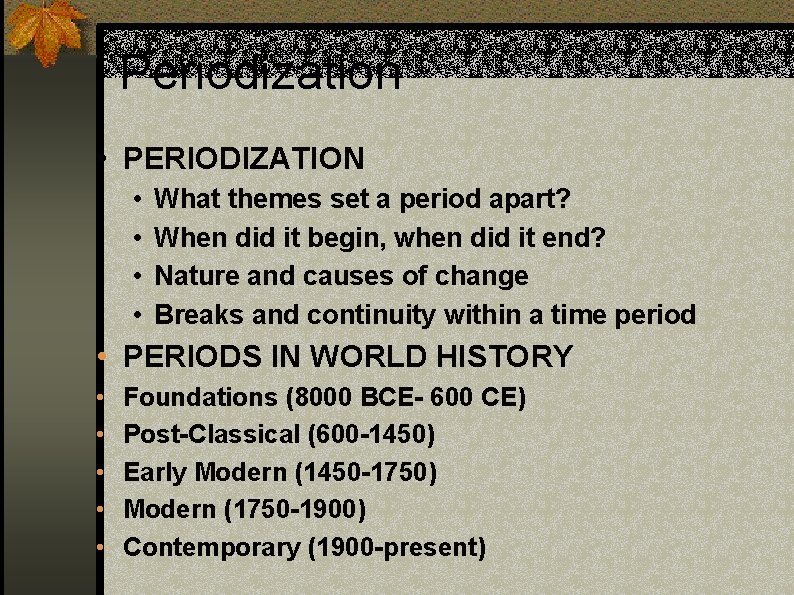
Periodization • PERIODIZATION • • What themes set a period apart? When did it begin, when did it end? Nature and causes of change Breaks and continuity within a time period • PERIODS IN WORLD HISTORY • • • Foundations (8000 BCE- 600 CE) Post-Classical (600 -1450) Early Modern (1450 -1750) Modern (1750 -1900) Contemporary (1900 -present)
Periodization in Foundations Era • 1, 000 BCE TO 600 CE • Prehistoric: 1 million to 4500 BCE • Ancient: 4500 to 1000 BCE • Classical: 1000 BCE to 600 CEreaks and continuity within a time period • Breaks and Continuity within Period • Prehistoric: Rise of Humans, Hunter Gatherers • Ancient: Sedentary culture, domestications • Classical: Use of Iron
Neolithic Revolution n Development of Agriculture begins in S. W. Asia. n Develops independently in several other regions, then spreads. n Slash and Burn Agriculture is earliest form.
Neolithic Society n Farming allows permanent settlements n Leads to formation of government, specialization of labor, social classes, new technology, and population increases. n Women lose status as men take over farming duties and women become more confined to domestic work. n Biggest threat to sedentary agriculture was pastorialism.
River Valley Civilizations n Characteristics of Civilization n Advanced Cities n Advanced Technology n Specialization of Labor n Complex Institutions (Government, Religion, ect) n Writing
Mesopotamia n Built on the Tigris and Euphrates Rivers n Divided into city-states n Sumerians develop first writing (Cuneiform) n Flooding was unpredictable, so elaborate irrigation systems are built. Leads to early government. n Patriarchal society. Women could serve as priestesses or scribes. n Openness to invasions led to city walls. Sumerians fall to the Akkadians and Babylonians. Hammurabi's Code is the first written code of laws
Egypt n Built along the Nile. Flooded regularly. n Led by a Pharaoh, created an empire. n Polytheistic n Patriarchal. Women could be priestesses n Social Stratification, however, some commoners could raise position. n Receive technology later b/c of natural barriers. Receive Iron independently from Kush. n Write using Hieroglyphics. n Trade w/ Mesopotamia
Indus River Valley n Built along Indus River. Major cities at Harrapa and Mohenjo Daro, built on a grid pattern. n Flooding unpredictable, leading to elaborate irrigation. n Writing has not been deciphered. n Trade w/ Sumerians via Persian Gulf n Decline due to natural disasters and over -using the land. Aryans (Indo. Europeans) move in and dominate.
China n Isolated from other civilizations. Built along the Huang He river. n Shang use bronze imported by Indo. Europeans from S. W. Asia. n Writing on oracle bones. Veneration of Ancestors No priests class. n Patriarchal society. n Shang falls to the Zhou dynasty. Overthrow justified by Mandate of Heaven.
Americas n Develops later. Built in Mesoamerica and along the Andes Mnts. n Lacked large animals to perform labor. n Polytheistic. Led by Rulers and Priest. Commoners and Slaves at the bottom. n Olmecs and Maya in Mesoamerica. Develop Pictographs for writing n City-States led by King.
Classical China n Qin dynasty provides order after period of warring states. n Han Dynasty n Centralized government with elaborate bureaucracy n Begin civil service exams based on Confucianism n Trade along the Silk Roads n Patriarchal Society
Classical India n Indo-Europeans (Aryans) introduce foundations of Hinduism and the Caste system n Mauryan Dynasty unites most of India n Ashoka helps spread Buddhism n Gupta Empire n Reinforce Hinduism and the Caste system n Expand Trade n Less Centralized than the Mauryan
Classical Greece n Mountains divide region into city-states n Lack of fertile soil n Persian War- Greece defeats Persia n Peloponnesian Wars- Sparta defeats Athens n Athens creates the first Democracy n Aristotle-Develops logical approach to science n Alexander the Great- Spreads Hellenistic culture throughout S. W. And S. Asia
Classical Rome n Begins as a Republic until Julius Caesar n n comes to power. Then transforms into an empire. Pax Romana- over 200 years of peace and stability in the Roman Empire Conquered peoples allowed a great amount of autonomy and many even became Roman citizens. Highly dependent on slave labor, leads to few innovations in agriculture. Roman Law - “innocence until proven quilty” and provided some unity throughout the
Hinduism n Began in India n Reincarnation n Reinforced the Caste System n Ultimate goal to achieve oneness with Brahma n Spread minimally to S. E. Asia via Trade
Buddhism n Found in India n Did Not believe in the Caste System n Appealed to the Lower Caste n Goal to follow the noble eightfold path to achieve Nirvana n Also believed in reincarnation n Spread by Buddhist Monks and Merchants along the Silk Roads. n Blended with Chinese beliefs in China to create Mahayana Buddhism. (Syncretism)
Confucianism n Founded during the Era of Warring States as a means to bring order to society n Based on Filial Piety and duty n Supported by the Han dynasty b/c it reinforced order. (Han issue the Examination System) n Becomes a basis for Chinese culture
Daoism n Founded by Laozi n “The Way of Nature” n Political involvement was not necessary n Natural Balance controlled everything (Do nothing, Achieve Everything)
Judaism n Monotheistic founded by Abraham n Moses leads the Jews out of Egypt and is given the Ten Commandments n Works are compiled in The Tora n Not attempt to spread the religion
Christianity n Monotheistic n Jesus was sent to save men from their sins n Roman Roads, the Pax Romana, Missionaries, Merchants, and Paul of Tarsus all help spread Christianity throughout the Roman Empire. n Emperor Constantine issues the Edict of Milan allowing Christians to worship in the Roman Empire. n Appealed to all social classes and women.
Comparative Collapses China n Poor Leadership n Population Decline n Land Distribution n Decline in Trade n Nomadic Invasions (Xiung-Nu) n Chinese culture survives n Rome n Poor Leadership n Population Decline in Trade n Lack of Income n Dependence on Slave Labor n Too many non-Romans n Barbarian Invasions (b/c of the Huns) n India n Lack of Centralization n Invasion (the Huns) n Hinduism provides continuation of Culture n
Major Trade Routes n Silk Roads n Carry goods and religions from China, India, S. W. Asia, and Europe. n Central Asian Nomads transported many of the goods n Indian Ocean n Facilitated trade between S. E. Asia, India, and Africa n Used Monsoon winds n Trans-Sahara n Used camels to trade salt for gold.