
AP WORLD HISTORY PERIOD 4 CHAPTER 3 WWII
- Slides: 27
AP WORLD HISTORY PERIOD 4 / CHAPTER 3 WWII
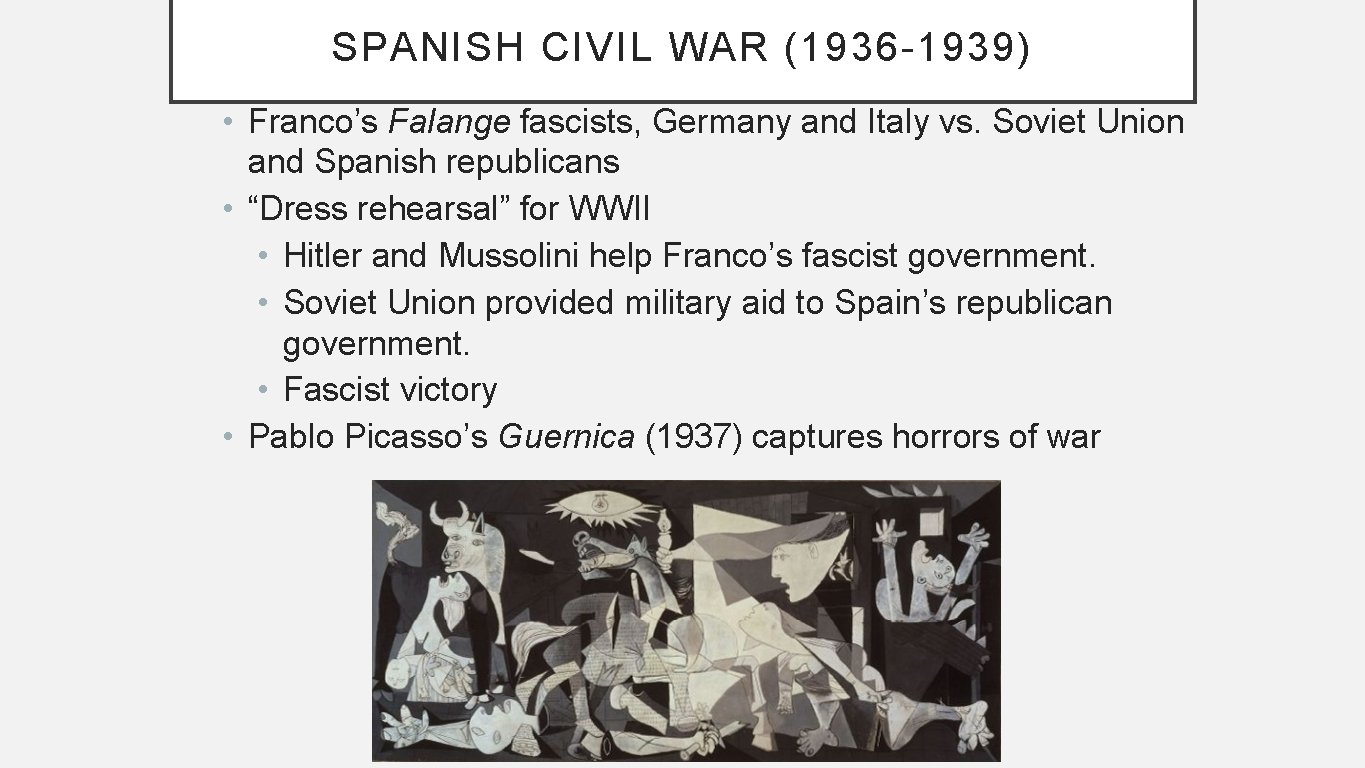
SPANISH CIVIL WAR (1936 -1939) • Franco’s Falange fascists, Germany and Italy vs. Soviet Union and Spanish republicans • “Dress rehearsal” for WWII • Hitler and Mussolini help Franco’s fascist government. • Soviet Union provided military aid to Spain’s republican government. • Fascist victory • Pablo Picasso’s Guernica (1937) captures horrors of war
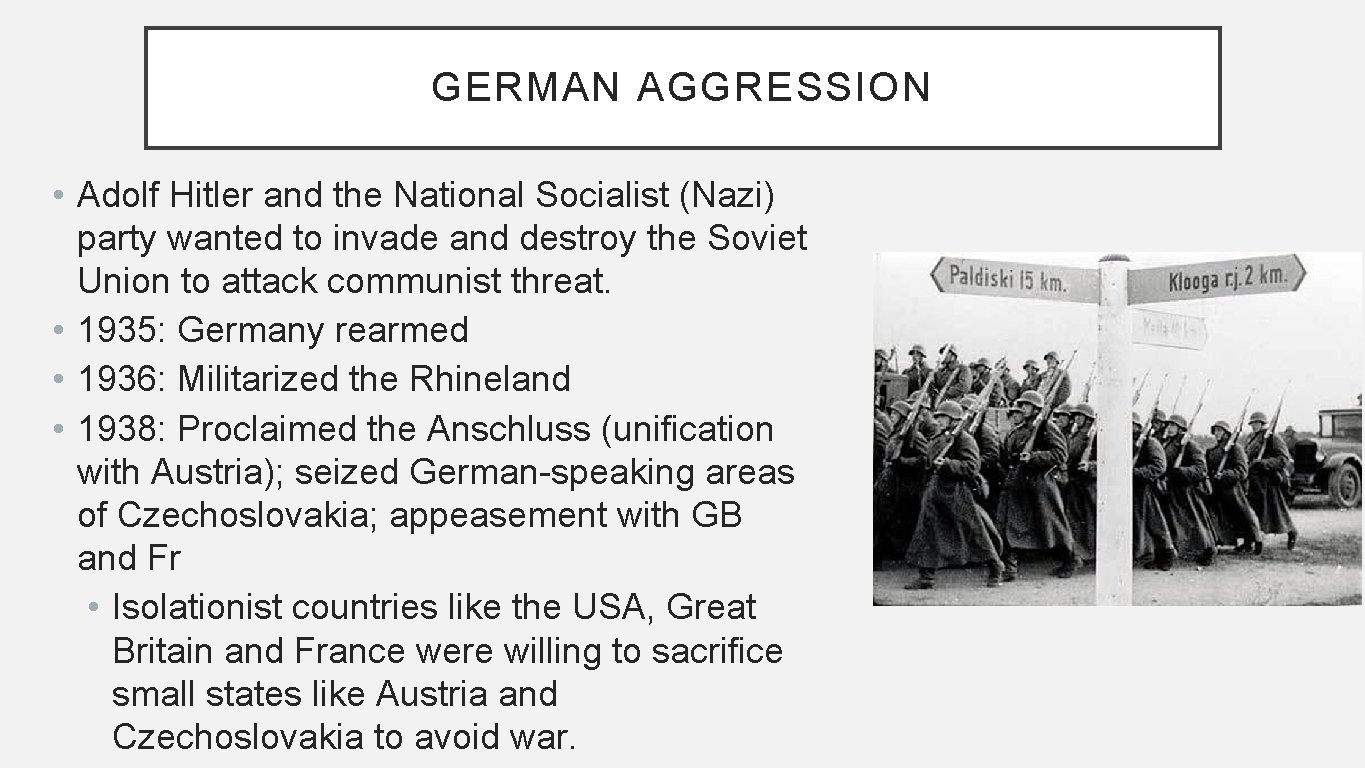
GERMAN AGGRESSION • Adolf Hitler and the National Socialist (Nazi) party wanted to invade and destroy the Soviet Union to attack communist threat. • 1935: Germany rearmed • 1936: Militarized the Rhineland • 1938: Proclaimed the Anschluss (unification with Austria); seized German-speaking areas of Czechoslovakia; appeasement with GB and Fr • Isolationist countries like the USA, Great Britain and France were willing to sacrifice small states like Austria and Czechoslovakia to avoid war.
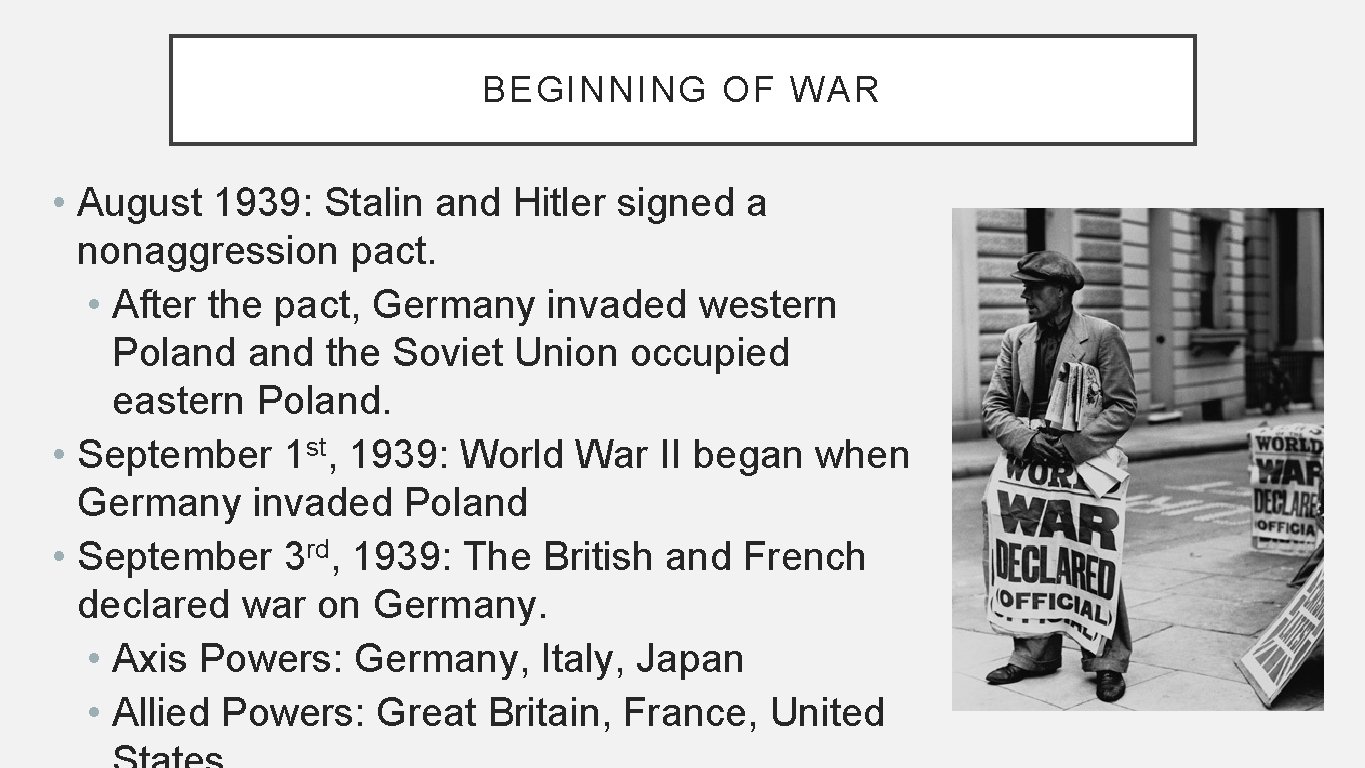
BEGINNING OF WAR • August 1939: Stalin and Hitler signed a nonaggression pact. • After the pact, Germany invaded western Poland the Soviet Union occupied eastern Poland. • September 1 st, 1939: World War II began when Germany invaded Poland • September 3 rd, 1939: The British and French declared war on Germany. • Axis Powers: Germany, Italy, Japan • Allied Powers: Great Britain, France, United
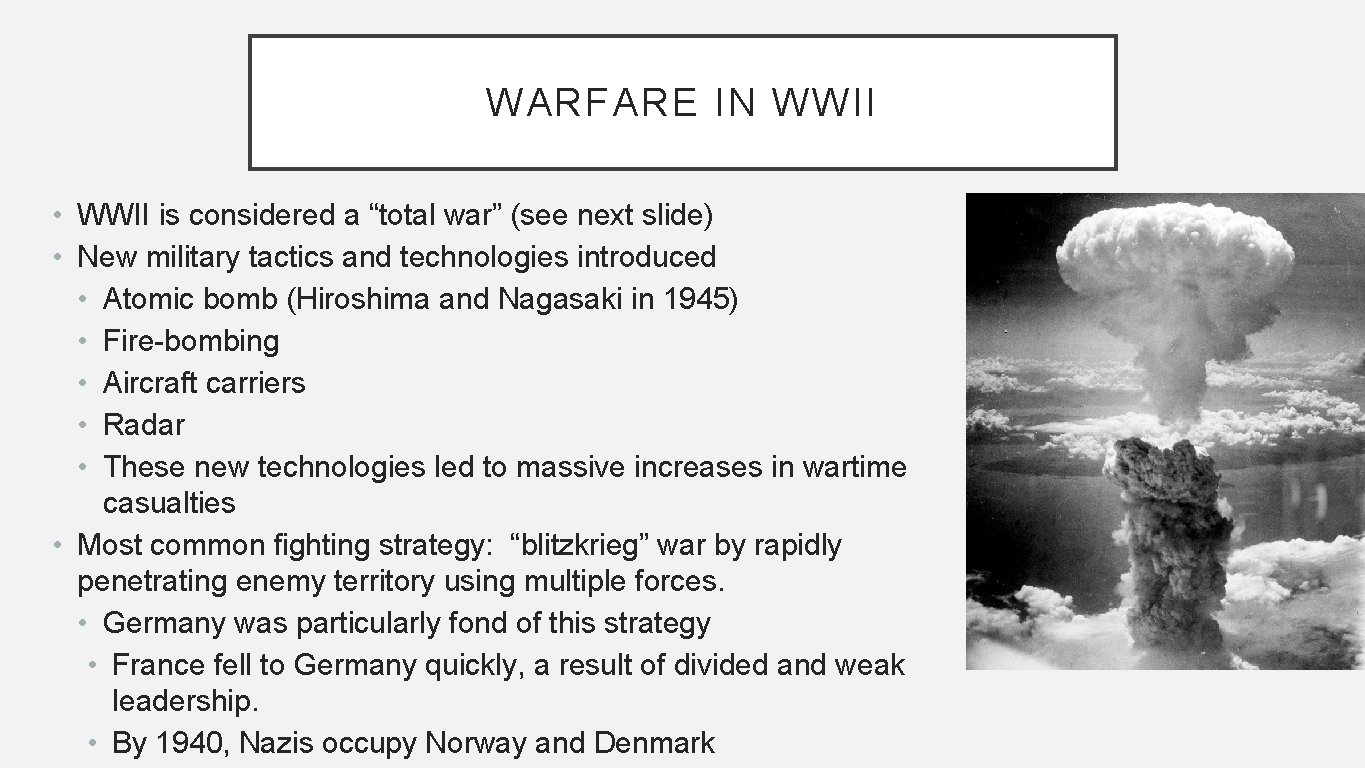
WARFARE IN WWII • WWII is considered a “total war” (see next slide) • New military tactics and technologies introduced • Atomic bomb (Hiroshima and Nagasaki in 1945) • Fire-bombing • Aircraft carriers • Radar • These new technologies led to massive increases in wartime casualties • Most common fighting strategy: “blitzkrieg” war by rapidly penetrating enemy territory using multiple forces. • Germany was particularly fond of this strategy • France fell to Germany quickly, a result of divided and weak leadership. • By 1940, Nazis occupy Norway and Denmark
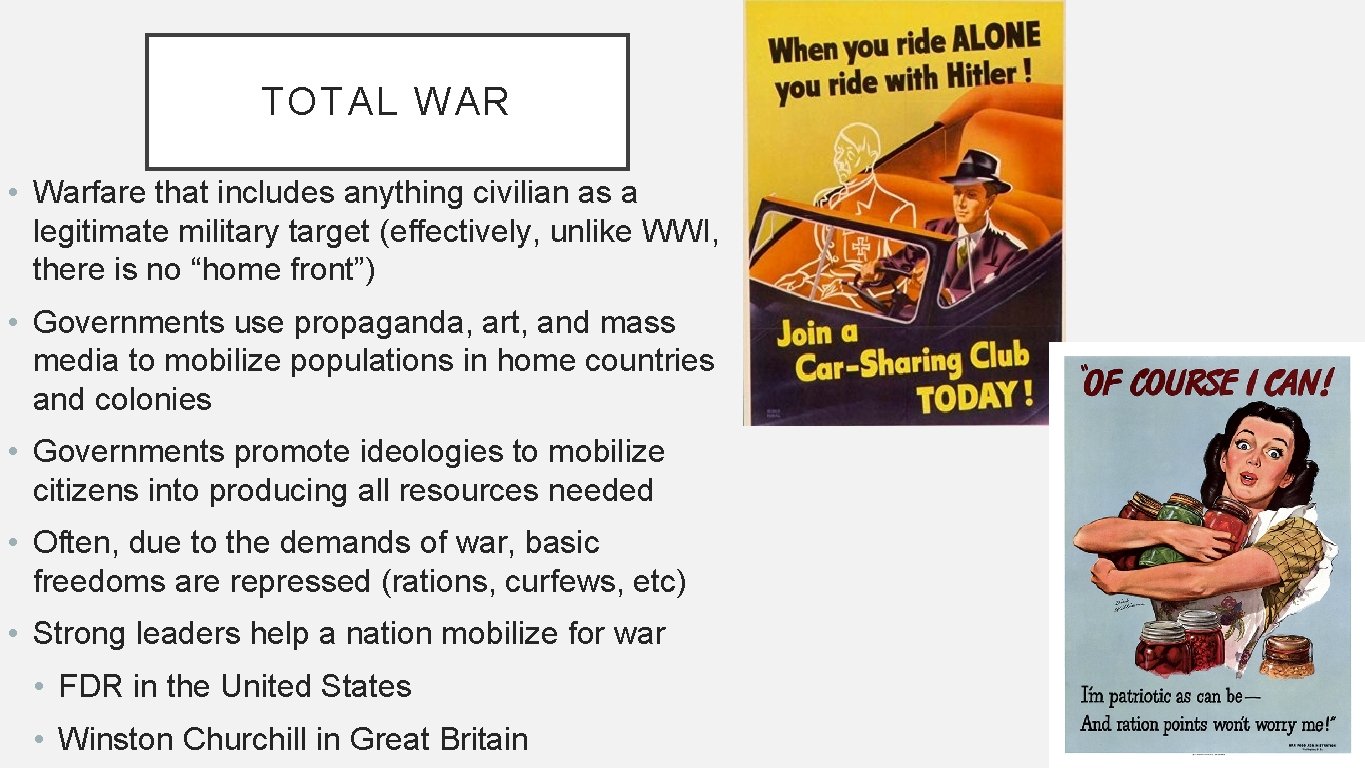
TOTAL WAR • Warfare that includes anything civilian as a legitimate military target (effectively, unlike WWI, there is no “home front”) • Governments use propaganda, art, and mass media to mobilize populations in home countries and colonies • Governments promote ideologies to mobilize citizens into producing all resources needed • Often, due to the demands of war, basic freedoms are repressed (rations, curfews, etc) • Strong leaders help a nation mobilize for war • FDR in the United States • Winston Churchill in Great Britain
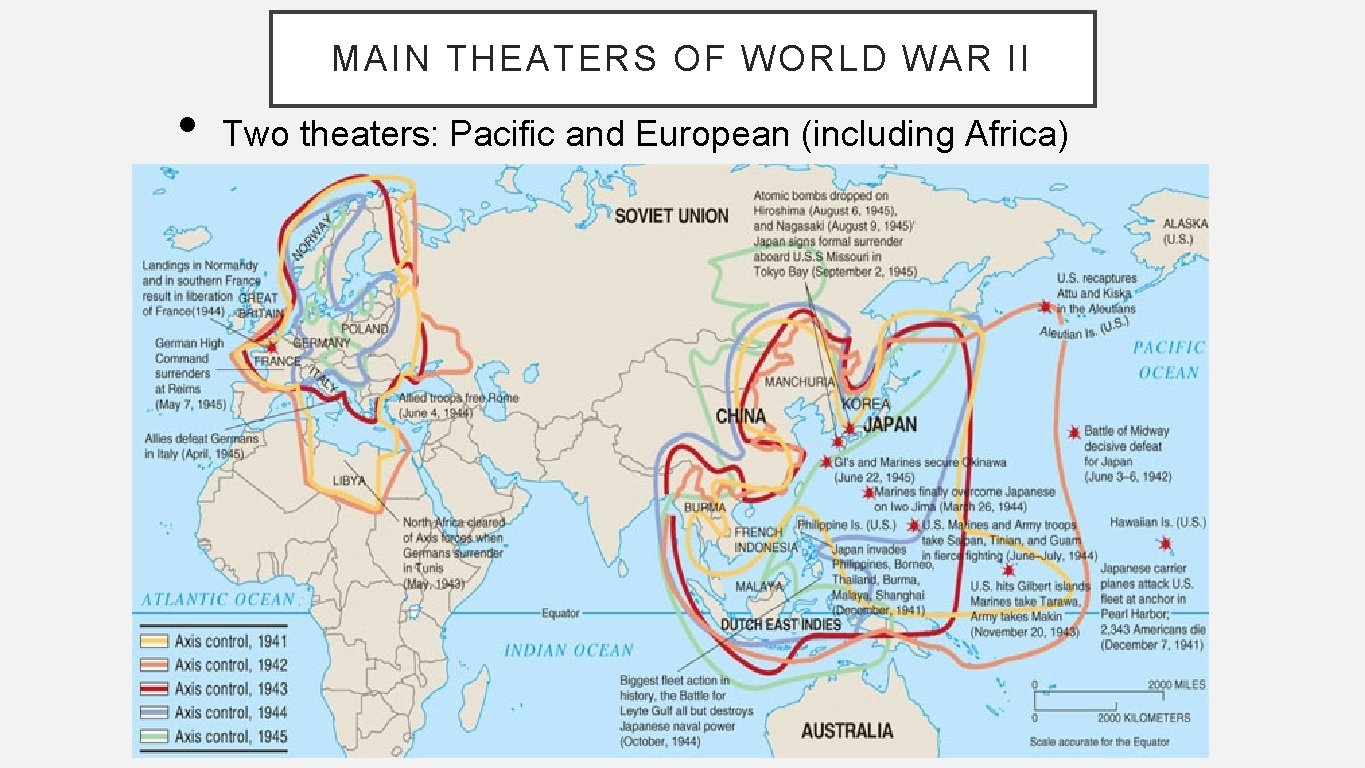
MAIN THEATERS OF WORLD WAR II • Two theaters: Pacific and European (including Africa)
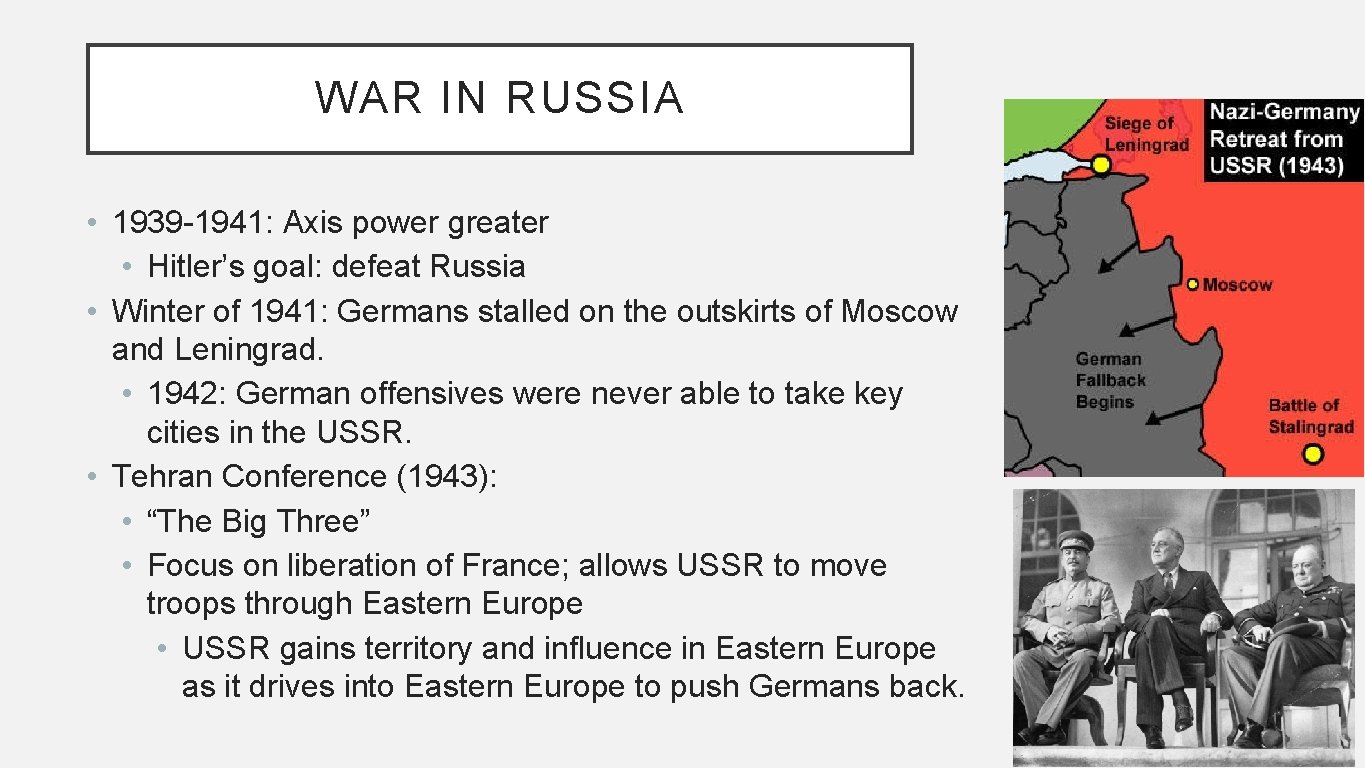
WAR IN RUSSIA • 1939 -1941: Axis power greater • Hitler’s goal: defeat Russia • Winter of 1941: Germans stalled on the outskirts of Moscow and Leningrad. • 1942: German offensives were never able to take key cities in the USSR. • Tehran Conference (1943): • “The Big Three” • Focus on liberation of France; allows USSR to move troops through Eastern Europe • USSR gains territory and influence in Eastern Europe as it drives into Eastern Europe to push Germans back.
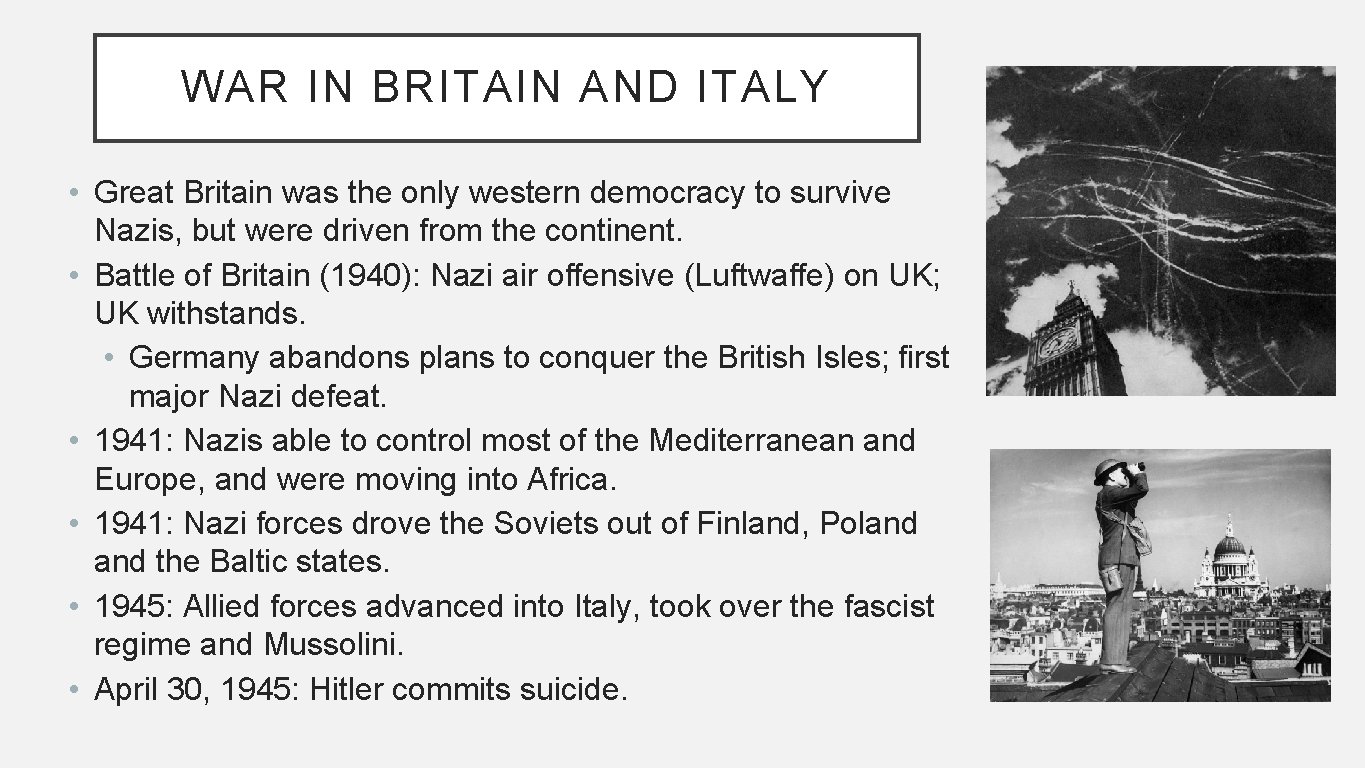
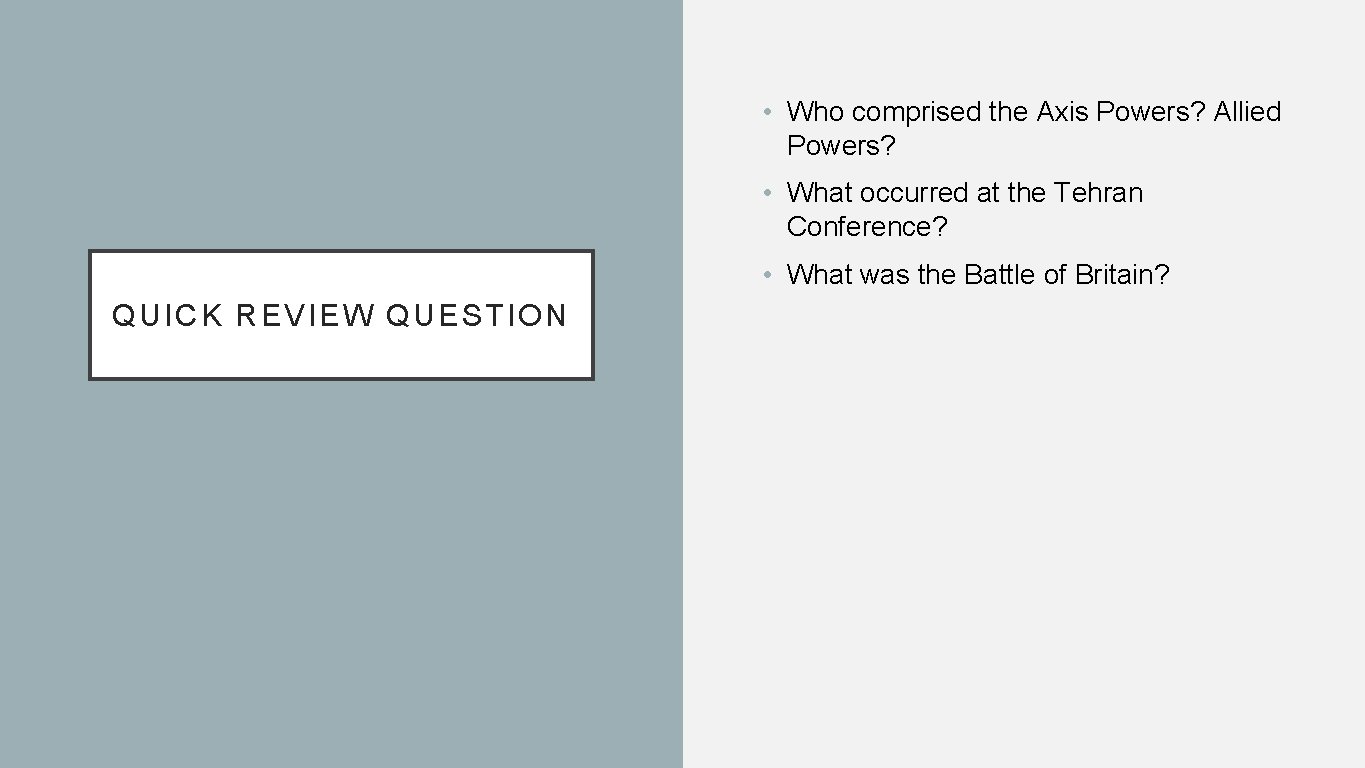
WAR IN BRITAIN AND ITALY • Great Britain was the only western democracy to survive Nazis, but were driven from the continent. • Battle of Britain (1940): Nazi air offensive (Luftwaffe) on UK; UK withstands. • Germany abandons plans to conquer the British Isles; first major Nazi defeat. • 1941: Nazis able to control most of the Mediterranean and Europe, and were moving into Africa. • 1941: Nazi forces drove the Soviets out of Finland, Poland the Baltic states. • 1945: Allied forces advanced into Italy, took over the fascist regime and Mussolini. • April 30, 1945: Hitler commits suicide.
• Who comprised the Axis Powers? Allied Powers? • What occurred at the Tehran Conference? • What was the Battle of Britain? QUICK REVIEW QUESTION
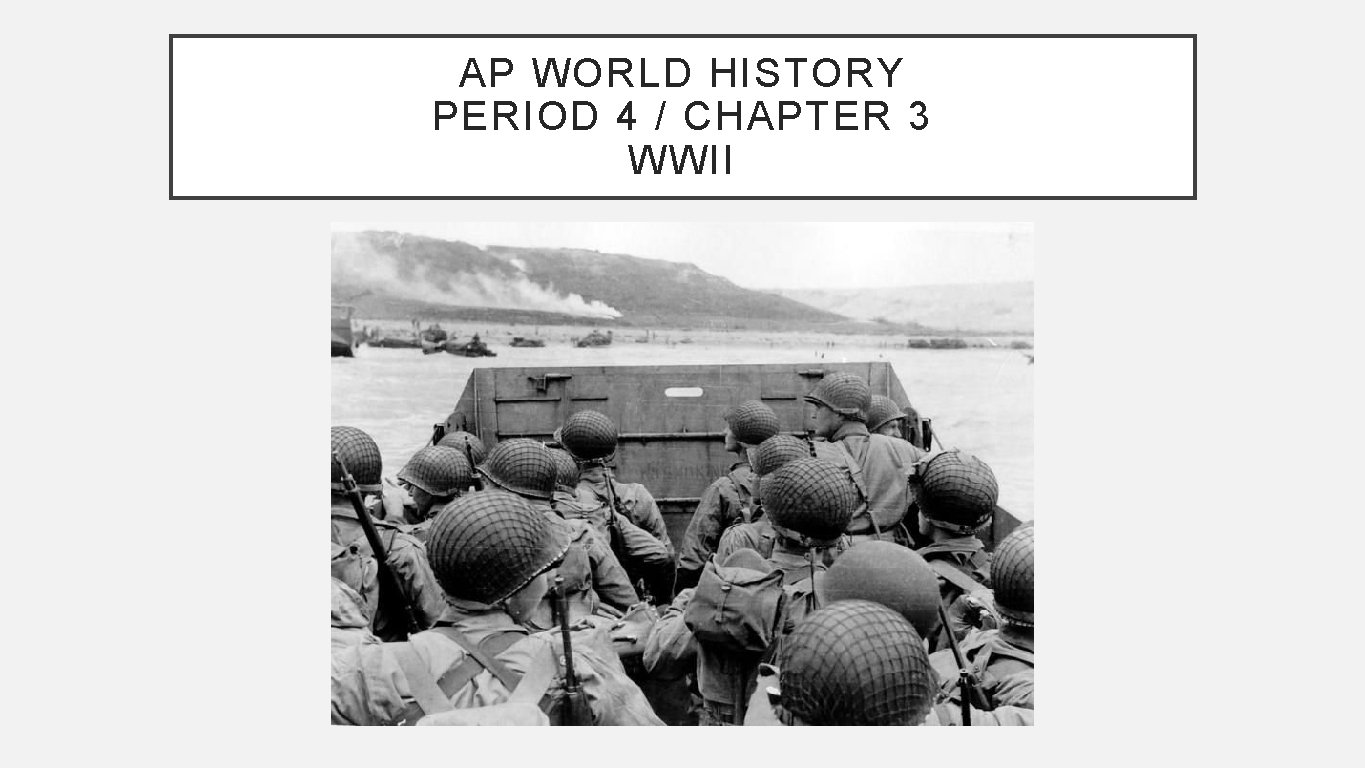
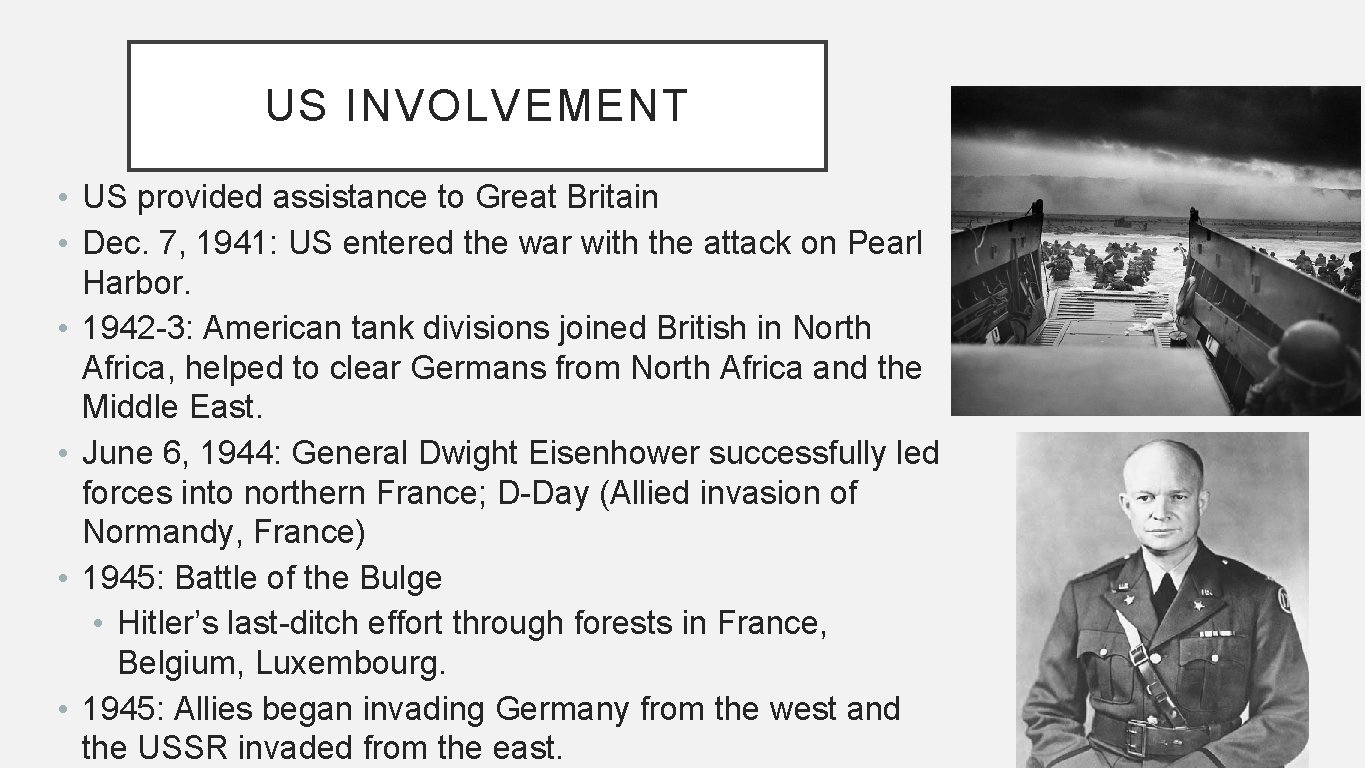
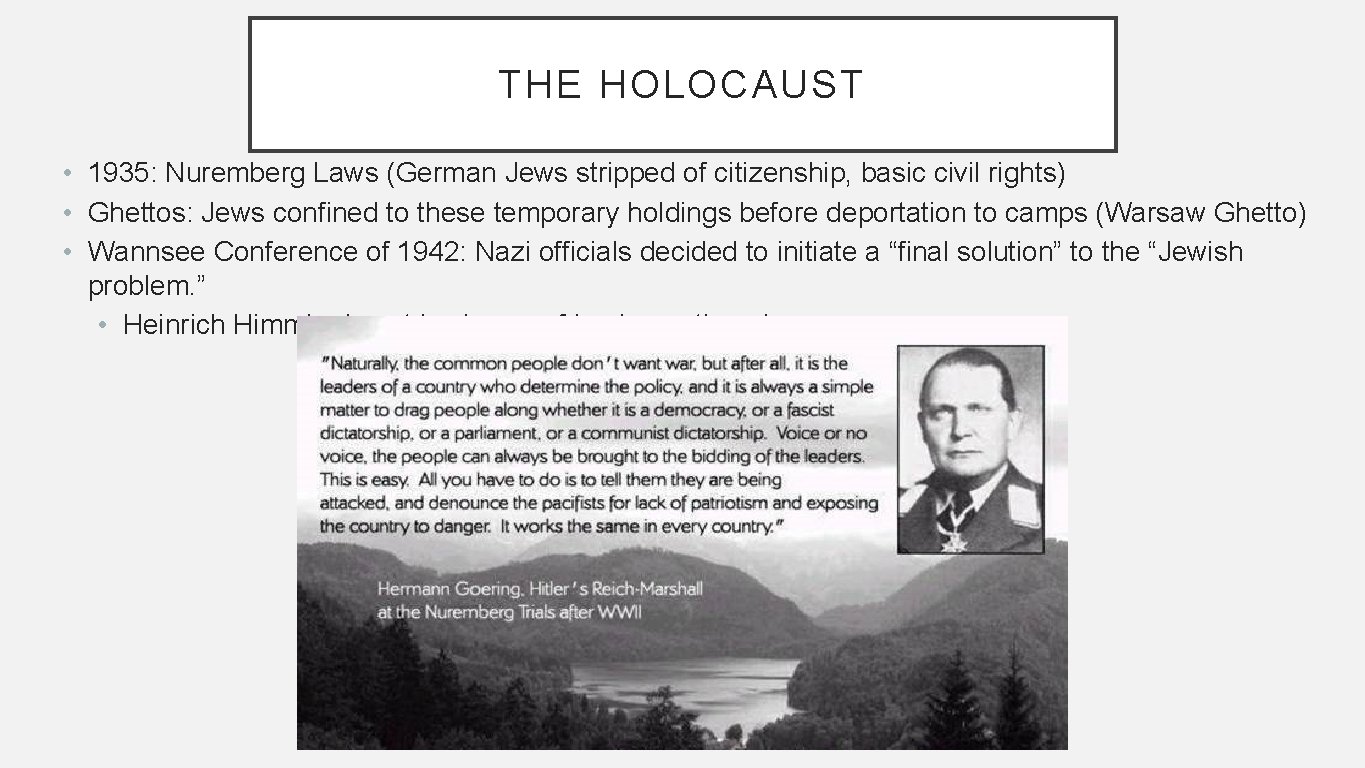
US INVOLVEMENT • US provided assistance to Great Britain • Dec. 7, 1941: US entered the war with the attack on Pearl Harbor. • 1942 -3: American tank divisions joined British in North Africa, helped to clear Germans from North Africa and the Middle East. • June 6, 1944: General Dwight Eisenhower successfully led forces into northern France; D-Day (Allied invasion of Normandy, France) • 1945: Battle of the Bulge • Hitler’s last-ditch effort through forests in France, Belgium, Luxembourg. • 1945: Allies began invading Germany from the west and the USSR invaded from the east.
THE HOLOCAUST • 1935: Nuremberg Laws (German Jews stripped of citizenship, basic civil rights) • Ghettos: Jews confined to these temporary holdings before deportation to camps (Warsaw Ghetto) • Wannsee Conference of 1942: Nazi officials decided to initiate a “final solution” to the “Jewish problem. ” • Heinrich Himmler is put in charge of implementing plan.
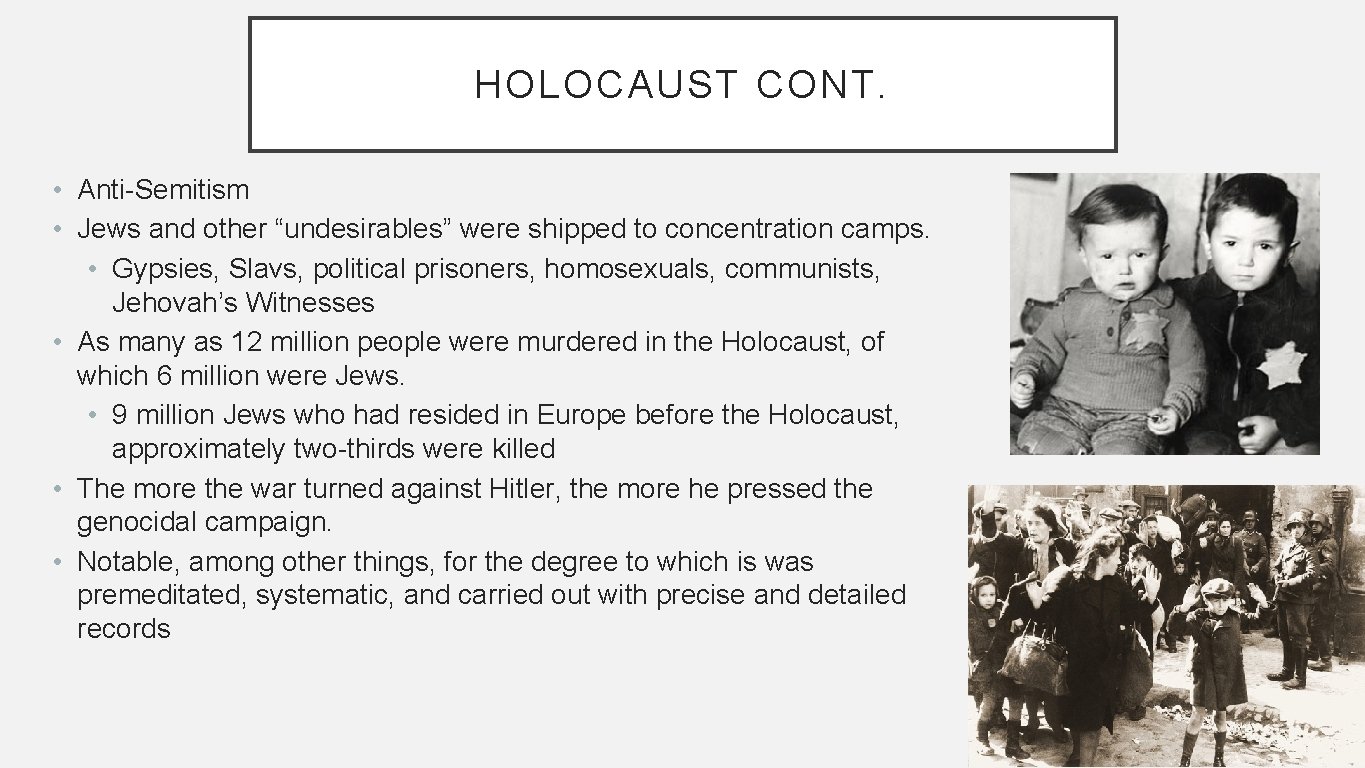
HOLOCAUST CONT. • Anti-Semitism • Jews and other “undesirables” were shipped to concentration camps. • Gypsies, Slavs, political prisoners, homosexuals, communists, Jehovah’s Witnesses • As many as 12 million people were murdered in the Holocaust, of which 6 million were Jews. • 9 million Jews who had resided in Europe before the Holocaust, approximately two-thirds were killed • The more the war turned against Hitler, the more he pressed the genocidal campaign. • Notable, among other things, for the degree to which is was premeditated, systematic, and carried out with precise and detailed records
• Why does D-Day mark a turning point in the war? • What were the Nuremberg Laws? • Describe the “Final Solution. ” QUICK REVIEW QUESTION
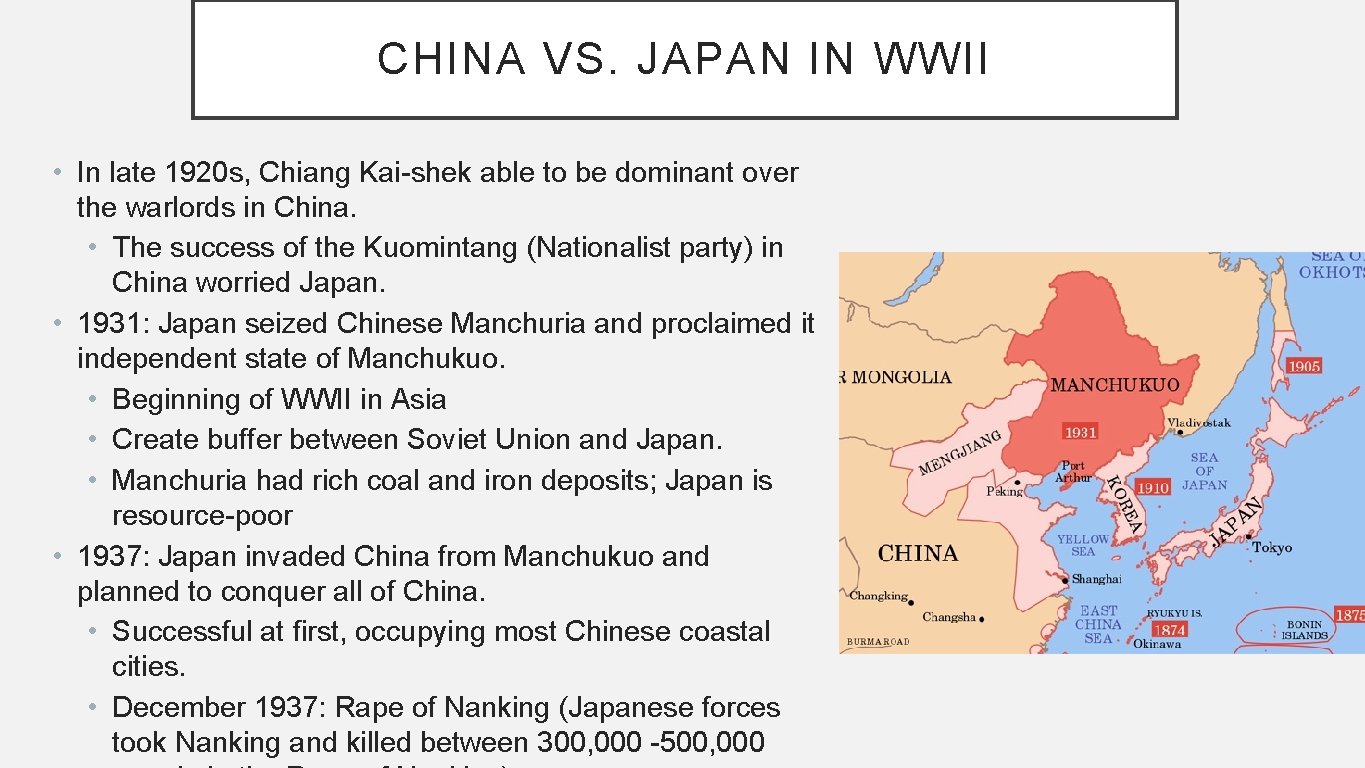
CHINA VS. JAPAN IN WWII • In late 1920 s, Chiang Kai-shek able to be dominant over the warlords in China. • The success of the Kuomintang (Nationalist party) in China worried Japan. • 1931: Japan seized Chinese Manchuria and proclaimed it independent state of Manchukuo. • Beginning of WWII in Asia • Create buffer between Soviet Union and Japan. • Manchuria had rich coal and iron deposits; Japan is resource-poor • 1937: Japan invaded China from Manchukuo and planned to conquer all of China. • Successful at first, occupying most Chinese coastal cities. • December 1937: Rape of Nanking (Japanese forces took Nanking and killed between 300, 000 -500, 000
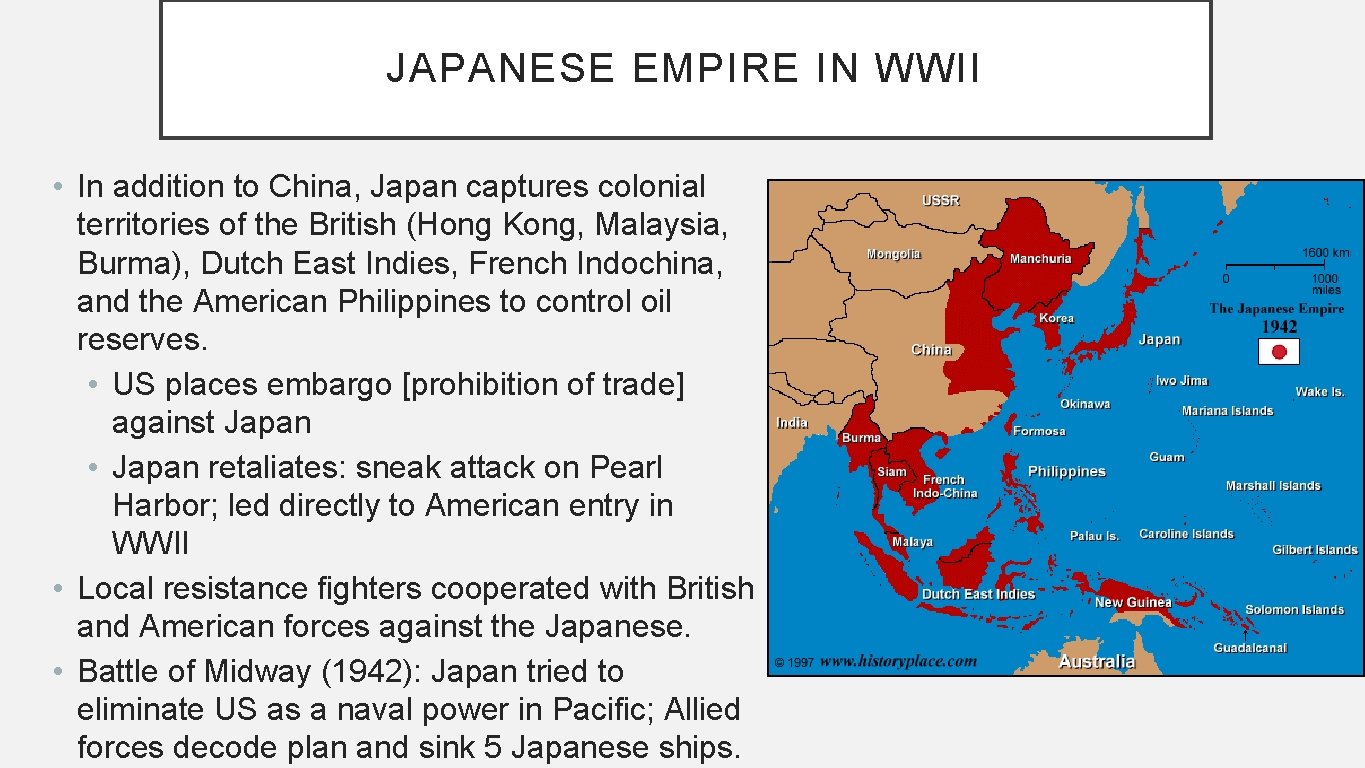
JAPANESE EMPIRE IN WWII • In addition to China, Japan captures colonial territories of the British (Hong Kong, Malaysia, Burma), Dutch East Indies, French Indochina, and the American Philippines to control oil reserves. • US places embargo [prohibition of trade] against Japan • Japan retaliates: sneak attack on Pearl Harbor; led directly to American entry in WWII • Local resistance fighters cooperated with British and American forces against the Japanese. • Battle of Midway (1942): Japan tried to eliminate US as a naval power in Pacific; Allied forces decode plan and sink 5 Japanese ships.
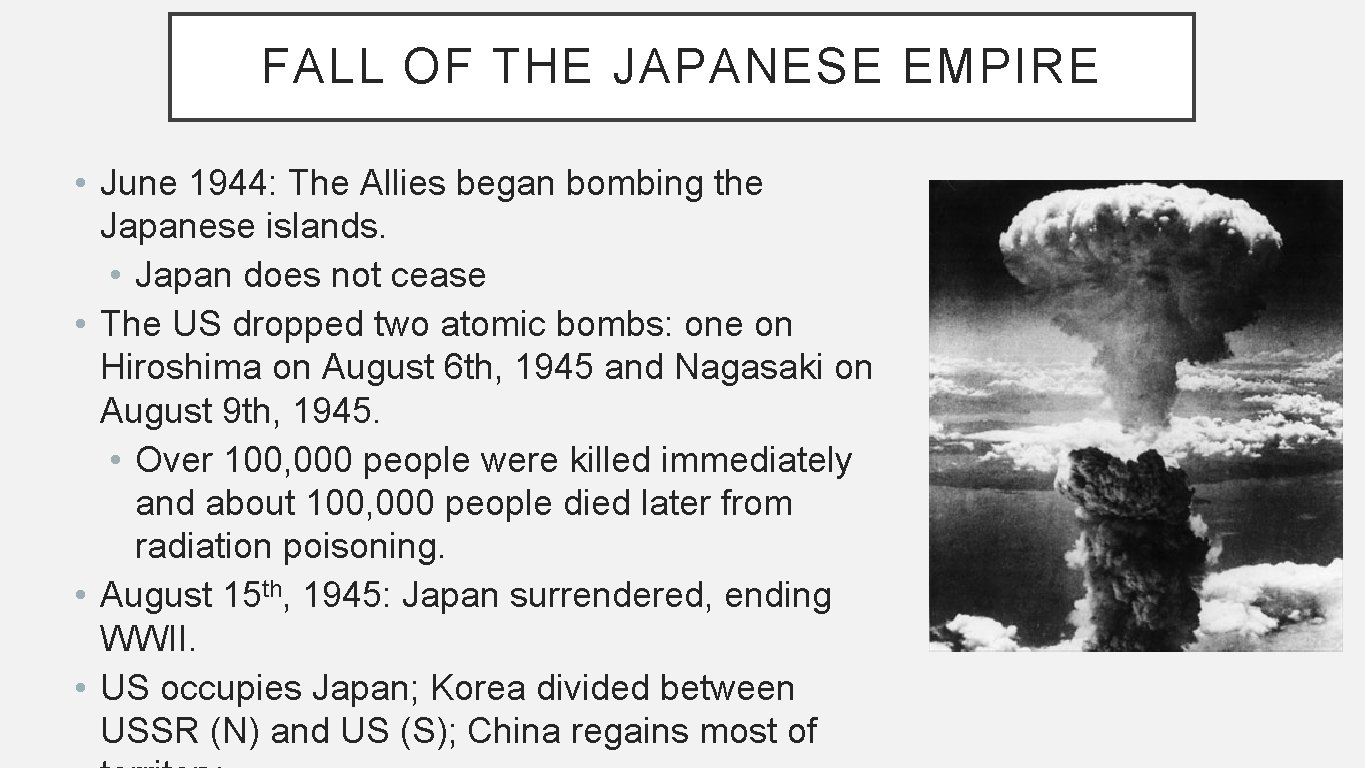
FALL OF THE JAPANESE EMPIRE • June 1944: The Allies began bombing the Japanese islands. • Japan does not cease • The US dropped two atomic bombs: one on Hiroshima on August 6 th, 1945 and Nagasaki on August 9 th, 1945. • Over 100, 000 people were killed immediately and about 100, 000 people died later from radiation poisoning. • August 15 th, 1945: Japan surrendered, ending WWII. • US occupies Japan; Korea divided between USSR (N) and US (S); China regains most of
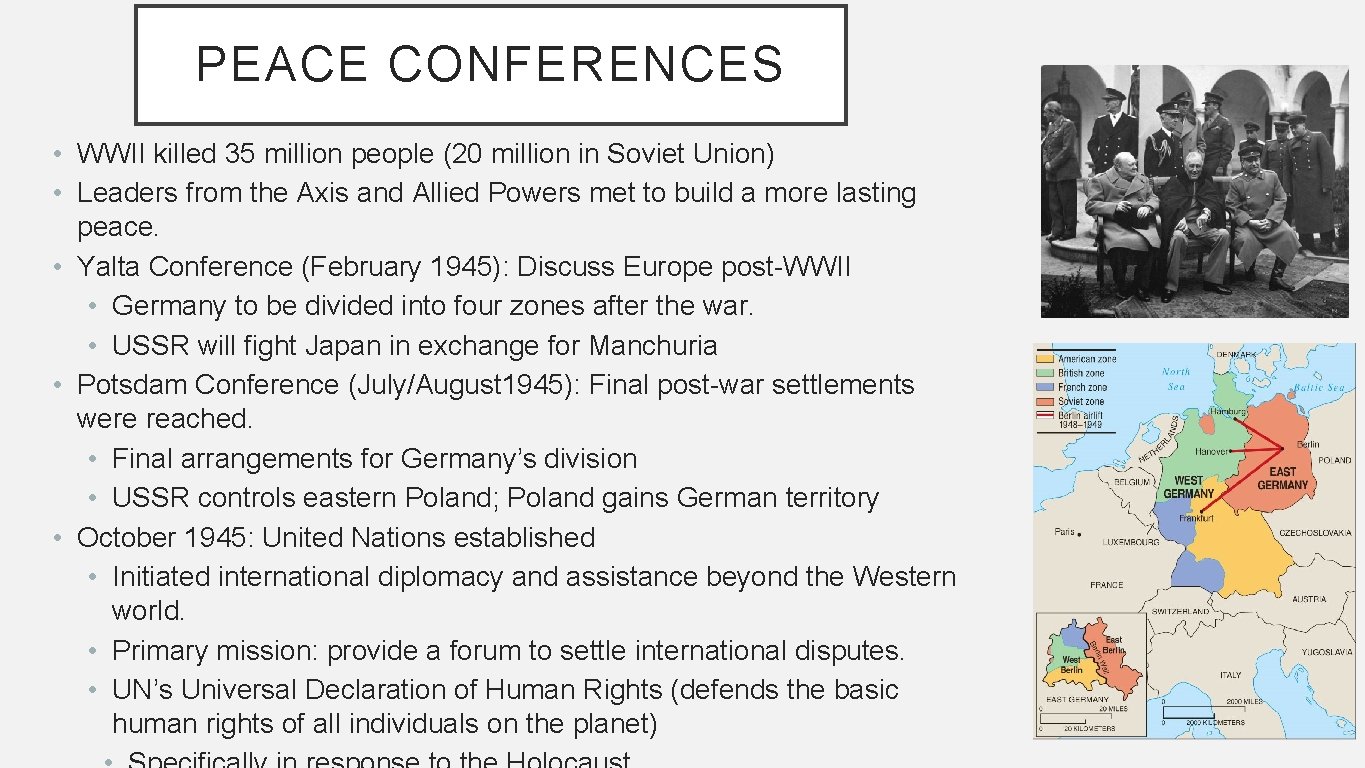
PEACE CONFERENCES • WWII killed 35 million people (20 million in Soviet Union) • Leaders from the Axis and Allied Powers met to build a more lasting peace. • Yalta Conference (February 1945): Discuss Europe post-WWII • Germany to be divided into four zones after the war. • USSR will fight Japan in exchange for Manchuria • Potsdam Conference (July/August 1945): Final post-war settlements were reached. • Final arrangements for Germany’s division • USSR controls eastern Poland; Poland gains German territory • October 1945: United Nations established • Initiated international diplomacy and assistance beyond the Western world. • Primary mission: provide a forum to settle international disputes. • UN’s Universal Declaration of Human Rights (defends the basic human rights of all individuals on the planet)
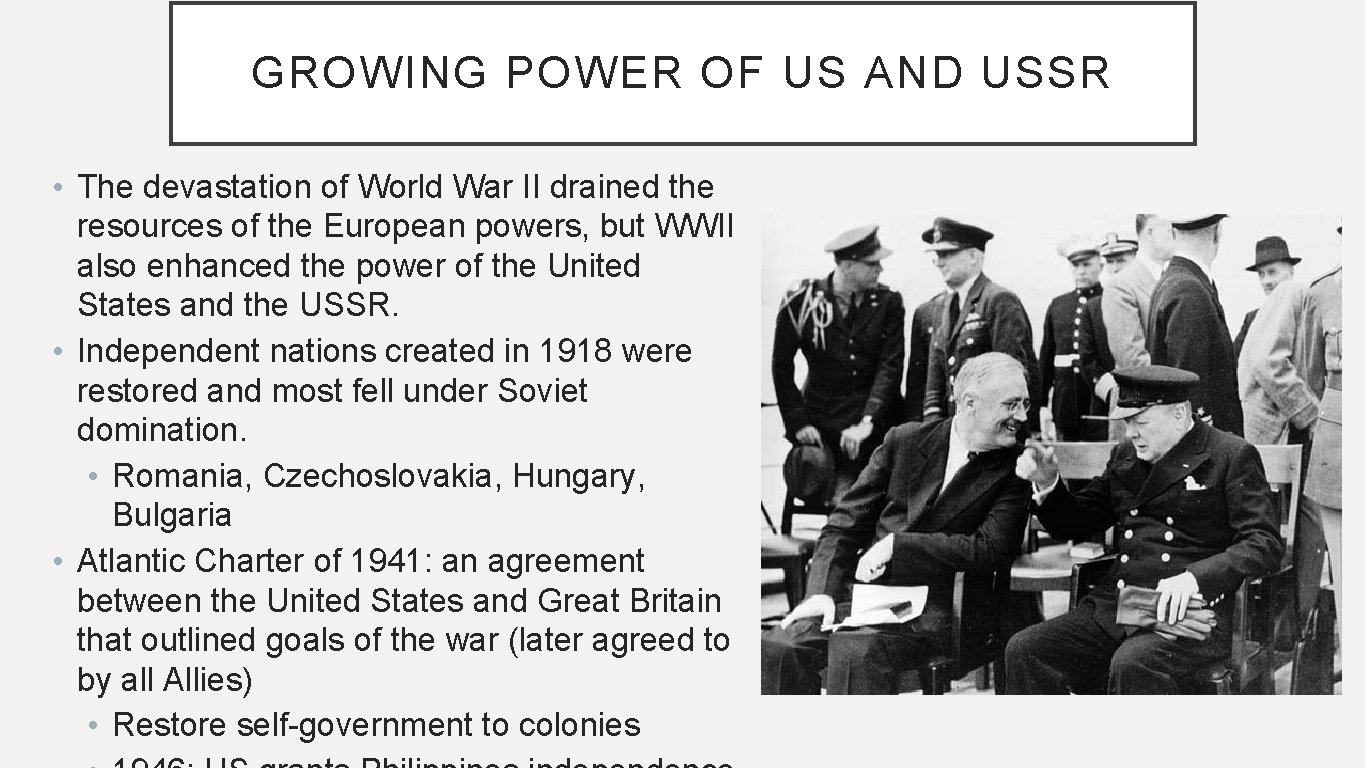
GROWING POWER OF US AND USSR • The devastation of World War II drained the resources of the European powers, but WWII also enhanced the power of the United States and the USSR. • Independent nations created in 1918 were restored and most fell under Soviet domination. • Romania, Czechoslovakia, Hungary, Bulgaria • Atlantic Charter of 1941: an agreement between the United States and Great Britain that outlined goals of the war (later agreed to by all Allies) • Restore self-government to colonies
• What event causes the fall of the Japanese Empire in WWII? QUICK REVIEW QUESTION • What did the Yalta Conference determine? • What long-term change did the Atlantic Charter stipulate must occur?
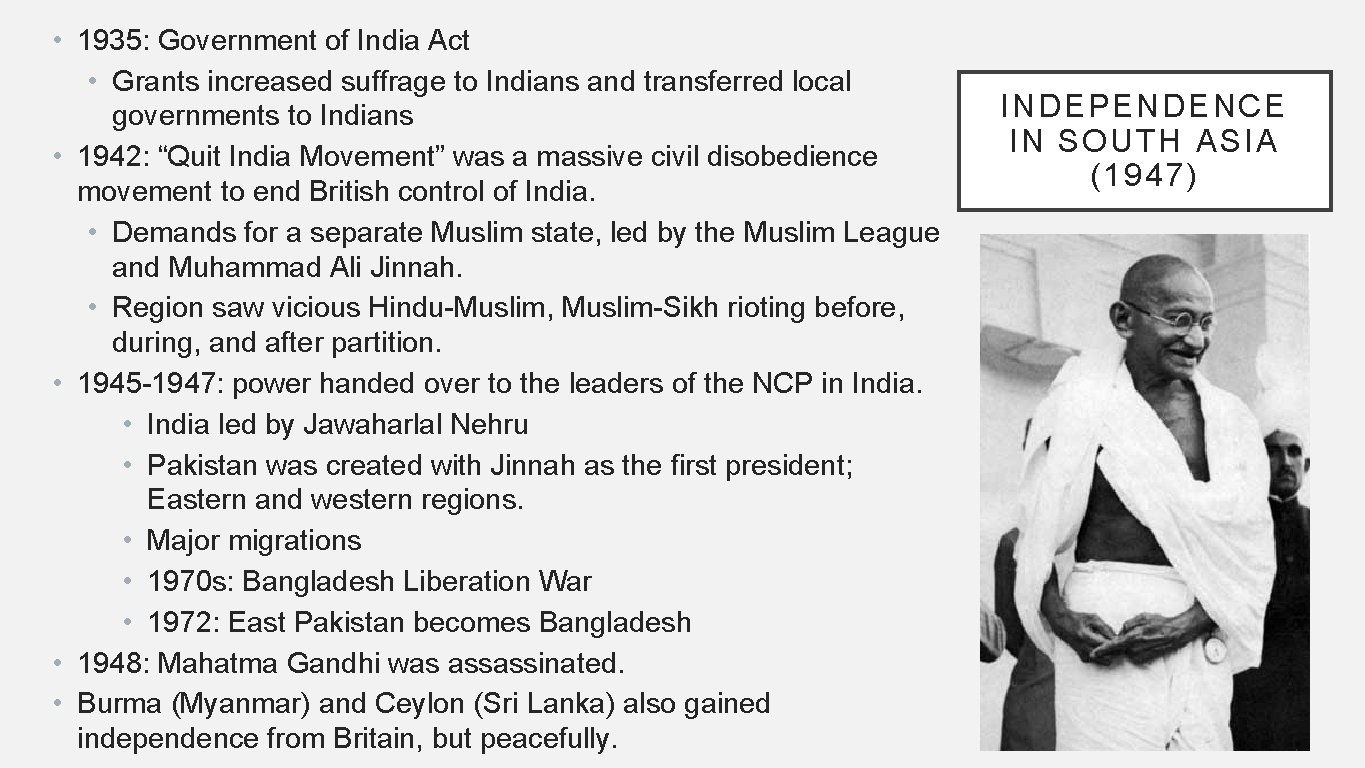
• 1935: Government of India Act • Grants increased suffrage to Indians and transferred local governments to Indians • 1942: “Quit India Movement” was a massive civil disobedience movement to end British control of India. • Demands for a separate Muslim state, led by the Muslim League and Muhammad Ali Jinnah. • Region saw vicious Hindu-Muslim, Muslim-Sikh rioting before, during, and after partition. • 1945 -1947: power handed over to the leaders of the NCP in India. • India led by Jawaharlal Nehru • Pakistan was created with Jinnah as the first president; Eastern and western regions. • Major migrations • 1970 s: Bangladesh Liberation War • 1972: East Pakistan becomes Bangladesh • 1948: Mahatma Gandhi was assassinated. • Burma (Myanmar) and Ceylon (Sri Lanka) also gained independence from Britain, but peacefully. INDEPENDENCE IN SOUTH ASIA (1947)
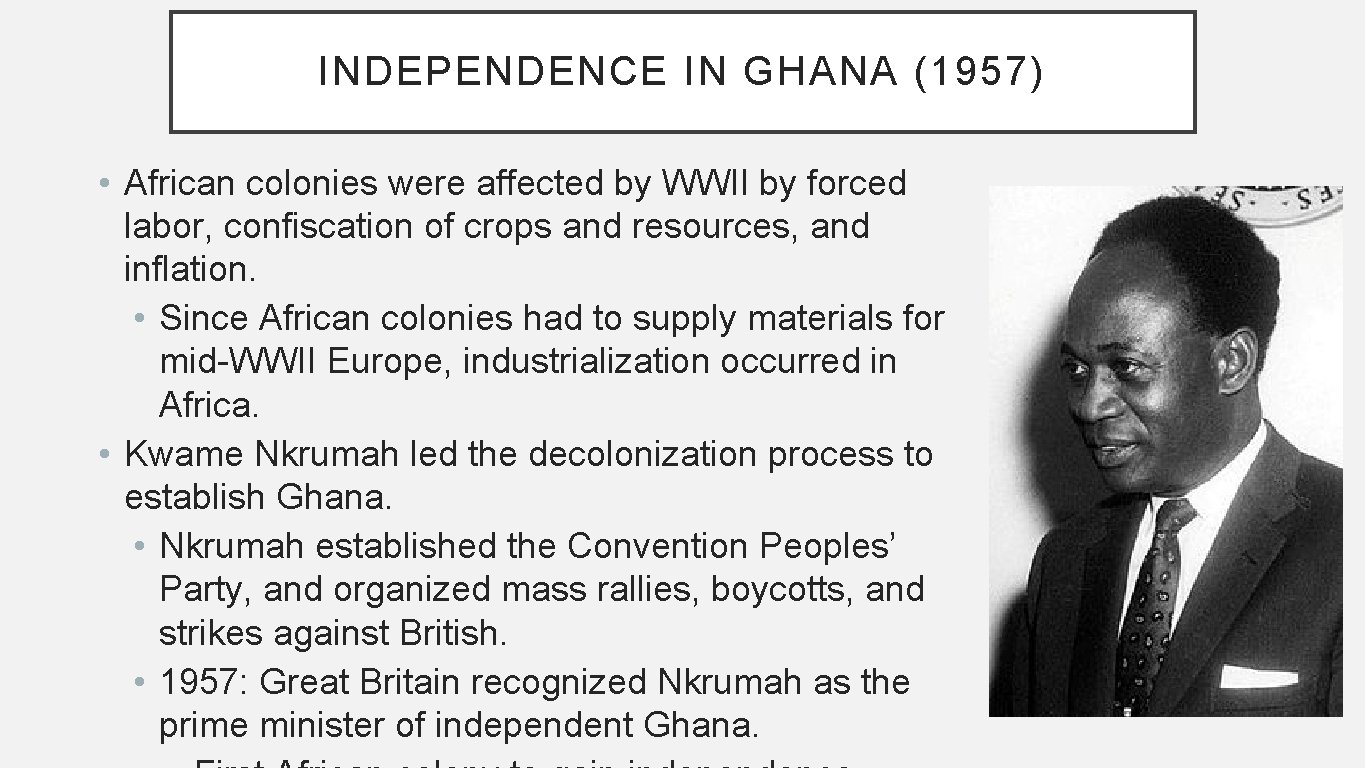
INDEPENDENCE IN GHANA (1957) • African colonies were affected by WWII by forced labor, confiscation of crops and resources, and inflation. • Since African colonies had to supply materials for mid-WWII Europe, industrialization occurred in Africa. • Kwame Nkrumah led the decolonization process to establish Ghana. • Nkrumah established the Convention Peoples’ Party, and organized mass rallies, boycotts, and strikes against British. • 1957: Great Britain recognized Nkrumah as the prime minister of independent Ghana.
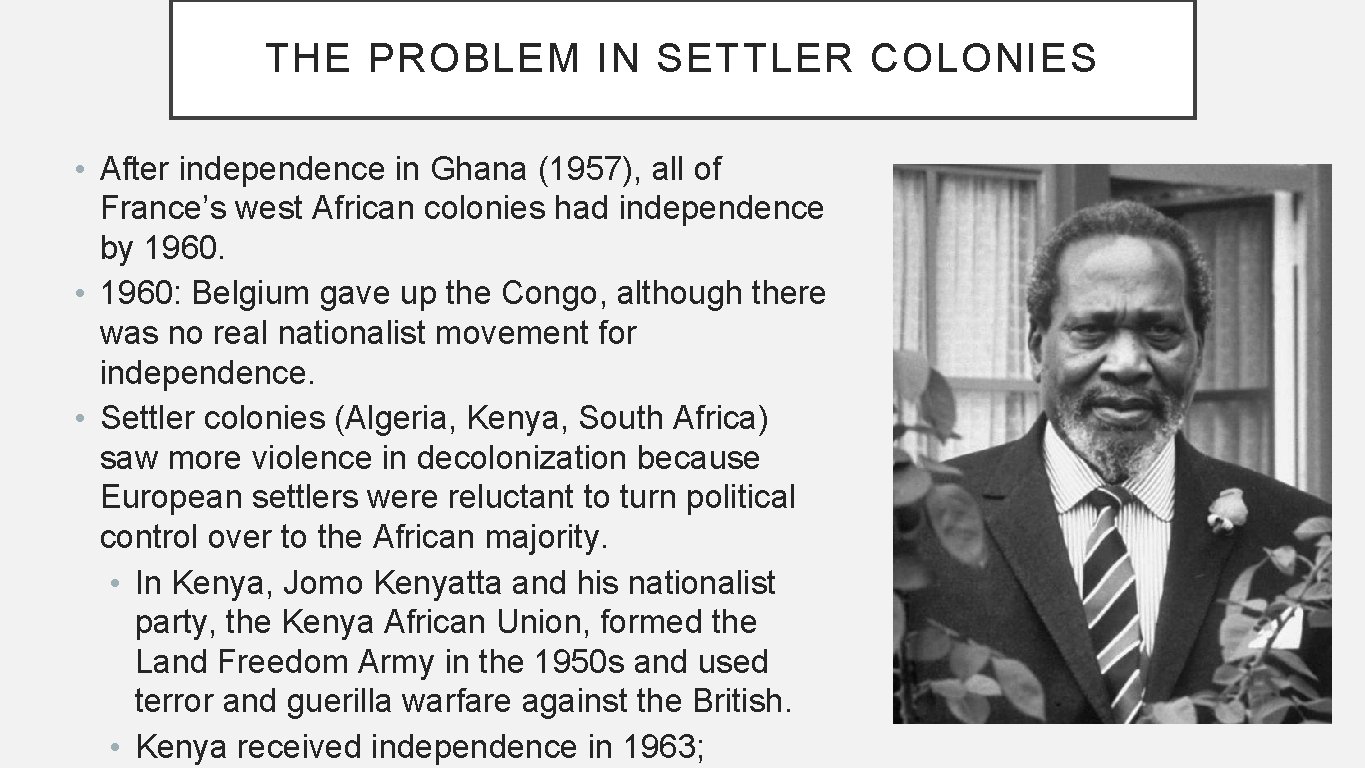
THE PROBLEM IN SETTLER COLONIES • After independence in Ghana (1957), all of France’s west African colonies had independence by 1960. • 1960: Belgium gave up the Congo, although there was no real nationalist movement for independence. • Settler colonies (Algeria, Kenya, South Africa) saw more violence in decolonization because European settlers were reluctant to turn political control over to the African majority. • In Kenya, Jomo Kenyatta and his nationalist party, the Kenya African Union, formed the Land Freedom Army in the 1950 s and used terror and guerilla warfare against the British. • Kenya received independence in 1963;
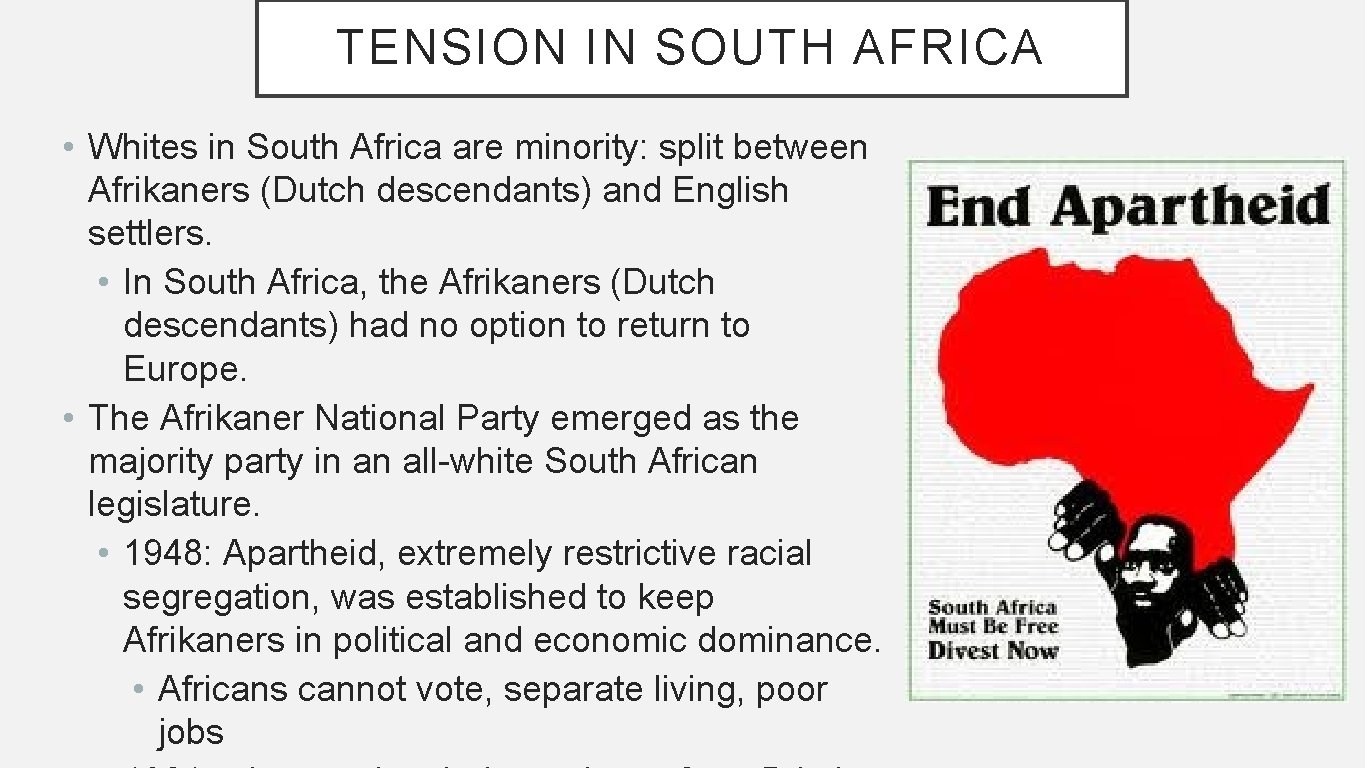
TENSION IN SOUTH AFRICA • Whites in South Africa are minority: split between Afrikaners (Dutch descendants) and English settlers. • In South Africa, the Afrikaners (Dutch descendants) had no option to return to Europe. • The Afrikaner National Party emerged as the majority party in an all-white South African legislature. • 1948: Apartheid, extremely restrictive racial segregation, was established to keep Afrikaners in political and economic dominance. • Africans cannot vote, separate living, poor jobs
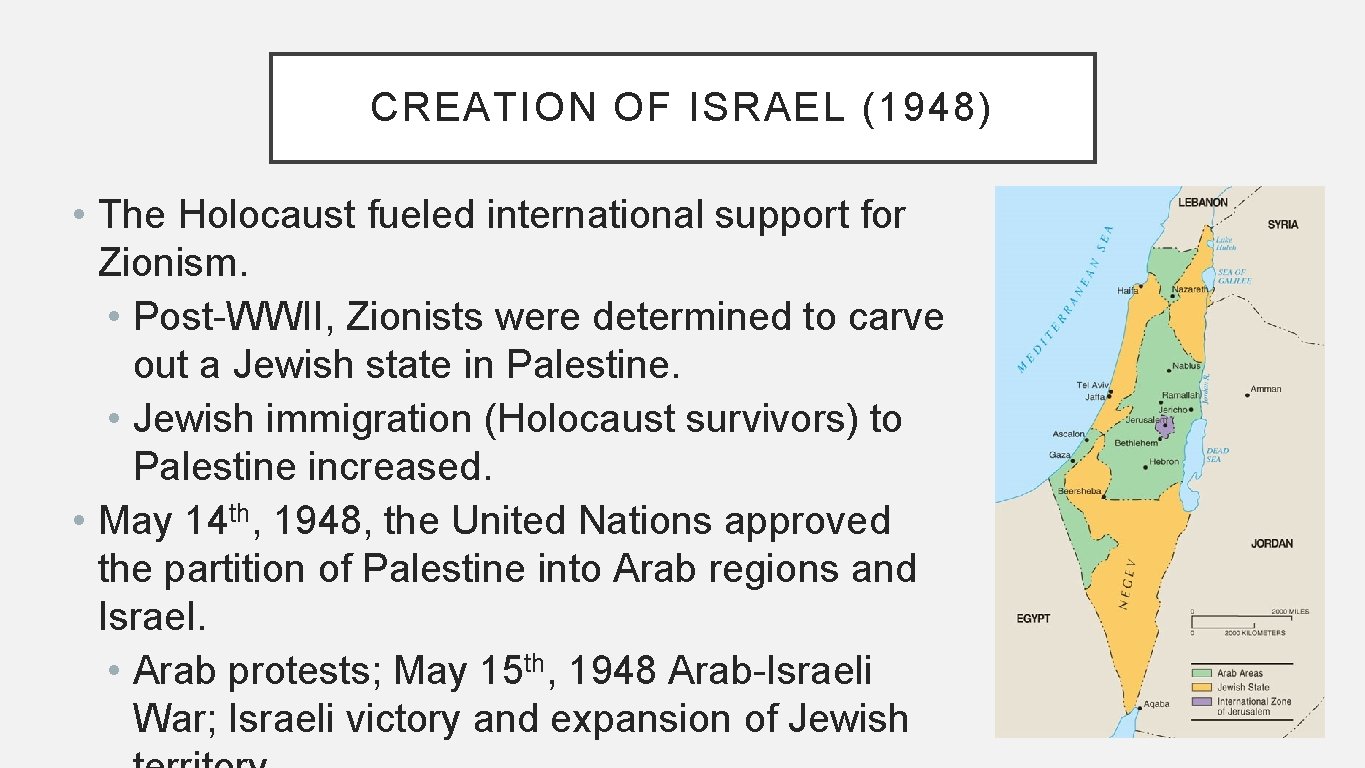
CREATION OF ISRAEL (1948) • The Holocaust fueled international support for Zionism. • Post-WWII, Zionists were determined to carve out a Jewish state in Palestine. • Jewish immigration (Holocaust survivors) to Palestine increased. • May 14 th, 1948, the United Nations approved the partition of Palestine into Arab regions and Israel. • Arab protests; May 15 th, 1948 Arab-Israeli War; Israeli victory and expansion of Jewish
• What group of Indians are frustrated with the Quit India Movement and lobby to have their own country? QUICK REVIEW QUESTION • In terms of decolonization, what is the difference between Tropical Dependency colonies and Settler colonies? • What is the Apartheid?
SUMMATIVE GROUP ACTIVITY • Compare WWI and WWII in the following ways: • Type of fighting • Countries involved • Outcome • Loss of life