
AP WORLD HISTORY DBQ RUBRIC CORE SCORING AP
AP WORLD HISTORY DBQ RUBRIC CORE SCORING
AP WORLD HISTORY AND AP EUROPEAN HISTORY CREATING GROUPS BY ANALYZING THE DOCUMENTS
THE BASIC CORE 4 Students must obtain points 1 -7 to get “to the gate” 4 Possible to get Expanded Core points only IF students obtain all of the Basic Core points
THE BASIC CORE 4 Point 1 - Explicit thesis that directly addresses the question Thesis must be explicit, not implied, and must address all parts of the question Thesis cannot simply restate the question
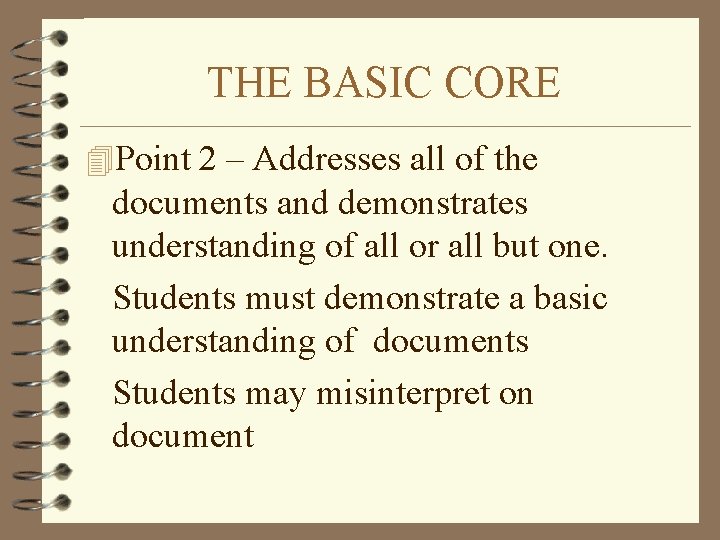
THE BASIC CORE 4 Point 2 – Addresses all of the documents and demonstrates understanding of all or all but one. Students must demonstrate a basic understanding of documents Students may misinterpret on document
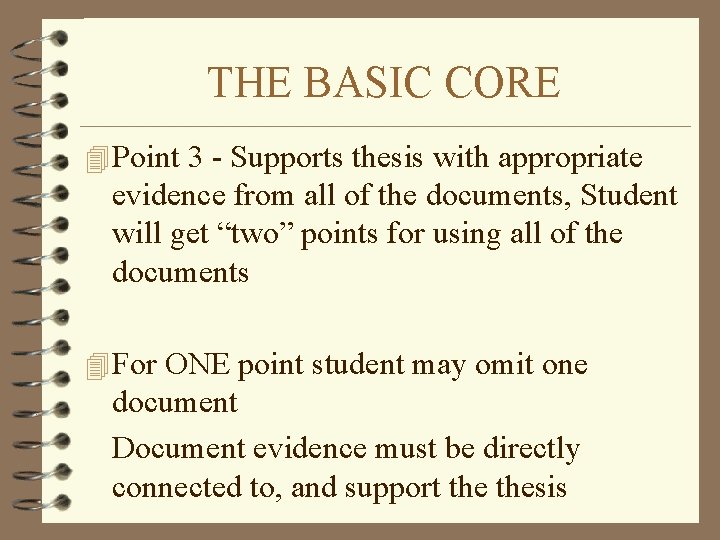
THE BASIC CORE 4 Point 3 - Supports thesis with appropriate evidence from all of the documents, Student will get “two” points for using all of the documents 4 For ONE point student may omit one document Document evidence must be directly connected to, and support thesis
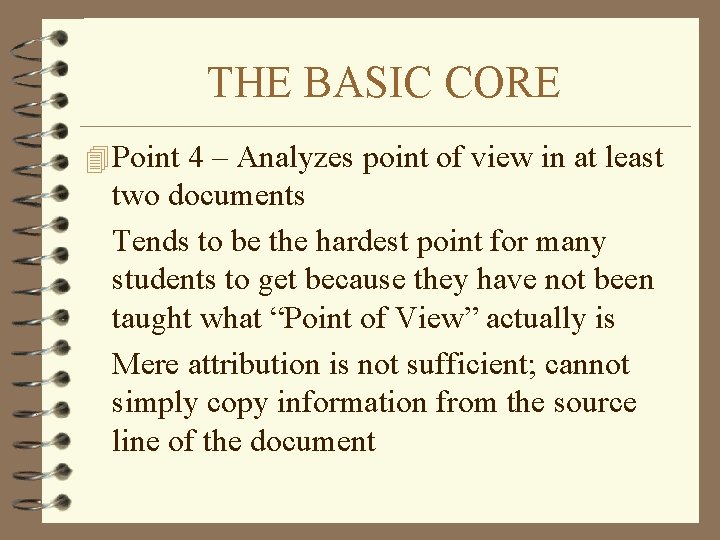
THE BASIC CORE 4 Point 4 – Analyzes point of view in at least two documents Tends to be the hardest point for many students to get because they have not been taught what “Point of View” actually is Mere attribution is not sufficient; cannot simply copy information from the source line of the document
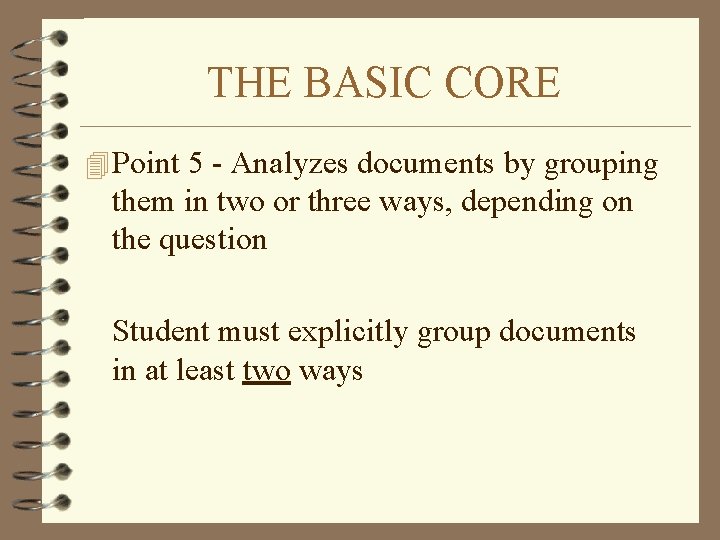
THE BASIC CORE 4 Point 5 - Analyzes documents by grouping them in two or three ways, depending on the question Student must explicitly group documents in at least two ways
THE BASIC CORE 4 Point 6 – Identifies and explains the need for one type of appropriate additional document or source Students must identify an “appropriate” additional document or source and explain how it will contribute to the analysis of the documents
THE EXPANDED CORE 4 Unlike the Basic Core, the Expanded Core can be viewed as somewhat subjective 4 Up to two points are given based on how well a student accomplishes the examples given for the Expanded Core

THE EXPANDED CORE 4 Seven possible ways for students to achieve Expanded Core points 4 Recommend students concentrate on these four: 1. Shows careful and insightful analysis of the documents 2. Addressing all parts of the question thoroughly 3. Analyzing point of view in at most or all documents, and 4. Analyzes the documents in additional waysgroupings, comparisons, synthesis
THE EXPANDED CORE 4 Devote less time to these three: 5. Having a clear, analytical and comprehensive thesis can be very “subjective” 6. Explains why additional types of documents or sources are needed- did this in thesis already! 7. Bringing in “relevant” outside information - students are given historical background in the DBQ; often they use this background as outside information
GROUPING DOCUMENTS 4 Properly grouping documents is “Basic Core” requirement in both AP World History and AP European History 4 Students must be able to create at least two groups in AP World, depends on question 4 Students must be able to create at least three groups in AP Euro
THE BASIC CORE 4 Point 6 - Analyzes the documents by grouping them in two or three ways, depending on the question (AP World History) 4 Point 6 - Analyzes the documents by organizing them into at least THREE distinct groups (AP European History)
ANALYZING DOCUMENTS 4 As part of the “Basic Core, ” students must also understand the basic meaning of the documents 4 Students may not misinterpret the meaning of more than one document 4 This requires that students be able to properly analyze documents
THE BASIC CORE 4 Point 2 - Understands the basic meaning of documents cited in the essay, may misinterpret no more than one document (AP World History) 4 Point 3 - Demonstrates an understanding of the majority of the documents, may have no more than one major error in interpretation (AP European History)
ANALYZING DOCUMENTS 4 Document analysis requires we teach students to locate keys aspects: § Read question carefully; what is it asking? § Review documents carefully for clues: § § § Author Document type Purpose of writing
SAMPLE AP WH DOCUMENT Source: Zong Mi, a leading Buddhist scholar, favored by the Tang imperial household, essay, “On the Nature of Man, ” early ninth century C. E. “Confucius, Laozi, and Buddha were all perfect sages. They established their teachings according to the demands of the ages and the needs of various beings. They differ in their approaches in that they encourage the perfection of good deeds, punish wicked ones, and reward good ones; all three teachings lead to the creation of an orderly society and for this they must be observed with respect. ”
IMPORTANT POINTS 4 Author was a Buddhist scholar 4 Favored by Tang Dynasty 4 Wants to reconcile the teachings of Buddha with those of Confucius and Laozi § Would allow Buddhism to remain in the Tang Emperor’s favor (along with more the more traditional teachings of Confucius) § Would keep Buddhism in China and men like Zong Mi in their “favored” positions
SAMPLE AP EURO DOCUMENT Source: Cardinal Richelieu, royal councillor, unofficial statement on poverty, France, 1625. “Instead of working as they should to earn a living, vagabonds and good-for-nothings have turned to begging, taking bread from the sick and deserving poor to whom it is due. We desire that in every town in our kingdom rules and regulations for the poor should be established, so that not only all those of the said town but also of the neighboring areas should be confined and fed, and those who are able to do so should be employed on public works. ”
IMPORTANT POINTS 4 Author is a royal official, also a Cardinal in the Catholic church 4 An “unofficial” statement, as opposed to an “official” proclamation 4 Students should also be aware that this person is a well-known historical figure, and many will also have an idea of his policies and views
DOCUMENT ANALYSIS USING GROUPS IN CLASS 4 Have students practice analysis of documents in order to group them 4 Give each group a document to work with, have them determine the view of the author 4 Group documents based on the question itself, and how the documents respond to the question 4 Remember: A group requires two or more documents, make sure their groups do also!
AP WH POSSIBLE GROUPS 4 Could include the simplest ways of grouping: 4 Group One: Pro Buddhism- 1 and 2 4 Group Two: Coexistence- 3 and 5 4 Group Three: Negative 4 and 6 4 There are other equally effective ways to group the documents
AP EURO POSSIBLE GROUPS 4 Could include the following ways of grouping: § Group by – Poor should be punished § Group by – Poor should be seen sympathetically § Group by – Undeserving versus deserving poor
WH- THESIS 4 World History - After being founded in India during the sixth century B. C. E. Buddhism spread to other parts of Asia, including China. Although Buddhism began to attract many followers in China, there were those who favored traditional teachings, and even though there was an attempt for the two to coexist, it was finally outlawed by the emperor. Those who opposed Buddhism held fast to their traditional teachings, such as Confucianism or Daoism. Two additional documents that would be useful in looking at the spread of, and reaction to Buddhism would be a chart that showed how many people actually converted to Buddhism, and a document such as a diary entry from a merchant or peasant to show the lower classes felt about Buddhism.
AP EURO- THESIS 4 There were many, often conflicting views regarding the poor from the fifteenth century to the eighteenth century. Although there were those who were willing to help the poor no matter what, and some who would help the poor who could not fend for themselves and needed aid, there were still others who felt that the poor deserved no help because their condition was their own fault. They had no desire to offer comfort, instead showing disdain for those less fortunate.
- Slides: 26