
AP TEST REVIEW English Language and Composition Organization
- Slides: 31
AP TEST REVIEW English Language and Composition
Organization of AP Language and Composition Exam 3 hours 15 minutes total 1. MC section I hour 2. Essay 2 hours 15 minutes three possible types of essay -analysis *You are responsible for dividing -argument your time appropriately! -synthesis
MULTIPLE CHOICE
Multiple Choice Scoring Number right = raw score l Raw score is then multiplied by a constant to give your multiple-choice total l The MC section is 45% of your overall score l
Types of Multiple Choice Questions l l l 1. The straightforward question 2. The question that refers you to specific lines and asks you to draw a conclusion or to interpret 3. The ALL… EXCEPT question 4. The question that asks you to make an inference or to abstract a concept not directly stated in the passage 5. The “killer” Roman numeral question 6. The footnote question
Specific Techniques 1. Process of Elimination l 2. Substitution/ Fill-in the blank l 3. Using Context l 4. Anticipation l 5. Intuition/ The Educated Guess l
Question Categories Questions about rhetoric l Questions about the author’s meaning and purpose l Questions about the main idea l Questions about organization and structure l Questions about rhetorical modes l
ANALYSIS ESSAY
The AP English Language Exam Requires the analysis of another author’s… 1. structure l 2. purpose l 3. style l
SAMPLE Analysis Questions Analyze an author’s view on a specific subject l Analyze rhetorical devices used by an author to achieve his or her purpose l Analyze stylistic elements in a passage and their effects l Analyze the author’s tone and how the author conveys this tone l
SAMPLE Analysis Questions Cont. l l l Compare and/or contrast two passages with regard to style, purpose, or tone Analyze the author’s purpose and how he or she achieves it Analyze some of the ways an author recreates a real or imagined experience Analyze how an author presents him or herself in the passage Discuss the intended and/or probable effect of a passage
RHETORICAL STRATEGIES YOU MAY NEED TO ANALYZE (Structure) 1. Example l 2. Comparison and contrast l 3. Definition l 4. Cause and effect l 5. Process analysis l 6. Classification l
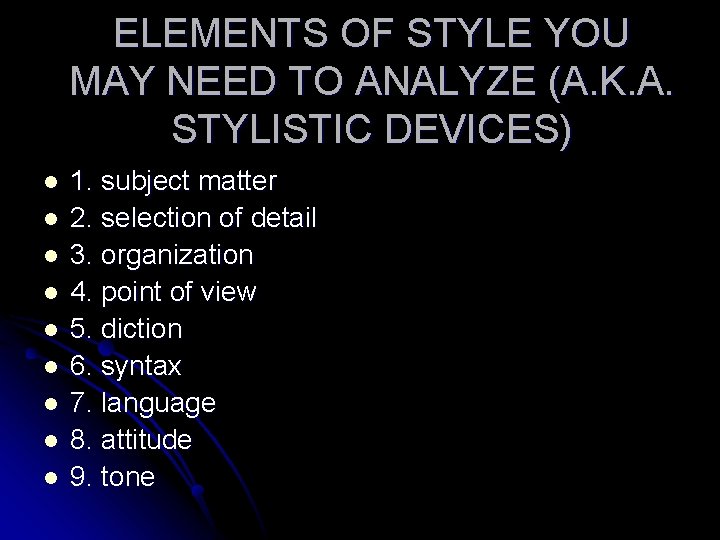
ELEMENTS OF STYLE YOU MAY NEED TO ANALYZE (A. K. A. STYLISTIC DEVICES) l l l l l 1. subject matter 2. selection of detail 3. organization 4. point of view 5. diction 6. syntax 7. language 8. attitude 9. tone
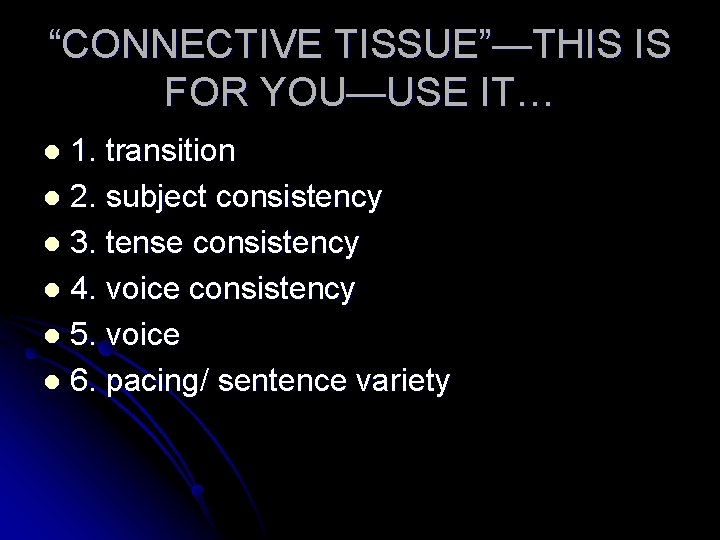
“CONNECTIVE TISSUE”—THIS IS FOR YOU—USE IT… 1. transition l 2. subject consistency l 3. tense consistency l 4. voice consistency l 5. voice l 6. pacing/ sentence variety l
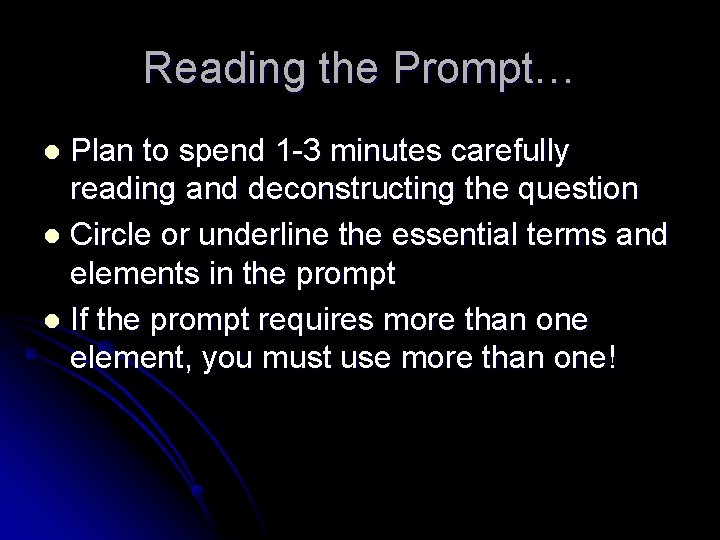
Reading the Prompt… Plan to spend 1 -3 minutes carefully reading and deconstructing the question l Circle or underline the essential terms and elements in the prompt l If the prompt requires more than one element, you must use more than one! l
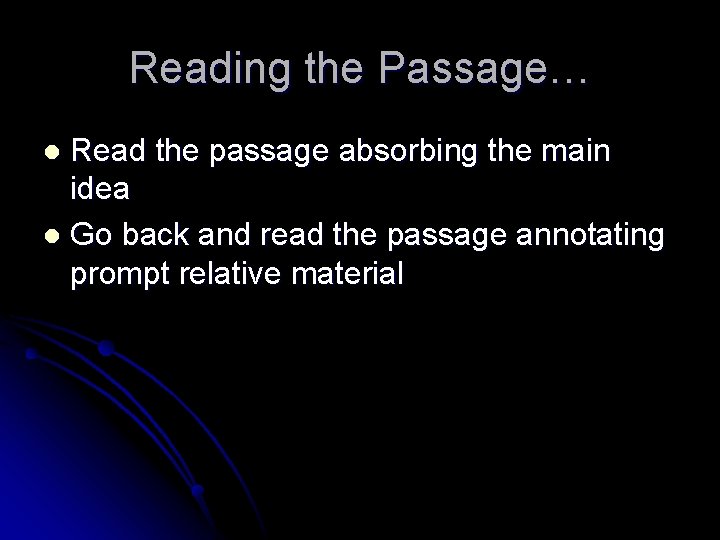
Reading the Passage… Read the passage absorbing the main idea l Go back and read the passage annotating prompt relative material l
Composition l l l Review the prompt List the elements that need to be included in your introduction: author, title, question elements, the elements that you plan to mention in your essay Draw a graphic organizer and fill it out for the body After you complete this—composition will be a breeze Don’t worry about a “catchy” opening thingy—get to the point and get out if nothing earth shattering immediately pops into your head After composition, mark the grid and intro. list and make sure that you haven’t left anything out of the response
WARNINGS… l l l Avoid paraphrasing the material Use TEXTUAL evidence Actually analyze the textual evidence—make sure you use quotation marks and put the periods and commas inside!!! ARGHHH!!!!!!! Use connective tissue and transitions Vary your syntax! USE AP TERMS thoughtfully indicating that you really know what they mean—Remember the ughhhhhh example, “The author used diction…”
ARGUMENTATIVE ESSAY
DO THESE THREE THINGS… Understand the nature of the position taken in the prompt l Take a specific stand l Clearly and logically support your claim l
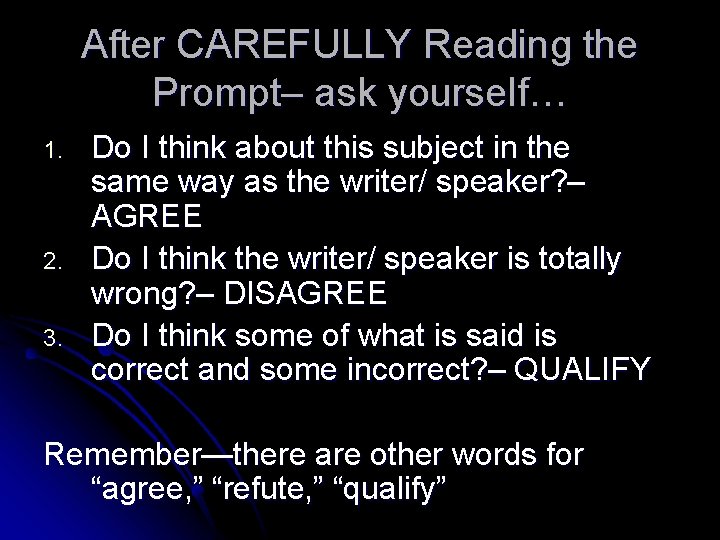
After CAREFULLY Reading the Prompt– ask yourself… 1. 2. 3. Do I think about this subject in the same way as the writer/ speaker? – AGREE Do I think the writer/ speaker is totally wrong? – DISAGREE Do I think some of what is said is correct and some incorrect? – QUALIFY Remember—there are other words for “agree, ” “refute, ” “qualify”
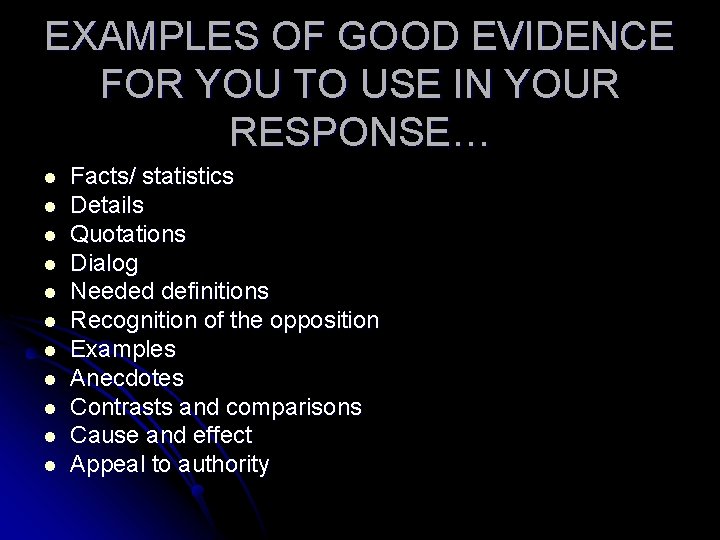
EXAMPLES OF GOOD EVIDENCE FOR YOU TO USE IN YOUR RESPONSE… l l l Facts/ statistics Details Quotations Dialog Needed definitions Recognition of the opposition Examples Anecdotes Contrasts and comparisons Cause and effect Appeal to authority
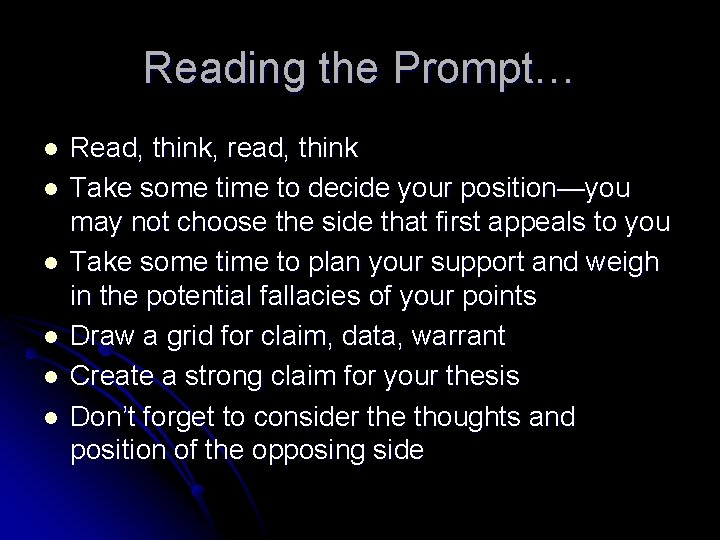
Reading the Prompt… l l l Read, think, read, think Take some time to decide your position—you may not choose the side that first appeals to you Take some time to plan your support and weigh in the potential fallacies of your points Draw a grid for claim, data, warrant Create a strong claim for your thesis Don’t forget to consider the thoughts and position of the opposing side
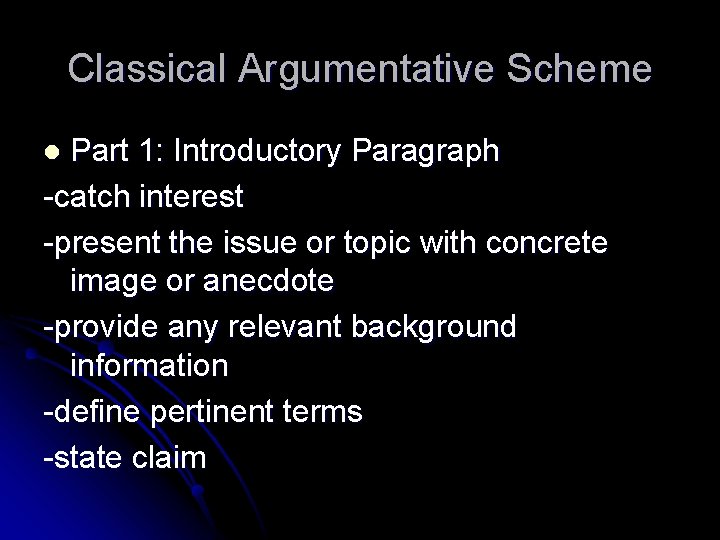
Classical Argumentative Scheme Part 1: Introductory Paragraph -catch interest -present the issue or topic with concrete image or anecdote -provide any relevant background information -define pertinent terms -state claim l
Classical Argumentative Scheme Con’t. Part 2: Concession and Refutation -ignoring the other side is dangerous -perhaps find weaknesses within the opposing reasons, facts, testimonies, etc. -“yes, ” is the concession; “but” is the refutation -you still must demonstrate that your claims are more valid -you may concede or refute in the introductory paragraph or through the body paragraphs as you bring up additional points l
Classical Argumentative Scheme Con’t. Part 3: Confirmation Paragraphs -the most important and longest section of the argument -provides the reasons and the evidence of a writer’s claim -shows the logical development of the argument -should include both logical reasons and evidence but also emotional appeals to human needs or values -incorporate other modes of discourse to further develop your writing l
Classical Argumentative Scheme Con’t. Part 4: Concluding Paragraph -wrap up the argument -restate the claim -provide a new appeal to needs or values -enrich with additional commentary -voice a final plea for readers to take action or to change thinking -refrain from repeating any information l
SYNTHESIS ESSAY
What is the Purpose? l The College Board wants to determine that you can… -Read critically -Understand texts -Analyze texts -Develop a position on a given topic -Support a position with appropriate evidence from outside sources -Incorporate outside sources into the text of the essay -Cite sources used
Source Possibilities Six or seven documents l Short works l At least one visual, non textual (charts, cartoons, tables, etc. ) l Black and white print l Opposing views—dialectic l You are invited to join the conversation l
Remember! l l l Create your own thesis—thus showing a sense of independence YOU are choosing your view and using the sources to support that view Weaker writers have a tendency to paraphrase and list—so, don’t do that Use at least three sources Cite/ attribute sources Remember that the best writers create a dialectic – thus offering complexity– they do not simplify