
AP STATISTICS LESSON 6 3 DAY 1 GENERAL


- Slides: 17
AP STATISTICS LESSON 6. 3 (DAY 1) GENERAL PROBABILITY RULES
Warm – up # 1 Page 323 # 5. 87
ESSENTIAL QUESTION: What are general probability rules and how are they used to solve probability problems? Objectives: § To become familiar with general probability rules. § To use the general probability rules to solve problems. § To use Venn diagrams, Tree diagrams and tables to solve probability problems.
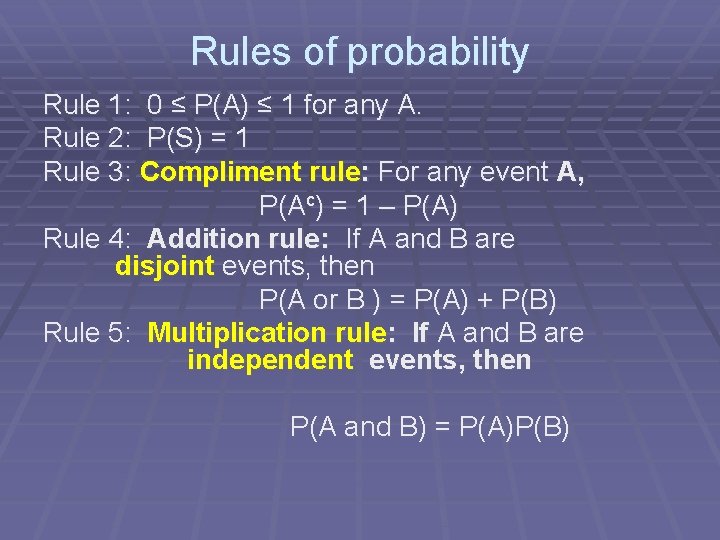
Rules of probability Rule 1: 0 ≤ P(A) ≤ 1 for any A. Rule 2: P(S) = 1 Rule 3: Compliment rule: For any event A, P(Ac) = 1 – P(A) Rule 4: Addition rule: If A and B are disjoint events, then P(A or B ) = P(A) + P(B) Rule 5: Multiplication rule: If A and B are independent events, then P(A and B) = P(A)P(B)
Union The union of any collection of events is the event that at least one of the collection occurs.
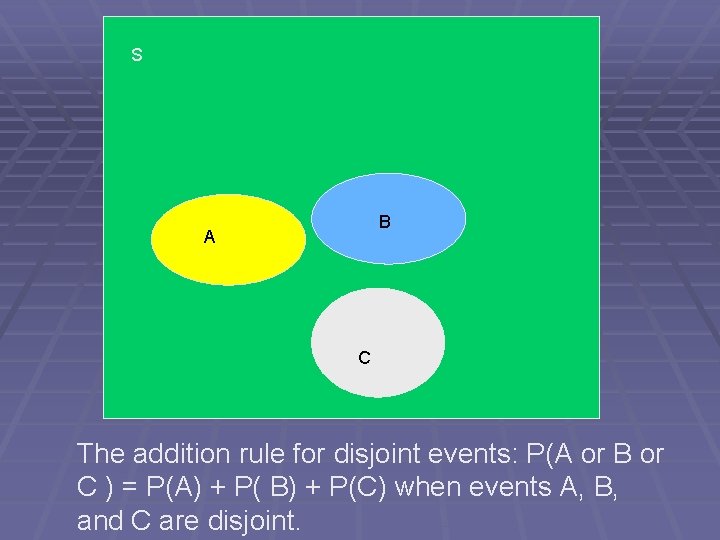
S B A C The addition rule for disjoint events: P(A or B or C ) = P(A) + P( B) + P(C) when events A, B, and C are disjoint.
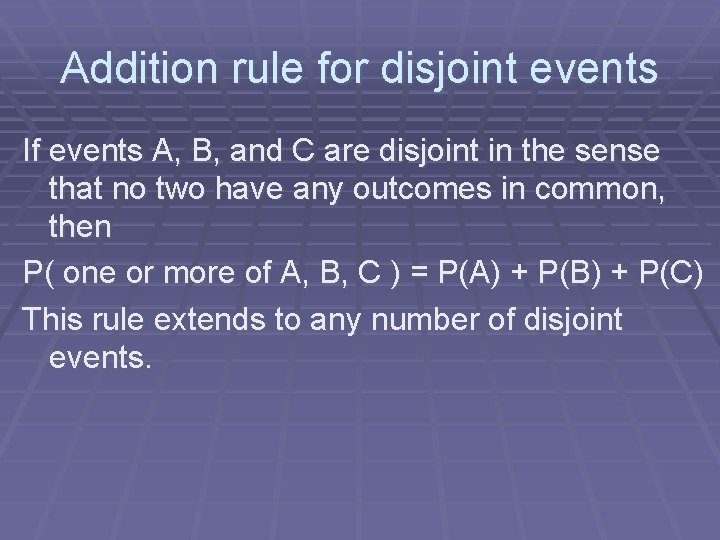
Addition rule for disjoint events If events A, B, and C are disjoint in the sense that no two have any outcomes in common, then P( one or more of A, B, C ) = P(A) + P(B) + P(C) This rule extends to any number of disjoint events.
Example 6. 16 Page 361
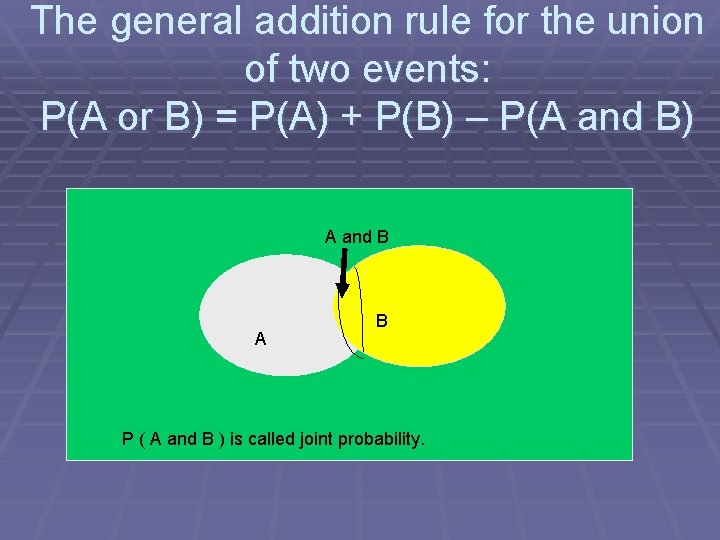
The general addition rule for the union of two events: P(A or B) = P(A) + P(B) – P(A and B) A and B A B P ( A and B ) is called joint probability.
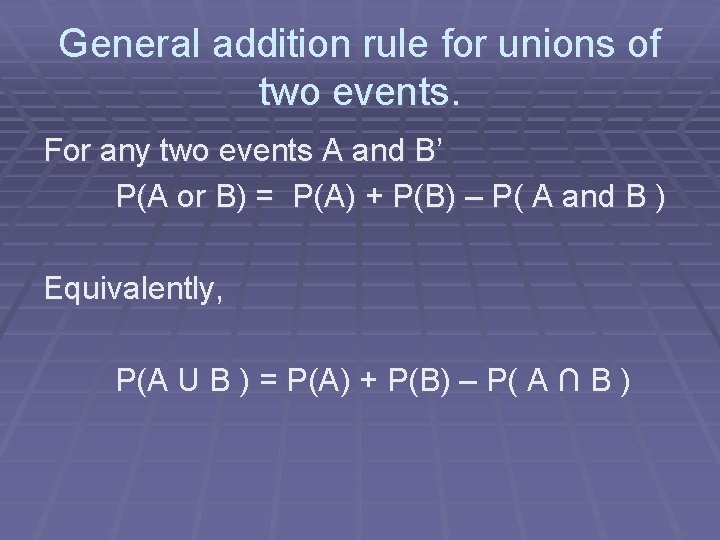
General addition rule for unions of two events. For any two events A and B’ P(A or B) = P(A) + P(B) – P( A and B ) Equivalently, P(A U B ) = P(A) + P(B) – P( A ∩ B )
Example 6. 17 Page 362
Conditional Probability P(A/B) – Conditional probability – gives the probability of one event under the condition that we know another event.
Example 6. 19 § Page 366
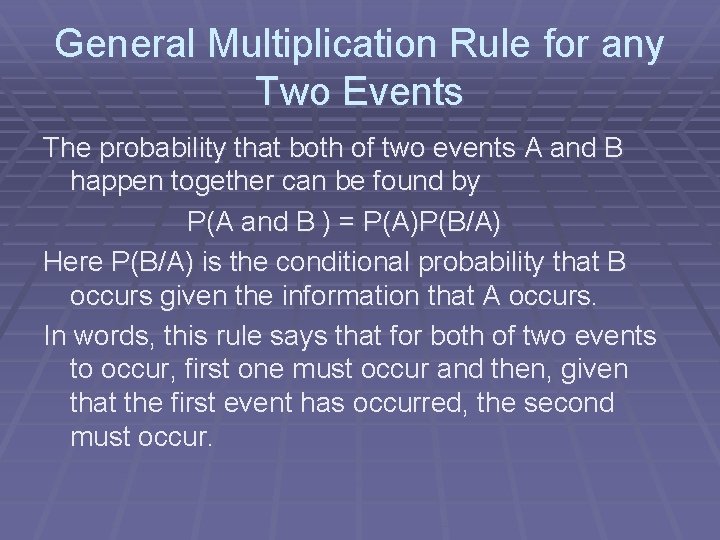
General Multiplication Rule for any Two Events The probability that both of two events A and B happen together can be found by P(A and B ) = P(A)P(B/A) Here P(B/A) is the conditional probability that B occurs given the information that A occurs. In words, this rule says that for both of two events to occur, first one must occur and then, given that the first event has occurred, the second must occur.
Example 6. 20 Page 368
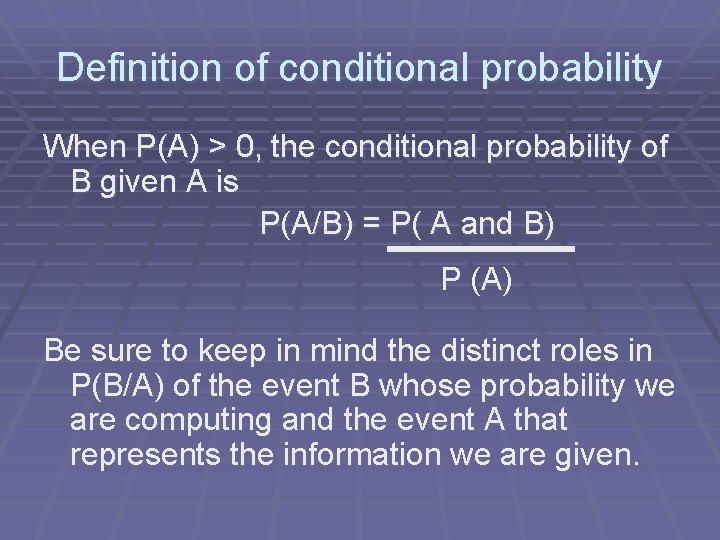
Definition of conditional probability When P(A) > 0, the conditional probability of B given A is P(A/B) = P( A and B) P (A) Be sure to keep in mind the distinct roles in P(B/A) of the event B whose probability we are computing and the event A that represents the information we are given.
Example 6. 21 § Page 369