
AP Statistics Chapter 5 Notes Ways to Collect







- Slides: 18
AP Statistics Chapter 5 Notes
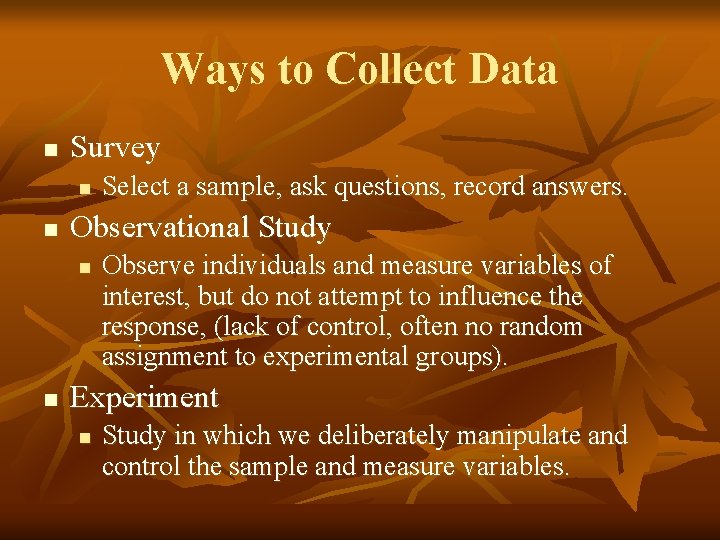
Ways to Collect Data n Survey n n Observational Study n n Select a sample, ask questions, record answers. Observe individuals and measure variables of interest, but do not attempt to influence the response, (lack of control, often no random assignment to experimental groups). Experiment n Study in which we deliberately manipulate and control the sample and measure variables.
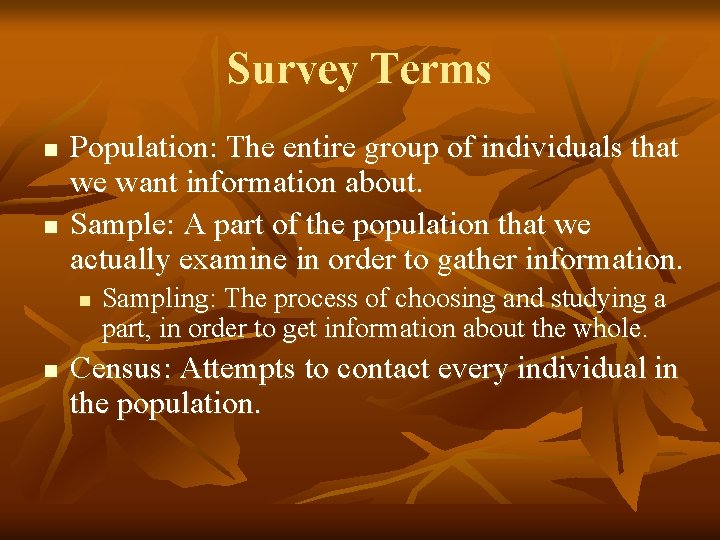
Survey Terms n n Population: The entire group of individuals that we want information about. Sample: A part of the population that we actually examine in order to gather information. n n Sampling: The process of choosing and studying a part, in order to get information about the whole. Census: Attempts to contact every individual in the population.
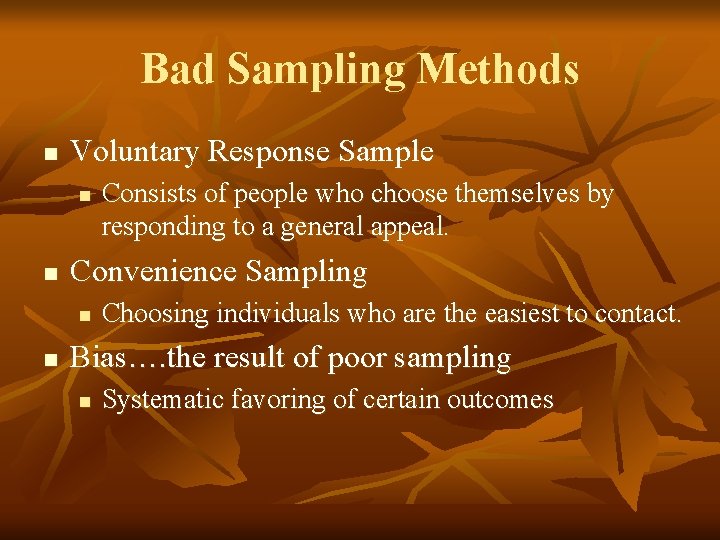
Bad Sampling Methods n Voluntary Response Sample n n Convenience Sampling n n Consists of people who choose themselves by responding to a general appeal. Choosing individuals who are the easiest to contact. Bias…. the result of poor sampling n Systematic favoring of certain outcomes
Proper Sampling Methods n n Probability Sample: Sample chosen by chance. Simple Random Sample (SRS) n n n individuals from the population chosen in such a way that every set of n individuals has an equal chance to be the sample actually selected. Stratified Random Sample n Population is first divided into groups called strata, that are similar in a way that is important to the response. SRS is then taken from each stratum to form the sample. n # of individuals taken from the strata should be proportional to the number of individuals in the strata.
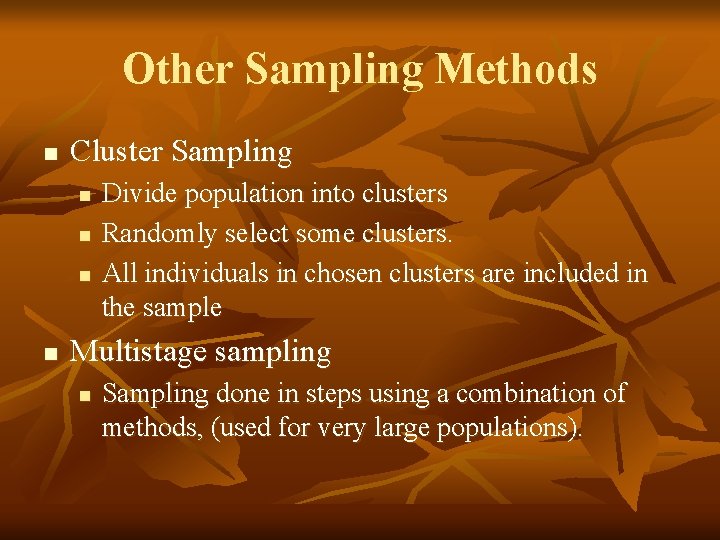
Other Sampling Methods n Cluster Sampling n n Divide population into clusters Randomly select some clusters. All individuals in chosen clusters are included in the sample Multistage sampling n Sampling done in steps using a combination of methods, (used for very large populations).
Problems with surveys (even when sampling methods are good) n Undercoverage n n Nonresponse n n Some groups in the population are left out of the process of choosing a sample. Individual chosen for the sample can’t be contacted or does not cooperate *These problems may or may not cause bias. * n Bias will result if the people left out are different, as a group, than the people included.
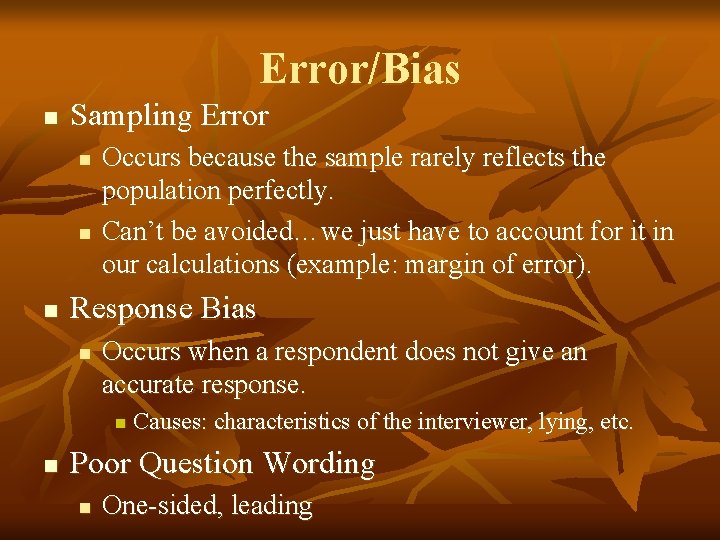
Error/Bias n Sampling Error n n n Occurs because the sample rarely reflects the population perfectly. Can’t be avoided…we just have to account for it in our calculations (example: margin of error). Response Bias n Occurs when a respondent does not give an accurate response. n n Causes: characteristics of the interviewer, lying, etc. Poor Question Wording n One-sided, leading
Parts of an Experiment n n Experimental Units: Individuals on which the experiment is being performed, (called subjects or participants when human) Treatment: An experimental condition applied to the units. Factors: The explanatory variables in an experiment. Level: A specific value of a factor n n Examples: Dosage, temperature Combination of levels and factors form the treatment. n Example: 200 mg given orally, 400 mg administered intravenously
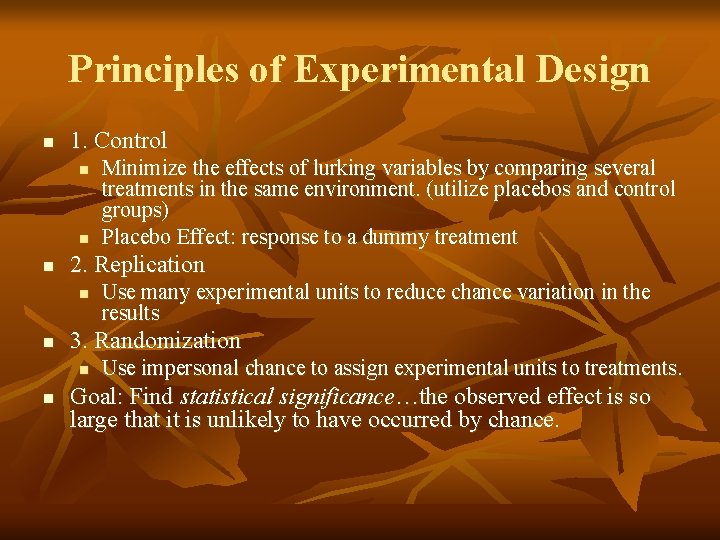
Principles of Experimental Design n 1. Control n n n 2. Replication n n Use many experimental units to reduce chance variation in the results 3. Randomization n n Minimize the effects of lurking variables by comparing several treatments in the same environment. (utilize placebos and control groups) Placebo Effect: response to a dummy treatment Use impersonal chance to assign experimental units to treatments. Goal: Find statistical significance…the observed effect is so large that it is unlikely to have occurred by chance.
Types of Experimental Designs n Completely Randomized Design n n aka a basic comparative experiment All experimental units are allocated at random among all the treatments
Comparative Experiment
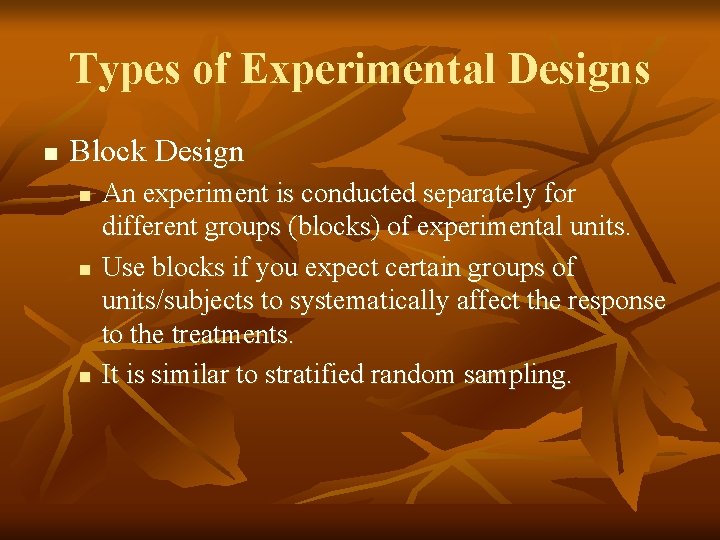
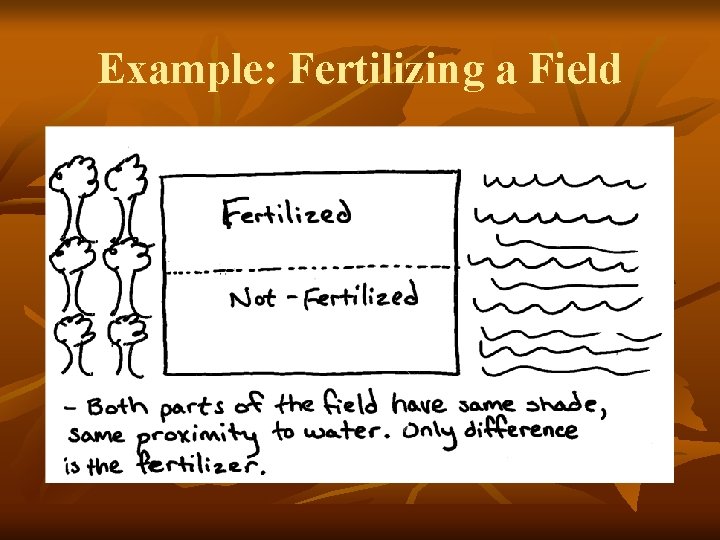
Types of Experimental Designs n Block Design n An experiment is conducted separately for different groups (blocks) of experimental units. Use blocks if you expect certain groups of units/subjects to systematically affect the response to the treatments. It is similar to stratified random sampling.
Block Design
Types of Experimental Designs n Matched Pairs Design (type of block design) n n Compares two treatments by comparing the response of two matched experimental units. Units are matched one of two ways…. (a) Two different units/subjects matched based on similar characteristics (e. g. identical twins) n (b) One subject/unit receives both treatments (i. e. A person is paired with him/herself. Each subject serves as his/her own control. ) n n Randomization is still used to determine who gets which treatment, or which treatment is given first.
Example: Fertilizing a Field
Other Considerations with Experiments n It is sometimes better if the experiment is conducted in a double-blind manner. n n Neither the subjects nor the people administering the experiment know which treatment the subjects received. Sometimes a lack of realism is a problem for experiments. n A laboratory setting is not always the same as real life, which makes it difficult to generalize your findings.
Other Considerations Cont… n n Don’t forget to describe your randomization process in detail when writing an open-ended response. Random sample n n Allows you to generalize your results to the population Random allocation to treatment groups n Allows you to state that the difference between the responses in the treatment groups was due to the effects of the explanatory variable, not the personal characteristics of the subjects.