
AP PSYCHOLOGY Thinking and Language Adapted from James
- Slides: 38
AP PSYCHOLOGY Thinking and Language Adapted from James A. Mc. Cubbin, Ph. D Clemson University Worth Publishers
Thinking z. Cognition ymental activity associated with processing, understanding, and communicating information z. Cognitive Psychology ythe study of these mental activities xconcept formation xproblem solving xdecision making xjudgement formation ystudy of both logical and illogical thinking
Thinking z. Concept ymental grouping of similar objects, events, or people xaddress • country, city, street, house • zip codes z. Prototype ythe best example of a category xmatching new items to the prototype provides a quick and easy method for including items in a category (as when comparing feathered creatures to a prototypical bird, such as a robin. )
Thinking z. Algorithm ymethodical, logical rule or procedure that guarantees solving a particular problem ycontrasts with the usually speedier – but also more error-prone use of heuristics
Thinking z. Heuristic yrule-of-thumb strategy that often allows us to make judgements and solve problems efficiently yusually speedier than algorithms ymore error-prone than algorithms ysometimes we’re unaware of using heuristics
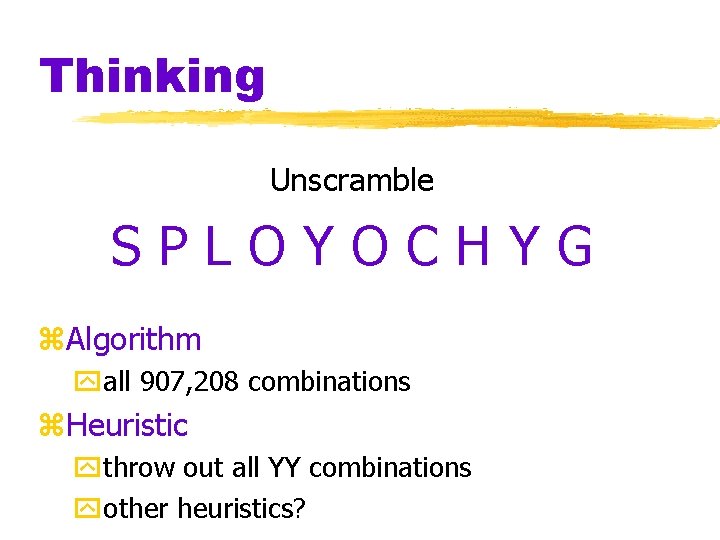
Thinking Unscramble SPLOYOCHYG z. Algorithm yall 907, 208 combinations z. Heuristic ythrow out all YY combinations yother heuristics?
Thinking z Insight ysudden and often novel realization of the solution to a problem ycontrasts with strategy-based solutions z Confirmation Bias ytendency to search for information that confirms one’s preconceptions z Fixation yinability to see a problem from a new perspective yimpediment to problem solving
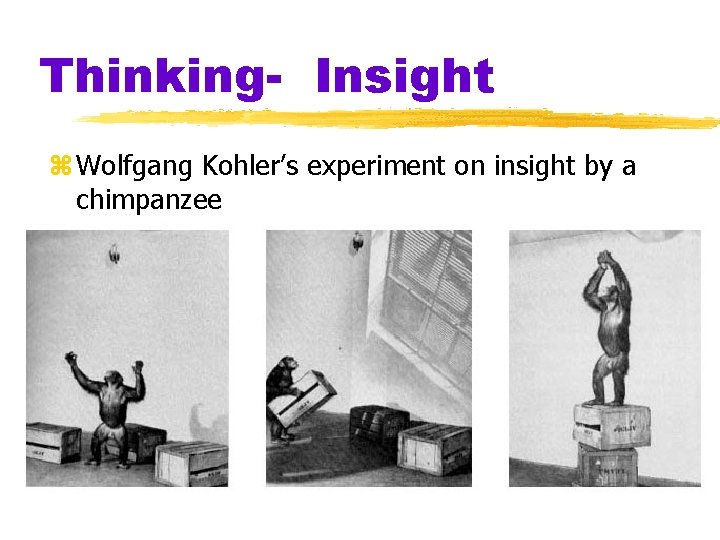
Thinking- Insight z Wolfgang Kohler’s experiment on insight by a chimpanzee
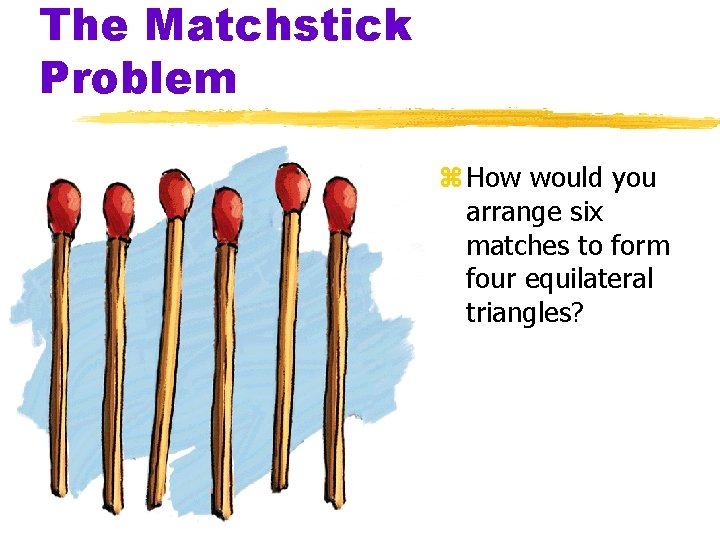
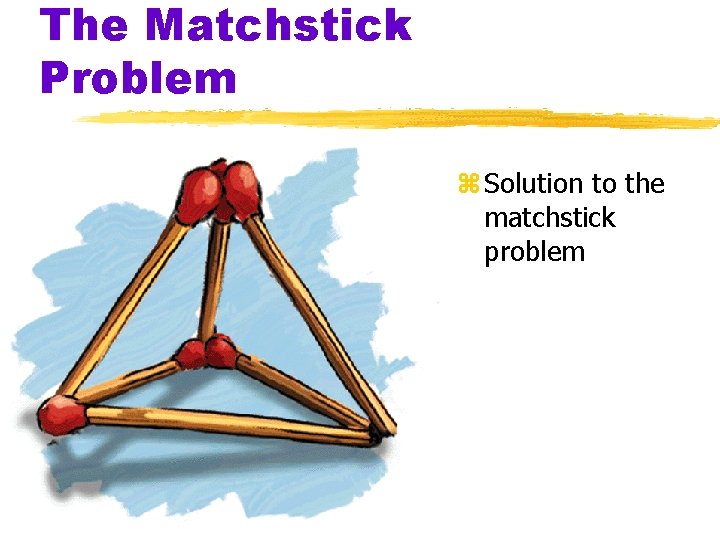
The Matchstick Problem z How would you arrange six matches to form four equilateral triangles?
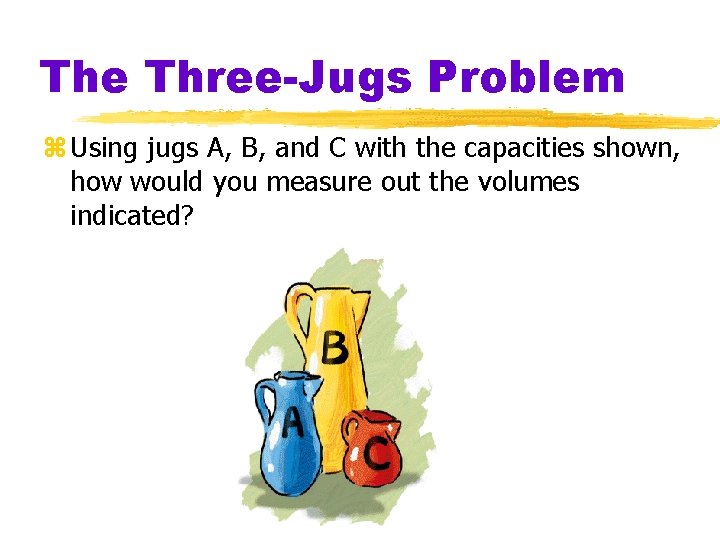
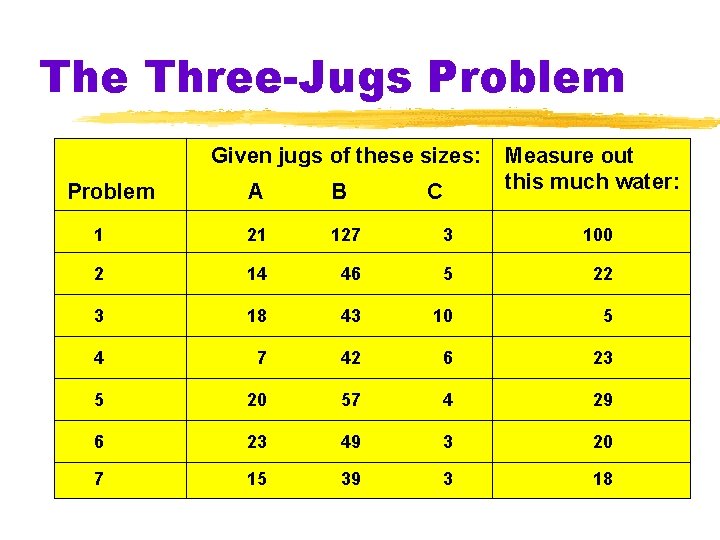
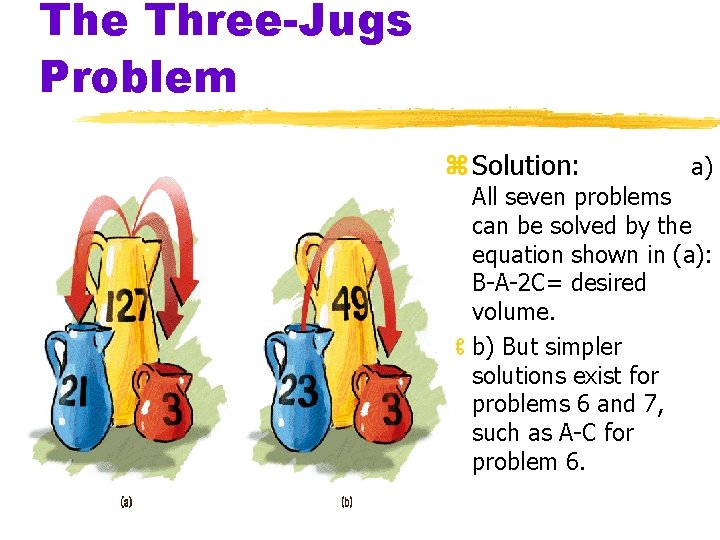
The Three-Jugs Problem z Using jugs A, B, and C with the capacities shown, how would you measure out the volumes indicated?
The Three-Jugs Problem Given jugs of these sizes: Problem C Measure out this much water: A B 1 21 127 3 100 2 14 46 5 22 3 18 43 10 5 4 7 42 6 23 5 20 57 4 29 6 23 49 3 20 7 15 39 3 18
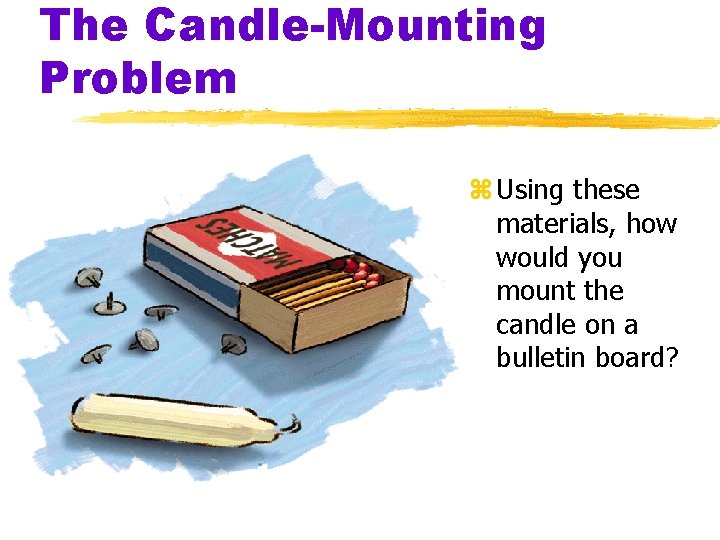
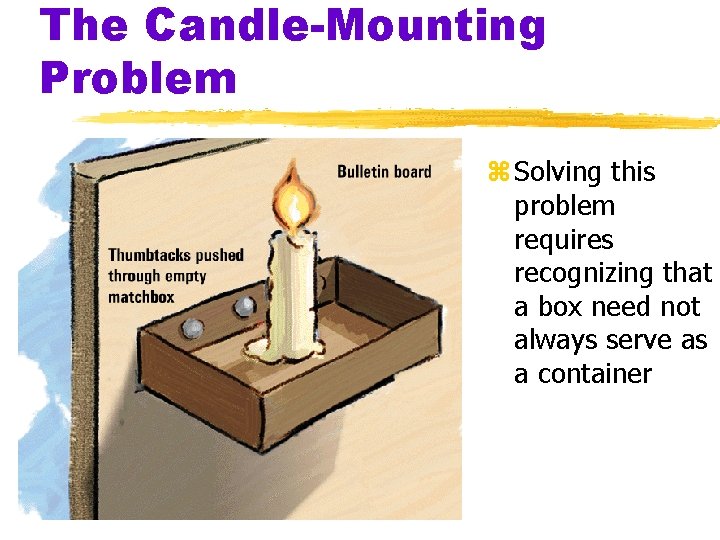
The Candle-Mounting Problem z Using these materials, how would you mount the candle on a bulletin board?
Thinking z. Mental Set ytendency to approach a problem in a particular way yespecially a way that has been successful in the past but may or may not be helpful in solving a new problem
Thinking z. Functional Fixedness ytendency to think of things only in terms of their usual functions yimpediment to problem solving
The Matchstick Problem z Solution to the matchstick problem
The Three-Jugs Problem z Solution: a) All seven problems can be solved by the equation shown in (a): B-A-2 C= desired volume. z b) But simpler solutions exist for problems 6 and 7, such as A-C for problem 6.
The Candle-Mounting Problem z Solving this problem requires recognizing that a box need not always serve as a container
Heuristics z. Representativeness Heuristic yrule of thumb for judging the likelihood of things in terms of how well they seem to represent, or match, particular prototypes ymay lead one to ignore other relevant information
Heuristics z. Availability Heuristic yestimating the likelihood of events based on their availability in memory yif instances come readily to mind (perhaps because of their vividness), we presume such events are common y. Example: airplane crash
Thinking z. Overconfidence ytendency to be more confident than correct ytendency to overestimate the accuracy of one’s beliefs and judgements
Thinking z. Framing ythe way an issue is posed yhow an issue is framed can significantly affect decisions and judgements y. Example: What is the best way to market ground beef- As 25% fat or 75% lean?
Thinking z. Belief Bias ythe tendency for one’s preexisting beliefs to distort logical reasoning ysometimes by making invalid conclusions seem valid, or valid conclusions seem invalid z. Belief Perseverance yclinging to one’s initial conceptions after the basis on which they were formed has been discredited
Artificial Intelligence z. Artificial Intelligence ydesigning and programming computer systems xto do intelligent things xto simulate human thought processes • intuitive reasoning • learning • understanding language
Artificial Intelligence z. Artificial Intelligence yincludes practical applications xchess playing xindustrial robots xexpert systems yefforts to model human thinking inspired by our current understanding of how the brain works
Artificial Intelligence z. Computer Neural Networks ycomputer circuits that mimic the brain’s interconnected neural cells yperforming tasks xlearning to recognize visual patterns xlearning to recognize smells
Language z. Language your spoken, written, or gestured works and the way we combine them to communicate meaning z. Phoneme yin a spoken language, the smallest distinctive sound unit
Language z. Morpheme yin a language, the smallest unit that carries meaning ymay be a word or a part of a word (such as a prefix) z. Grammar ya system of rules in a language that enables us to communicate with and understand others
Language z. Semantics ythe set of rules by which we derive meaning from morphemes, words, and sentences in a given language yalso, the study of meaning z. Syntax ythe rules for combining words into grammatically sensible sentences in a given language
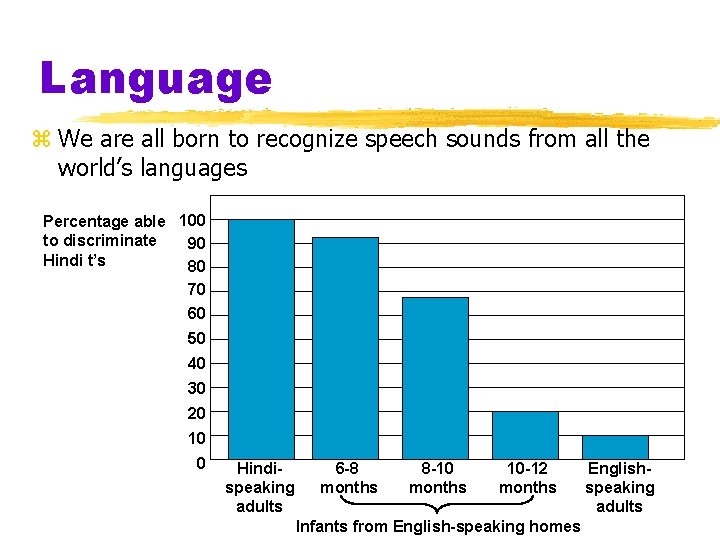
Language z We are all born to recognize speech sounds from all the world’s languages Percentage able 100 to discriminate 90 Hindi t’s 80 70 60 50 40 30 20 10 0 Hindispeaking adults 6 -8 months 8 -10 months 10 -12 months Infants from English-speaking homes Englishspeaking adults
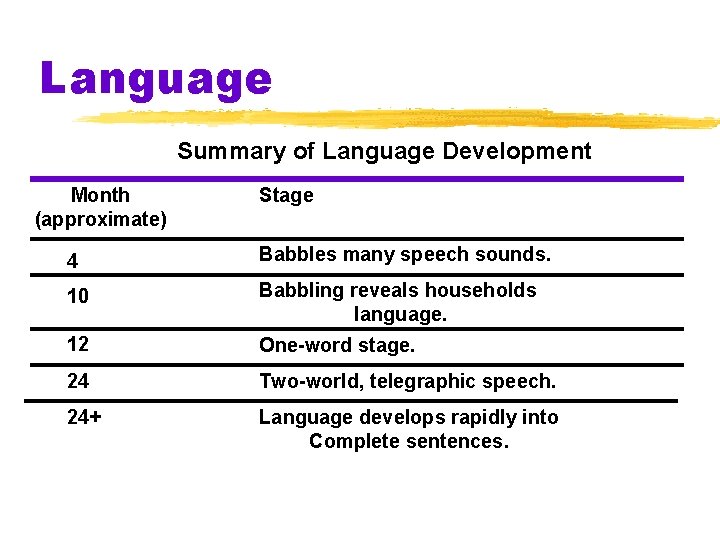
Language z. Babbling Stage ybeginning at 3 to 4 months ythe stage of speech development in which the infant spontaneously utters various sounds at first unrelated to the household language z. One-Word Stage yfrom about age 1 to 2 ythe stage in speech development during which a child speaks mostly in single words
Language z. Two-Word Stage ybeginning about age 2 ythe stage in speech development during which a child speaks mostly two-word statements z. Telegraphic Speech yearly speech stage in which the child speaks like a telegram – “go car” – using mostly nouns and verbs and omitting “auxiliary” words
Language Summary of Language Development Month (approximate) Stage 4 Babbles many speech sounds. 10 Babbling reveals households language. 12 One-word stage. 24 Two-world, telegraphic speech. 24+ Language develops rapidly into Complete sentences.
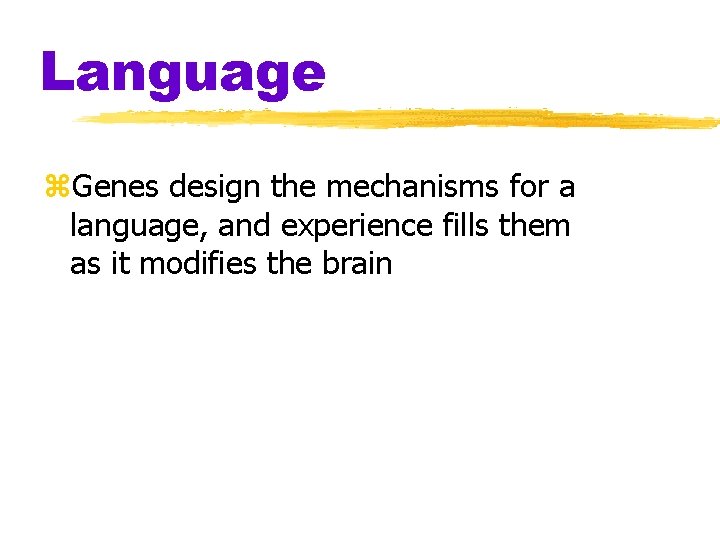
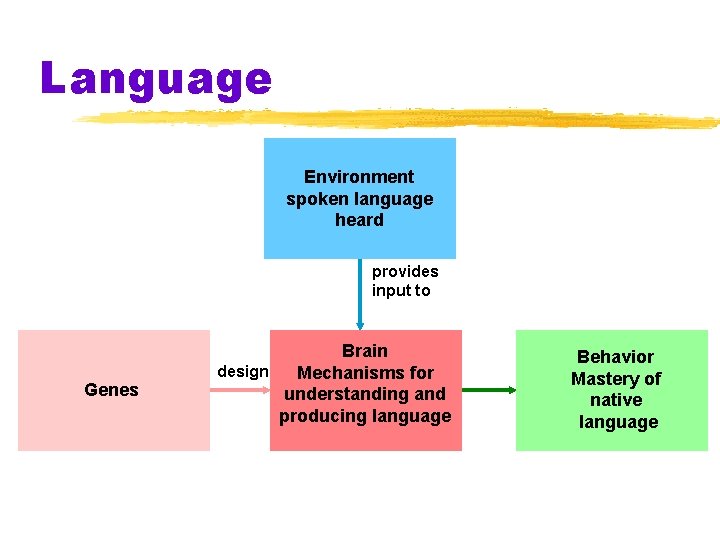
Language z. Genes design the mechanisms for a language, and experience fills them as it modifies the brain
Language Environment spoken language heard provides input to Genes Brain design Mechanisms for understanding and producing language Behavior Mastery of native language
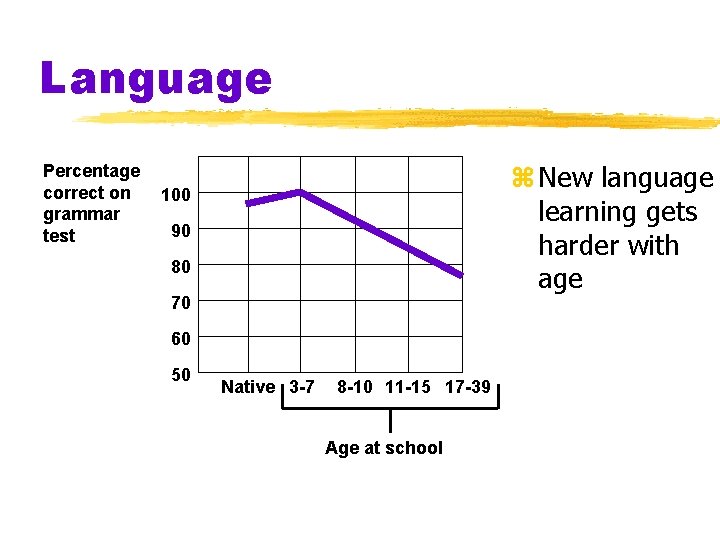
Language Percentage correct on grammar test z New language learning gets harder with age 100 90 80 70 60 50 Native 3 -7 8 -10 11 -15 17 -39 Age at school
Language z. Linguistic Relativity y. Whorf”s hypothesis that language determines the way we think
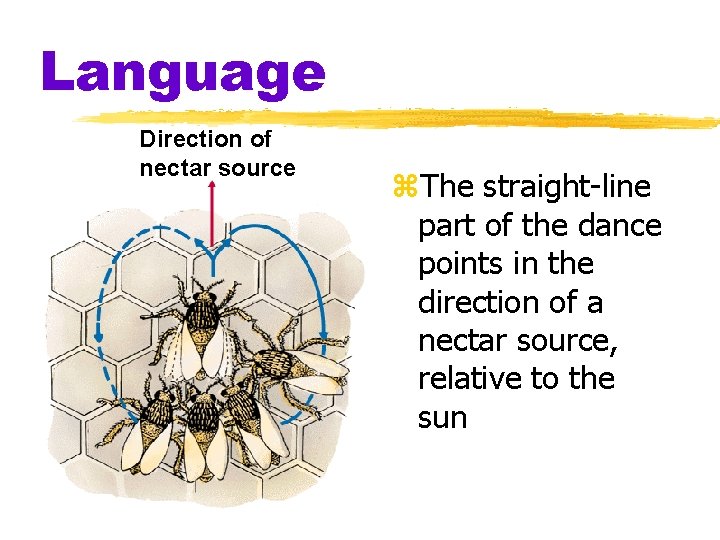
Language Direction of nectar source z. The straight-line part of the dance points in the direction of a nectar source, relative to the sun