
AP PSYCHOLOGY Chapter 11 Intelligence Testing and Individual
- Slides: 49
AP PSYCHOLOGY Chapter 11 Intelligence, Testing, and Individual Differences
Do Now: • Make two lists • List 1 = Behaviors characteristic of intelligent people • List 2 = Behaviors characteristic of unintelligent people • In research studies, these behaviors typically fall into three categories: • Practical problem-solving skills • Verbal skills • Social competence • Categorize your lists. Do you have any outliers? • Share and discuss
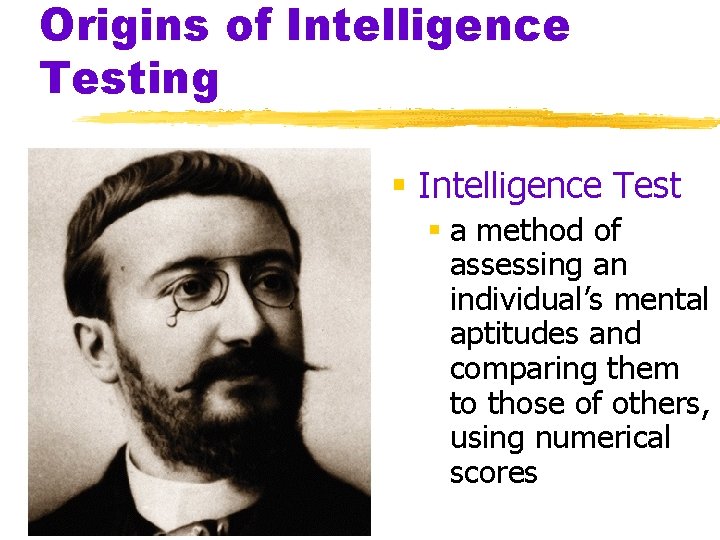
Origins of Intelligence Testing § Intelligence Test § a method of assessing an individual’s mental aptitudes and comparing them to those of others, using numerical scores
Origins of Intelligence Testing § Mental Age § a measure of intelligence test performance devised by Binet § chronological age that most typically corresponds to a given level of performance § child who does as well as the average 8 -year-old is said to have a mental age of 8
Origins of Intelligence Testing § Stanford-Binet § the widely used American revision of Binet’s original intelligence test § revised by Terman at Stanford University
Origins of Intelligence Testing § Intelligence Quotient (IQ) § defined originally the ratio of mental age (ma) to chronological age (ca) multiplied by 100 § IQ = ma/ca x 100) § on contemporary tests, the average performance for a given age is assigned a score of 100
What is Intelligence? § Intelligence § ability to learn from experience, solve problems, and use knowledge to adapt to new situations
What is Intelligence? § Factor Analysis § statistical procedure that identifies clusters of related items (called factors) on a test § used to identify different dimensions of performance that underlie one’s total score § General Intelligence (g) § factor that Spearman and others believed underlies specific mental abilities § measured by every task on an intelligence test
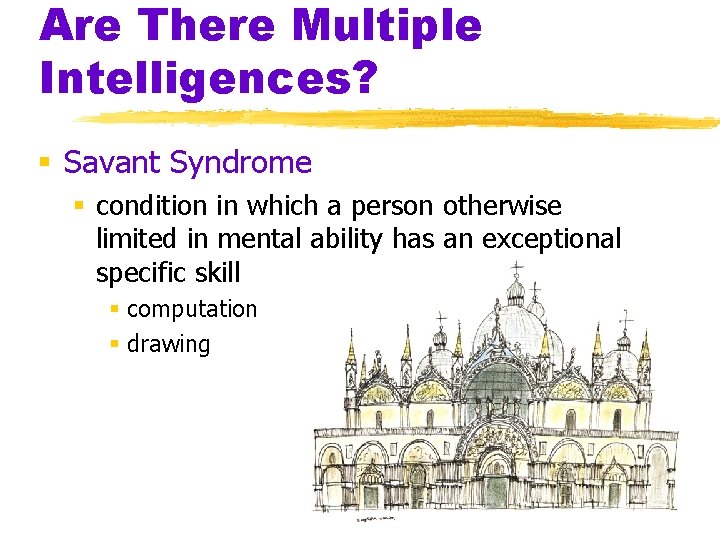
Are There Multiple Intelligences? § Savant Syndrome § condition in which a person otherwise limited in mental ability has an exceptional specific skill § computation § drawing
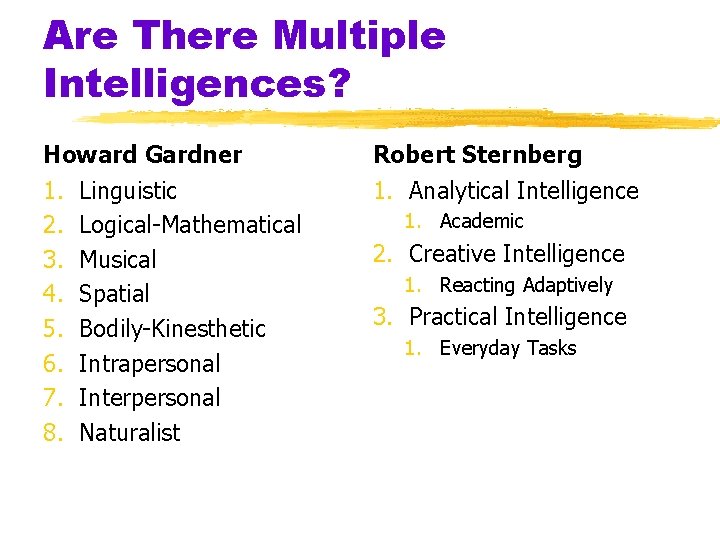
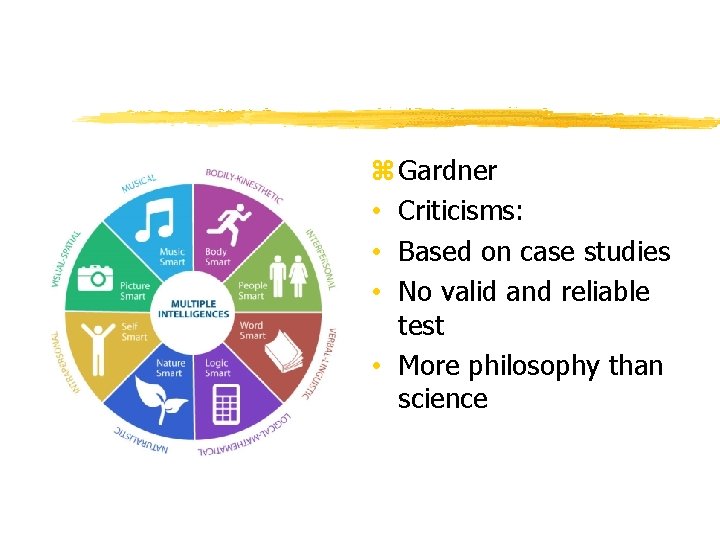
Are There Multiple Intelligences? Howard Gardner Robert Sternberg 1. 2. 3. 4. 5. 6. 7. 8. 1. Analytical Intelligence Linguistic Logical-Mathematical Musical Spatial Bodily-Kinesthetic Intrapersonal Interpersonal Naturalist 1. Academic 2. Creative Intelligence 1. Reacting Adaptively 3. Practical Intelligence 1. Everyday Tasks
z Gardner • Criticisms: • Based on case studies • No valid and reliable test • More philosophy than science
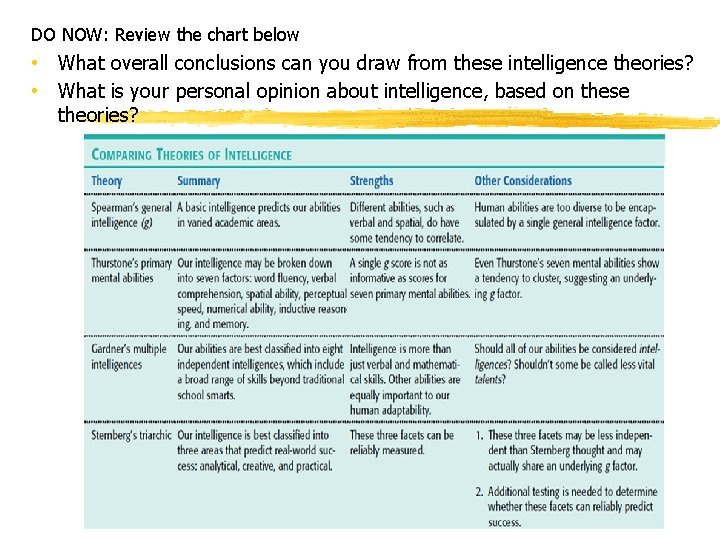
DO NOW: Review the chart below • What overall conclusions can you draw from these intelligence theories? • What is your personal opinion about intelligence, based on these theories?
Are There Multiple Intelligences? § Social Intelligence § the know-how involved in comprehending social situations and managing oneself successfully § Emotional Intelligence § ability to perceive, express, understand, and regulate emotions
Emotional Intelligence z “The best mechanic in a factory may fail as a foreman for lack of social intelligence. ” – Edward Thorndike. z Rationally smart people sometimes have difficulty processing and managing social information z Mayer, Salovey & Caruso – Emotional intelligence test that measures ability to: y Perceive emotions y Understand emotions y Manage emotions y Use emotions
Benefits of High Emotional Intelligence: z Higher quality interactions with friends z Less experience of overwhelming depression, anxiety and anger z Better ability to read others’ emotions z Modestly better job performance z Better at delaying gratification z More successful in marriage, career and parenting z But is emotional intelligence really “intelligence? ”
Intelligence and Creativity § the ability to produce novel and valuable ideas § expertise § imaginative thinking skills § venturesome personality § intrinsic motivation § creative environment
Brain function z. The frontal lobe seems to be the “global workspace for organizing and coordinating information. ” –John Duncan (2000) z. Verbal intelligence are related to retrieval speed z. Perceptual Speed z. Neurological speed
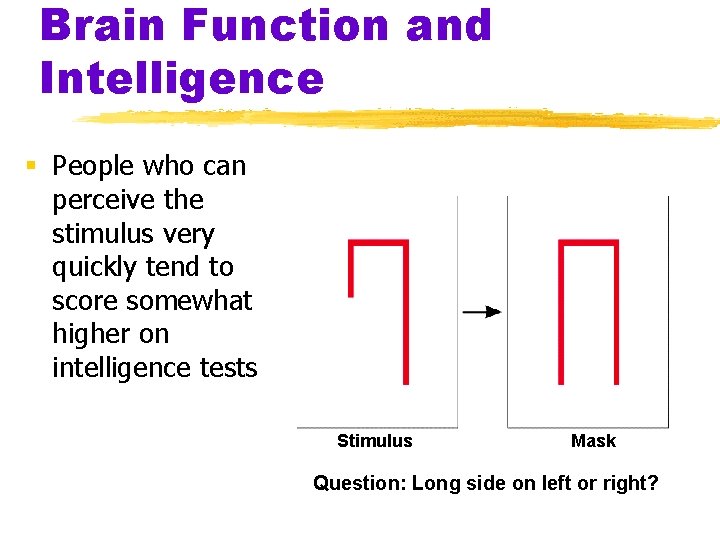
Brain Function and Intelligence § People who can perceive the stimulus very quickly tend to score somewhat higher on intelligence tests Stimulus Mask Question: Long side on left or right?
Activity
ACT and SAT Do Now: z. Studies show that standardized aptitude tests like the SAT and ACT are not as good as predicting future college success than GPA and class rank. z. Do you agree? Why or why not? z. What do you think colleges should use for entrance requirements? Why?
Assessing Intelligence § Aptitude Test § a test designed to predict a person’s future performance § aptitude is the capacity to learn § Achievement Test § a test designed to assess what a person has learned
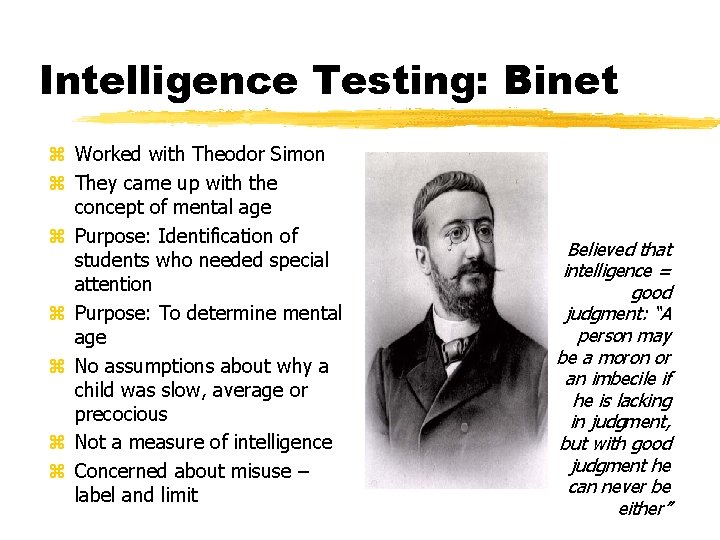
Intelligence Testing: Binet z Worked with Theodor Simon z They came up with the concept of mental age z Purpose: Identification of students who needed special attention z Purpose: To determine mental age z No assumptions about why a child was slow, average or precocious z Not a measure of intelligence z Concerned about misuse – label and limit Believed that intelligence = good judgment: “A person may be a moron or an imbecile if he is lacking in judgment, but with good judgment he can never be either”
Adaptations z Lewis Terman: concept of z Terman’s Termites – a superior adults. Adapted group of gifted children test for America to counter the idea of z Stanford-Binet maladjustment in adulthood z William Stern came up with the formula z New versions of SAT that is better at predicting z Intelligence Quotient (IQ) college success (now GPA z Had an influence on and class rank are better) immigration laws -- Sternberg z Concerns about cultural biases
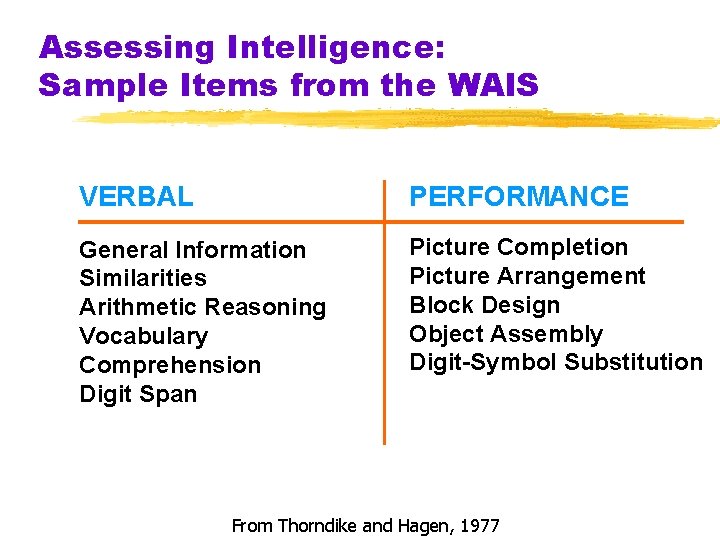
Assessing Intelligence § Wechsler Adult Intelligence Scale (WAIS) § most widely used intelligence test § subtests § verbal § performance (nonverbal)
Assessing Intelligence: Sample Items from the WAIS VERBAL PERFORMANCE General Information Similarities Arithmetic Reasoning Vocabulary Comprehension Digit Span Picture Completion Picture Arrangement Block Design Object Assembly Digit-Symbol Substitution From Thorndike and Hagen, 1977
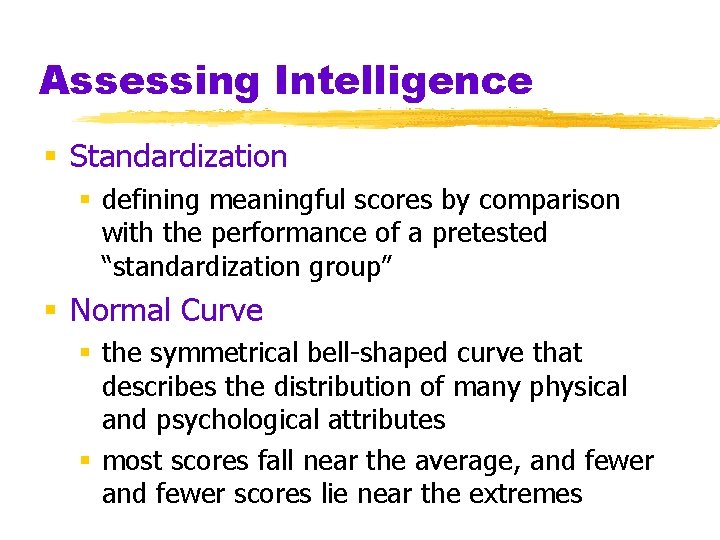
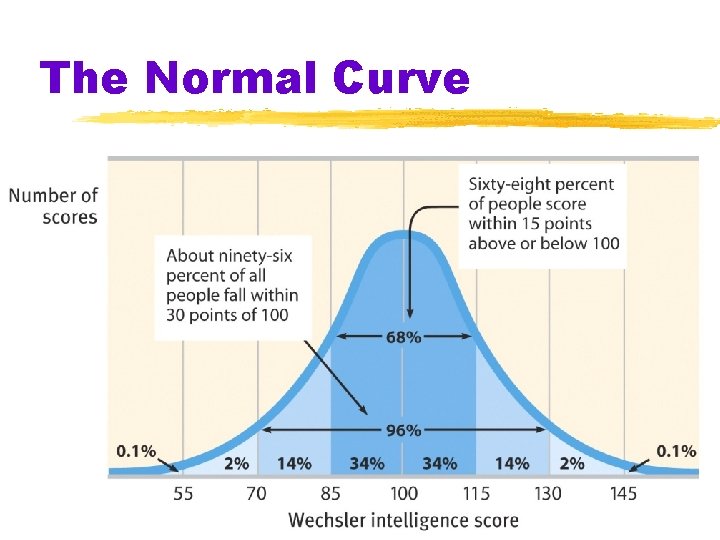
Assessing Intelligence § Standardization § defining meaningful scores by comparison with the performance of a pretested “standardization group” § Normal Curve § the symmetrical bell-shaped curve that describes the distribution of many physical and psychological attributes § most scores fall near the average, and fewer scores lie near the extremes
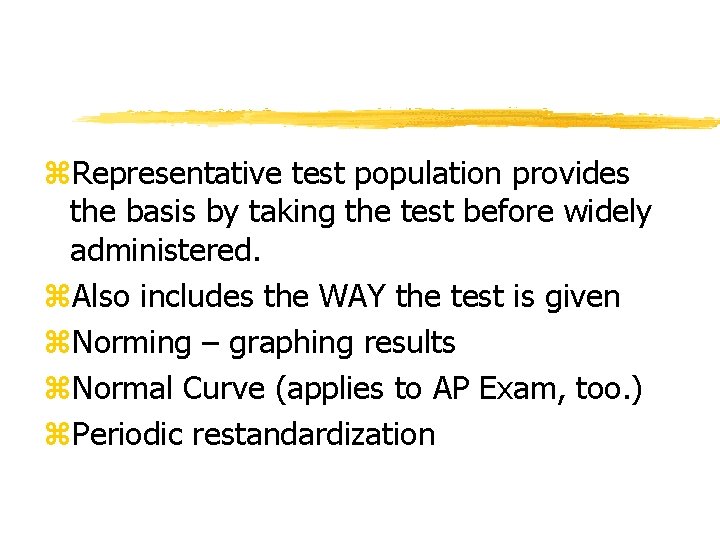
z. Representative test population provides the basis by taking the test before widely administered. z. Also includes the WAY the test is given z. Norming – graphing results z. Normal Curve (applies to AP Exam, too. ) z. Periodic restandardization
The Normal Curve
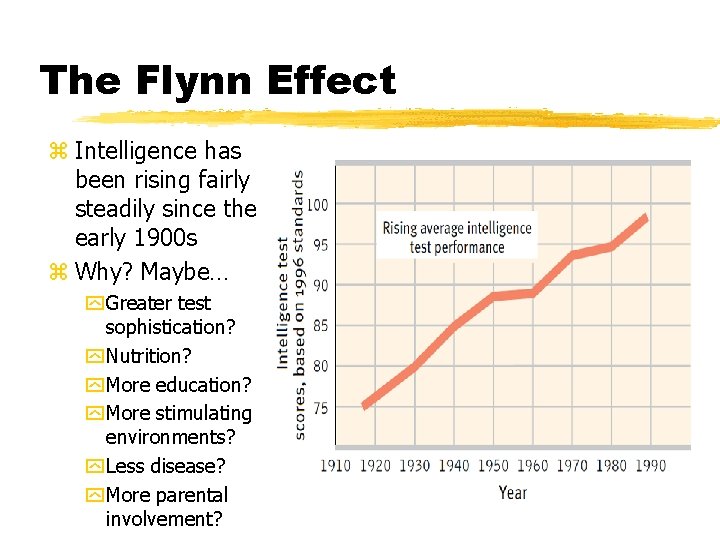
The Flynn Effect z Intelligence has been rising fairly steadily since the early 1900 s z Why? Maybe… y Greater test sophistication? y Nutrition? y More education? y More stimulating environments? y Less disease? y More parental involvement?
Assessing Intelligence § Reliability § the extent to which a test yields consistent results § assessed by consistency of scores on: § two halves of the test § alternate forms of the test § retesting § Validity § the extent to which a test measures or predicts what it is supposed to
Assessing Intelligence § Content Validity § the extent to which a test samples the behavior that is of interest § driving test that samples driving tasks § Criterion § behavior (such as college grades) that a test (such as the SAT) is designed to predict § the measure used in defining whether the test has predictive validity
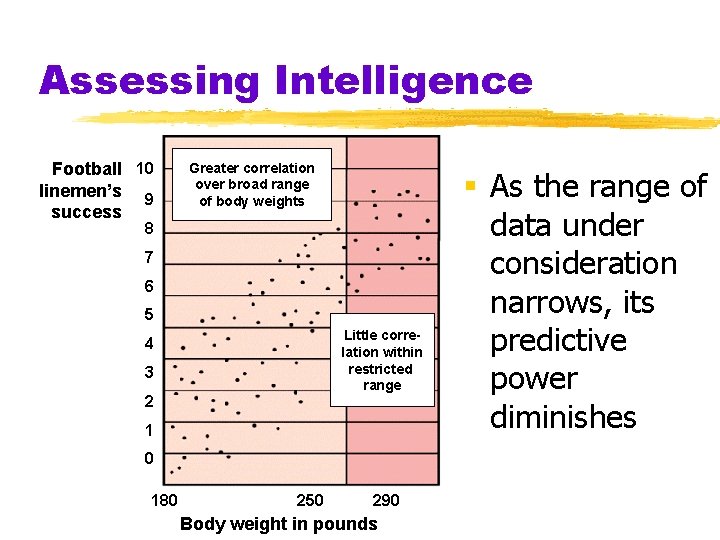
Assessing Intelligence § Predictive Validity § success with which a test predicts the behavior it is designed to predict § assessed by computing the correlation between test scores and the criterion behavior § also called criterion-related validity
Assessing Intelligence Football 10 linemen’s 9 success Greater correlation over broad range of body weights 8 7 6 5 Little correlation within restricted range 4 3 2 1 0 180 250 290 Body weight in pounds § As the range of data under consideration narrows, its predictive power diminishes
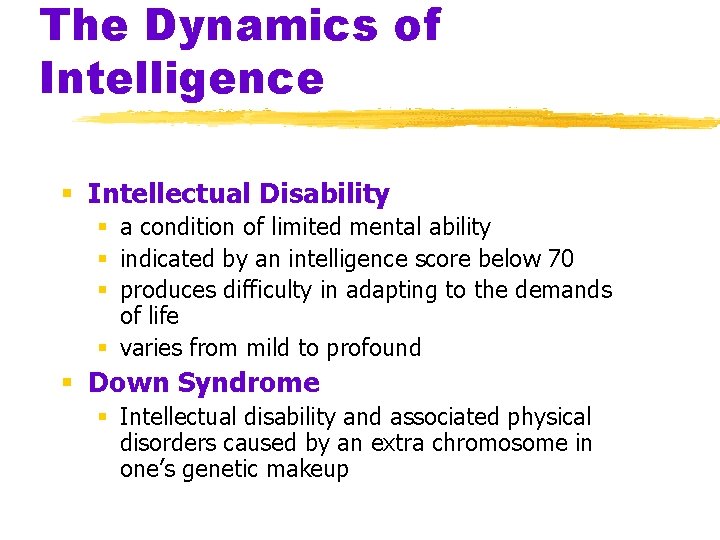
The Dynamics of Intelligence § Intellectual Disability § a condition of limited mental ability § indicated by an intelligence score below 70 § produces difficulty in adapting to the demands of life § varies from mild to profound § Down Syndrome § Intellectual disability and associated physical disorders caused by an extra chromosome in one’s genetic makeup
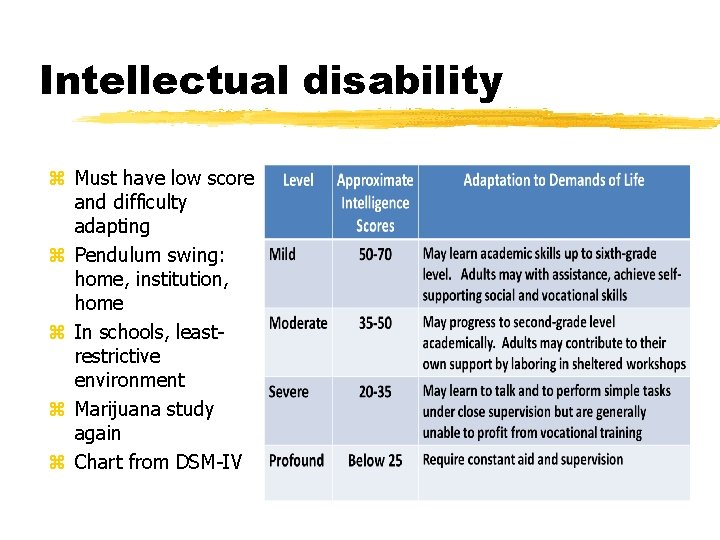
Intellectual disability z Must have low score and difficulty adapting z Pendulum swing: home, institution, home z In schools, leastrestrictive environment z Marijuana study again z Chart from DSM-IV
Intellectual Giftedness z Myth: Kids with high IQs are socially maladjusted z Controversy over tracking students z Is it better to separate students into ability groups or to have mainstreamed classes? Why? z How can intelligence tests hold students back or help them succeed?
Activity
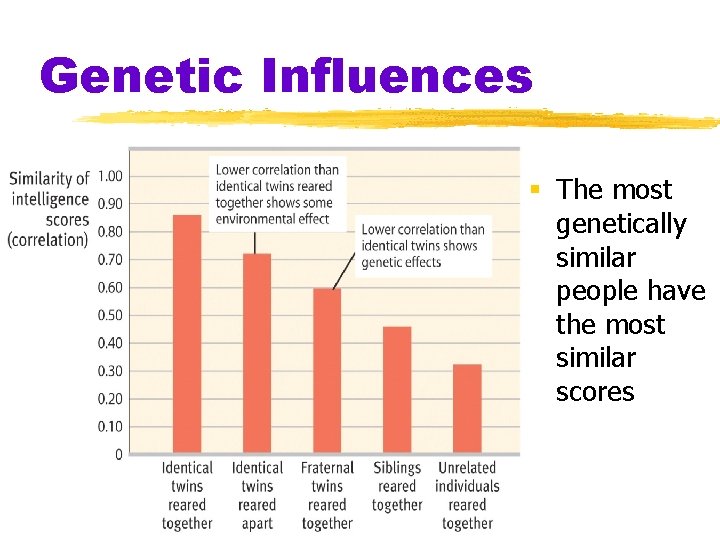
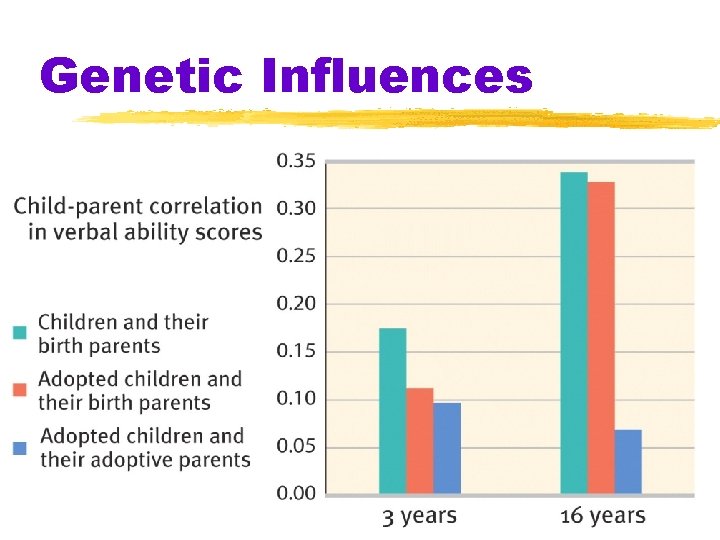
Genetic Influences § The most genetically similar people have the most similar scores
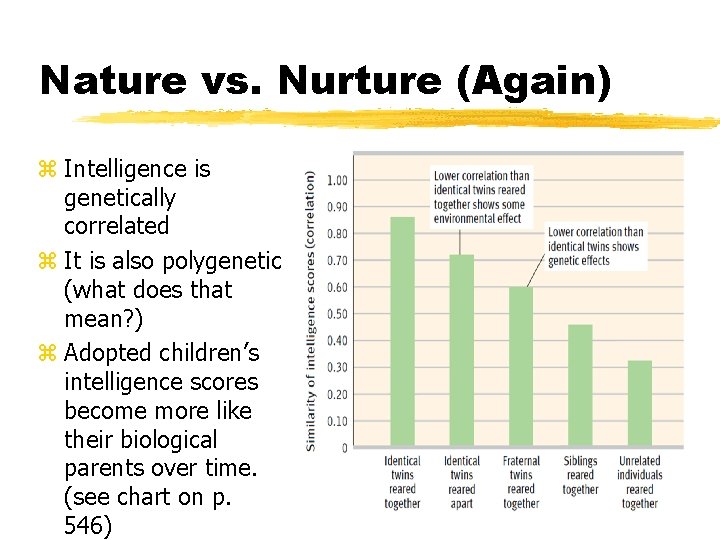
Nature vs. Nurture (Again) z Intelligence is genetically correlated z It is also polygenetic (what does that mean? ) z Adopted children’s intelligence scores become more like their biological parents over time. (see chart on p. 546)
Genetic Influences § Heritability § the proportion of variation among individuals that we can attribute to genes § variability depends on range of populations and environments studied
Genetic Influences
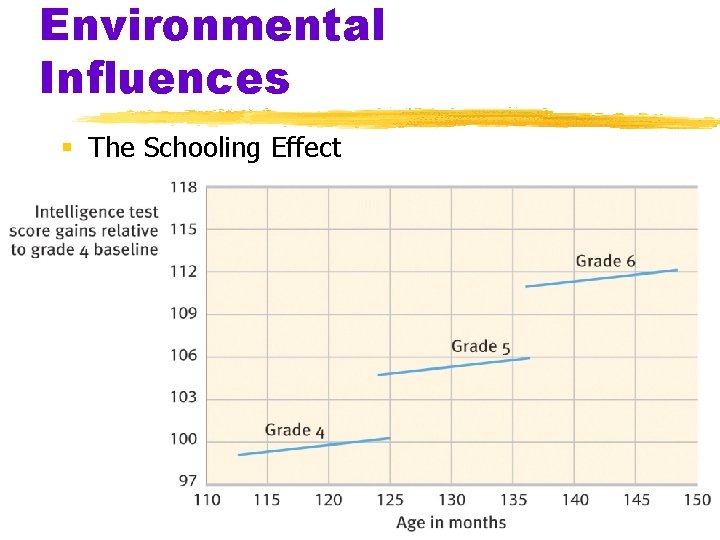
Environmental Influences § The Schooling Effect
Environmental influences z z z z Carefully review the description of heritability on p. 546. Heritability is responsible for about 50 percent of intelligence factors Remember heritability only applies to groups, not to individuals Impoverished environments depress normal intellectual development Enriched environments encourage it, but don’t turn babies into geniuses Schooling and intellect interact and are correlated with later higher income Intelligence is not completely fixed. Discipline, effort and practice exercise your mental “muscles. ” Dweck: it pays to have a “growth mindset” as opposed to a “fixed mindset”
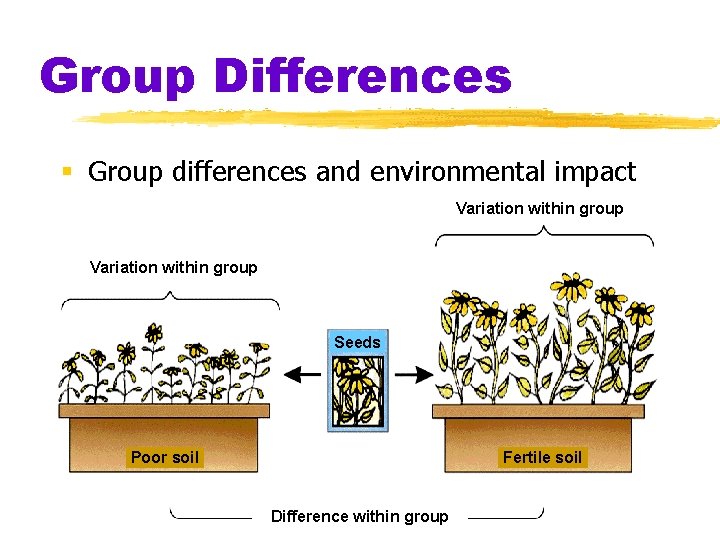
Group Differences § Group differences and environmental impact Variation within group Seeds Poor soil Fertile soil Difference within group
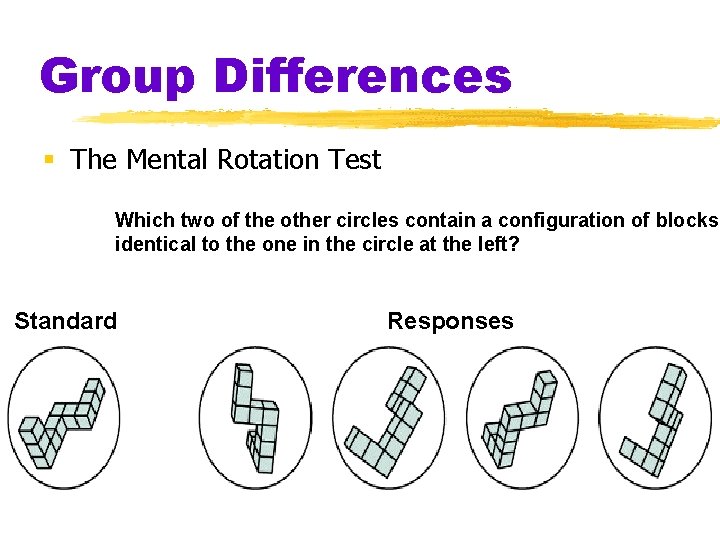
Group Differences § The Mental Rotation Test Which two of the other circles contain a configuration of blocks identical to the one in the circle at the left? Standard Responses
Gender differences: Scores are VERY similar, but differences do exist Females y Better spellers y Better in verbal fluency and remembering words y Better in nonverbal memory y More sensitive to touch, taste and odor y Better emotion detectors y Better at math computation Males z Better at math problem solving z Better in spatial ability tests z Greater variation in mental ability scores z Higher numbers in both extremes
Ethnic Differences z. Average score differences occur between: z. Blacks, Whites and Hispanics z. New Zealanders of European descent and native Maoris z. Hearing and Deaf people z. Israeli Jews and Israeli Arabs z. CRITICAL: Average scores say nothing about individual scores
Bias z Two main types y. When a test detects not only innate differences in intelligence, but also performance differences caused by cultural experiences y. When a test predicts behavior for one group, but not others y. Defenders say the tests are not biased because they show that differences are as great on nonverbal items as on verbal, and because they predict behavior in the same way for all tested z Stereotype threat – a self-confirming concern that one will be evaluated based on a negative stereotype
Activity