
AP PSYCH DMA 1 According to B F
AP PSYCH DMA 1. According to B. F. Skinner, human behavior is controlled primarily by…. 2. Define spontaneous recovery. Please write the question & answer it Please turn in your test corrections (from yesterday)
TODAY’S AGENDA • DMA • Turn in test corrections • Progress towards AP Exam • Behavior modification experiment • Chap. 8 Homework: • Chap. 8 notes due Thursday, Oct. 27 th • Chap. 8 test – Thursday, Oct. 27 th • FRQs # 1 & 2 due Friday, Oct. 21 st • FRQ #3 due Monday, Oct. 24 th
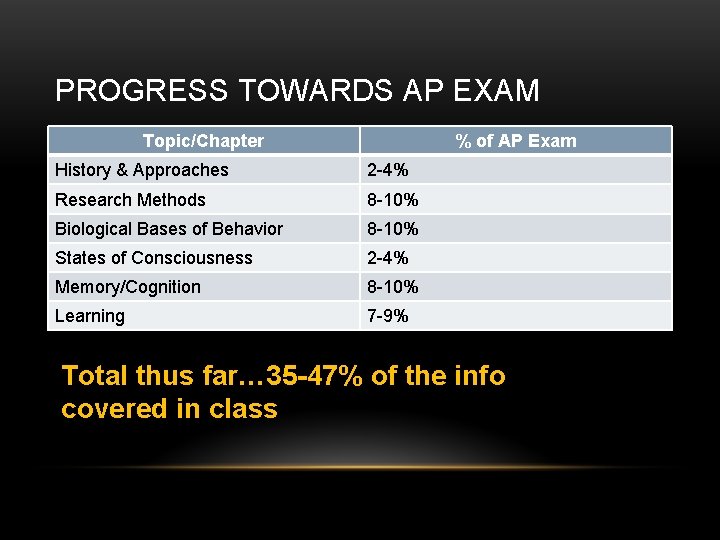
PROGRESS TOWARDS AP EXAM Topic/Chapter % of AP Exam History & Approaches 2 -4% Research Methods 8 -10% Biological Bases of Behavior 8 -10% States of Consciousness 2 -4% Memory/Cognition 8 -10% Learning 7 -9% Total thus far… 35 -47% of the info covered in class
BEHAVIOR MODIFICATION EXPERIMENT

IVAN PETROVICH PAVLOV Classical Conditioning
EVERYONE NEEDS ONE OF THE CUPS • Every time Wheeler says “Pavlov” you must – • Lick your finger • Stick it in the powder • Lick the powder off your finger (yummy)
PAVLOV WAS NOT A PSYCHOLOGIST • Nope – he was a prominent physiologist studying digestive processes. • He was awarded the Nobel Prize for science for his research on digestion. Side note – in the 1800 s Psych was not considered a “real” science so it was a great risk Pavlov took when he chose to pursue the experiment we are about to discuss.
PAVLOV WAS WORKING WITH DOG SPIT • Specifically he was looking at the role of salivation on digestion. • He measured the amount of saliva produced in reaction to certain substances • one type of food vs. another; food vs. nonfood, etc. • To gather the saliva scientifically, the dogs underwent a minor surgical procedure.
REFLEX • The production of saliva under these varying conditions was regarded by Pavlov as reflex • a response that occurs automatically.
BUT JUST HOW SMART IS THIS REFLEX? • Pavlov noticed that the reflex happened without the food even being present… • heck without it even being around for the dog to smell. • The dogs would salivate just looking at their bowl, • the person who usually brought the food in • or at the sound of that person’s footsteps.
SO PAVLOV BUILT HIMSELF A BIG, BEAUTIFUL, SOUNDPROOF LABORATORY • Trying to figure out what signal stimulation was causing the salivation • he figured out that there must be two kinds of reflexes.
UNCONDITIONED REFLEXES • are inborn and automatic • require no learning • are generally the same for all members of a species. Food = salivate Loud noise = jump Light = pupils dilate
CONDITIONED REFLEXES • Are acquired through experience or learning • May vary a great deal among individual members of a species Footsteps = salivation Smell of dental disinfectant = pain in teeth
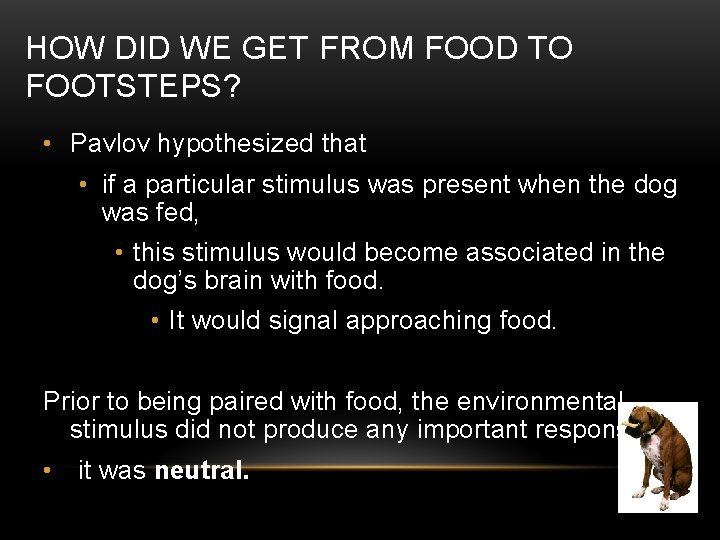
HOW DID WE GET FROM FOOD TO FOOTSTEPS? • Pavlov hypothesized that • if a particular stimulus was present when the dog was fed, • this stimulus would become associated in the dog’s brain with food. • It would signal approaching food. Prior to being paired with food, the environmental stimulus did not produce any important response. • it was neutral.
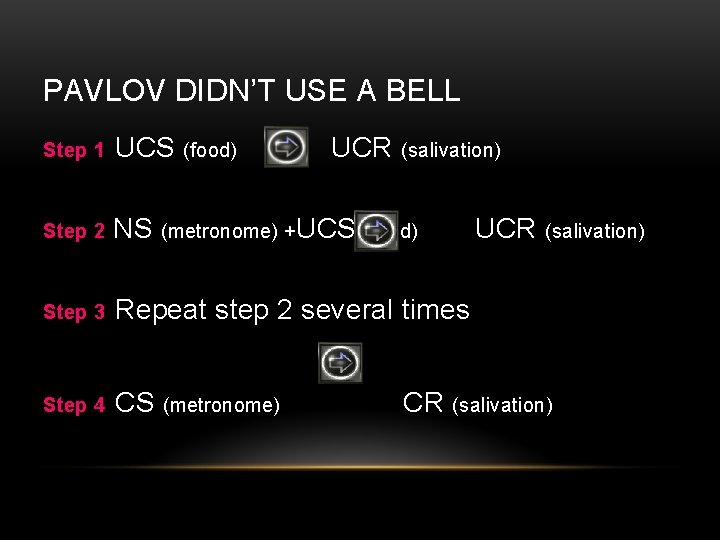
PAVLOV DIDN’T USE A BELL Step 1 UCS Step 2 NS Step 3 Repeat step 2 several times Step 4 CS (food) UCR (salivation) (metronome) +UCS (food) (metronome) UCR (salivation)
PAVLOV ALSO USED VISUAL AND OLFACTORY NS • He paired the smell of vanilla (NS) with lemon juice (UCS) to produce salivation (UCR). • After several exposures the Vanilla (CS) caused the dogs to salivate (CR). • He also paired a rotating object (NS) with food (UCS). • Again, after several exposures the rotating object (CS) produced salivation (CR).
WHY THE HECK DO WE CARE? Think about how we explain the following: • Phobias • Why you dislike certain foods • How advertising works • What arouses you sexually • The source of your emotions • Why you feel anxiety before a test
EXTINCTION… • When the pairing of NS and UCS no longer happens • eventually the CR goes away.
CLASSICAL CONDITIONING On a piece of paper… • Design an experiment you could conduct that tests classical conditioning. • Your subjects are 10 freshmen • You must identify your UCS, UCR, NS, CS and CR • Explain why you must repeat your experiment multiple times. • Please turn in your paper (in-box)
- Slides: 19