
AP Physics Unit 10 Part 1 Mechanical Waves





- Slides: 37
AP Physics Unit 10, Part 1 Mechanical Waves and Sound
Textbook Chapter 13: Vibrations and Waves 13. 3 Wave Motion 13. 4 Wave Properties 13. 5 Standing Waves Homework for Unit 10, Part 1 AP Classroom, Unit 10 Progress Check FRQ Part A: All except 12 & 13.
13. 3: Wave Motion
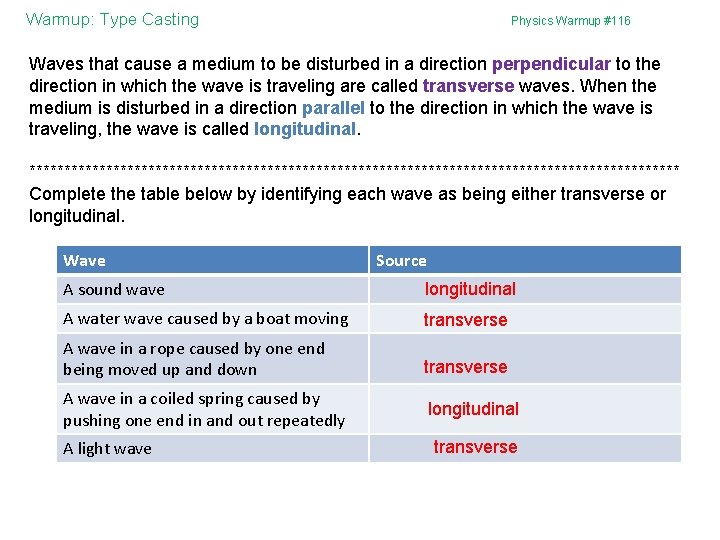
Warmup: Type Casting Physics Warmup #116 Waves that cause a medium to be disturbed in a direction perpendicular to the direction in which the wave is traveling are called transverse waves. When the medium is disturbed in a direction parallel to the direction in which the wave is traveling, the wave is called longitudinal. *********************************************** Complete the table below by identifying each wave as being either transverse or longitudinal. Wave Source A sound wave longitudinal A water wave caused by a boat moving transverse A wave in a rope caused by one end being moved up and down transverse A wave in a coiled spring caused by pushing one end in and out repeatedly longitudinal A light wave transverse
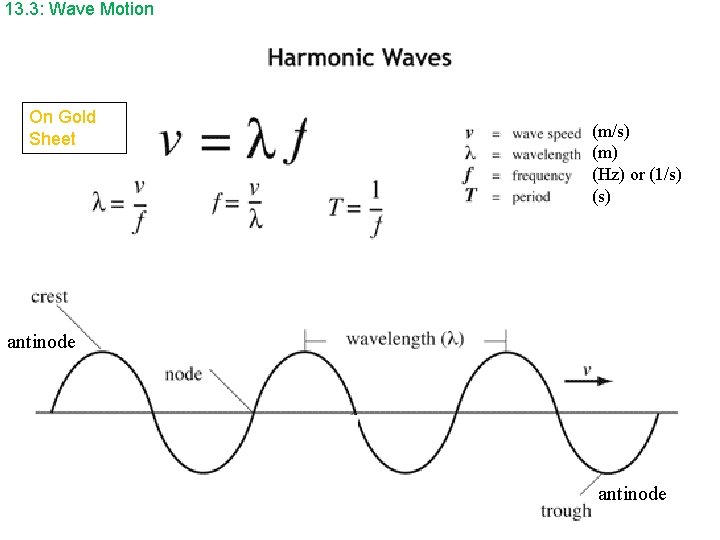
13. 3: Wave Motion On Gold Sheet (m/s) (m) (Hz) or (1/s) (s) antinode
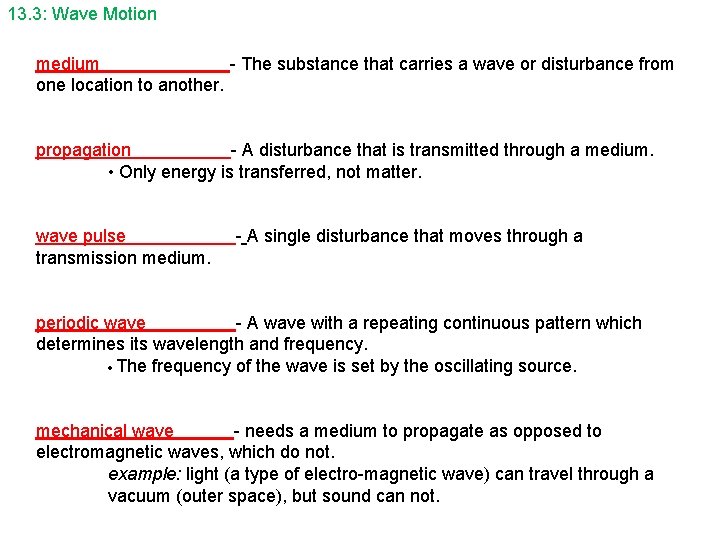
13. 3: Wave Motion medium - The substance that carries a wave or disturbance from one location to another. propagation - A disturbance that is transmitted through a medium. • Only energy is transferred, not matter. wave pulse transmission medium. - A single disturbance that moves through a periodic wave - A wave with a repeating continuous pattern which determines its wavelength and frequency. The frequency of the wave is set by the oscillating source. mechanical wave - needs a medium to propagate as opposed to electromagnetic waves, which do not. example: light (a type of electro-magnetic wave) can travel through a vacuum (outer space), but sound can not.
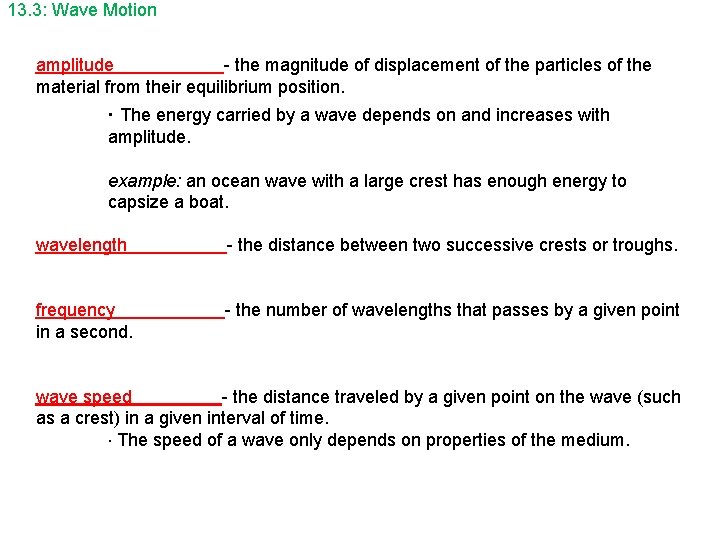
13. 3: Wave Motion amplitude - the magnitude of displacement of the particles of the material from their equilibrium position. The energy carried by a wave depends on and increases with amplitude. example: an ocean wave with a large crest has enough energy to capsize a boat. wavelength - the distance between two successive crests or troughs. frequency in a second. - the number of wavelengths that passes by a given point wave speed - the distance traveled by a given point on the wave (such as a crest) in a given interval of time. The speed of a wave only depends on properties of the medium.
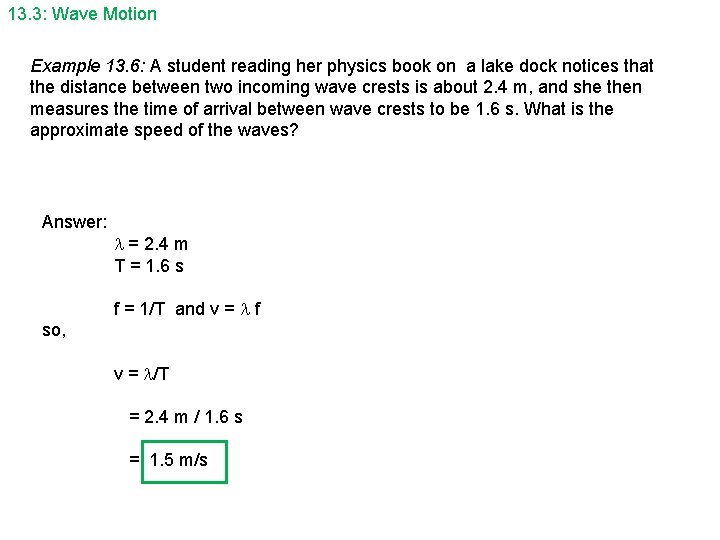
13. 3: Wave Motion Example 13. 6: A student reading her physics book on a lake dock notices that the distance between two incoming wave crests is about 2. 4 m, and she then measures the time of arrival between wave crests to be 1. 6 s. What is the approximate speed of the waves? Answer: = 2. 4 m T = 1. 6 s f = 1/T and v = f so, v = /T = 2. 4 m / 1. 6 s = 1. 5 m/s
13. 3: Wave Motion
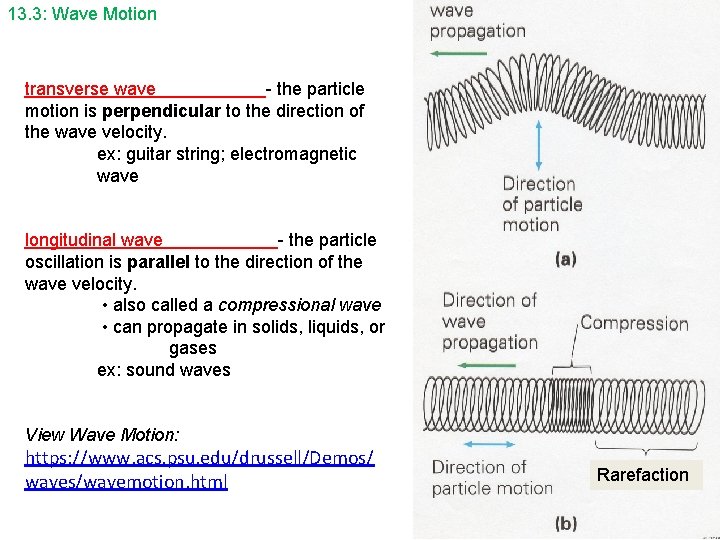
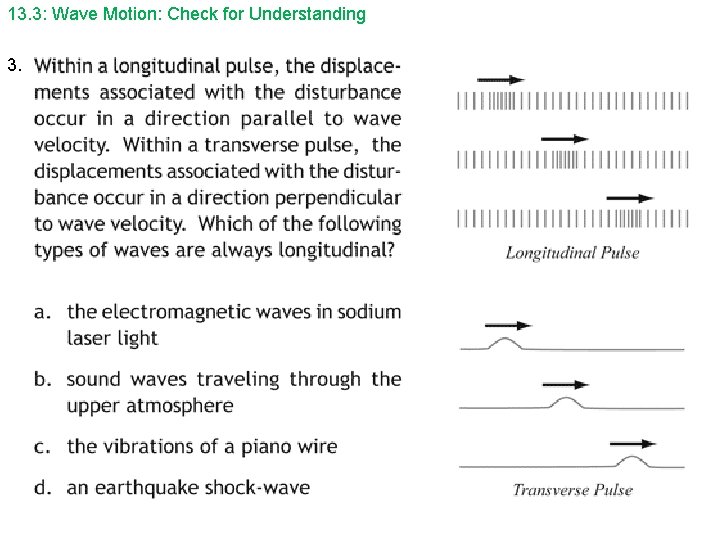
13. 3: Wave Motion transverse wave - the particle motion is perpendicular to the direction of the wave velocity. ex: guitar string; electromagnetic wave longitudinal wave - the particle oscillation is parallel to the direction of the wave velocity. • also called a compressional wave • can propagate in solids, liquids, or gases ex: sound waves View Wave Motion: https: //www. acs. psu. edu/drussell/Demos/ waves/wavemotion. html Rarefaction
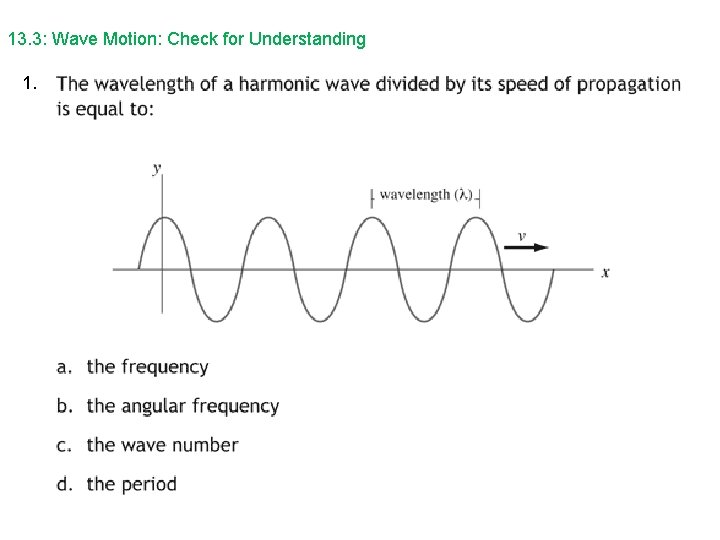
13. 3: Wave Motion: Check for Understanding 1.
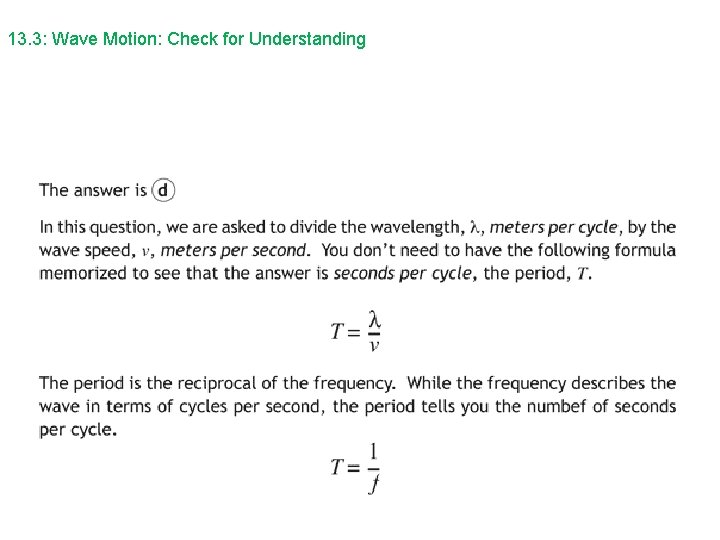
13. 3: Wave Motion: Check for Understanding
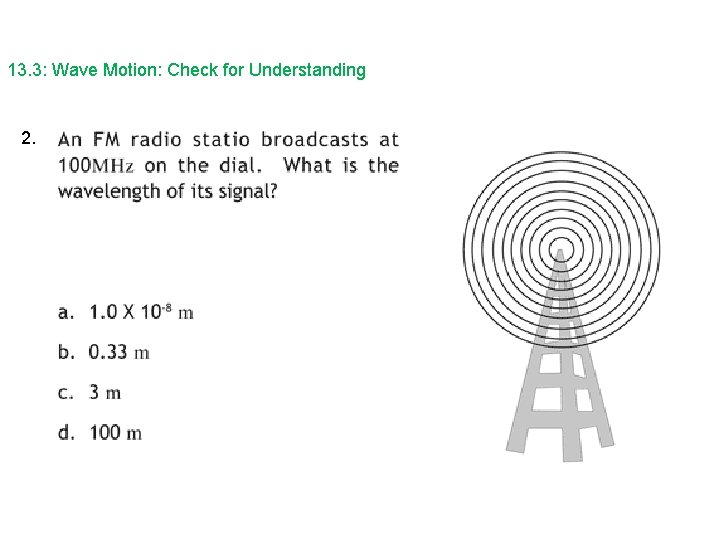
13. 3: Wave Motion: Check for Understanding 2.
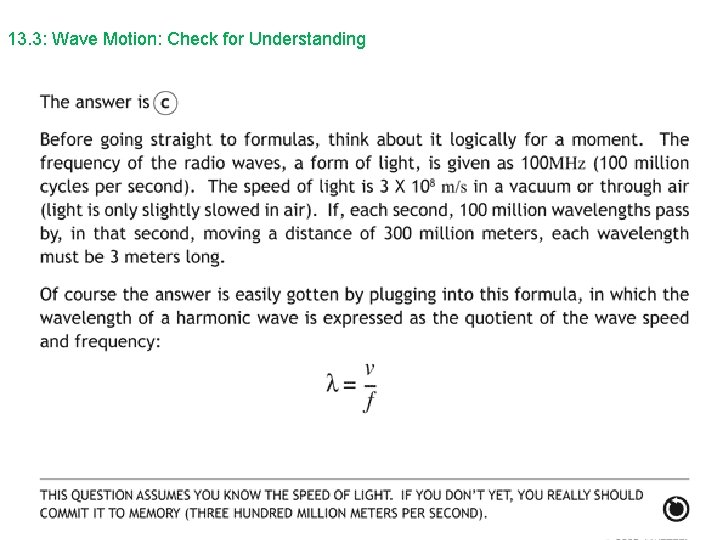
13. 3: Wave Motion: Check for Understanding
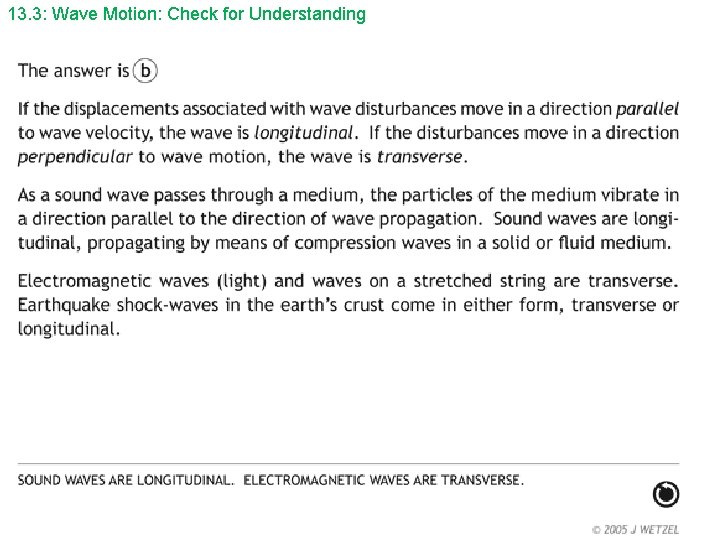
13. 3: Wave Motion: Check for Understanding 3.
13. 3: Wave Motion: Check for Understanding
13. 4: Wave Properties
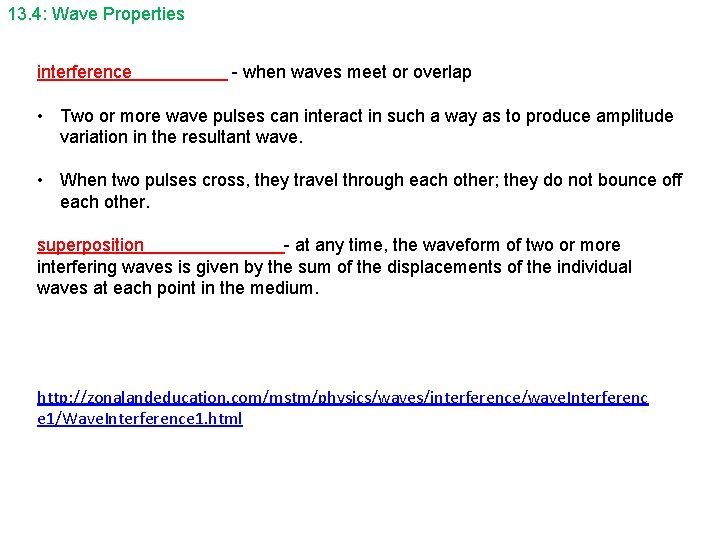
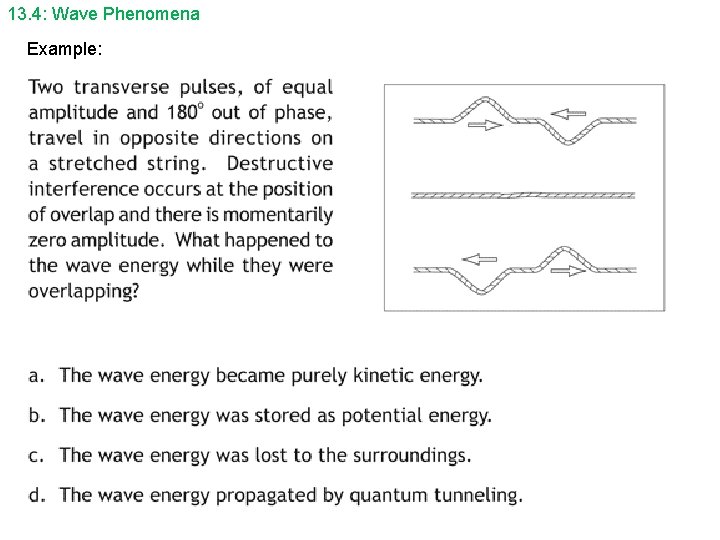
13. 4: Wave Properties interference - when waves meet or overlap • Two or more wave pulses can interact in such a way as to produce amplitude variation in the resultant wave. • When two pulses cross, they travel through each other; they do not bounce off each other. superposition - at any time, the waveform of two or more interfering waves is given by the sum of the displacements of the individual waves at each point in the medium. http: //zonalandeducation. com/mstm/physics/waves/interference/wave. Interferenc e 1/Wave. Interference 1. html
13. 4: Wave Properties
13. 4: Wave Phenomena Example:
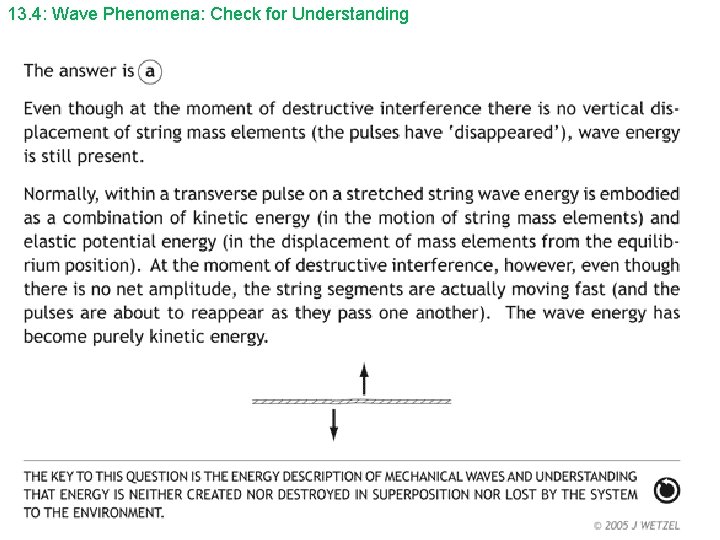
13. 4: Wave Phenomena: Check for Understanding
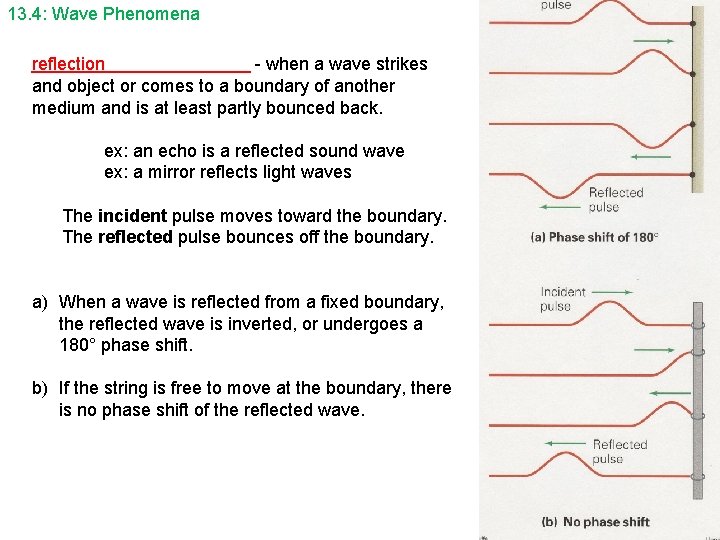
13. 4: Wave Phenomena reflection - when a wave strikes and object or comes to a boundary of another medium and is at least partly bounced back. ex: an echo is a reflected sound wave ex: a mirror reflects light waves The incident pulse moves toward the boundary. The reflected pulse bounces off the boundary. a) When a wave is reflected from a fixed boundary, the reflected wave is inverted, or undergoes a 180° phase shift. b) If the string is free to move at the boundary, there is no phase shift of the reflected wave.
Slinky Trivia Join the Kahoot
13. 5: Standing Waves
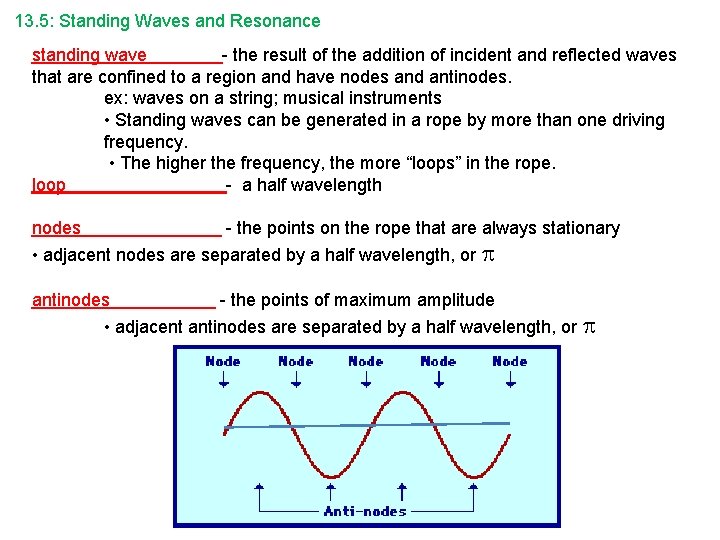
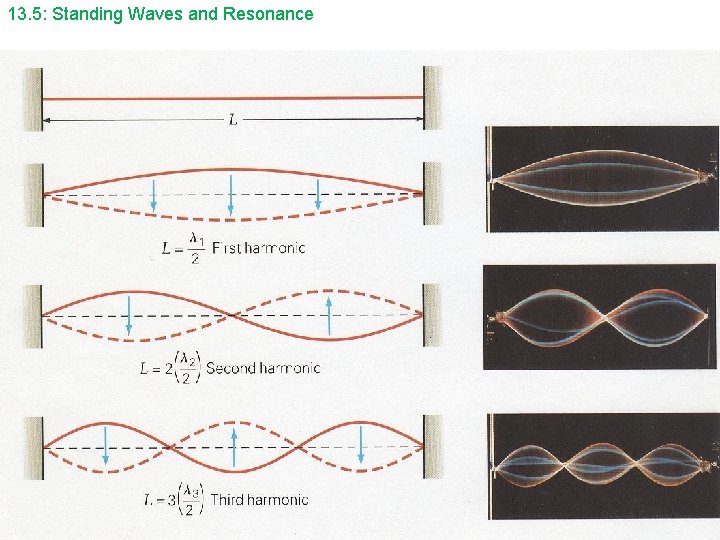
13. 5: Standing Waves and Resonance standing wave - the result of the addition of incident and reflected waves that are confined to a region and have nodes and antinodes. ex: waves on a string; musical instruments • Standing waves can be generated in a rope by more than one driving frequency. • The higher the frequency, the more “loops” in the rope. loop - a half wavelength nodes - the points on the rope that are always stationary • adjacent nodes are separated by a half wavelength, or antinodes - the points of maximum amplitude • adjacent antinodes are separated by a half wavelength, or
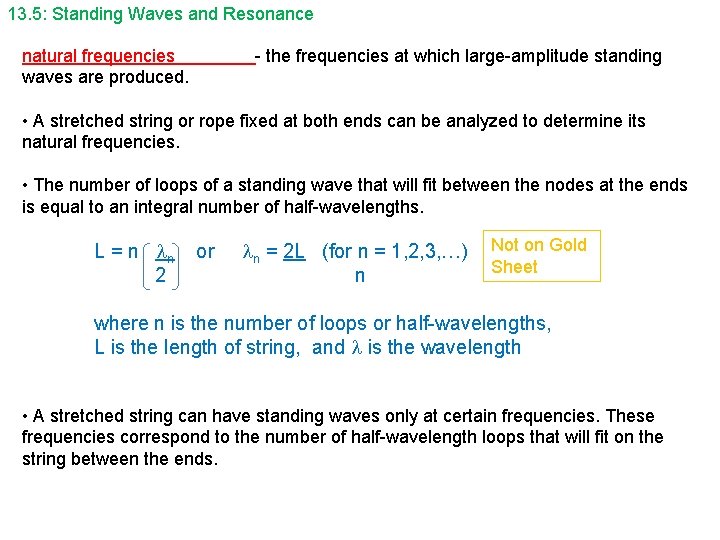
13. 5: Standing Waves and Resonance natural frequencies waves are produced. - the frequencies at which large-amplitude standing • A stretched string or rope fixed at both ends can be analyzed to determine its natural frequencies. • The number of loops of a standing wave that will fit between the nodes at the ends is equal to an integral number of half-wavelengths. L = n n 2 or n = 2 L (for n = 1, 2, 3, …) n Not on Gold Sheet where n is the number of loops or half-wavelengths, L is the length of string, and is the wavelength • A stretched string can have standing waves only at certain frequencies. These frequencies correspond to the number of half-wavelength loops that will fit on the string between the ends.
13. 5: Standing Waves and Resonance
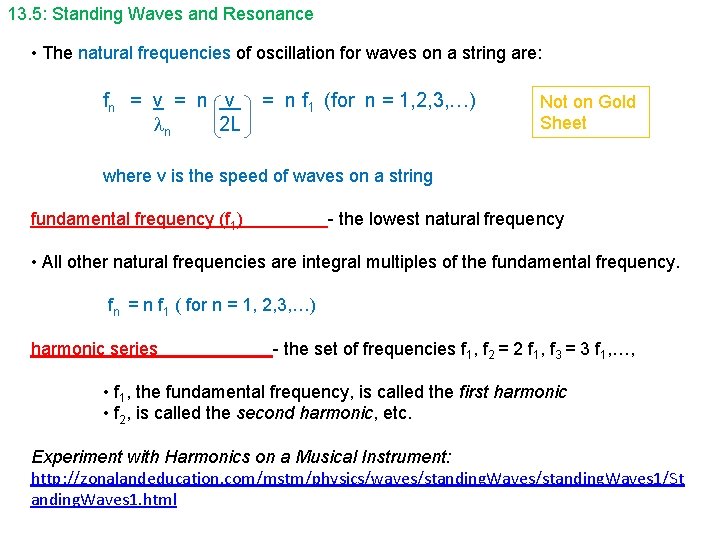
13. 5: Standing Waves and Resonance • The natural frequencies of oscillation for waves on a string are: fn = v = n v n 2 L = n f 1 (for n = 1, 2, 3, …) Not on Gold Sheet where v is the speed of waves on a string fundamental frequency (f 1) - the lowest natural frequency • All other natural frequencies are integral multiples of the fundamental frequency. fn = n f 1 ( for n = 1, 2, 3, …) harmonic series - the set of frequencies f 1, f 2 = 2 f 1, f 3 = 3 f 1, …, • f 1, the fundamental frequency, is called the first harmonic • f 2, is called the second harmonic, etc. Experiment with Harmonics on a Musical Instrument: http: //zonalandeducation. com/mstm/physics/waves/standing. Waves 1/St anding. Waves 1. html
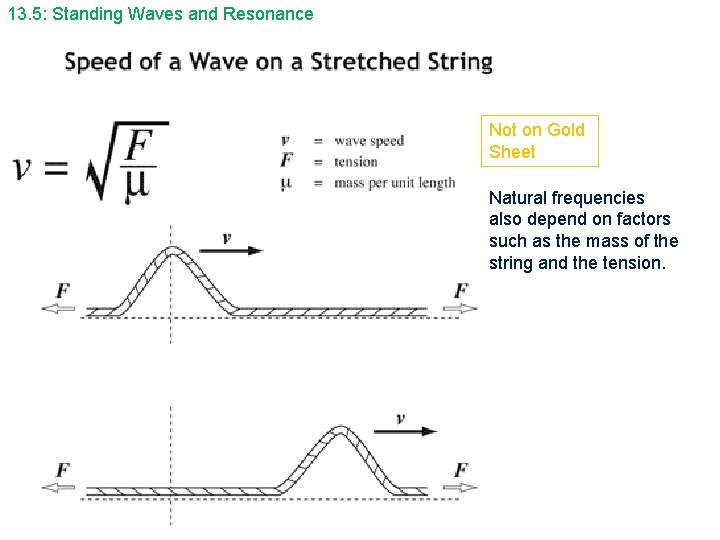
13. 5: Standing Waves and Resonance Not on Gold Sheet Natural frequencies also depend on factors such as the mass of the string and the tension.
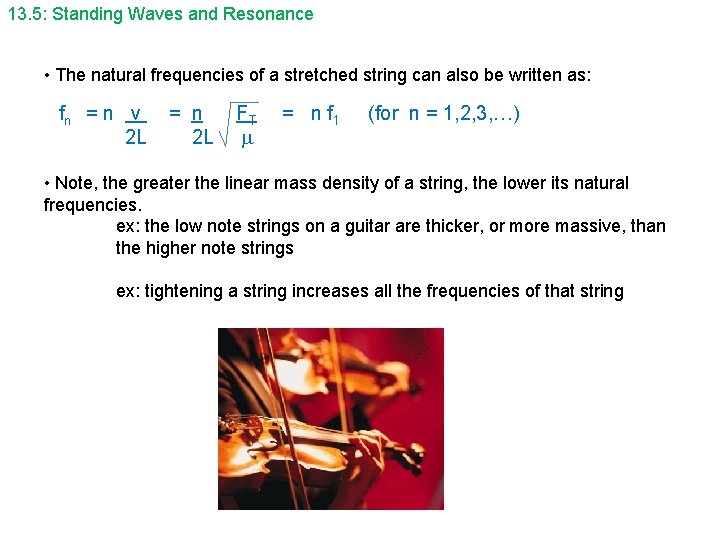
13. 5: Standing Waves and Resonance • The natural frequencies of a stretched string can also be written as: fn = n v 2 L = n 2 L FT = n f 1 (for n = 1, 2, 3, …) • Note, the greater the linear mass density of a string, the lower its natural frequencies. ex: the low note strings on a guitar are thicker, or more massive, than the higher note strings ex: tightening a string increases all the frequencies of that string
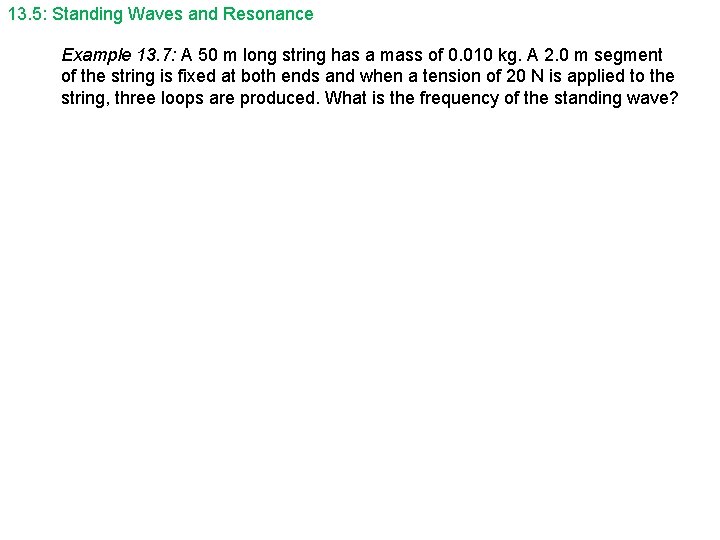
13. 5: Standing Waves and Resonance Example 13. 7: A 50 m long string has a mass of 0. 010 kg. A 2. 0 m segment of the string is fixed at both ends and when a tension of 20 N is applied to the string, three loops are produced. What is the frequency of the standing wave?
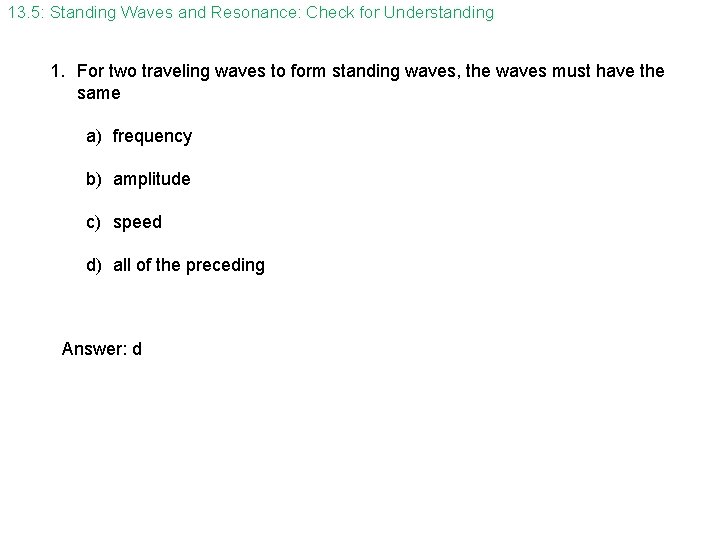
13. 5: Standing Waves and Resonance: Check for Understanding 1. For two traveling waves to form standing waves, the waves must have the same a) frequency b) amplitude c) speed d) all of the preceding Answer: d
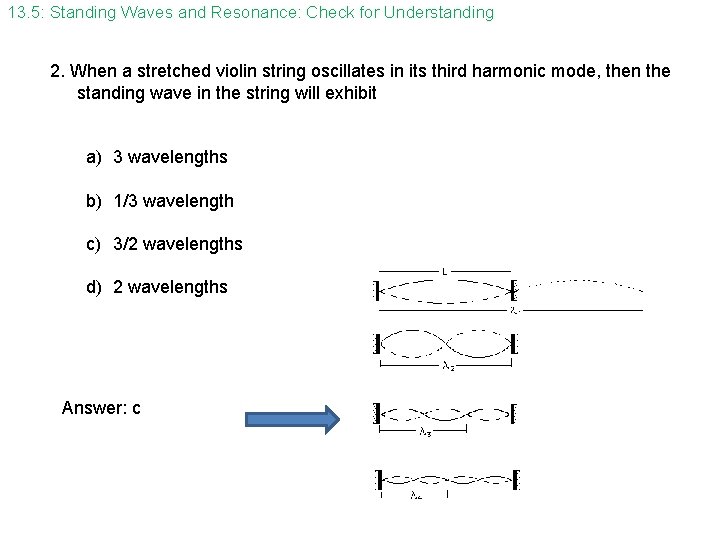
13. 5: Standing Waves and Resonance: Check for Understanding 2. When a stretched violin string oscillates in its third harmonic mode, then the standing wave in the string will exhibit a) 3 wavelengths b) 1/3 wavelength c) 3/2 wavelengths d) 2 wavelengths Answer: c
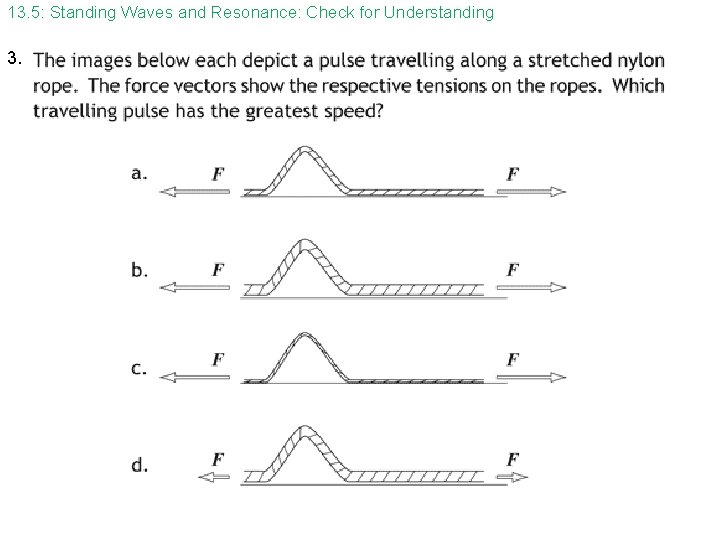
13. 5: Standing Waves and Resonance: Check for Understanding 3.
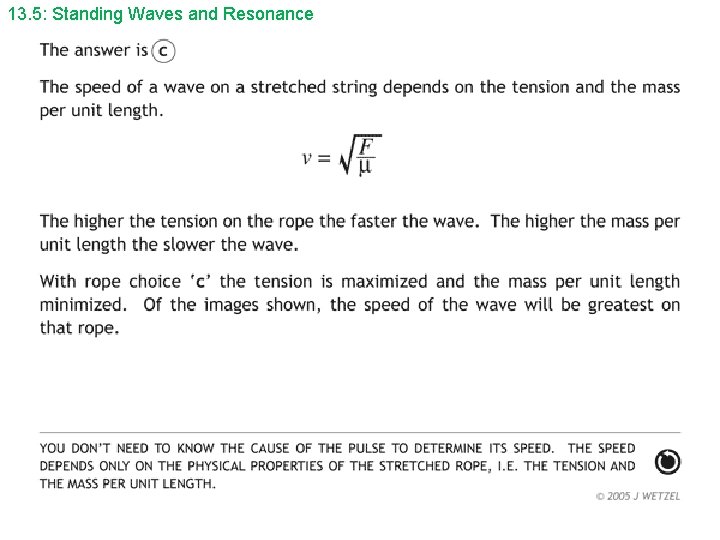
13. 5: Standing Waves and Resonance
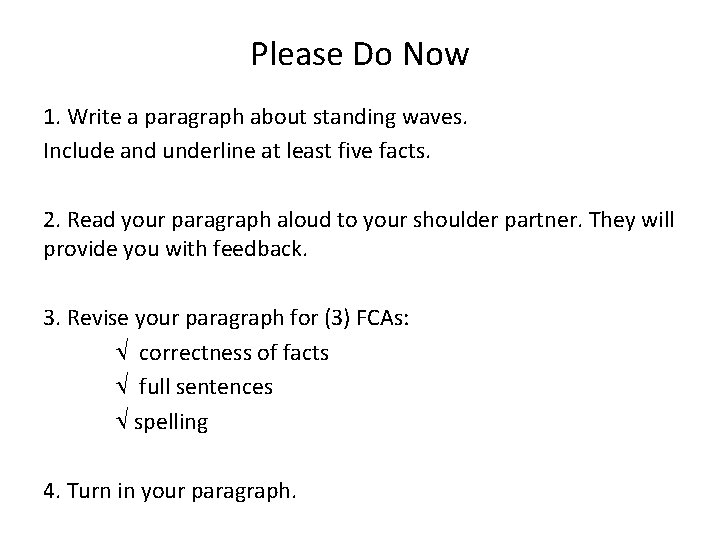
Please Do Now 1. Write a paragraph about standing waves. Include and underline at least five facts. 2. Read your paragraph aloud to your shoulder partner. They will provide you with feedback. 3. Revise your paragraph for (3) FCAs: correctness of facts full sentences spelling 4. Turn in your paragraph.
Homework for Unit 10, Part 1 Textbook Chapter 13 AP Classroom, Unit 10 Progress Check FRQ Part A: All except 12 & 13.