
AP Physics Newtons Laws 1 st SEMESTER Unit



- Slides: 27
AP Physics Newton’s Laws 1 st SEMESTER, Unit 2 -2 Dr. Crofoot RIM High School
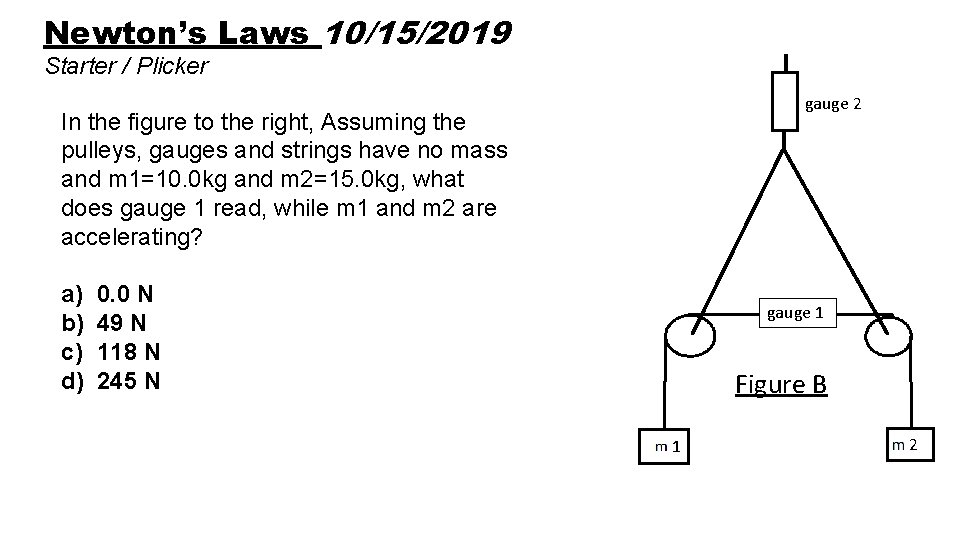
Newton’s Laws 10/15/2019 Starter / Plicker gauge 2 In the figure to the right, Assuming the pulleys, gauges and strings have no mass and m 1=10. 0 kg and m 2=15. 0 kg, what does gauge 1 read, while m 1 and m 2 are accelerating? a) b) c) d) 0. 0 N 49 N 118 N 245 N gauge 1 Figure B 1 2
Newton’s Laws 10/15/19 Write in Notebook Friction • The magnitude of the maximum static friction is: fs, max = �� s FN • The magnitude of the kinetic friction is: fk = �� k FN Sample Problem 6 -3
Newton’s Laws 10/15/19 Home Work Friction • From Chapter 6: • Problem 7, 13 Home Work Sheet Name Period Date Assigned Problems. Complete sentences Show math, units, sig. figs. Highlight or box answers 2. 5 m/s
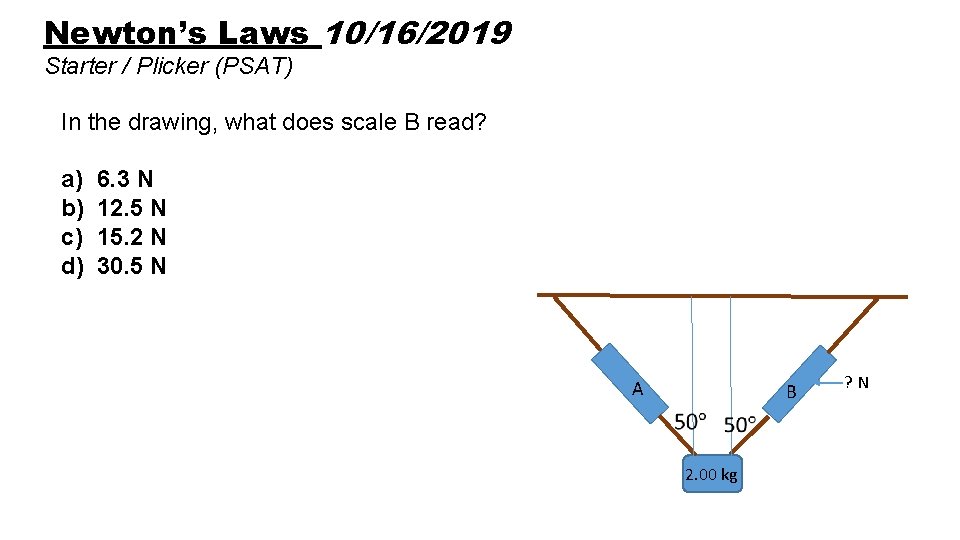
Newton’s Laws 10/16/2019 Starter / Plicker (PSAT) In the drawing, what does scale B read? a) b) c) d) 6. 3 N 12. 5 N 15. 2 N 30. 5 N A B 2. 00 kg ? N
Newton’s Laws 10/16/19 Write in Notebook (PSAT) Friction • The magnitude of the maximum static friction is: fs, max = �� s FN • The magnitude of the kinetic friction is: fk = �� k FN m. B = 2 kg Work Problem 69 on the board. a) Tension on the cord. b) Magnitude of acceleration. g k 4 = m. A ss fr le n o i ict 30° �� k = 0. 50
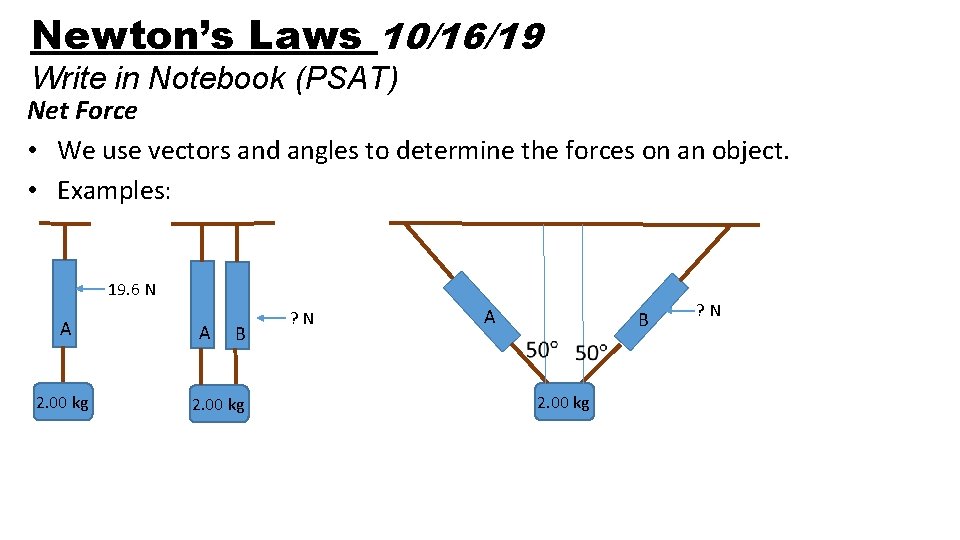
Newton’s Laws 10/16/19 Write in Notebook (PSAT) Net Force • We use vectors and angles to determine the forces on an object. • Examples: 19. 6 N A 2. 00 kg A B 2. 00 kg ? N
Newton’s Laws 10/16/19 Write in Notebook (PSAT) Net Force • We use vectors and angles to determine the forces on an object. • Examples: B A A ? N 2. 00 kg B ? N 2. 00 kg • How do you think this applies to the design of things like bridges? • Next week, you will design and build a bridge, then test it for strength.
Newton’s Laws 10/16/19 Home Work (PSAT) Friction • From Chapter 6: • Problem 65 Home Work Sheet Name Period Date Assigned Problems. Complete sentences Show math, units, sig. figs. Highlight or box answers 2. 5 m/s
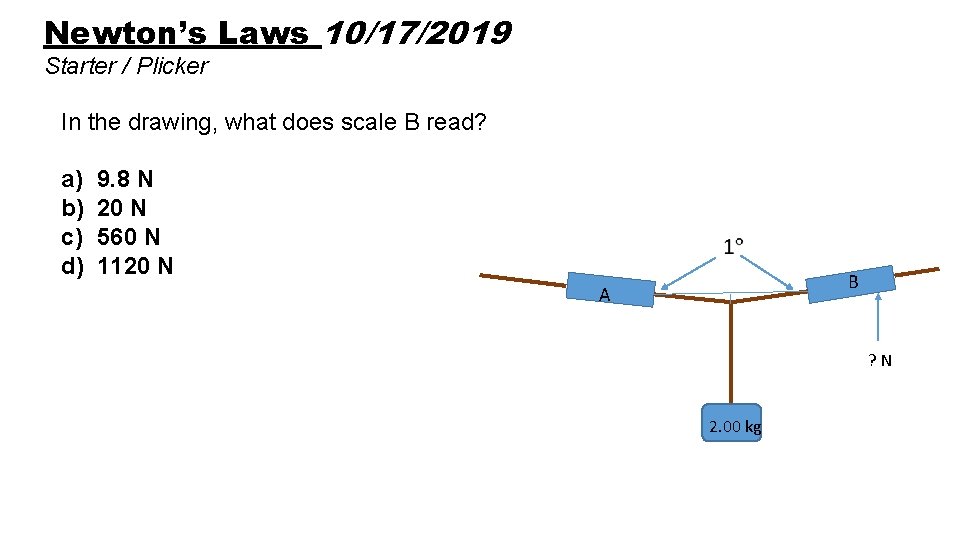
Newton’s Laws 10/17/2019 Starter / Plicker In the drawing, what does scale B read? a) b) c) d) 9. 8 N 20 N 560 N 1120 N B A ? N 2. 00 kg
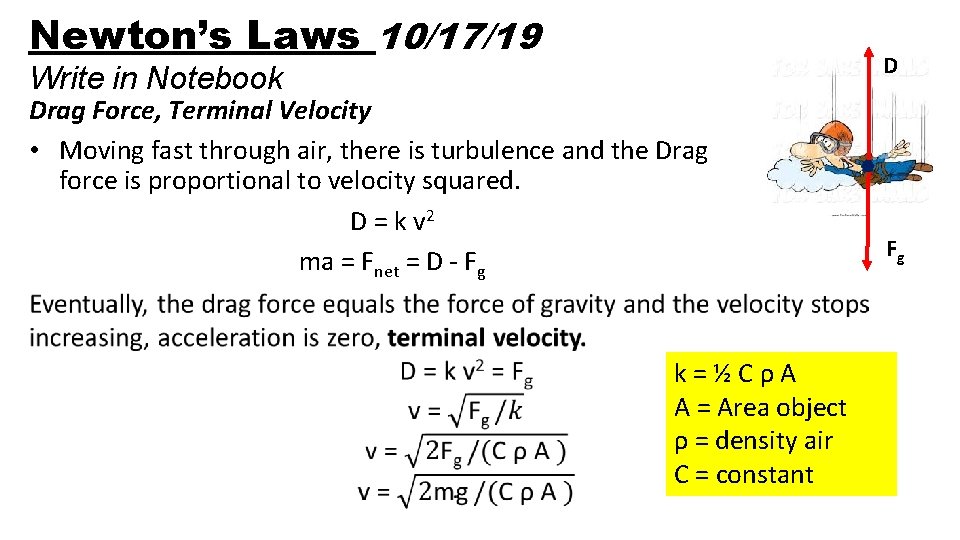
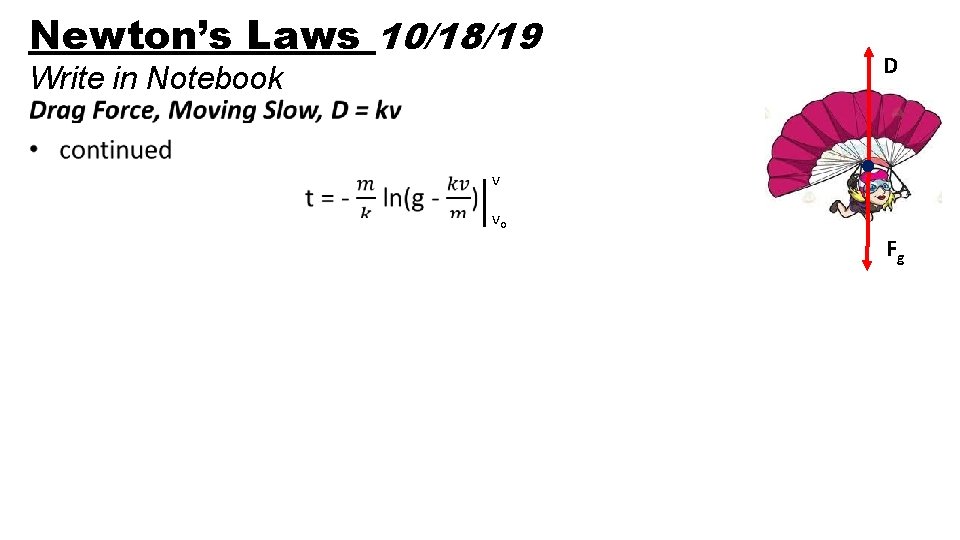
Newton’s Laws 10/17/19 Write in Notebook Drag Force • The friction that we have been looking at is a simple function of the Normal Force, not a function of the objects velocity. • An object moving through air experiences friction from the air that is a function of velocity, Drag Force. • Moving slowly through air, there is no turbulence and the Drag force is proportional to velocity. D = k v • Moving fast through air, there is turbulence and the Drag force is proportional to velocity squared. D = k v 2
Newton’s Laws 10/17/19 D Write in Notebook Drag Force, Terminal Velocity • Moving fast through air, there is turbulence and the Drag force is proportional to velocity squared. D = k v 2 ma = Fnet = D - Fg k = ½ C ρ A A = Area object ρ = density air C = constant Fg
Newton’s Laws 10/17/19 Home Work Friction • From Chapter 6: • Problem 32 Home Work Sheet Name Period Date Assigned Problems. Complete sentences Show math, units, sig. figs. Highlight or box answers 2. 5 m/s
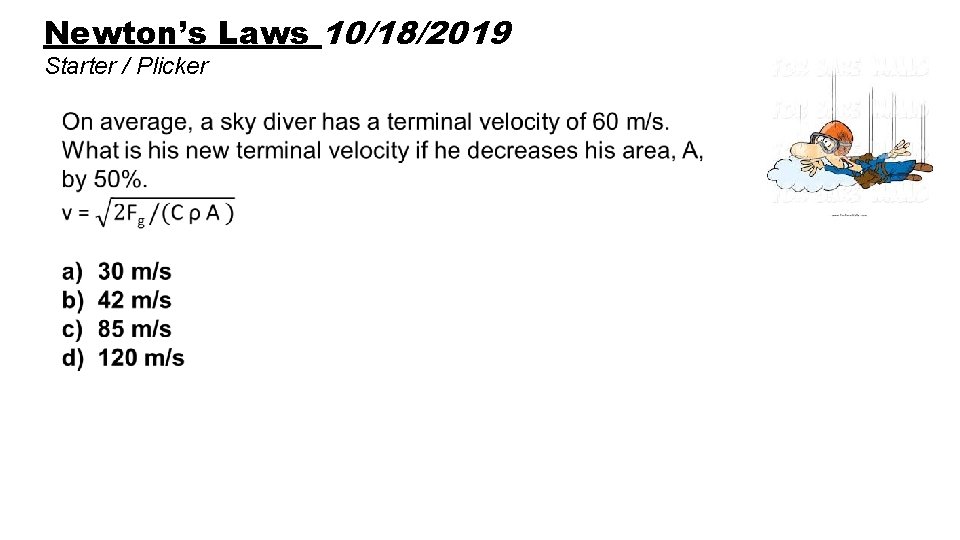
Newton’s Laws 10/18/2019 Starter / Plicker
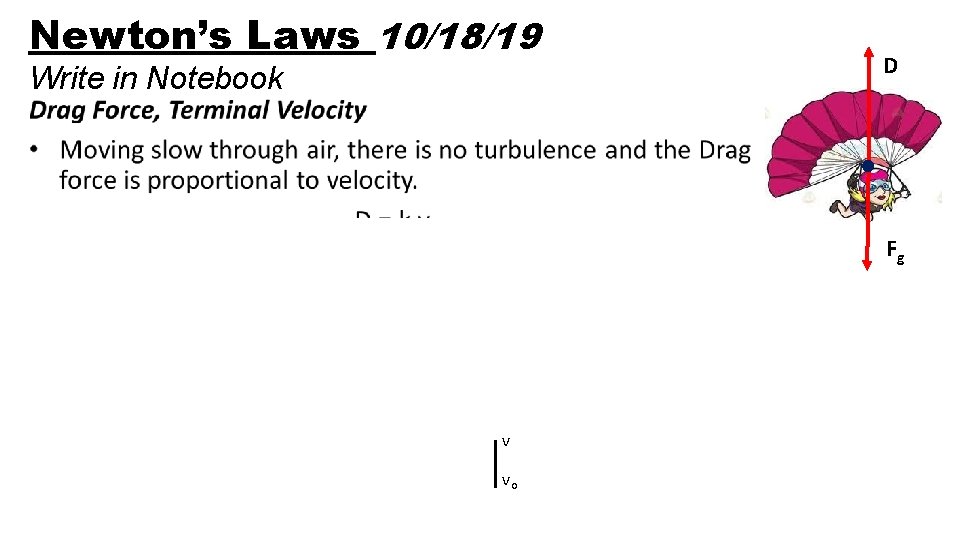
Newton’s Laws 10/18/19 Write in Notebook D • Fg v vo
Newton’s Laws 10/18/19 Write in Notebook D • v vo Fg
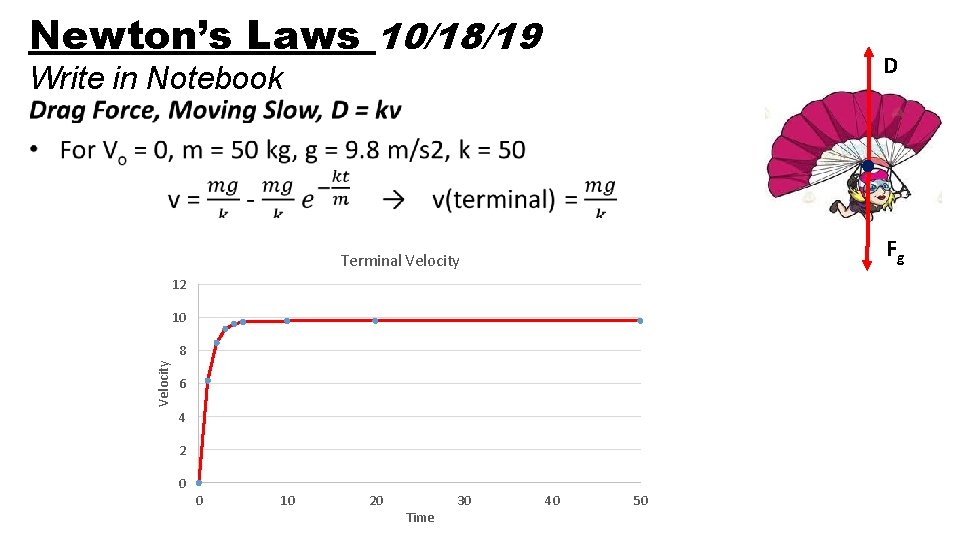
Newton’s Laws 10/18/19 D Write in Notebook • Fg Terminal Velocity 12 10 Velocity 8 6 4 2 0 0 10 20 Time 30 40 50
Newton’s Laws 10/18/19 Home Work Friction • From Chapter 6: • Problem 33 Home Work Sheet Name Period Date Assigned Problems. Complete sentences Show math, units, sig. figs. Highlight or box answers 2. 5 m/s
Newton’s Laws 10/21/2019 Substitute Lesson Plan, Period 3 - AP Physics Work on old and new homework problems. New Homework Problems From Chapter 6: Problem 49, 69
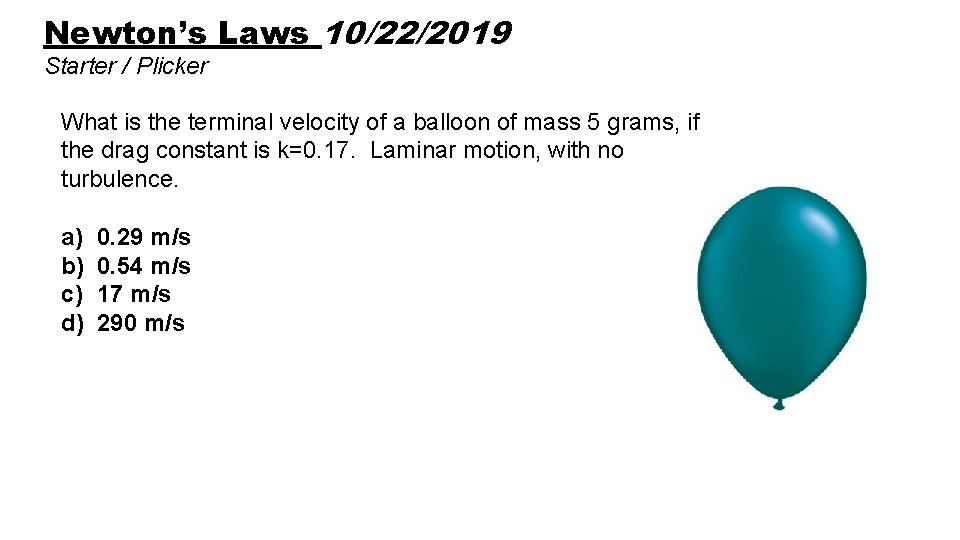
Newton’s Laws 10/22/2019 Starter / Plicker What is the terminal velocity of a balloon of mass 5 grams, if the drag constant is k=0. 17. Laminar motion, with no turbulence. a) b) c) d) 0. 29 m/s 0. 54 m/s 17 m/s 290 m/s
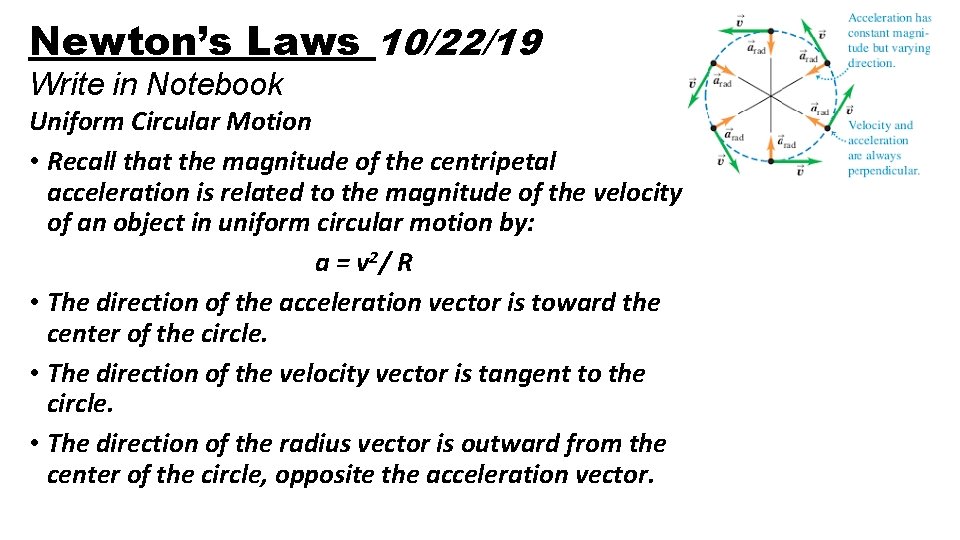
Newton’s Laws 10/22/19 Write in Notebook Uniform Circular Motion • Recall that the magnitude of the centripetal acceleration is related to the magnitude of the velocity of an object in uniform circular motion by: a = v 2/ R • The direction of the acceleration vector is toward the center of the circle. • The direction of the velocity vector is tangent to the circle. • The direction of the radius vector is outward from the center of the circle, opposite the acceleration vector.
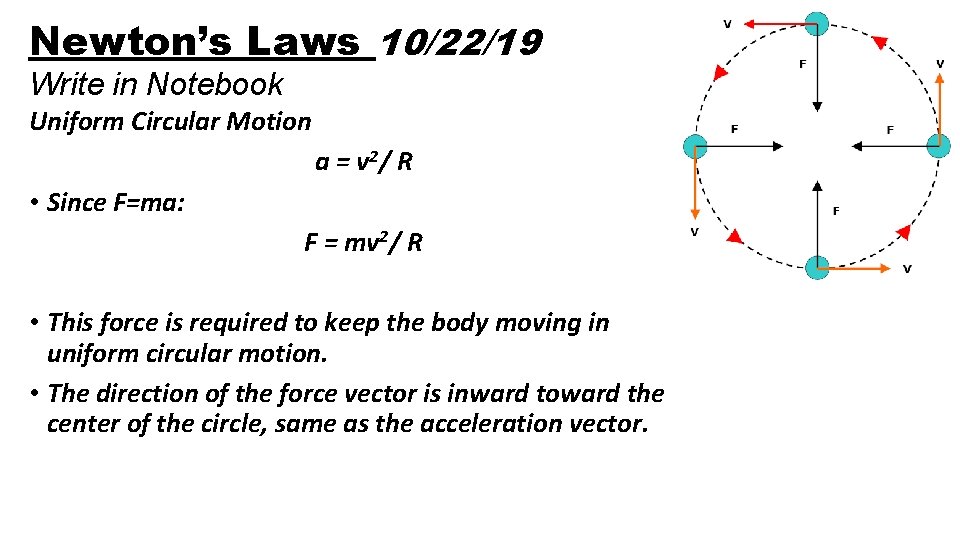
Newton’s Laws 10/22/19 Write in Notebook Uniform Circular Motion a = v 2/ R • Since F=ma: F = mv 2/ R • This force is required to keep the body moving in uniform circular motion. • The direction of the force vector is inward toward the center of the circle, same as the acceleration vector.
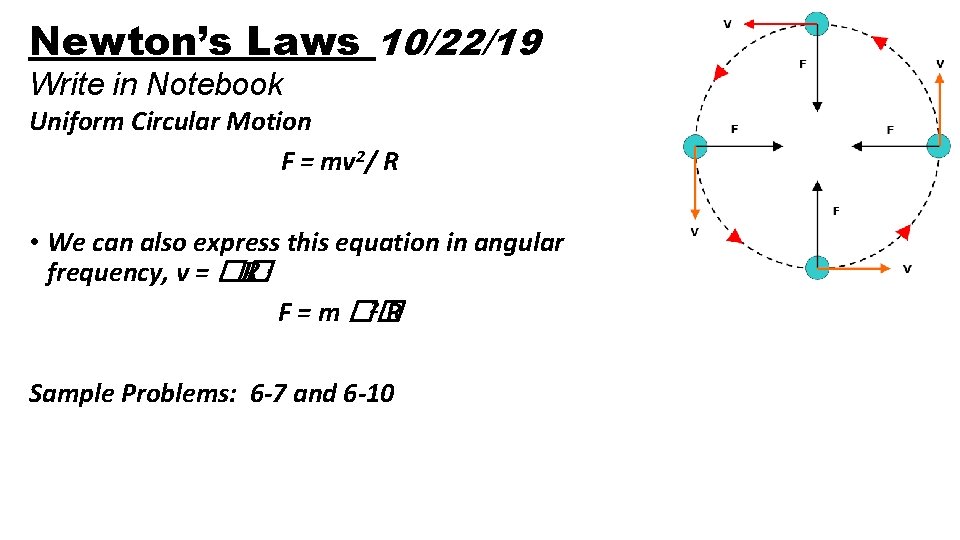
Newton’s Laws 10/22/19 Write in Notebook Uniform Circular Motion F = mv 2/ R • We can also express this equation in angular frequency, v = �� R: 2 R F = m �� Sample Problems: 6 -7 and 6 -10
Newton’s Laws 10/22/19 Home Work Friction • From Chapter 6: • Problem 39, 47 • Review Sample Problem 6 -8 and 6 -9 Home Work Sheet Name Period Date Assigned Problems. Complete sentences Show math, units, sig. figs. Highlight or box answers 2. 5 m/s
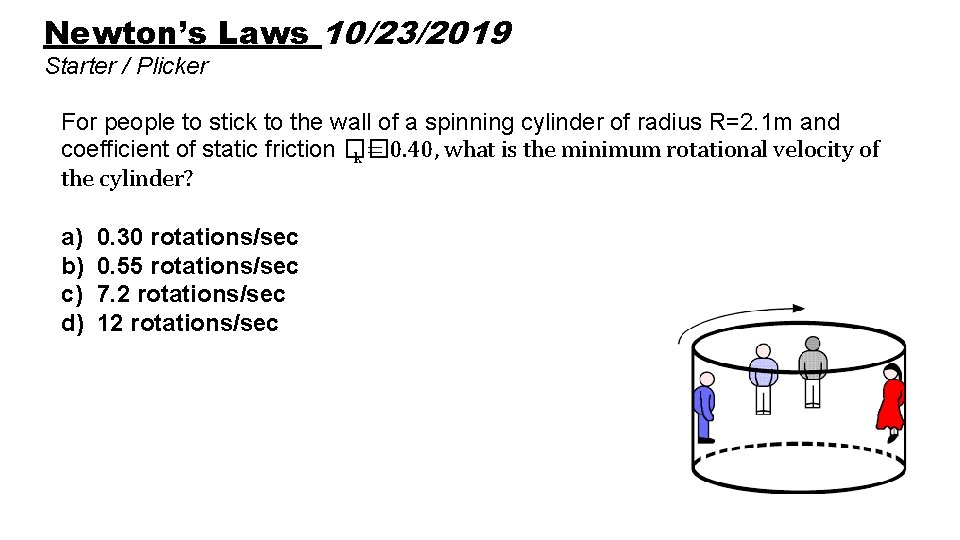
Newton’s Laws 10/23/2019 Starter / Plicker For people to stick to the wall of a spinning cylinder of radius R=2. 1 m and coefficient of static friction �� k = 0. 40, what is the minimum rotational velocity of the cylinder? a) b) c) d) 0. 30 rotations/sec 0. 55 rotations/sec 7. 2 rotations/sec 12 rotations/sec
Newton’s Laws 10/23/19 CRAM Sheet • Work on CRAM Sheet • Test Monday (MC) and Tuesday (FR)
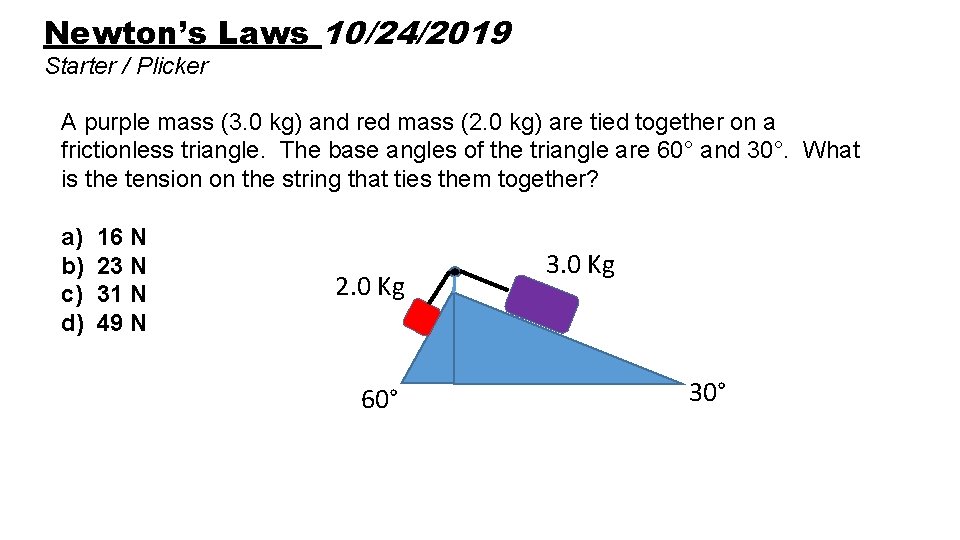
Newton’s Laws 10/24/2019 Starter / Plicker A purple mass (3. 0 kg) and red mass (2. 0 kg) are tied together on a frictionless triangle. The base angles of the triangle are 60° and 30°. What is the tension on the string that ties them together? a) b) c) d) 16 N 23 N 31 N 49 N 2. 0 Kg 60° 3. 0 Kg 30°