
AP Microeconomics In Class Review 3 A Producers

- Slides: 28
AP Microeconomics In Class Review #3
A Producer’s price is derived from 3 things: 1. Cost of Production 2. Competition between firms 3. Demand for product
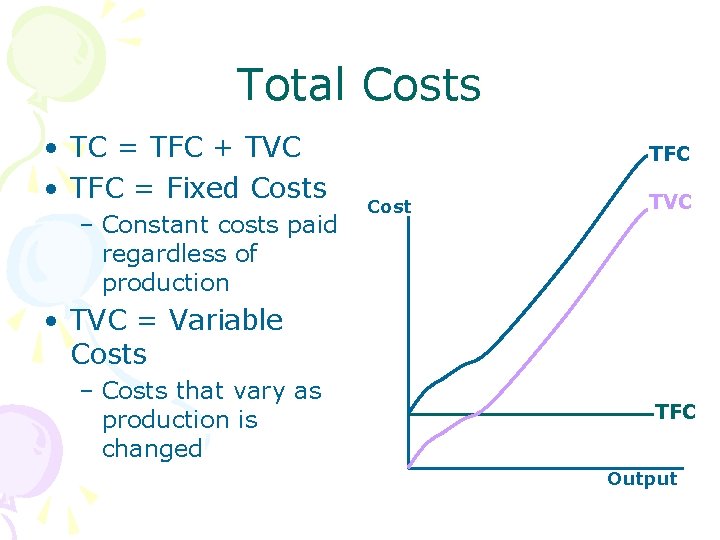
Total Costs • TC = TFC + TVC • TFC = Fixed Costs – Constant costs paid regardless of production TFC Cost TVC • TVC = Variable Costs – Costs that vary as production is changed TFC Output
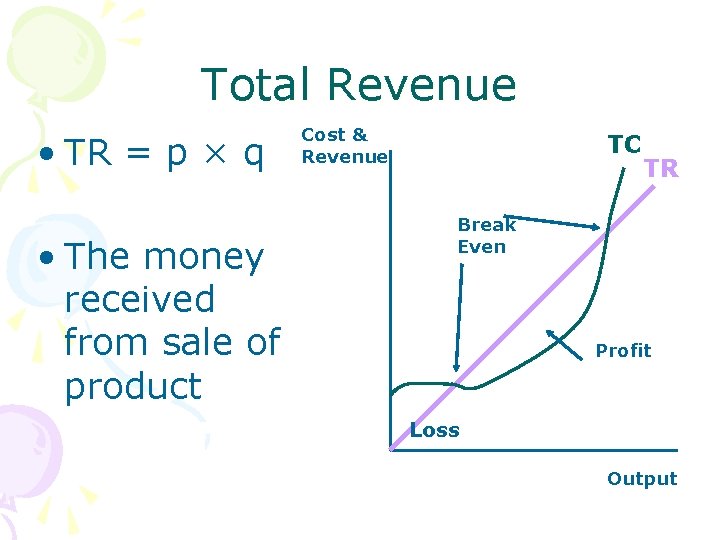
Total Revenue • TR = p × q • The money received from sale of product Cost & Revenue TC TR Break Even Profit Loss Output
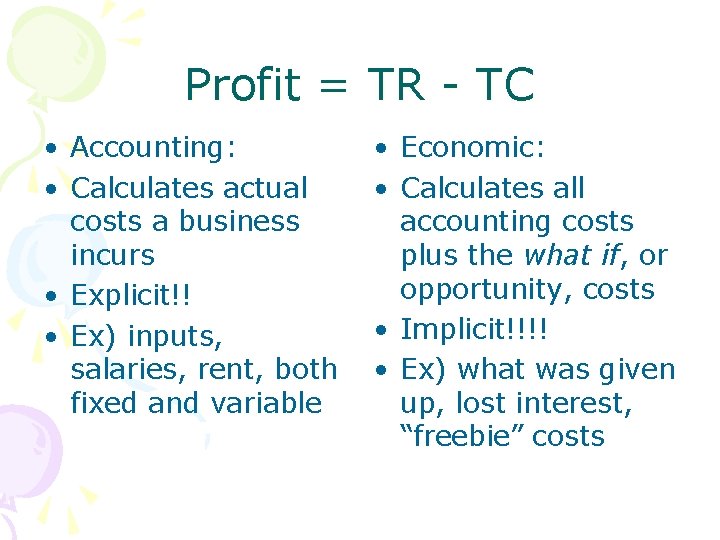
Profit = TR - TC • Accounting: • Calculates actual costs a business incurs • Explicit!! • Ex) inputs, salaries, rent, both fixed and variable • Economic: • Calculates all accounting costs plus the what if, or opportunity, costs • Implicit!!!! • Ex) what was given up, lost interest, “freebie” costs
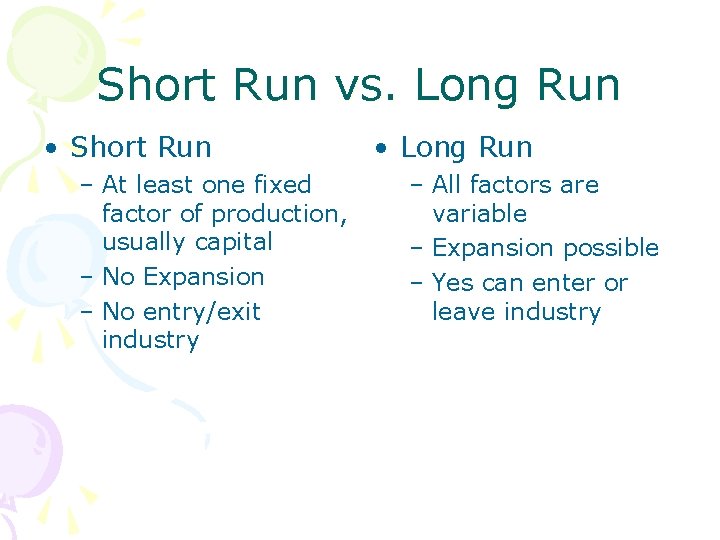
Short Run vs. Long Run • Short Run – At least one fixed factor of production, usually capital – No Expansion – No entry/exit industry • Long Run – All factors are variable – Expansion possible – Yes can enter or leave industry
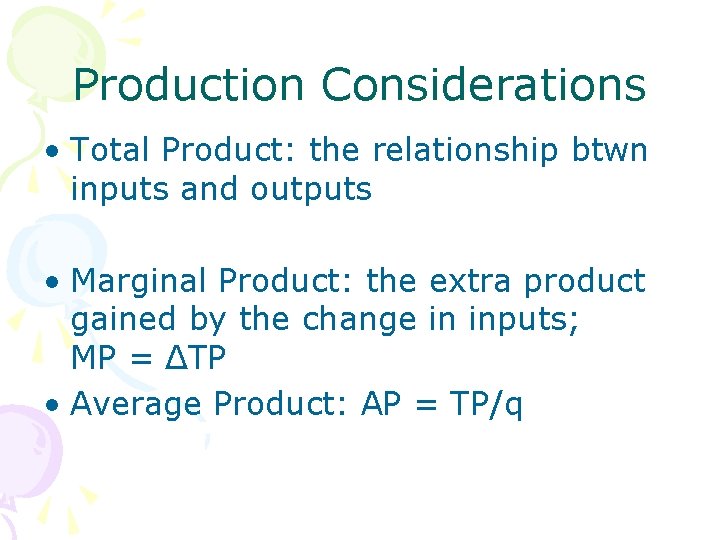
Production Considerations • Total Product: the relationship btwn inputs and outputs • Marginal Product: the extra product gained by the change in inputs; MP = ΔTP • Average Product: AP = TP/q
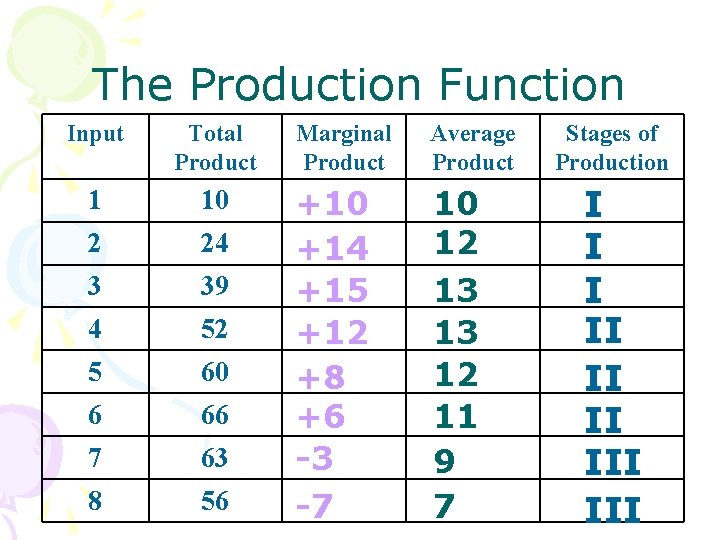
The Production Function Input Total Product 1 10 2 24 3 39 4 52 5 60 6 66 7 63 8 56 Marginal Product Average Product +10 +14 +15 +12 +8 +6 -3 -7 10 12 13 13 12 11 9 7 Stages of Production I II III
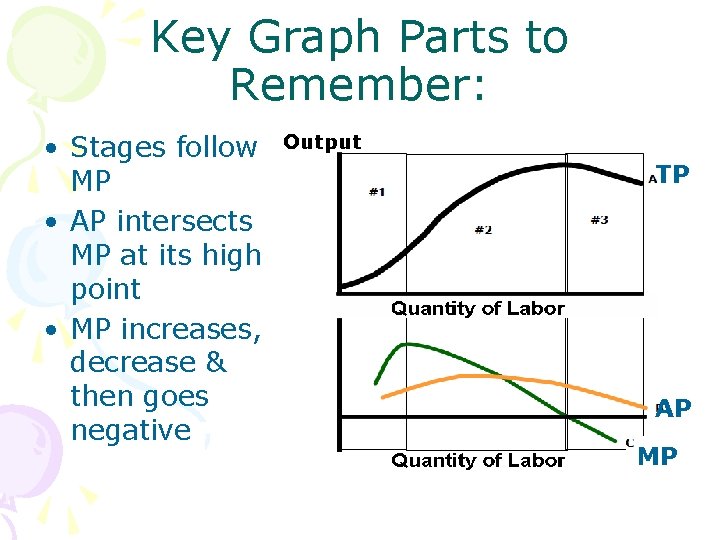
Key Graph Parts to Remember: • Stages follow MP • AP intersects MP at its high point • MP increases, decrease & then goes negative Output TP AP MP
Production Function 8. Law of Diminishing Returns 1. Due to limited capacity, output will slow down and then decrease beyond a certain point 9. Choice of Technology 1. Capital (K) and Labor (L) are both complements and substitutes, firms will find the combination that is the most efficient (cheapest)
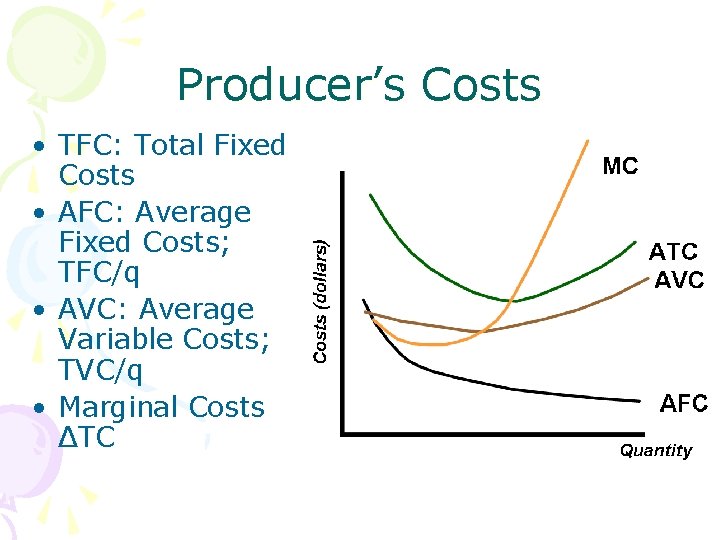
Producer’s Costs • TFC: Total Fixed Costs • AFC: Average Fixed Costs; TFC/q • AVC: Average Variable Costs; TVC/q • Marginal Costs ΔTC
Perfect Competition • Characteristics: many firms, homogenous products, no barriers to entry, P = MC = MR • Marginal Revenue: extra revenue gained with each additional unit of output; MR = ΔTR • P = d = MR: Price Takers, each firm takes market price (or market demand) so P and MR are constant (perfectly elastic & horizontal)
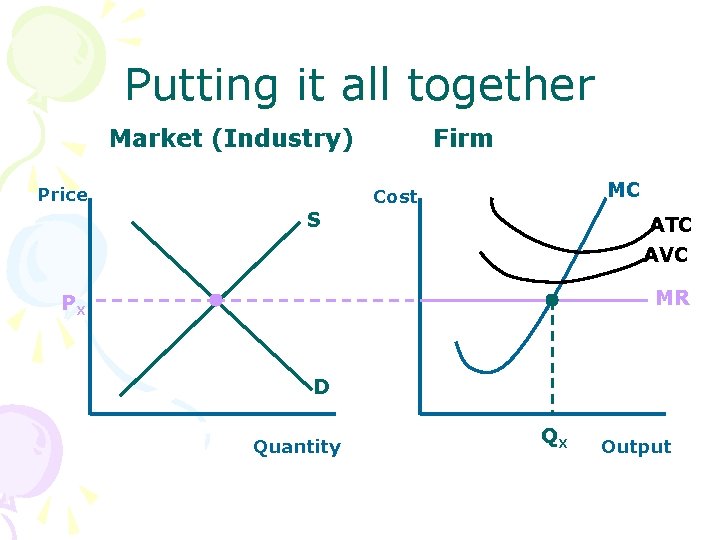
Putting it all together Market (Industry) Price Firm MC Cost S ATC AVC MR PX D Quantity QX Output
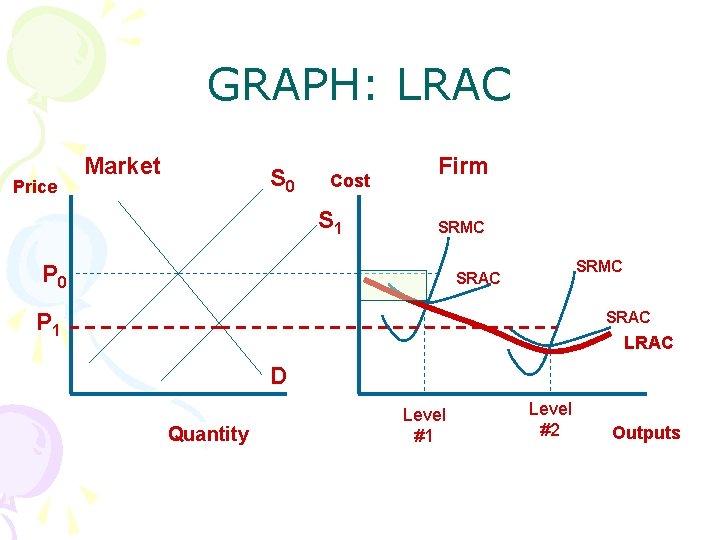
More Questions 14. How can you tell if we are talking about long-run or short-run? Look for multiple short run graphs, look for LRAC, profit leads to expansion 15. Profits in long run? Explain. Will lead to Long-Run Equilibrium where firms will no longer have economic profits (characteristics of market make long run profits impossible)
GRAPH: LRAC Price Market S 0 Cost S 1 Firm SRMC P 0 SRMC SRAC P 1 LRAC D Quantity Level #1 Level #2 Outputs
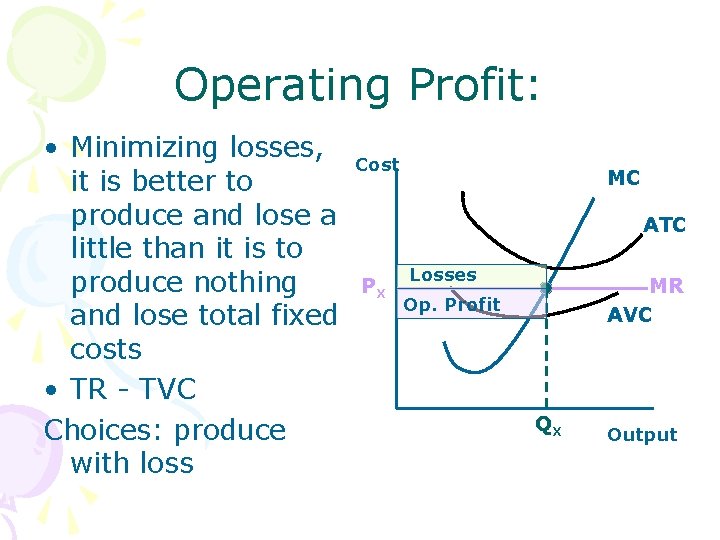
Operating Profit: • Minimizing losses, it is better to produce and lose a little than it is to produce nothing and lose total fixed costs • TR - TVC Choices: produce with loss Cost MC ATC PX Losses MR AVC Op. Profit QX Output
Shutting Down vs. Exiting the Industry • Shutting Down: • Short Run option • Still paying out Total Fixed Costs but not producing • Exiting: • Long Run option • No costs, no production, business no longer exists
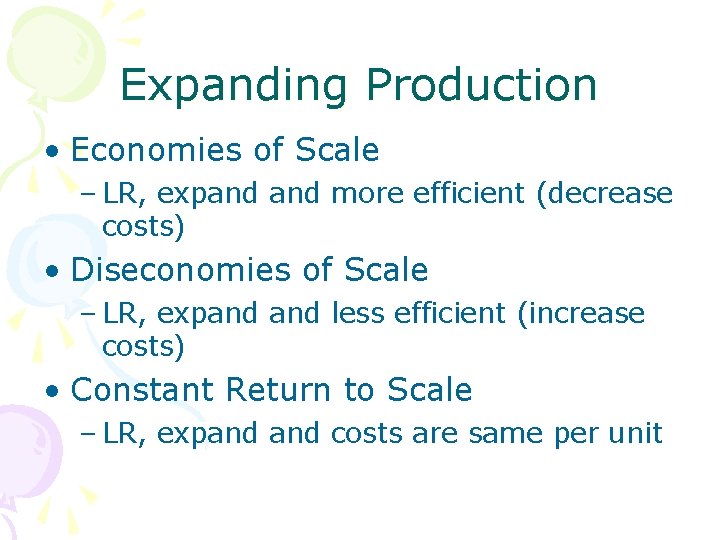
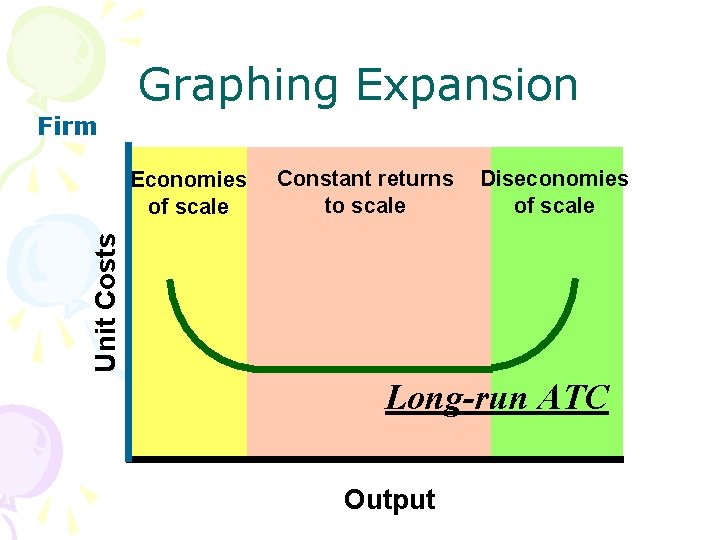
Expanding Production • Economies of Scale – LR, expand more efficient (decrease costs) • Diseconomies of Scale – LR, expand less efficient (increase costs) • Constant Return to Scale – LR, expand costs are same per unit
Expanding Production • Increasing Returns – LR, expand increase production • Diminishing Returns – LR, expand decrease production
Graphing Expansion Firm Constant returns to scale Diseconomies of scale Unit Costs Economies of scale Long-run ATC Output
• Derived Demand: the demand for labor is directly dependent on the demand for the output that labor creates • Law of Diminishing Returns & Hiring Labor: there is a limit to how many workers a firm should hire (SR), hire as long as they are efficient
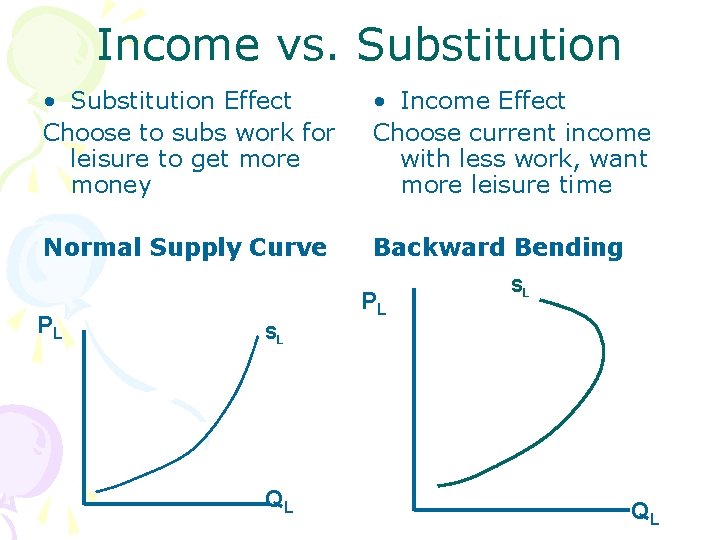
Income vs. Substitution • Substitution Effect Choose to subs work for leisure to get more money • Income Effect Choose current income with less work, want more leisure time Normal Supply Curve Backward Bending PL PL SL SL QL QL
• Marginal Product of Labor: (MPL) • The additional output produced as one more unit of labor is added • Marginal Revenue Product of Labor: (MRPL) • The addition to the firm’s revenue as the result of the marginal product per labor unit – Represents the firm’s demand curve for labor
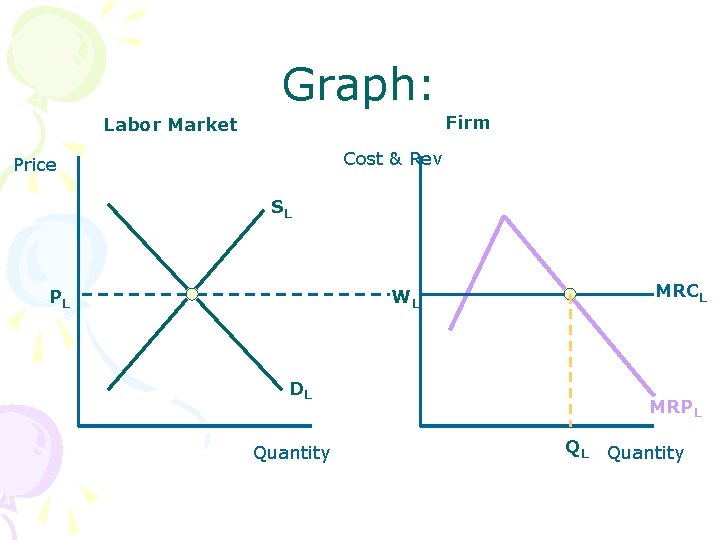
Marginal Resource Cost = Wage of Labor = Price of Labor • MRC = WL = PL • All refer to the cost of the input labor and are interchangeable. • In a perfectly competitive labor market, the PL comes from market and is a horizontal line for the firm – It is the supply curve of labor faced by the firm
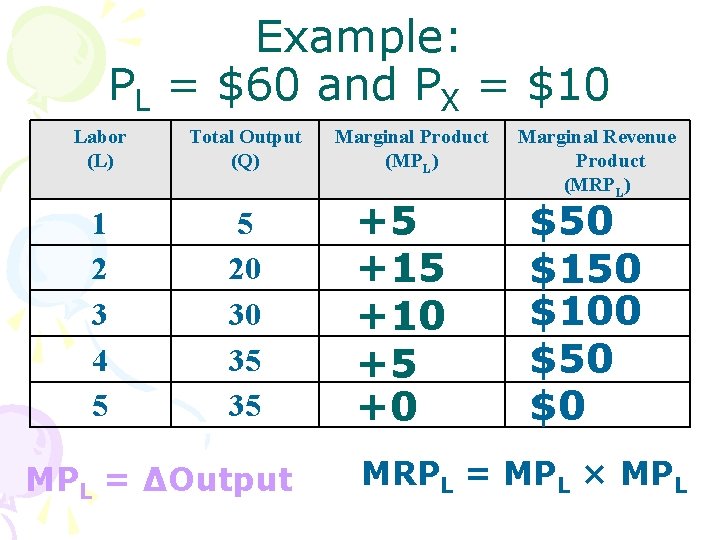
Example: PL = $60 and PX = $10 Labor (L) Total Output (Q) 1 2 3 4 5 5 20 30 35 35 MPL = ΔOutput Marginal Product (MPL) +5 +10 +5 +0 Marginal Revenue Product (MRPL) $50 $100 $50 $0 MRPL = MPL × MPL
How many workers should be hired? • PL = $60 • The firm will hire 3 workers; any more and the additional cost will not cover the additional revenue earned; or MRPL ≥ MRC.
Graph: Firm Labor Market Cost & Rev Price SL PL MRCL WL DL Quantity MRPL QL Quantity
Parts to Remember: #1: MRC is the labor supply curve available to the firm #2: MRP is the labor demand curve of the firm #3: find where they intersect and that is the quantity of labor hired!! (MC = MR)