
AP Language and Composition Exam Review the art
![Deconstruct the rhetorical analysis prompt Title, Author, and Genre + Background [], Advice ____,](https://slidetodoc.com/presentation_image/19a2d25abc46526c7414f63ca1e2b618/image-45.jpg "Deconstruct the rhetorical analysis prompt Title, Author, and Genre + Background [], Advice ____,")
- Slides: 49
AP Language and Composition Exam Review
"the art of effective or persuasive speaking or writing, esp. the use of figures of speech and other compositional techniques" rhetoric
Three rhetorical appeals created by Aristotle Pathos, Ethos, and Logos
How can a writer use context to their advantage? -Time? Location or cultural significance? A writer uses context to help his message be received. For example, if Lou Gehrig hadn't said his farewell speech at one of his baseball games then the crowd could have possible not understood the importance behind his message. They could have possible not recognized him or his importance, but because he stood in front of his fans they understood his message.
SOAPSTone- What does the acronym stand for? When do you use it? Subject, Occasion, Audience, Purpose, Speaker we use it to understand literary works
Ethos, Pathos, and Logos What do the terms mean? How do you identify them? Ethos (Character) is the credibility, pathos (Experience) is the emotion, and Logos (Word) is the reason.
How would you identify the appeals in the rhetorical essay? ETHOS Ethos can be identified by the use of a person who can support the person's claim.
How would you identify the appeals in the rhetorical essay? PATHOS Pathos can be identified by the use of anecdotes, babies, animals, and anything that brings about emotion to the reader.
How would you identify the appeals in the rhetorical essay? LOGOS Logos can be identified through the use of facts and statistics.
How might you use them in the argumentative essay? You can use them to add help persuade your reader.
Logical Fallacy - What is it? How might you use it? When should you avoid it? It is an error in reasoning. You can use it to intelligently refute arguments and build effective arguments. Avoid it when making a claim.
Bandwagon Urging the audience to accept a position because a majority of people hold that opinion.
Either/ or/ false Dichotomy Assuming there are only two options when there are many.
Hasty Generalization Drawing a conclusion when there is not sufficient evidence.
Ad Hominem Attack your opponent's character or personal traits in an attempt to undermine their argument. STICKING IT TO THE MAN
Description Narration/ Anecdote Cause and Effect Comparison and Contrast Definition Division and Classification Exemplification Process Analysis Argumentation Patterns of essay development or rhetorical modes
giving a verbal picture using space order Description
How do short, clipped phrases affect the pace of a piece? They tend to create a feeling of quickness, decisiveness, and speed to a piece.
How do long, convoluted sentences, especially with subordinate clauses at the beginning tend to slow the pace of a piece? Often they are connected to a contemplative section, a heavy or serious subject and the writer wants to emphasize it. They slow down the pace because of the subordinate clauses which case them to take a longer and force the reader to breath between the clause and the sentence.
What's the difference between a periodic and loose sentence? When would you use a periodic sentence? A loose sentence makes complete sense if brought to a close before the actual ending while a periodic sentence only makes sense when the end of the sentence is reached. You would use a periodic sentence to lead the reader on and force them to continue reader or build suspense.
reference to a mythological literary, historical, or biblical person, place, or thing Allusion
comparison of two things to show they are alike Analogy
Hyperbole- Define and give an example exaggeration
Metaphor-Define and give an example. Comparison without using “like” or “as”
paradox which combines a pair of contrary terms into a single expression oxymoron
Paradox statement that contradicts itself
Personification-Define and give an example. kind of metaphor which gives inanimate objects or abstract ideas human characteristics
a question that expects no answer and is used to draw attention to a point and is generally stronger than a direct statement Rhetorical question
comparison of two different things or ideas through the use of the words "like" or "as". simile
Synecdoche- Define and give an example. A part of something is used to signify the whole "All eyes were on him"
the repetition of the same word or group of words at the beginning of successive clauses anaphora
involves a direct contrast of structurally parallel word groupings generally for the purpose of contrast antithesis
“He came, he saw, and he conquered. ” parallelism
Polysyndeton the use of many conjunctions
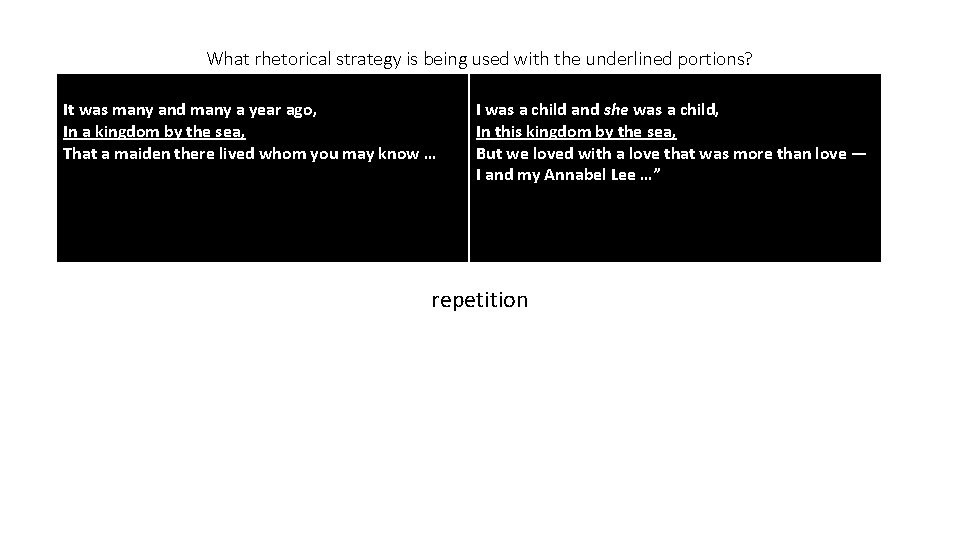
What rhetorical strategy is being used with the underlined portions? I was a child and she was a child, In this kingdom byathe sea, It was many and many a year ago, I was child and she was a child, was more than love In a kingdom by the sea, But we loved with a love that In this kingdom by the sea, — I and … my Annabel …”with a love that was more than love — That a maiden there lived whom you may know But we. Lee loved I and my Annabel Lee …” repetition
containing an exact meaning denotation
containing a suggested meaning connotative
What are the functions of footnotes/endnotes? Identify sources Define Terms Add facts or details Clarify confusion Refer readers to other sources for more information
Jack Canfield, et al. , Chicken Soup for the Kid’s Soul: 101 Stories of Courage, Hope, and Laughter (Deerfield Beach, FL: Health Communications, 1998)68. Translates as “and other people. ” It is used for publications for 4+ authors.
What does CHELPS stand for and when is it used? Current events, History, Experience, Literature, Pop culture, Sports/Science To find evidence to support your claim with the argument essay.
What is a good ratio to follow when incorporating direct quotes and explaining them? 1: 2 For every quote, have 1 -2 sentences of your own thoughts and opinions.
How do you discover the tone of a passage? Diction + Detail = Tone
$SEEITT- What does it stand for and when do you use it? Economic ($), Safety, Ethics, Environment, International Impact, Technological Issues, and Time We use it to help think of concrete issues to consider for the synthesis prompt.
Deconstruct the synthesis prompt Box the issue, underline the exigence, bracket the task, circle key terms
Deconstruct the rhetorical analysis prompt Title, Author, and Genre + Background [], Advice ____, and Task ().
What is the little question? BIG question?
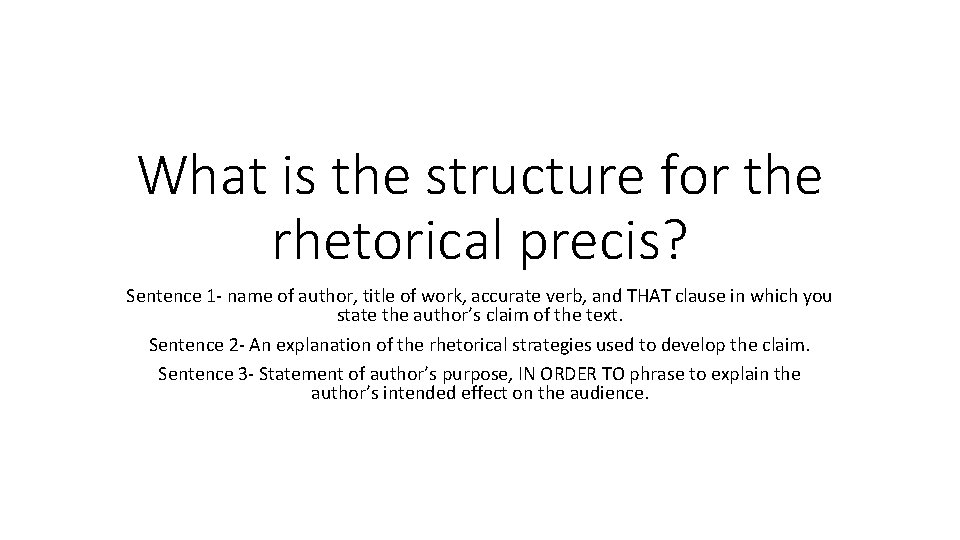
What is the structure for the rhetorical precis? Sentence 1 - name of author, title of work, accurate verb, and THAT clause in which you state the author’s claim of the text. Sentence 2 - An explanation of the rhetorical strategies used to develop the claim. Sentence 3 - Statement of author’s purpose, IN ORDER TO phrase to explain the author’s intended effect on the audience.
Yes/No/But Expand your initial response to the argument prompt and acknowledge the opposition.
Other AP Terms If you thought I was going to include the whole list, you’re crazy! Just make sure to review over them!