
AP LANG SUMMER ASSIGNMENT AP LANGUAGE AND COMPOSITION

- Slides: 21
AP LANG SUMMER ASSIGNMENT AP LANGUAGE AND COMPOSITION CLOSE READING ASSIGNMENT
AP LANGUAGE AND COMPOSITION CLOSE READING ASSIGNMENT • Your close reading assignment consists of the following, described in detail below: • 1. Fully annotate your book (on each page). • 2. Read one text and complete a rhetorical journal about your selected book. • 3. Complete a 3 -page rhetorical analysis essay about your selected book. • These assignments are all required for AP Language and Composition. Additionally, you will be assigned an extension activity at the start of the year.
CLOSE READING ASSIGNMENT PART 1: ANNOTATING THE TEXT YOU NEED TO READ ONE OF THE FOLLOWING TEXTS:
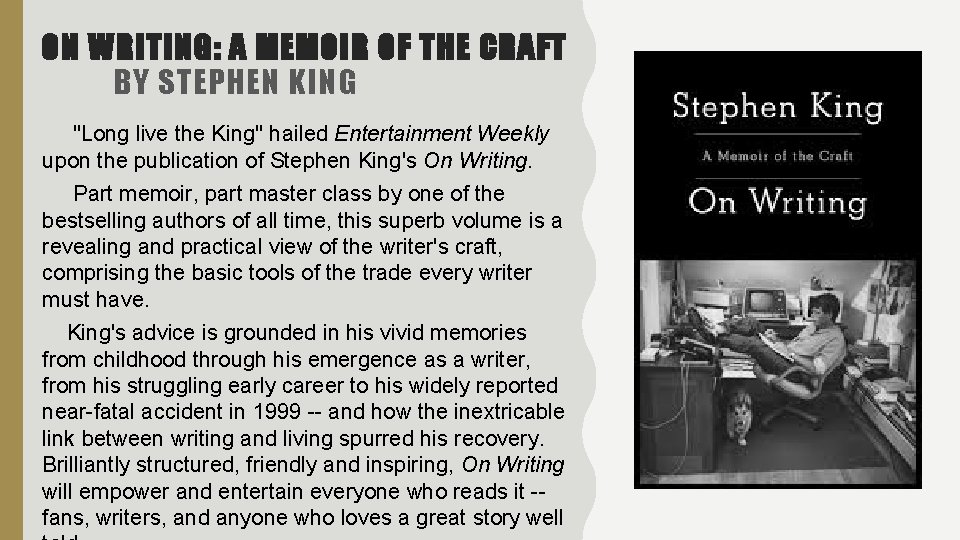
ON WRITING: A MEMOIR OF THE CRAFT BY STEPHEN KING "Long live the King" hailed Entertainment Weekly upon the publication of Stephen King's On Writing. Part memoir, part master class by one of the bestselling authors of all time, this superb volume is a revealing and practical view of the writer's craft, comprising the basic tools of the trade every writer must have. King's advice is grounded in his vivid memories from childhood through his emergence as a writer, from his struggling early career to his widely reported near-fatal accident in 1999 -- and how the inextricable link between writing and living spurred his recovery. Brilliantly structured, friendly and inspiring, On Writing will empower and entertain everyone who reads it -- fans, writers, and anyone who loves a great story well
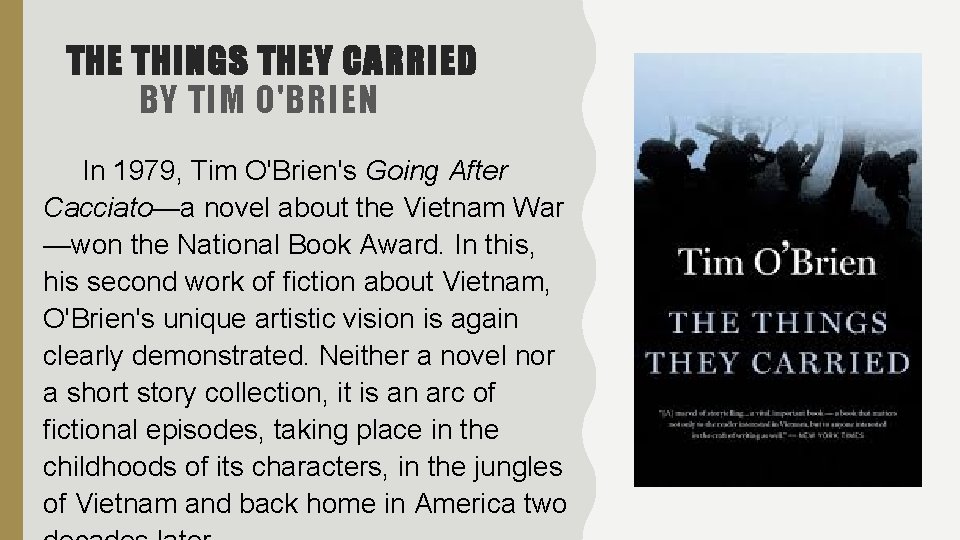
THE THINGS THEY CARRIED BY TIM O'BRIEN In 1979, Tim O'Brien's Going After Cacciato—a novel about the Vietnam War —won the National Book Award. In this, his second work of fiction about Vietnam, O'Brien's unique artistic vision is again clearly demonstrated. Neither a novel nor a short story collection, it is an arc of fictional episodes, taking place in the childhoods of its characters, in the jungles of Vietnam and back home in America two
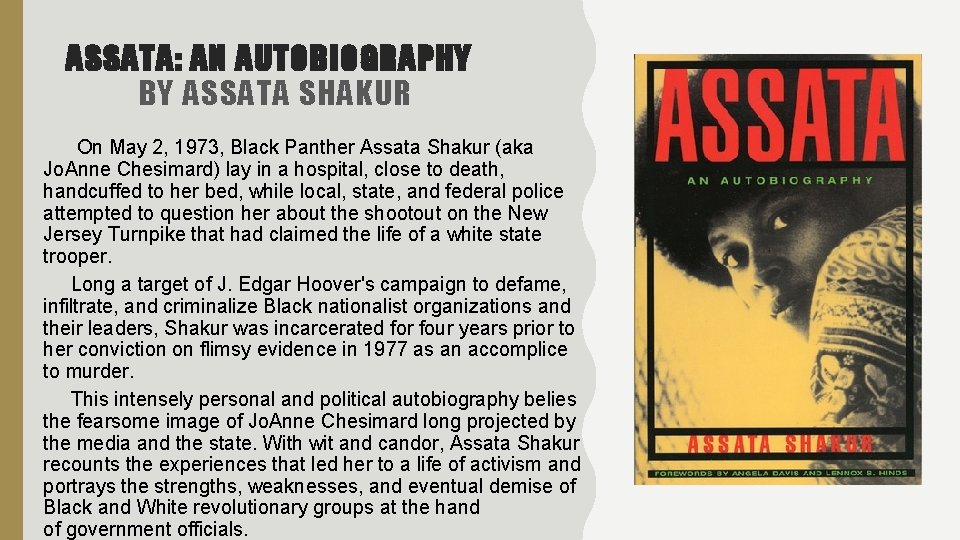
ASSATA: AN AUTOBIOGRAPHY BY ASSATA SHAKUR On May 2, 1973, Black Panther Assata Shakur (aka Jo. Anne Chesimard) lay in a hospital, close to death, handcuffed to her bed, while local, state, and federal police attempted to question her about the shootout on the New Jersey Turnpike that had claimed the life of a white state trooper. Long a target of J. Edgar Hoover's campaign to defame, infiltrate, and criminalize Black nationalist organizations and their leaders, Shakur was incarcerated for four years prior to her conviction on flimsy evidence in 1977 as an accomplice to murder. This intensely personal and political autobiography belies the fearsome image of Jo. Anne Chesimard long projected by the media and the state. With wit and candor, Assata Shakur recounts the experiences that led her to a life of activism and portrays the strengths, weaknesses, and eventual demise of Black and White revolutionary groups at the hand of government officials.
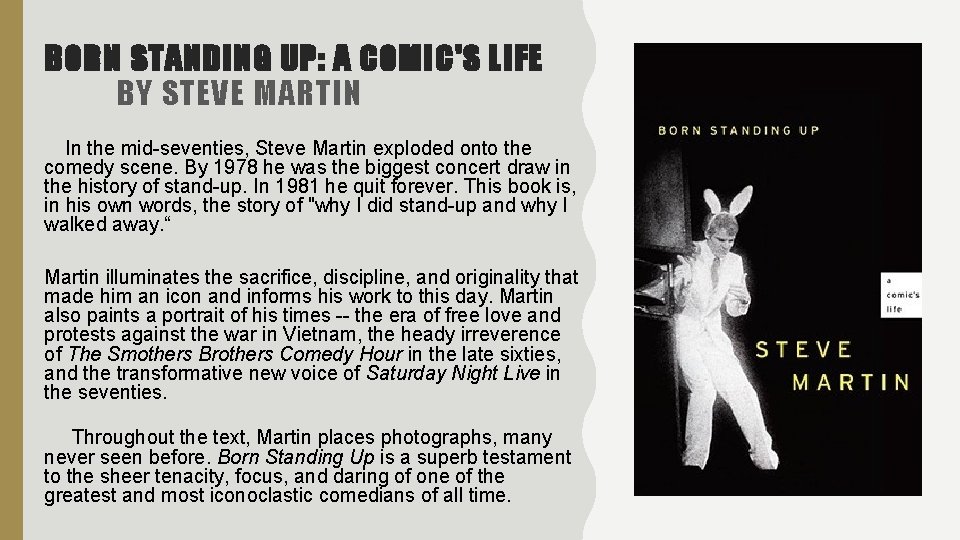
BORN STANDING UP: A COMIC'S LIFE BY STEVE MARTIN In the mid-seventies, Steve Martin exploded onto the comedy scene. By 1978 he was the biggest concert draw in the history of stand-up. In 1981 he quit forever. This book is, in his own words, the story of "why I did stand-up and why I walked away. “ Martin illuminates the sacrifice, discipline, and originality that made him an icon and informs his work to this day. Martin also paints a portrait of his times -- the era of free love and protests against the war in Vietnam, the heady irreverence of The Smothers Brothers Comedy Hour in the late sixties, and the transformative new voice of Saturday Night Live in the seventies. Throughout the text, Martin places photographs, many never seen before. Born Standing Up is a superb testament to the sheer tenacity, focus, and daring of one of the greatest and most iconoclastic comedians of all time.
A RIVER COULD BE A TREE BY ANGELA HIMSEL Angela Himsel was raised in a German-American family, one of eleven children who shared a single bathroom in their rented ramshackle farmhouse in Indiana. The Himsels followed an evangelical branch of Christianity—the Worldwide Church of God—which espoused a doomsday philosophy. With self-preservation in mind, she decided, at nineteen, to study at The Hebrew University in Jerusalem. But instead of strengthening her faith, Himsel was introduced to a whole new world—one with different people and perspectives. Her eyes were slowly opened to the church's shortcomings, even dangers, and fueled her natural tendency to question everything she had been taught, including the guiding principles of the church and the words of the Bible itself. Himsel's seemingly impossible road from childhood cult to a committed Jewish life is traced in and around the major events of the 1970 s and 80 s with warmth, humor, and a multitude of religious and philosophical insights. A River Could Be a Tree: A Memoir is a fascinating story of struggle, doubt, and personal fulfillment.
CLOSE READING ASSIGNMENT PART 1: ANNOTATING THE TEXT WHAT ARE WE ANNOTATING FOR?
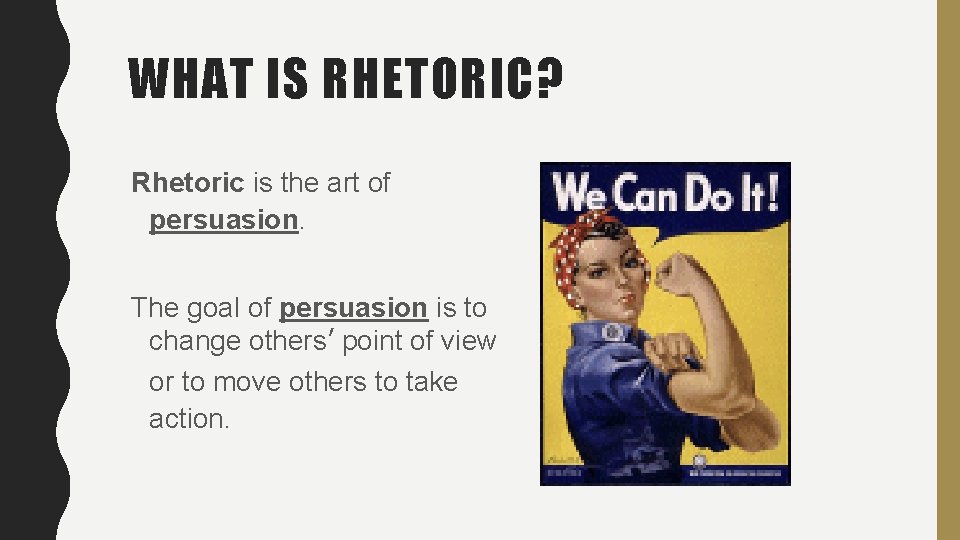
WHAT IS RHETORIC? Rhetoric is the art of persuasion. The goal of persuasion is to change others’ point of view or to move others to take action.
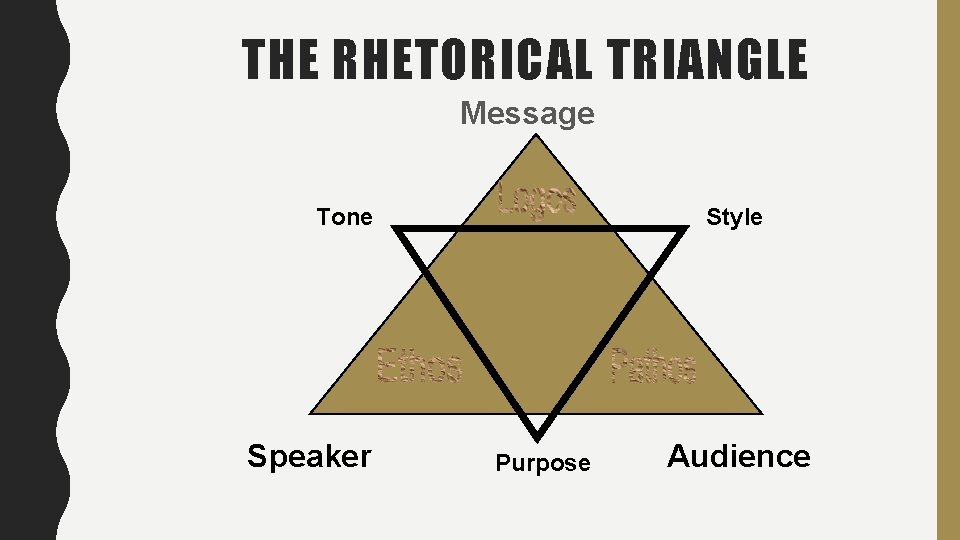
THE RHETORICAL TRIANGLE Message Tone Speaker Style Purpose Audience
LOGOS, ETHOS, PATHOS Making appeals to logos (logic), ethos (credibility, and pathos (emotion) will help you to master the art of persuasion. • Through language, you will be able to change the point of view of others! • Through language, you will be able to motivate others to take action!
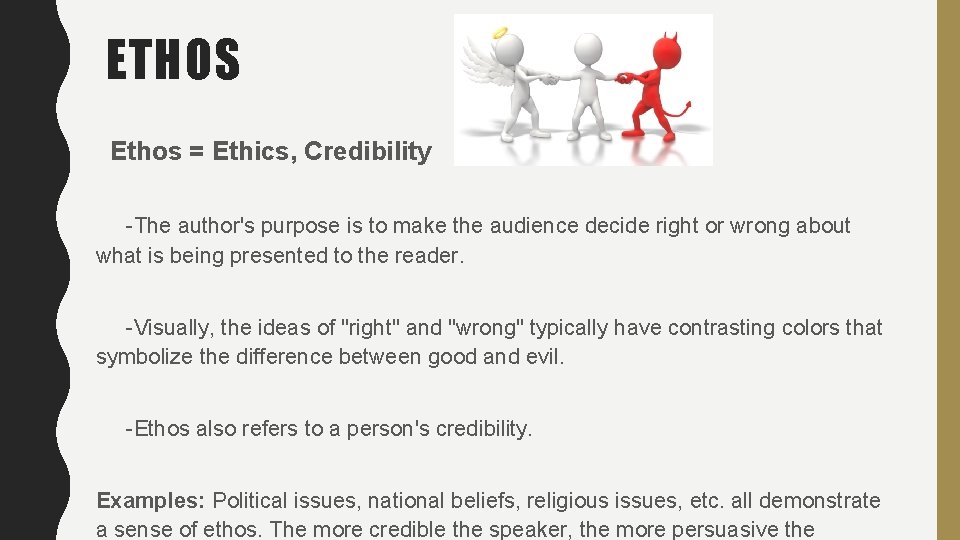
ETHOS Ethos = Ethics, Credibility -The author's purpose is to make the audience decide right or wrong about what is being presented to the reader. -Visually, the ideas of "right" and "wrong" typically have contrasting colors that symbolize the difference between good and evil. -Ethos also refers to a person's credibility. Examples: Political issues, national beliefs, religious issues, etc. all demonstrate a sense of ethos. The more credible the speaker, the more persuasive the
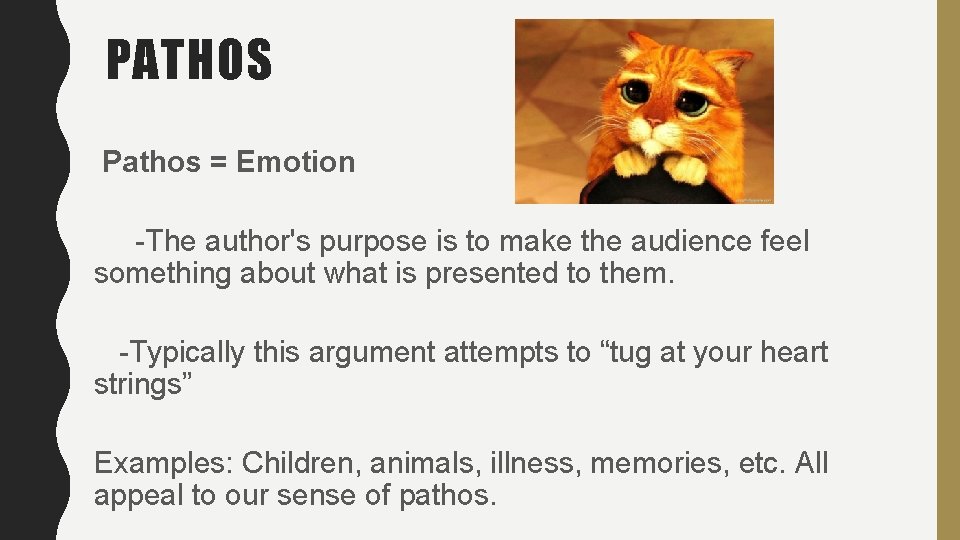
PATHOS Pathos = Emotion -The author's purpose is to make the audience feel something about what is presented to them. -Typically this argument attempts to “tug at your heart strings” Examples: Children, animals, illness, memories, etc. All appeal to our sense of pathos.
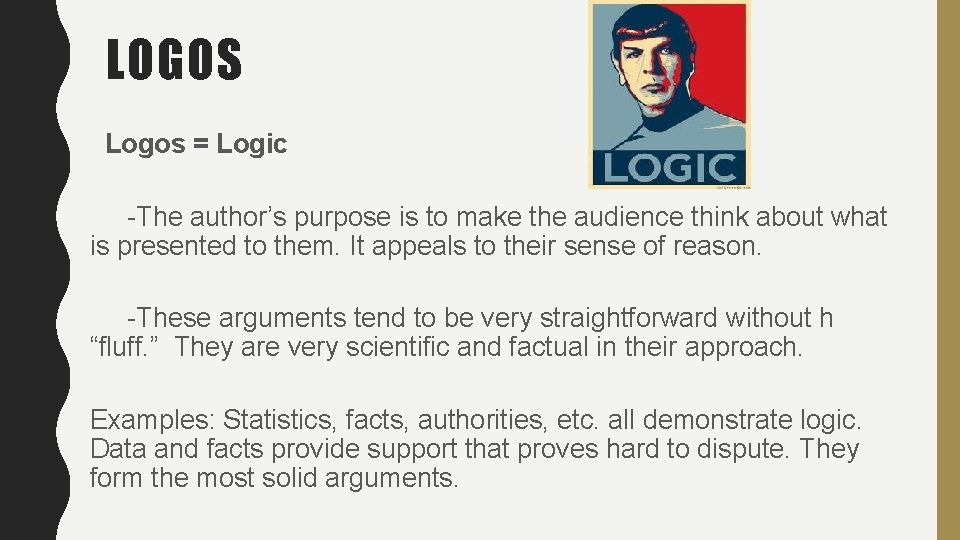
LOGOS Logos = Logic -The author’s purpose is to make the audience think about what is presented to them. It appeals to their sense of reason. -These arguments tend to be very straightforward without h “fluff. ” They are very scientific and factual in their approach. Examples: Statistics, facts, authorities, etc. all demonstrate logic. Data and facts provide support that proves hard to dispute. They form the most solid arguments.
CLOSE READING ASSIGNMENT PART 2: RHETORICAL ANALYSIS JOURNAL WHILE READING EACH WORK, YOU MUST COMPLETE A RHETORICAL JOURNAL ON YOUR SELECTED BOOK.
CLOSE READING ASSIGNMENT PART 2: RHETORICAL ANALYSIS JOURNAL • While reading each work, you must complete a rhetorical journal about your selected book. Your rhetorical journal must answer each of the questions listed on the critical reading guide. For each question, be sure to: • Rewrite the numbered question. • Write a strong answer which includes at least one specific, relevant quotation from the text. • Be sure to explain how the quotation you selected to include supports the way you answered the question. • You DO NOT have to work on these questions in order. Rather, when you notice an element of the book that fits into a critical reading question, do that question next. Just be sure to present your answers in number order upon completion and submission. • Each response should be a minimum of 5 -8 sentences.
CLOSE READING ASSIGNMENT PART 2 RHETORICAL ANALYSIS JOURNAL QUESTIONS 1) What is the Author’s Central Argument (the overall point)? How does the author comment on the central argument? 2) What is the tone of the text? What specific words contribute to that tone? 3) What is the writer’s purpose? (To explain? To inform? To persuade? To motivate? To amuse? ) Is there more than one purpose? Does the purpose shift at all throughout the text? 4) How does the writer arrange his/her ideas? (What are the patterns of arrangement? General to specific? Specific to general? Spatial? Chronological? ) 5) What is the sentence structure like in the text? Does the writer use fragments or run-ons? Declarative? Imperative? Interrogative? Exclamatory? Are they simple? Compound? Complex? Compound-complex? Short? Long? Loose? Periodic? Parallel? Are there any patterns in the sentence structure? Can you make any 6) How does the writer use diction? Is it formal? Informal? Technical? Jargon? Slang? Does the language change throughout the piece? How does the language contribute to the writer’s purpose? 7) Is there anything unusual in the writer’s use of punctuation? What punctuation or other techniques of emphasis (italics, capitals, underlining, ellipses, parentheses) does the writer use? Is punctuation over- or under used? Which marks does the writer use when, and for what effects? (Dashes to create a hasty breathlessness? Semi-colons for balance or contrast? ) 8) Are important terms repeated throughout the text? Why? 9) Are there any particularly vivid images that stand out? What effect do these images have on the writer’s purpose? 10) Does the writer use devices of humor? Puns? Irony? Sarcasm? Understatement? Is the effect
CLOSE READING ASSIGNMENT PART 3: RHETORICAL ANALYSIS ESSAY YOUR NEXT TASK IS TO TYPE A 3 -PAGE RHETORICAL ANALYSIS PAPER BASED ON YOUR SELECTED SUMMER READING BOOK.
CLOSE READING ASSIGNMENT PART 3: RHETORICAL ANALYSIS ESSAY Your essay must include: -A thought-provoking title. -An Introduction with a thesis statement (the purpose the author conveys). -2 -3 Body Paragraphs that discuss the rhetorical strategies used and gives specific examples from the text. (Each topic sentence MUST include a new rhetorical strategy that the author uses —you may need to look some up). -Direct quotes from the novel (use correct MLA parenthetical documentation) Example: “This is the sentence from the novel that is in my paper” (Smith 23). -A Conclusion that re-states thesis and transcends beyond a summary of what you have said. *AVOID PLOT SUMMARY* Parts Two and Three need to be typed and printed. Please adhere to MLA formatting guidelines. Due Date: This will need to be completed and turned in the second Monday of the first
AP LANG CONTACT INFORMATION: • Mr. Throne – Throne. A@fultonschools. org • Mr. Zand – Zand@fultonschools. org