
AP Lab 2 a s 1 7 Tissues
A&P Lab #2 a (#’s 1 -7) Tissues, Integument, & Endocrine System

Introduction 1. Complete laminate sheets provided by instructor.
Biological Hierarchy 2. Define the concept of a tissue and understand its place in the biological hierarchy (cells, tissues, organ systems, organism).
Biological Hierarchy • Cells are organized into layers or groups called tissues. • These tissues associate and interact to form organs and specialized functions.
Tissue Classification 3. List and briefly describe the four types of animal tissues.
Tissues • There are four major tissue types found in the body: epithelial, connective, muscle, and nervous.
Epithelial Tissue Characteristics 4. Describe the general characteristics and locations of epithelial tissue in the body.
Epithelial Tissue • Epithelium functions in protection, secretion, absorption, and excretion. • It is composed of tightly packed cells anchored to a basement membrane. • Epithelium lacks blood vessels and rapidly divides. • Epithelial tissues are classified by cell shape and number of cell layers.
Anatomical Planes/Sections 5. Demonstrate the four planes commonly used in anatomy. Using fruit, cut each piece of fruit into one of the listed planes/sections. Make sure to draw all from an anterior and interior perspective. Identify cross (transverse) sections, longitudinal (sagittal) sections, frontal, and oblique sections in various applications such as the whole body, a part of the body, or a tissue.

Histology – Epithelial Tissue 6. Using microscope images and illustrations, identify the following epithelial tissues and associated structures. Be sure that you know if you are looking at a cross, longitudinal, or oblique section. Identify at least one specific place in the body where each tissue type can be found, as indicated in the textbook. (For example, transitional – lines urinary bladder).
Histology – Epithelial Tissue (cont. ) 6. Specific Epithelial Structures: q Apical (free) surface q Basal lamina (basement membrane) q Mucous (goblet) cell q Cilia q Karatinocytes Note: A squamous cell that secretes the protein keratin is referred to as a keratinocyte. Keratinocytes are found in the epidermis of the skin.
Histology – Epithelial Tissue (cont. ) 6. Epithelial Tissue Samples: q Simple Squamous Epithelium q Simple Cuboidal Epithelium q Simple Columnar Epithelium q Stratified Squamous Epithelium q Ciliated Pseudostratified Columnar Epithelium q Transitional Epithelium
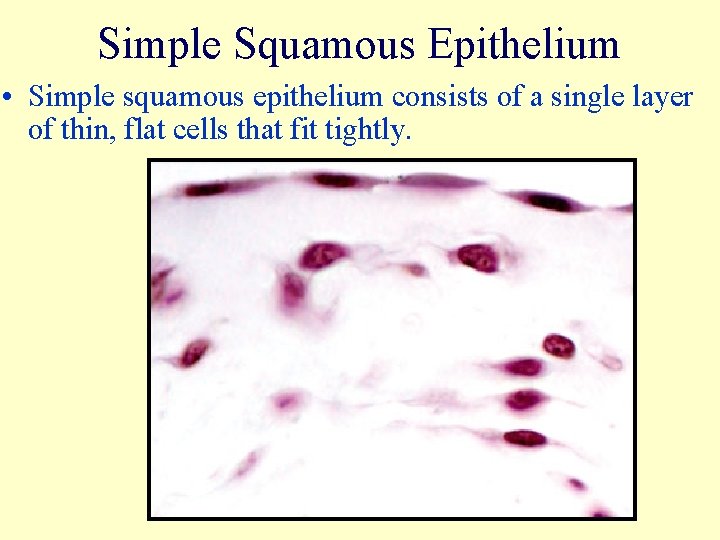
Simple Squamous Epithelium • Simple squamous epithelium consists of a single layer of thin, flat cells that fit tightly.
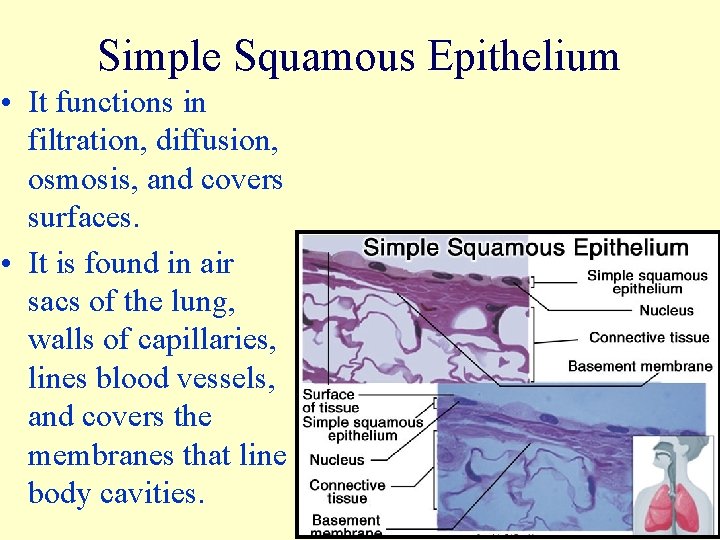
Simple Squamous Epithelium • It functions in filtration, diffusion, osmosis, and covers surfaces. • It is found in air sacs of the lung, walls of capillaries, lines blood vessels, and covers the membranes that line body cavities.
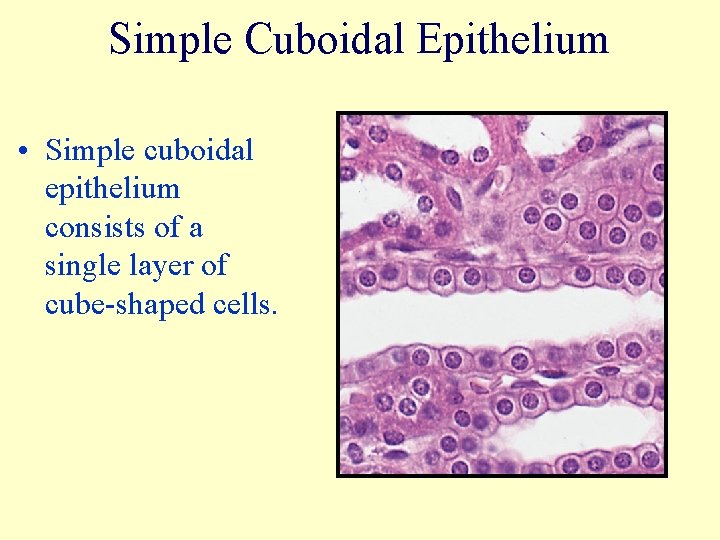
Simple Cuboidal Epithelium • Simple cuboidal epithelium consists of a single layer of cube-shaped cells.
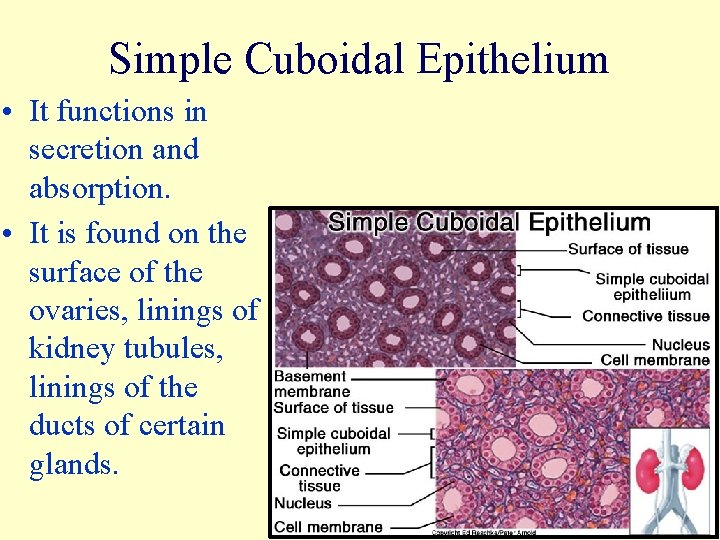
Simple Cuboidal Epithelium • It functions in secretion and absorption. • It is found on the surface of the ovaries, linings of kidney tubules, linings of the ducts of certain glands.
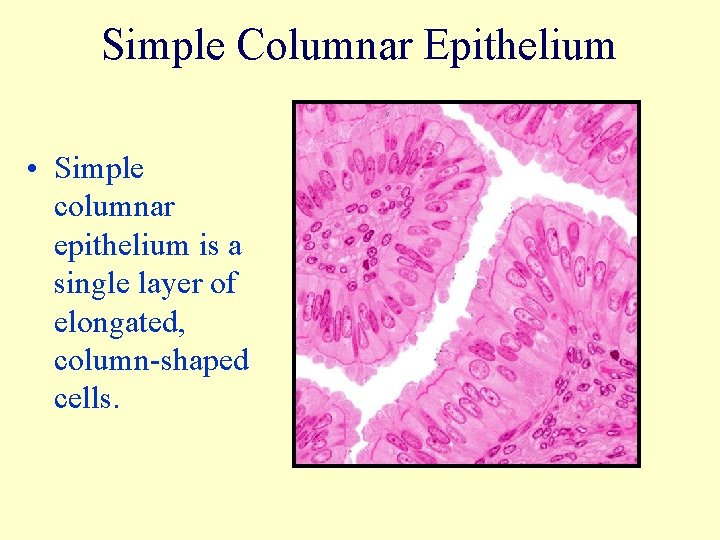
Simple Columnar Epithelium • Simple columnar epithelium is a single layer of elongated, column-shaped cells.
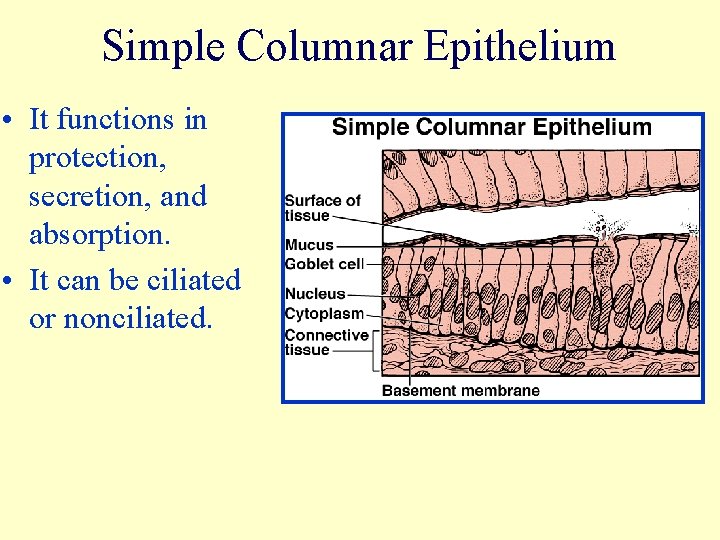
Simple Columnar Epithelium • It functions in protection, secretion, and absorption. • It can be ciliated or nonciliated.
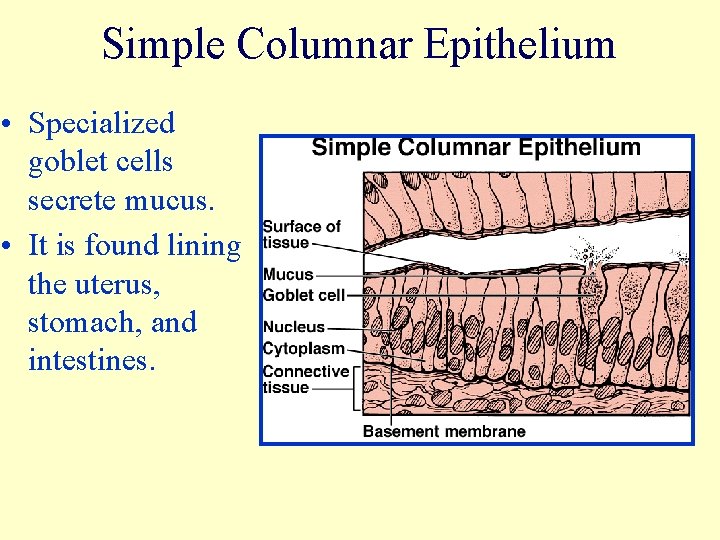
Simple Columnar Epithelium • Specialized goblet cells secrete mucus. • It is found lining the uterus, stomach, and intestines.
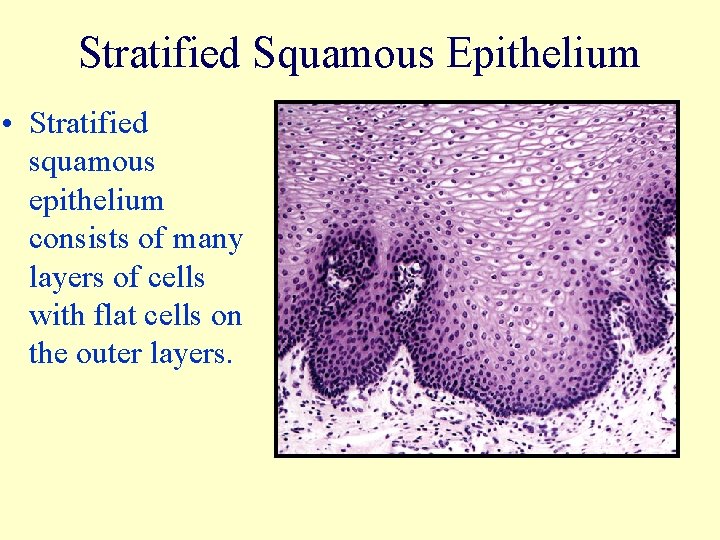
Stratified Squamous Epithelium • Stratified squamous epithelium consists of many layers of cells with flat cells on the outer layers.
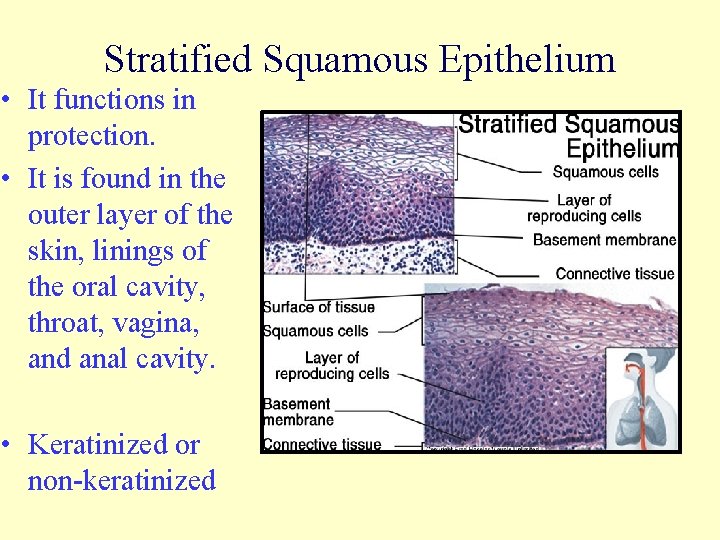
Stratified Squamous Epithelium • It functions in protection. • It is found in the outer layer of the skin, linings of the oral cavity, throat, vagina, and anal cavity. • Keratinized or non-keratinized
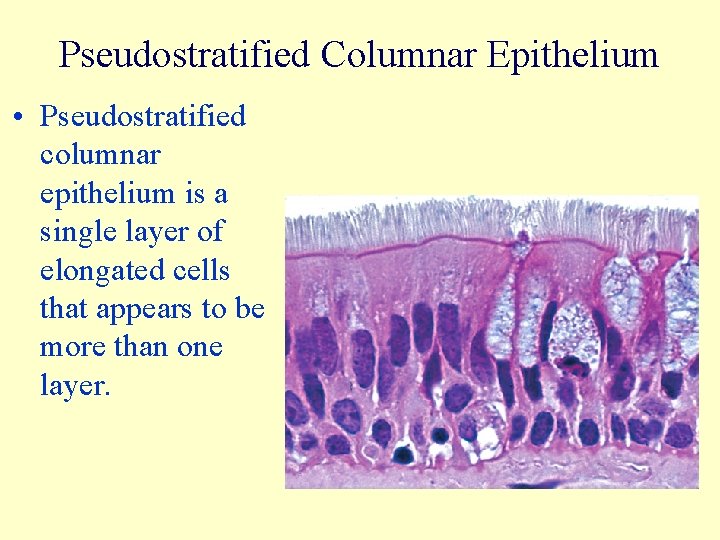
Pseudostratified Columnar Epithelium • Pseudostratified columnar epithelium is a single layer of elongated cells that appears to be more than one layer.
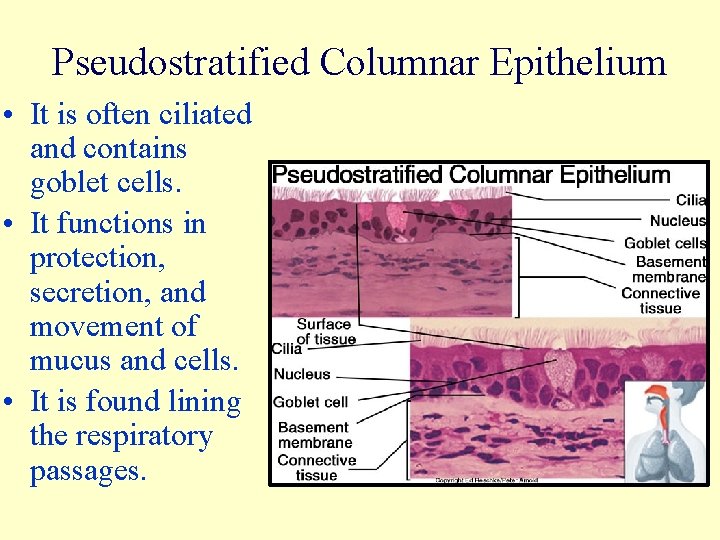
Pseudostratified Columnar Epithelium • It is often ciliated and contains goblet cells. • It functions in protection, secretion, and movement of mucus and cells. • It is found lining the respiratory passages.
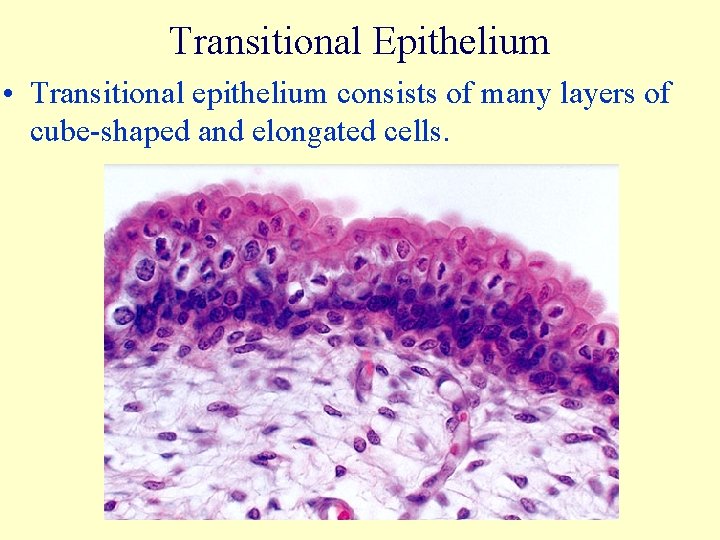
Transitional Epithelium • Transitional epithelium consists of many layers of cube-shaped and elongated cells.
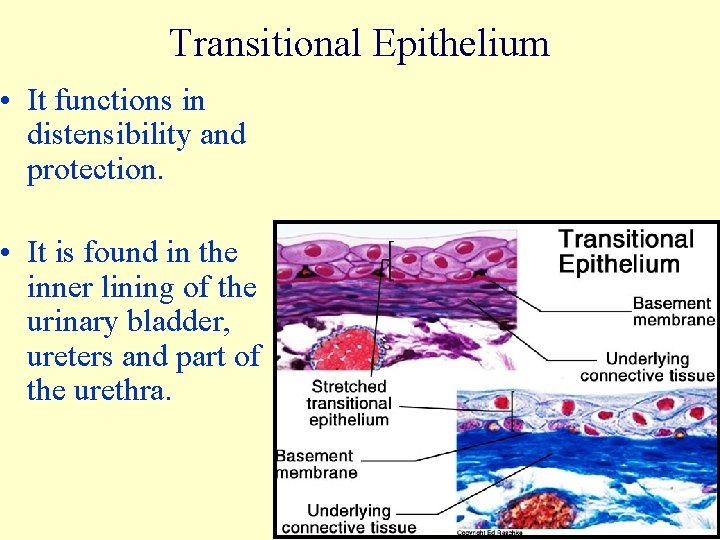
Transitional Epithelium • It functions in distensibility and protection. • It is found in the inner lining of the urinary bladder, ureters and part of the urethra.
Histology - Connective Tissue #7. Describe and identify the structural characteristics of the following connective tissues and their associated elements: q Connective tissue cells q Matrix: o Ground substance o Fibers: • Collagen fibers • Elastic fibers • Reticular fibers
Histology - Connective Tissue (cont. ) #7. Classification of Connective Tissue: q Loose connective tissue q Dense connective tissue q Special connective tissue: o Cartilage o Bone o Blood
Histology - Connective Tissue • Connective tissue is the most abundant tissue in the body. • Extracellular material, matrix, makes up the bulk of the tissue. • Matrix is composed of fibers and ground substance. • Connective tissue cells usually can divide.
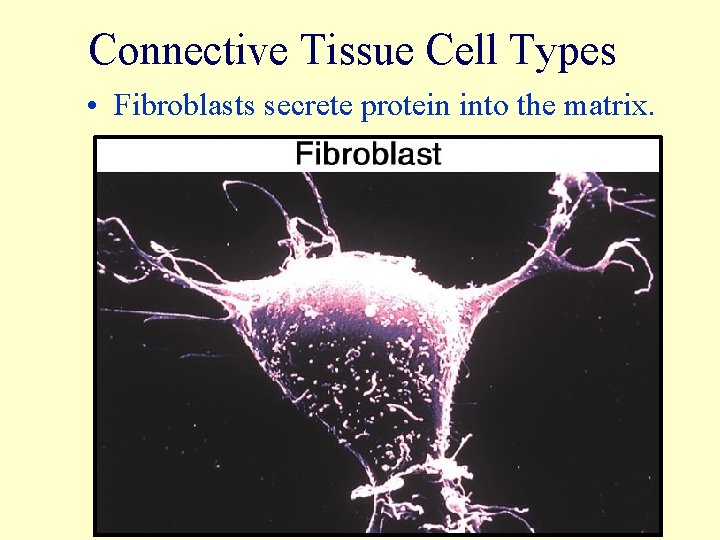
Connective Tissue Cell Types • Fibroblasts secrete protein into the matrix.
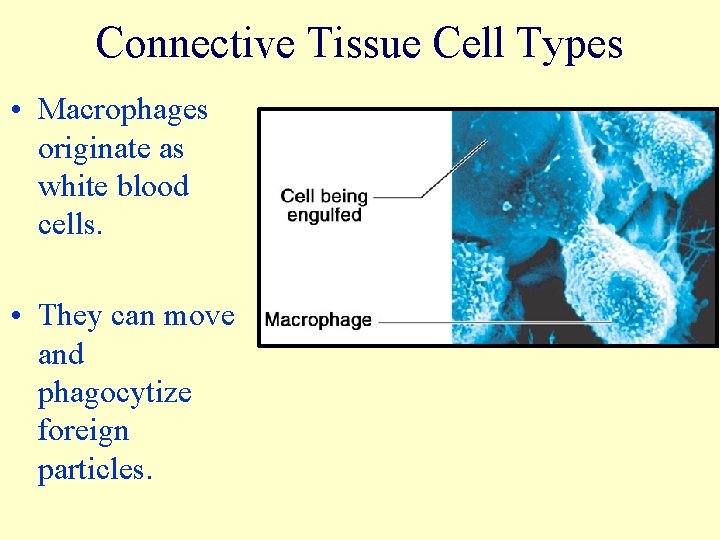
Connective Tissue Cell Types • Macrophages originate as white blood cells. • They can move and phagocytize foreign particles.
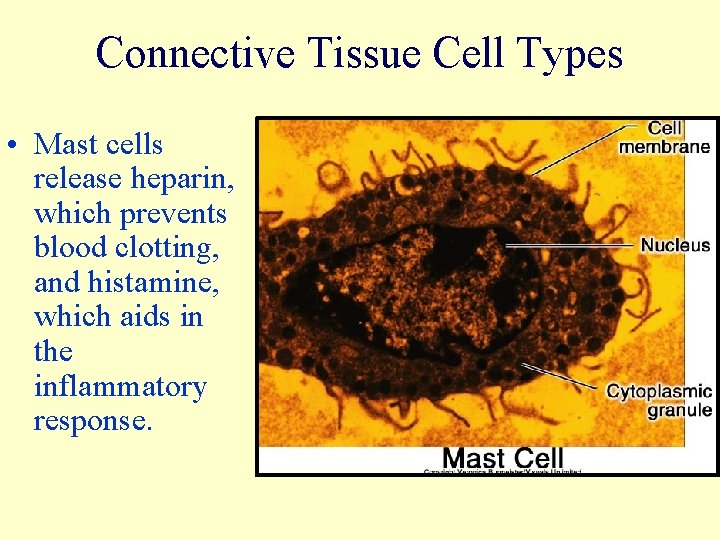
Connective Tissue Cell Types • Mast cells release heparin, which prevents blood clotting, and histamine, which aids in the inflammatory response.
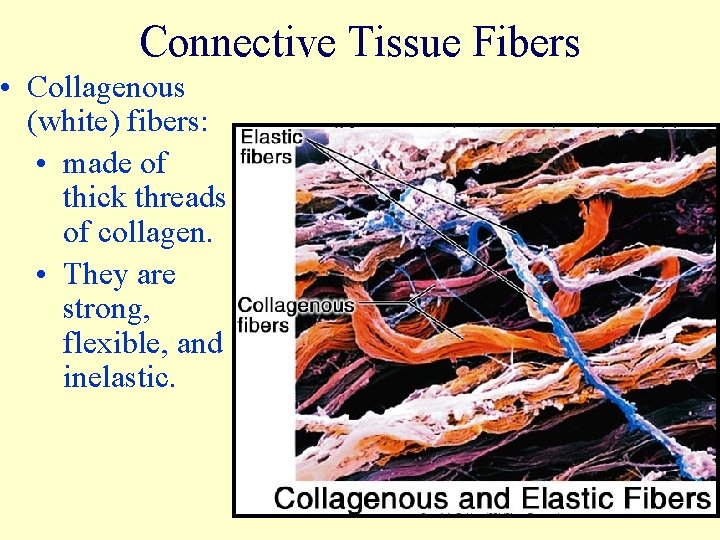
Connective Tissue Fibers • Collagenous (white) fibers: • made of thick threads of collagen. • They are strong, flexible, and inelastic.
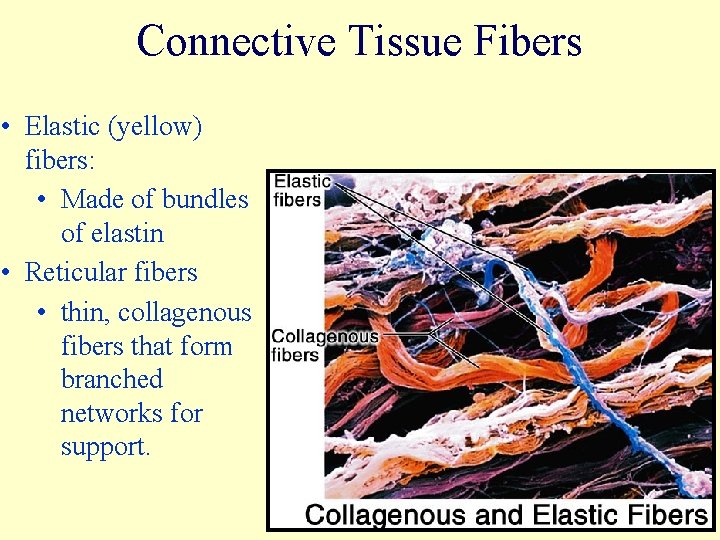
Connective Tissue Fibers • Elastic (yellow) fibers: • Made of bundles of elastin • Reticular fibers • thin, collagenous fibers that form branched networks for support.
Histology - Connective Tissue #7. Using microscope images & illustrations, be able to identify each of the following connective tissues and cite one specific body location where the tissue type would occur (e. g. , covering the ends of the long bone).
Histology - Connective Tissue #7. Samples of Connective Tissues: q q q q q Areolar (loose) connective tissue Adipose connective tissue Reticular connective tissue Dense regular connective tissue Dense elastic connective tissue Hyaline cartilage connective tissue Elastic cartilage connective tissue Fibrocartilage connective tissue Blood & Bone (to be examined in later labs)
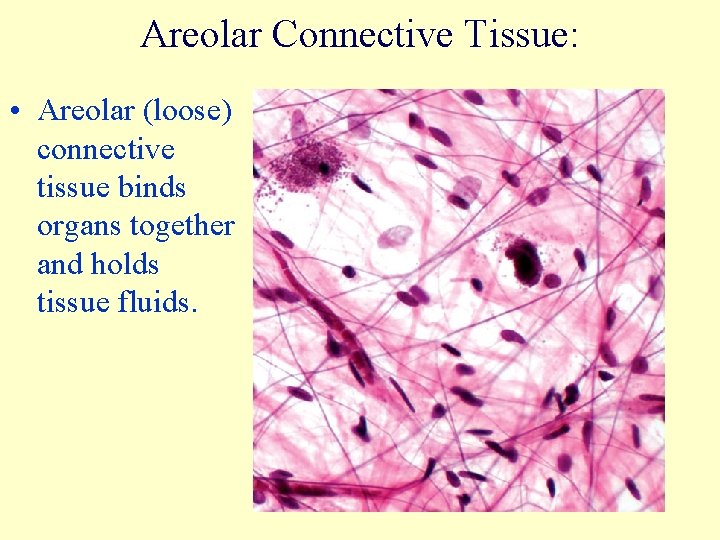
Areolar Connective Tissue: • Areolar (loose) connective tissue binds organs together and holds tissue fluids.
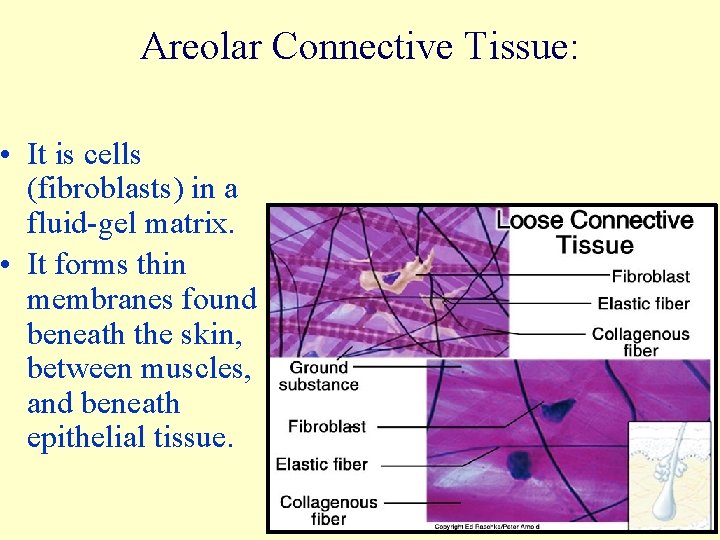
Areolar Connective Tissue: • It is cells (fibroblasts) in a fluid-gel matrix. • It forms thin membranes found beneath the skin, between muscles, and beneath epithelial tissue.
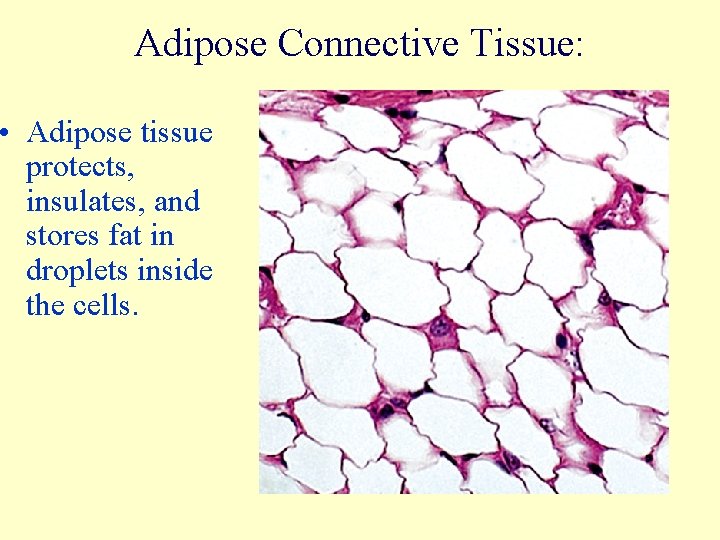
Adipose Connective Tissue: • Adipose tissue protects, insulates, and stores fat in droplets inside the cells.
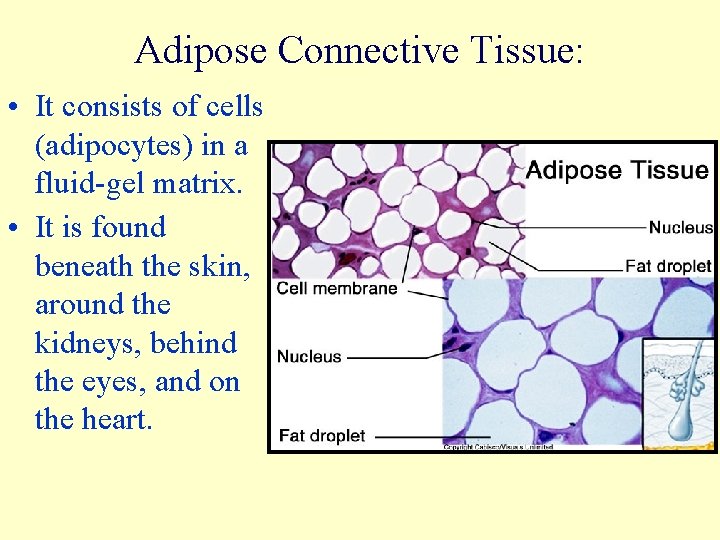
Adipose Connective Tissue: • It consists of cells (adipocytes) in a fluid-gel matrix. • It is found beneath the skin, around the kidneys, behind the eyes, and on the heart.
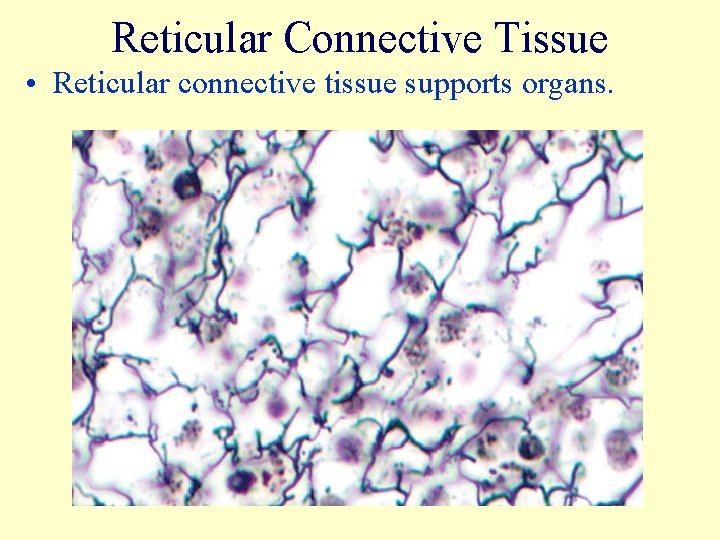
Reticular Connective Tissue • Reticular connective tissue supports organs.
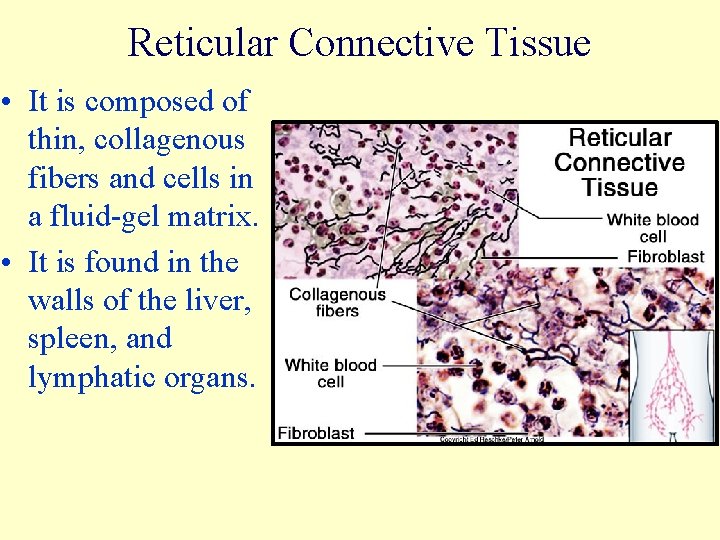
Reticular Connective Tissue • It is composed of thin, collagenous fibers and cells in a fluid-gel matrix. • It is found in the walls of the liver, spleen, and lymphatic organs.
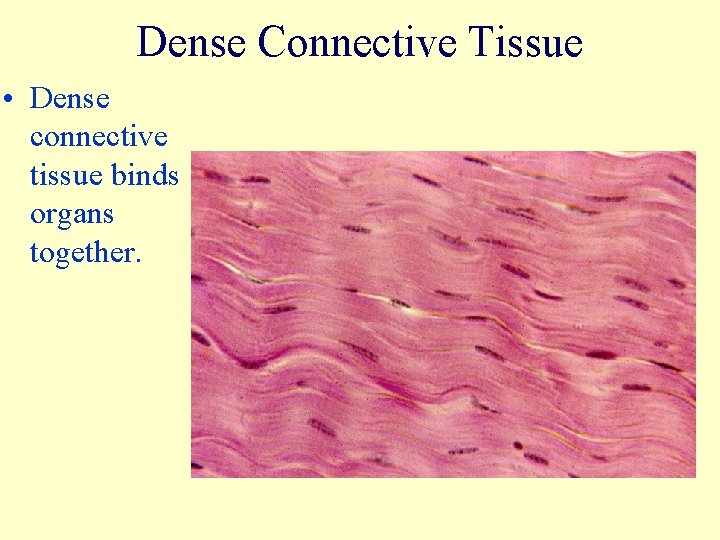
Dense Connective Tissue • Dense connective tissue binds organs together.
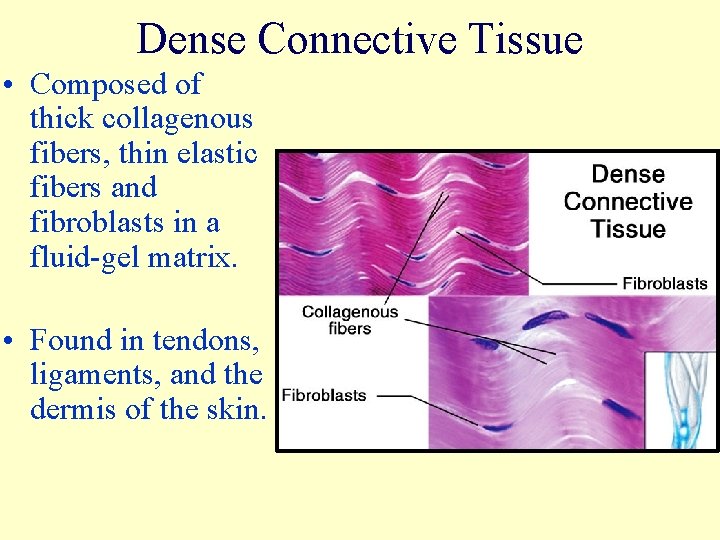
Dense Connective Tissue • Composed of thick collagenous fibers, thin elastic fibers and fibroblasts in a fluid-gel matrix. • Found in tendons, ligaments, and the dermis of the skin.
Characteristics of Cartilage • Cartilage is a rigid connective tissue. • The matrix consists of collagenous fibers in a gellike ground substance. • Cartilage cells, chondrocytes, are found in small chambers, lacunae. • Cartilage is covered with a thin layer of connective tissue, the perichondrium. • Cartilage lacks blood vessels.
Characteristics of Cartilage • Cartilage cells, chondrocytes, are found in small chambers, lacunae. • Cartilage is covered with a thin layer of connective tissue, the perichondrium. • Cartilage lacks blood vessels.
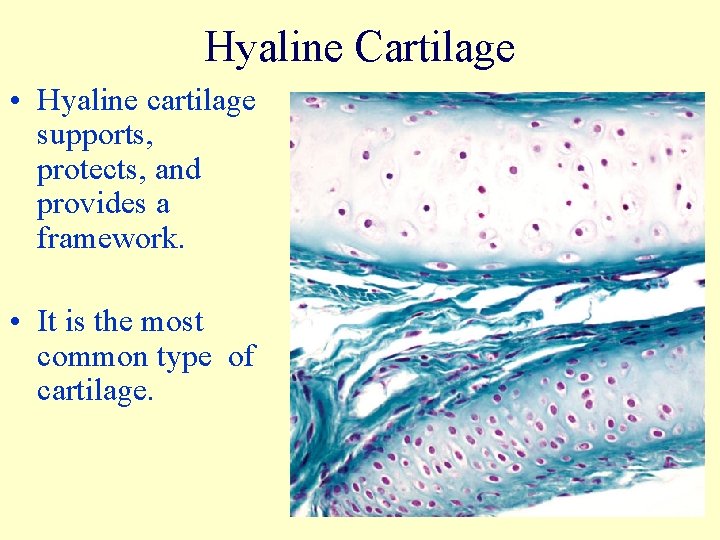
Hyaline Cartilage • Hyaline cartilage supports, protects, and provides a framework. • It is the most common type of cartilage.
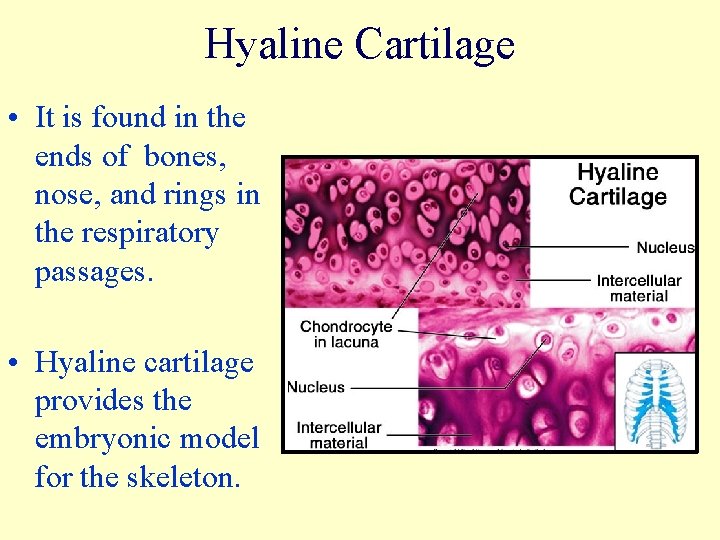
Hyaline Cartilage • It is found in the ends of bones, nose, and rings in the respiratory passages. • Hyaline cartilage provides the embryonic model for the skeleton.
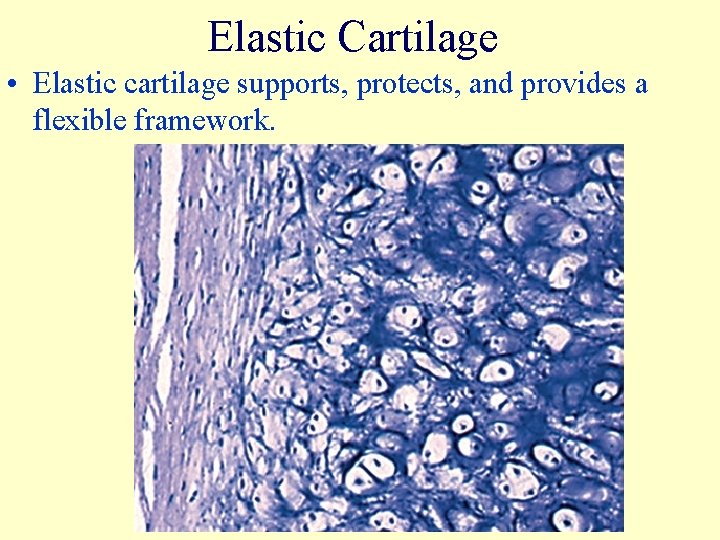
Elastic Cartilage • Elastic cartilage supports, protects, and provides a flexible framework.
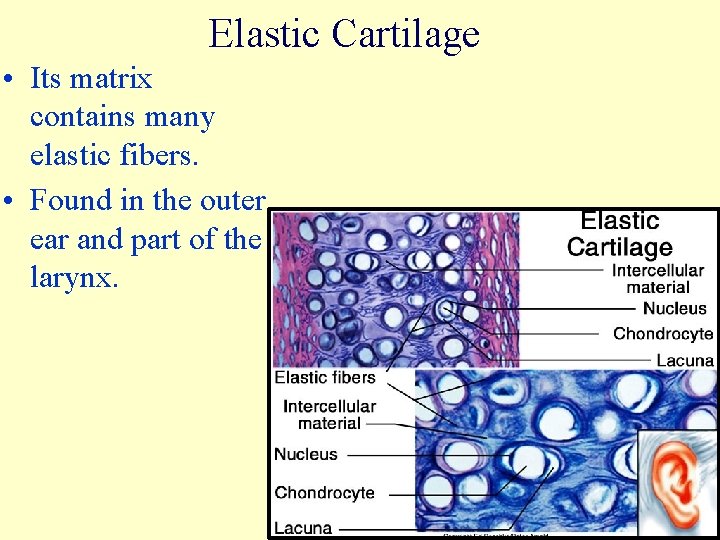
Elastic Cartilage • Its matrix contains many elastic fibers. • Found in the outer ear and part of the larynx.
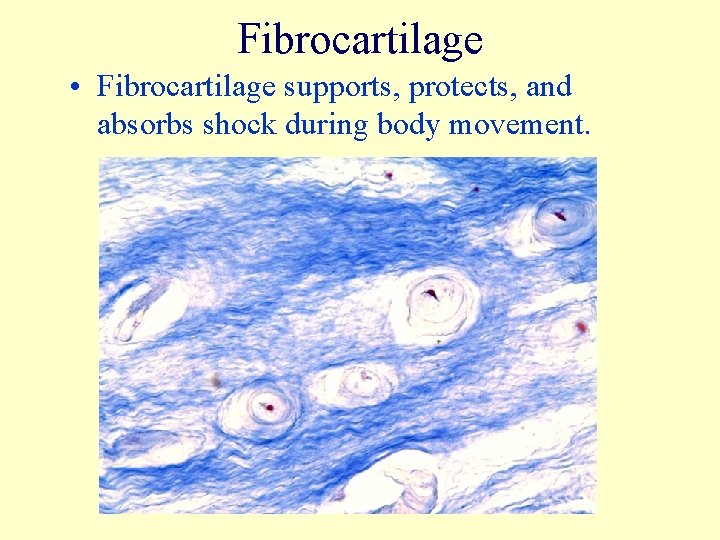
Fibrocartilage • Fibrocartilage supports, protects, and absorbs shock during body movement.
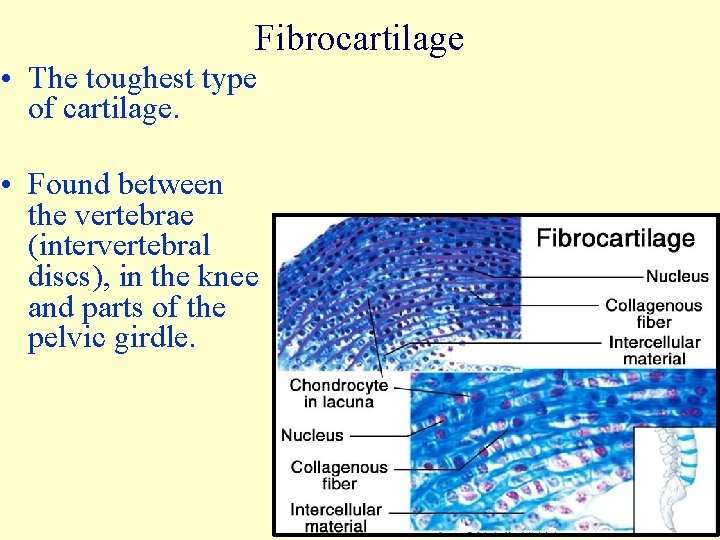
Fibrocartilage • The toughest type of cartilage. • Found between the vertebrae (intervertebral discs), in the knee and parts of the pelvic girdle.
Glandular Epithelium
Glandular Epithelium • Glandular epithelium is composed of cells that produce and secrete substances. • Exocrine glands secrete products into ducts. • Endocrine glands secrete products into tissue fluid or blood. • A unicellular exocrine gland is the mucoussecreting goblet cell.
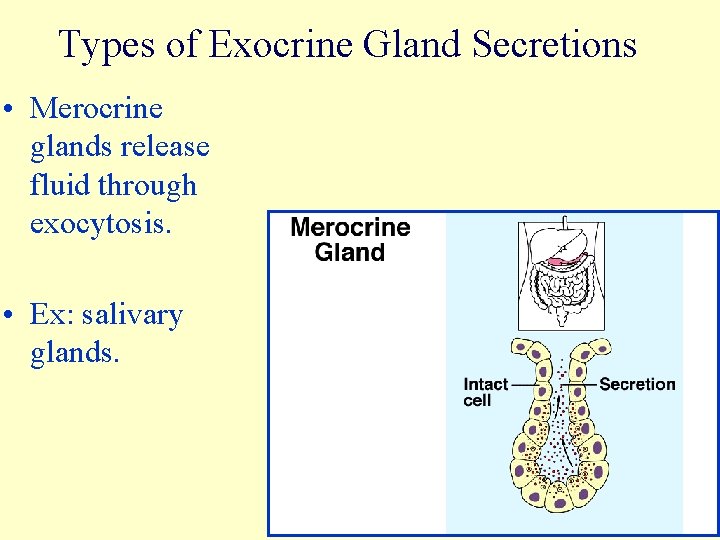
Types of Exocrine Gland Secretions • Merocrine glands release fluid through exocytosis. • Ex: salivary glands.
Merocrine Secretion • Most exocrine glands are merocrine. • There are two types of merocrine cells, serous and mucous. • Serous fluid is watery with a high enzyme concentration. • Mucous cells secrete a mucus, a thick fluid rich in the glycoprotein, mucin.
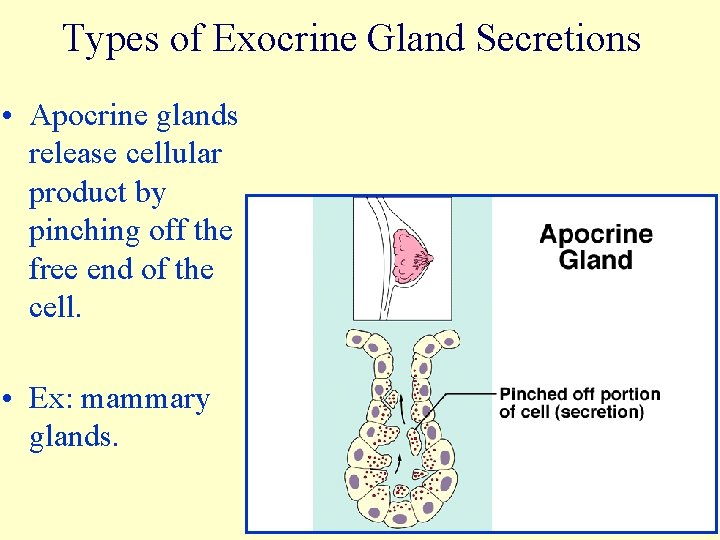
Types of Exocrine Gland Secretions • Apocrine glands release cellular product by pinching off the free end of the cell. • Ex: mammary glands.
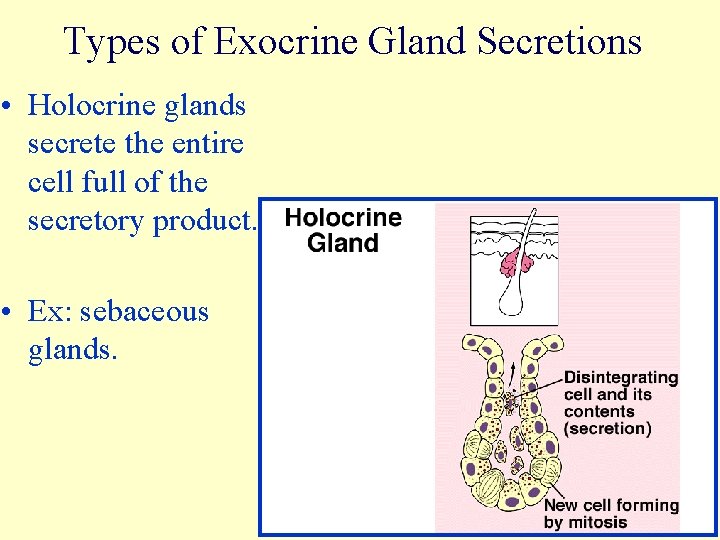
Types of Exocrine Gland Secretions • Holocrine glands secrete the entire cell full of the secretory product. • Ex: sebaceous glands.
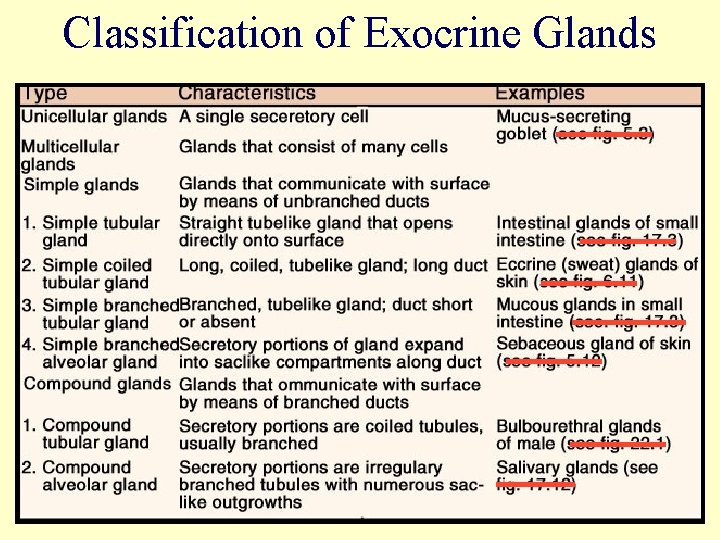
Classification of Exocrine Glands
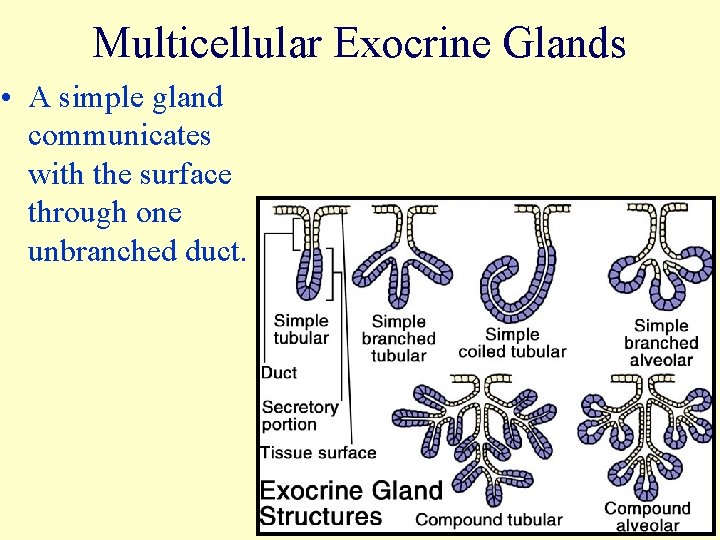
Multicellular Exocrine Glands • A simple gland communicates with the surface through one unbranched duct.
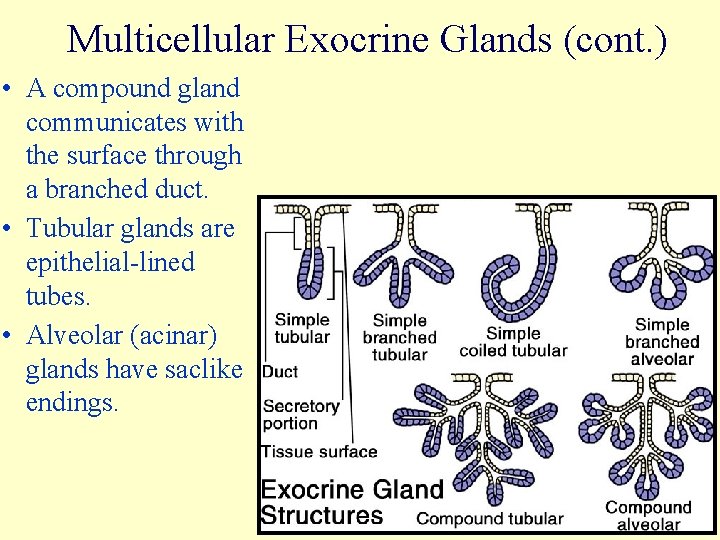
Multicellular Exocrine Glands (cont. ) • A compound gland communicates with the surface through a branched duct. • Tubular glands are epithelial-lined tubes. • Alveolar (acinar) glands have saclike endings.
- Slides: 61