
AP Government Review REVIEW AND DEFINE KEY TERMSANSWER
- Slides: 29
AP Government Review REVIEW AND DEFINE KEY TERMS/ANSWER QUESTIONS!
UNIT 1 Ch. 1 3: Constitutional Underpinnings Overview 5 15% The study of modern politics in the United States requires students to examine the kind of government established by the Constitution, paying particular attention to federalism and the separation of powers. Understanding these developments involves both knowledge of the historical situation at the time of the Constitutional Convention and an awareness of the ideological and philosophical traditions on which the framers drew. Such understanding addresses specific concerns of the framers: e. g. , Why did Madison fear factions? What were the reasons for the swift adoption of the Bill of Rights? Familiarity with the Supreme Court’s interpretation of key provisions of the Constitution will aid student understanding of theoretical and practical features of federalism and the separation of powers. Students should be familiar with a variety of theoretical perspectives relating to the Constitution, such as democratic theory, theories of republican government, pluralism, and elite theory. A. Considerations that influenced the formulation and adoption of the Constitution B. Separation of powers C. Federalism D. Theories of democratic government
Unit 1 Ch. 1 3 Define I. Theory of Modern Government Direct Democracy Grand committee Paticipatory Democracy Elite and Class Theory Government Hyperpluralism Linkage institution Loose construction Pluralism Policy Agenda Political Party Politics Public Policy Representative Democracy Strict constructionists
Unit I Ch. 1 3 Define II. Constitutional Foundations Anti Federalists Articles of Confederation Connecticut Compromise Consent of the governed Constitution Declaration of Independence John Locke influence Federalist Papers: #10, #51, #78 Brutus No. 1 Limited government Natural rights New Jersey Plan/Virginia Plan/Connecticut Compromise Shay’s Rebellion Three Fifths Compromise Unalienable rights
Unit I Ch. 1 3 Define III. The Constitution Bicameral Checks and balances Elastic clause Electoral college Enumerated powers Ex post facto laws Executive privilege Federalism Full faith and credit Judicial review Preamble Privileges and immunities Reserved power amendment Separation of power Supremacy clause
Unit I Ch. 1 3 Define IV. Federalism Tenth Amendment U. S. v. Lopez Block grants Categorical grants Competitive federalism (Devolution) Conflicted federalism Cooperative federalism Creative (Centralized) federalism Dual federalism Funded mandates Layer cake federalism Marble cake federalism Unfunded mandates
Unit 2 Ch. 4 5: Civil Rights and Civil Liberties Overview 5 15% An understanding of U. S. politics involves the study of the development of individual rights and liberties and their impact on citizens. Basic to this study is an analysis of the workings of the Supreme Court and an understanding of its most significant decisions. Students should examine judicial interpretations of various civil rights and liberties such as freedom of speech, assembly, and expression; the rights of the accused; and the rights of minority groups and women. For example, students should understand the legal, social, and political evolution following the Supreme Court’s decisions regarding racial segregation. Finally, it is important that students be able to assess the strengths and weaknesses of Supreme Court decisions as tools of social change. A. The development of civil liberties and civil rights by judicial interpretation B. Knowledge of substantive rights and liberties C. The impact of the 14 th Amendment on the constitutional development of rights and liberties.
Unit 2 Ch. 4 5 Define V. The Bill of Rights and Civil Liberties Bill of Rights: Describe each amendment Civil liberties Clear and Present Danger doctrine/Clear and Probable/ Incitement Cruel and Unusual punishment Due process (procedural due process) Establishment Clause Exclusionary rule Fighting words doctrine Barron v. Baltimore and Gitlow v. New York Mc. Donald v. Chicago Habeas Corpus Incorporation of the 14 th Amendment (Selective Incorporation) Indictment Miranda rights Separation of church and state Symbolic speech
Unit 2 Ch. 4 5 Define VI. Civil Rights: Equal Protection Under the Law Affirmative Action Americans with Disabilities Act Civil rights De facto segregation De jure segregation Jim Crow laws Plessy v. Ferguson (1896) (Separate but equal) Brown v. Board (I and II) Letter from Birmingham Jail National Organization for Women
Units 1 2: Answer Main Ideas Questions What are important cases that incorporated provisions of the Bill of Rights via the due process clause of the 14 th amendment? What are important cases that advanced civil rights and liberties? What are cases that strengthened power of federal government? States? What are the advantages and disadvantages of federalism?
Unit 3 Ch. 11 15: Institutions of the National Government Overview 35 45% Students must become familiar with the organization and powers, both formal and informal, of the major political institutions in the United States – the Congress, the presidency, the bureaucracy, and the federal courts. The functions these institutions perform and do not perform, as well as the powers that they do and do not possess, are important. It is necessary for students to understand that power balances and relationships between these institutions may evolve gradually or change dramatically as a result of crises. Students are also expected to understand ties between the various branches of national government and political parties, interest groups, the media, and state and local governments. For example, a study of the conflicting interests and powers of the President and Congress may help explain recent and repeated struggles to adopt a national budget.
Unit 3 Ch. 11 15 Overview Institutions of National Government: The Congress, the Presidency, the Bureaucracy, and the Federal Courts A. The major formal and informal institutional arrange ments of power B. Relationships among these four institutions, and varying balances of power C. Linkages between institutions and the following 1. Public opinion and voters 2. Interest groups 3. Political parties 4. The media 5. Sub national governments
Unit 3 Ch. 11 15: Define Congress Baker v. Carr and Shaw v. Reno Cloture/Filibuster Coalitions Conference Committee of the Whole Congressional oversight Regulatory policy, Gerrymandering Gridlock Trustee/Delegate/Politico Incumbents (Why do they so often win reelection? ) Logrolling Pork barrel legislation and Earmarks Reapportionment Standing committees Whips/Leadership in Congress
Unit 3 Ch. 11 15: Define Executive Bully pulpits Cabinet: Name each department EOP Line item veto Signing statements Station of the Union Bully Pulpit Federalist No. 70 National Security Council Pocket veto Riders Senatorial Courtesy Trial balloons WHO
Unit 3 Ch. 11 15: Define Judicial Branch Amicus curiae Federalist No. 78 Marbury v. Madison Civil law/Criminal Mc. Culloch v. Maryland Judicial activism Judicial restraint Judiciary committee Marshall Court/Warren Court/Rehnquist Court Original jurisdiction Stare decisis Writ of cert
Unit 3 Ch. 11 15: Define Bureaucracy Civil Service Reform Act Hatch Act Iron triangle Issue Networks Cabinet Departments Independent regulatory agencies Red tape Describe oversight of the bureaucracy
Unit 3: Answer Main Ideas Questions Origins of Congress List Formal and informal powers of Congress How does a bill become a law? Explain differences between House and Senate Origins of Executive Explain the process of presidential elections List various roles of the president How has presidential power evolved over time? Origins of Judiciary Federal Courts: structure, how judges are chosen, stages how S. C. decide cases, precedents How do the national institutions of government AND linkage institutions affect the policy making process?
Unit 4 Ch. 6, 9: Political Beliefs and Behaviors Overview 10 20% Individual citizens hold a variety of beliefs about their government, its leaders, and the political system in general. Taken together, these beliefs form the foundation of U. S. political culture. It is important for students to understand how these beliefs are formed, how they evolve and the processes by which they are transmitted. Specifically, why do Americans hold certain beliefs about politics, and how do families, schools, and the media act to perpetuate or change these beliefs? The ways in which these beliefs affect and inform political participation are also critical. For example, what do voting and protest mean to those who engage in them? Finally, it is essential that students understand what leads citizens to differ from one another in their political beliefs and behaviors. Why might a person from one ethnic or racial group have a different view of the American political process than someone from another group? And what are the political ramifications of these differences? A. Beliefs that citizens hold about their government and its leaders B. Processes by which citizens learn about politics C. The nature, sources, and consequences of public opinion D. The ways in which citizens vote and otherwise partici pate in political life E. Factors that influence citizens to differ from one another in terms of political beliefs and behaviors
Unit 4 Ch. 6, 9: Define VII. Voting Behavior and Public Opinion Voting Requirements Political socialization Lifecycle effects Generational effects Public opinion poll Benchmark tracking polls Civil Rights Act of 1964 Voting Rights Act of 1965 Voting Amendments
Unit 4 Ch. 6, 9: Define Soft Money—Buckley v. Valeo Delegates Direct primary (open/closed/Modified) Incumbency Advantage Frontloading Caucus National Convention PACS and Super PACS Bipartisan Campaign Finance Reform Act 2002 Citizens United v. FEC Super Tuesday (Super Duper) Bully pulpit Lobby Divided Government Ticket splitting (Split Ticketing)
Unit 4 Ch. 6, 9: Define General election Rational Choice voting Retrospective voting Party line voting Absentee voting Electors Winner take all system Electoral College Press: penny press, yellow journalism, muckraking, new media, fireside chats, talk radio, internet, horse races Media bias Media regulation
Unit 5 Ch. 7, 8, 10: Media, Political Parties, Interest Groups Relation between people and government Linkage Institutions Overview 10 20% Students should understand the mechanisms that allow citizens to organize and communicate their interest and concerns. Among these are political parties, elections, political action committees (PACs), interest groups, and the mass media. Students should examine the historical evolution of the U. S. party system, the functions and structures of political parties, and the effects they have on the political process. Examination of issues of party reform and of campaign strategies and financing in the electronic age provides students with important perspectives. A study of elections, election laws, and election systems on the national and state levels will help students understand the nature of both party and individual voting behavior. Treatment of the development and the role of PACs in elections, and ideological and demographic differences between the two major parties, as well as third parties, form an important segment of this material. Students must also consider the political roles played by a variety of lobbying and interest groups. Important features of this section of the course include an explanation for why some interests are represented by organized groups while others are not, and the consequences of these differences. Students study what interest groups do, how they do it, and how this affects both the political process and public policy. Why are certain segments of the population, such as farmers and the elderly, able to exert pressure on political institutions and actors in order to obtain favorable policies? The media have become a major force in U. S. politics. Students are expected to understand the role of the media in the political system. In addition, the impact of the media on public opinion, voter perceptions, campaign strategies, electoral outcomes, agenda development, and the images of officials and candidates should be explored and understood by students. Understanding the often symbiotic, and frequently conflictual relationship between candidates, elected officials, and the media is also important.
Unit 5 Ch. 7, 8, 10 Overview A. Political parties and elections 1. Functions 2. Organization 3. Development—Campaign Finance 4. Effects on the political process 5. Electoral laws and systems B. Interest groups, including political action committees (PACs) 1. The range of interests represented 2. The activities of interest groups 3. The effects of interest groups on the political process 4. The unique characteristics and roles of PACs in the political process C. The mass media 1. The functions and structures of the media 2. The impacts of media on politics
Unit 5 Ch. 7, 8, 10: Define Campaign finance reform Citizens United v. FEC Freedom of Information Act Interest groups Free Rider Problem Lobbyists Party de alignment and re alignment Party eras Party machine Party platforms Political Parties—Major/Third
Unit 4 5: Answer Main Ideas Questions What functions do the media perform? Explain the electoral process in the United States Voting requirements, Who votes? How do people vote? What functions do political parties perform? Why a two party system? Identify positive and negative impacts of interest groups. Interest groups: who join? What strategies do they use? Types/Examples?
Unit 6 Ch. 16 18: Public Policy Overview 5 15% Public policy is the result of interactions and dynamics among actors, interest groups, institutions, and processes. The formation of policy agendas, the enactment of public policies by Congress and the President, and the implementation and interpretation of policies by the bureaucracy and the courts are all stages in the policy process with which students should be familiar. Students should also investigate policy networks, iron triangles, and other forms of policy sub governments in the domestic and foreign policy areas. The study of these will give students a clear understanding of the impact of federalism, interest groups, parties, and elections on policy processes and policy making in the federal context. Policy making in a federal system The formation of policy agendas The role of institutions in the enactment of policy The role of the bureaucracy and the courts in policy implementation and interpretation Linkages between policy processes and the following: Political institutions and federalism Political parties interest groups Public opinion Elections Policy networks
Unit 6 Ch. 16 18: Define Block grants Entitlements Flat tax/Progressive tax/Regressive Medicare/Medicaid/Social Security Cold War—Containment, détente, domino theory Isolationism, NAFTA, SALT II
Foundational Documents: Summarize Each Doc. Federalist No. 10 Brutus No. 1 The Declaration of Independence The Articles of Confederation The Constitution of the United States (Articles and 27 amendments Federalist No. 51 Letter from a Birmingham Jail Federalist No. 70 Federalist No. 78
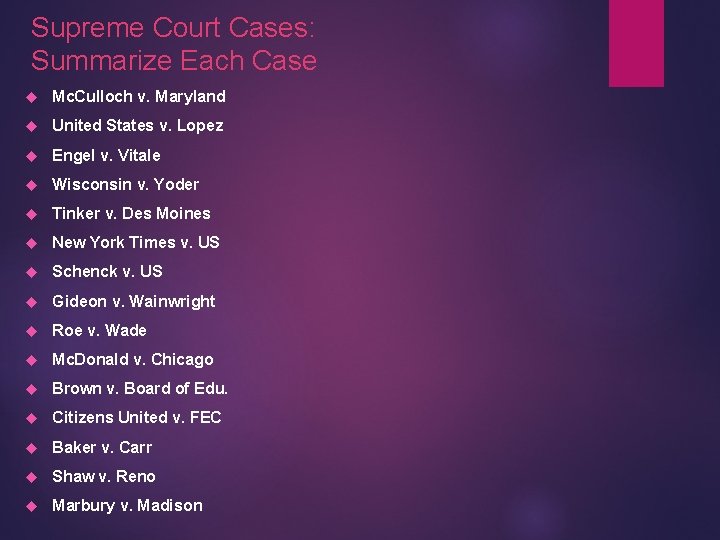
Supreme Court Cases: Summarize Each Case Mc. Culloch v. Maryland United States v. Lopez Engel v. Vitale Wisconsin v. Yoder Tinker v. Des Moines New York Times v. US Schenck v. US Gideon v. Wainwright Roe v. Wade Mc. Donald v. Chicago Brown v. Board of Edu. Citizens United v. FEC Baker v. Carr Shaw v. Reno Marbury v. Madison