
AP European History Test Overview and class explanation

- Slides: 14
AP European History Test Overview and class explanation
Things we will know when we are done 1. What are the components of the AP European History Exam 2. What skills should I have in order to receive credit 3. What themes are important to the AP European History class
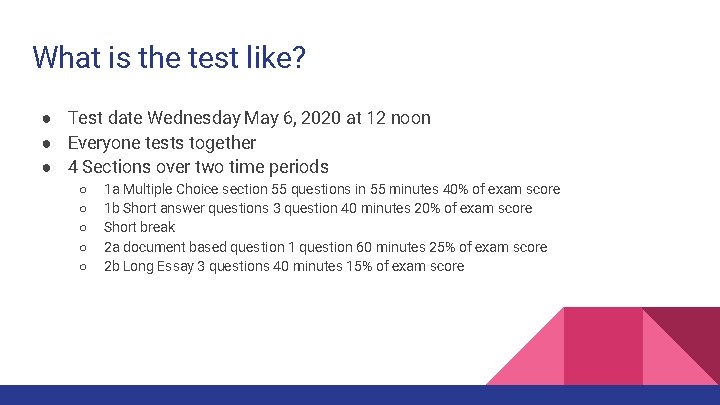
What is the test like? ● Test date Wednesday May 6, 2020 at 12 noon ● Everyone tests together ● 4 Sections over two time periods ○ ○ ○ 1 a Multiple Choice section 55 questions in 55 minutes 40% of exam score 1 b Short answer questions 3 question 40 minutes 20% of exam score Short break 2 a document based question 1 question 60 minutes 25% of exam score 2 b Long Essay 3 questions 40 minutes 15% of exam score
Multiple Choice Section 55 Questions | 55 Minutes | 40% of Exam Score ● Questions usually appear in sets of 3– 4 questions. ● Students analyze historical texts, interpretations, and evidence. ● Primary and secondary sources, images, graphs, and maps are included.
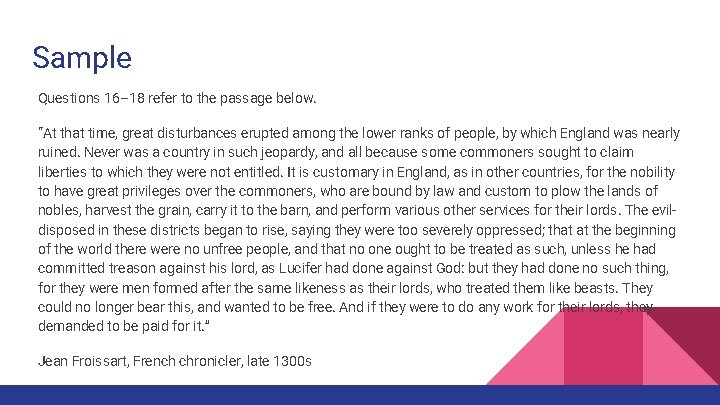
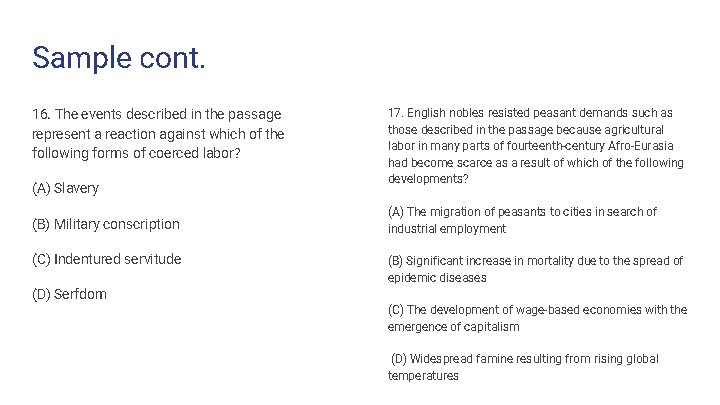
Sample Questions 16– 18 refer to the passage below. “At that time, great disturbances erupted among the lower ranks of people, by which England was nearly ruined. Never was a country in such jeopardy, and all because some commoners sought to claim liberties to which they were not entitled. It is customary in England, as in other countries, for the nobility to have great privileges over the commoners, who are bound by law and custom to plow the lands of nobles, harvest the grain, carry it to the barn, and perform various other services for their lords. The evildisposed in these districts began to rise, saying they were too severely oppressed; that at the beginning of the world there were no unfree people, and that no one ought to be treated as such, unless he had committed treason against his lord, as Lucifer had done against God: but they had done no such thing, for they were men formed after the same likeness as their lords, who treated them like beasts. They could no longer bear this, and wanted to be free. And if they were to do any work for their lords, they demanded to be paid for it. ” Jean Froissart, French chronicler, late 1300 s
Sample cont. 16. The events described in the passage represent a reaction against which of the following forms of coerced labor? (A) Slavery (B) Military conscription (C) Indentured servitude 17. English nobles resisted peasant demands such as those described in the passage because agricultural labor in many parts of fourteenth-century Afro-Eurasia had become scarce as a result of which of the following developments? (A) The migration of peasants to cities in search of industrial employment (B) Significant increase in mortality due to the spread of epidemic diseases (D) Serfdom (C) The development of wage-based economies with the emergence of capitalism (D) Widespread famine resulting from rising global temperatures
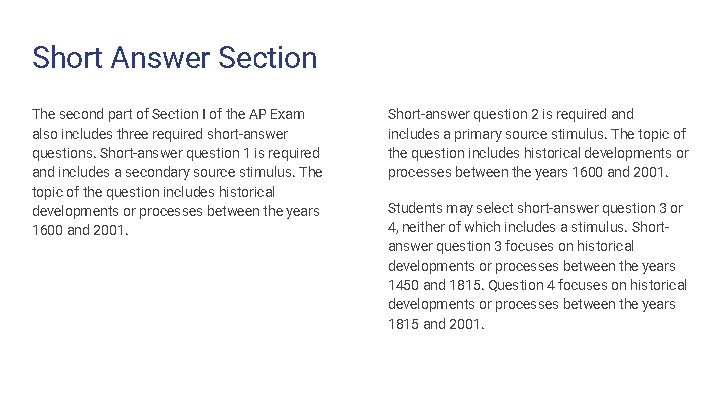
Short Answer Section The second part of Section I of the AP Exam also includes three required short-answer questions. Short-answer question 1 is required and includes a secondary source stimulus. The topic of the question includes historical developments or processes between the years 1600 and 2001. Short-answer question 2 is required and includes a primary source stimulus. The topic of the question includes historical developments or processes between the years 1600 and 2001. Students may select short-answer question 3 or 4, neither of which includes a stimulus. Shortanswer question 3 focuses on historical developments or processes between the years 1450 and 1815. Question 4 focuses on historical developments or processes between the years 1815 and 2001.
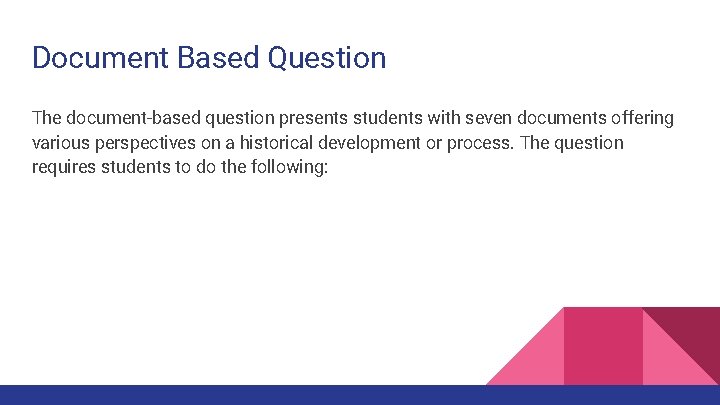
Document Based Question The document-based question presents students with seven documents offering various perspectives on a historical development or process. The question requires students to do the following:
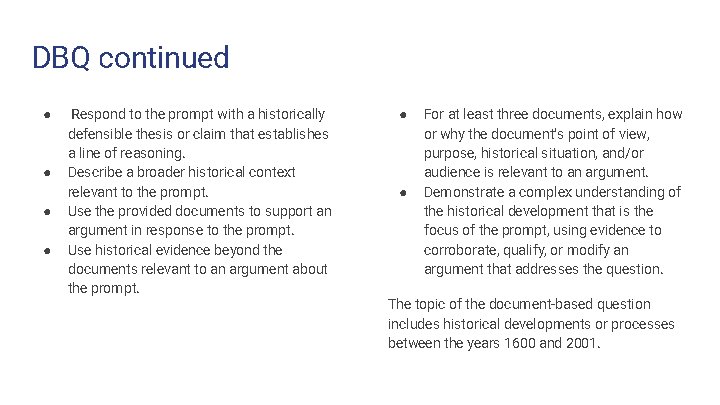
DBQ continued ● ● Respond to the prompt with a historically defensible thesis or claim that establishes a line of reasoning. Describe a broader historical context relevant to the prompt. Use the provided documents to support an argument in response to the prompt. Use historical evidence beyond the documents relevant to an argument about the prompt. ● ● For at least three documents, explain how or why the document’s point of view, purpose, historical situation, and/or audience is relevant to an argument. Demonstrate a complex understanding of the historical development that is the focus of the prompt, using evidence to corroborate, qualify, or modify an argument that addresses the question. The topic of the document-based question includes historical developments or processes between the years 1600 and 2001.
Long Essay Section The long essay question requires students to do the following: ● Respond to the prompt with a historically defensible thesis or claim that establishes a line of reasoning. ● Describe a broader historical context relevant to the prompt. ● Support an argument in response to the prompt using specific and relevant examples of evidence ● Demonstrate a complex understanding of the historical development that is the focus of the prompt, using evidence to corroborate, qualify, or modify an argument that addresses the question.
Long Essay Section Continued Students must select one of the three long essay questions. Each question focuses on the same reasoning process, but historical developments and processes in different time periods. The first option focuses primarily on historical developments or processes between 1450 and 1700, the second primarily on historical developments or processes between 1648 and 1914, and the third primarily on historical developments or processes between 1815 and 2001.
Historical Thinking Skills 1. Developments and Processes - Identify and explain historical developments and processes. 2. Sourcing and Situation - Analyze sourcing and situation of primary and secondary sources. 3. Claims and Evidence in Sources - Analyze arguments in primary and secondary sources. 4. Contextualization - Analyze the context of historical events, developments, or processes. 5. Making Connections - Using historical reasoning processes (comparison, causation, continuity and change) analyze patterns and connections between and among historical developments and processes. 6. Argumentation - Develop an Argument
Themes 1. 2. 3. 4. 5. 6. 7. Interaction of Europe and the World Economic and Commercial Developments Cultural and Intellectual Developments States and Other Institutions of Power Social Organization and development National and European Identity Technological and Scientific Innovation
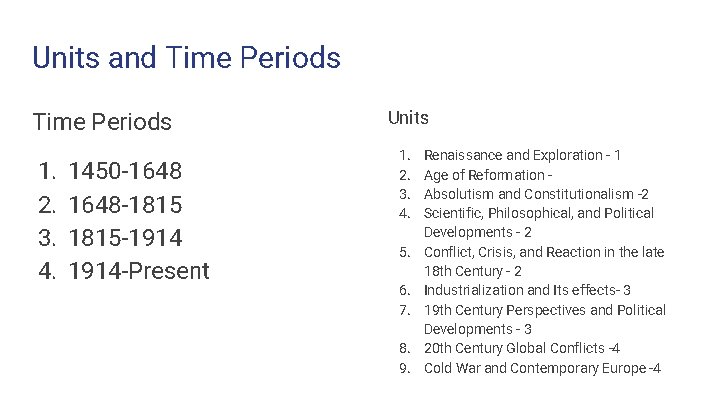
Units and Time Periods 1. 2. 3. 4. 1450 -1648 -1815 -1914 -Present Units 1. 2. 3. 4. 5. 6. 7. 8. 9. Renaissance and Exploration - 1 Age of Reformation Absolutism and Constitutionalism -2 Scientific, Philosophical, and Political Developments - 2 Conflict, Crisis, and Reaction in the late 18 th Century - 2 Industrialization and Its effects- 3 19 th Century Perspectives and Political Developments - 3 20 th Century Global Conflicts -4 Cold War and Contemporary Europe -4