
AP English Language and Composition Textual Examples of
- Slides: 55
AP English Language and Composition Textual Examples of Terms
Alliteration • Yes, I have • The read that repetition of little bundle initial of pernicious consonant prose, but I sounds, have no such as comment to "Peter Piper make upon it. picked a peck of pickled peppers. " al-lit'-er-a'-tion
Antithesis • The • Though presentation of surprising, two contrasting it is true; images. The ideas are though balanced by frightening word, phrase, at first, it is clause or paragraphs. really harmless. an-tith'-e-sis
Climax • The concerto was applauded at the house of Baron von Schnooty, it was praised highly at court, it was voted best concerto of the year by the Academy, it was considered by Mozart the highlight of his career, and it has become known today as the best concerto in the world. • The point of highest interest in a literary work. cli'-max
Epizeuxis • The best • The way to repetition of describe this one word or portion of a short South phrase. America is lush, lush. e-pi-zook'-sis
Metanoia • The chief thing • Qualifies a statement or to look for in part of a impact sockets statement by is hardness; rejecting it or no, not so calling it back much and hardness as expressing it resistance to in a better, shock and milder, or shattering. stronger way. me-tə-ˈno i-ə
Polysyndeton • They read • The use, for and studied rhetorical and wrote effect, of more and drilled. I conjunctions laughed and than is played and necessary or talked and natural. flunked. pol-y-syn'-de-ton
Allusion • You must • A reference to borrow me another more Gargantua's famous work mouth first. (such as the 'Tis a word too Bible and great for any Mythology) mouth of this contained in a age's size. – work. Shakespeare. uh-loo-zhuhn
Apophasis • Of course, I • do not need to mention that you should bring a No. 2 pencil to the exam. Brings up a subject by pretending not to bring it up. a-pof'-a-sis
Procatalepsis • But you might object that, if what I say is actually true, why would people buy products advertised illogically? The answer to that lies in human psychology. . . • Anticipates an objection that might be raised by a reader and responds to it. pro-cat-a-lep'-sis
Amplification • In my hunger after ten days of rigorous dieting I saw visions of ice cream-mountains of creamy, luscious ice cream, dripping with gooey syrup and calories. • Consists of restating a word or idea and adding more detail. am-pluh-fi-key-shuhn
Aporia • I am not sure whether to side with those who say that higher taxes reduce inflation or with those who say that higher taxes increase inflation. • Expresses a doubt about a fact, idea, or conclusion. a-po'-ri-a
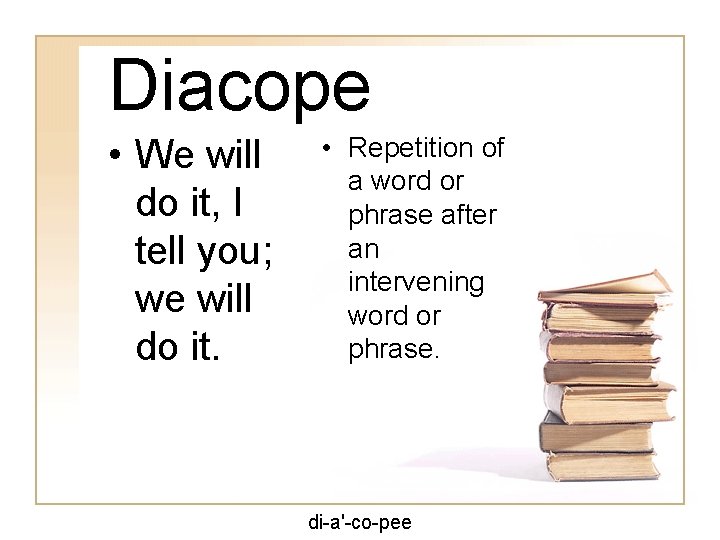
Diacope • We will do it, I tell you; we will do it. • Repetition of a word or phrase after an intervening word or phrase. di-a'-co-pee
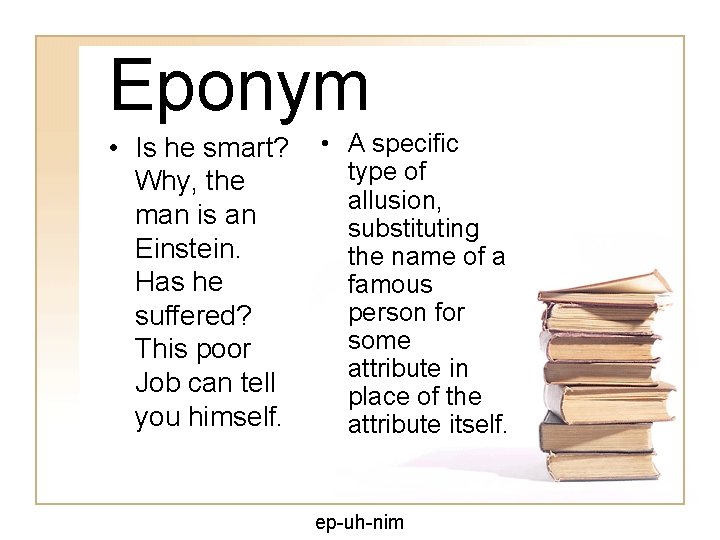
Eponym • Is he smart? • A specific type of Why, the allusion, man is an substituting Einstein. the name of a Has he famous person for suffered? some This poor attribute in Job can tell place of the you himself. attribute itself. ep-uh-nim
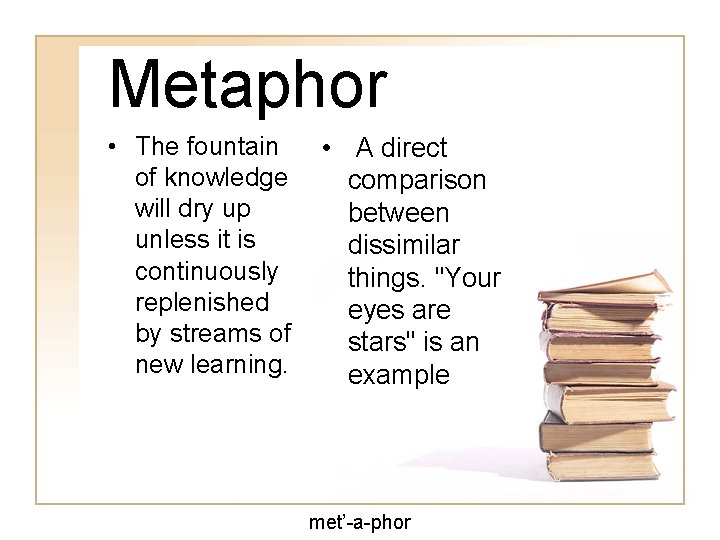
Metaphor • The fountain • A direct of knowledge comparison will dry up between unless it is dissimilar continuously things. "Your replenished eyes are by streams of stars" is an new learning. example met’-a-phor
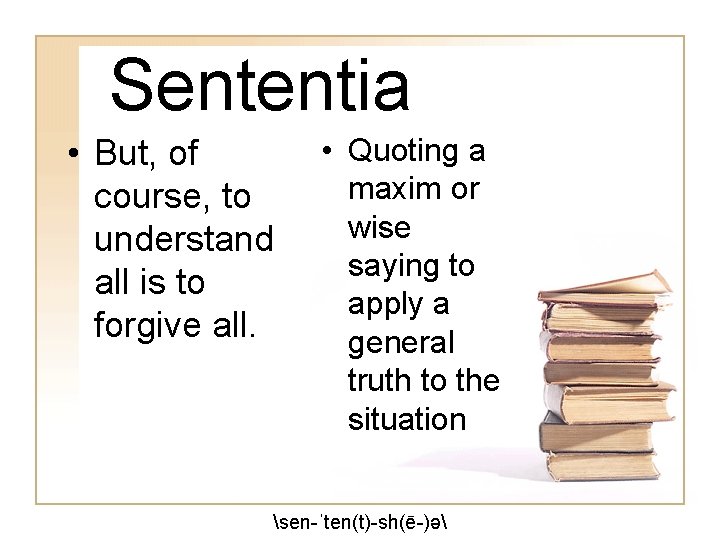
Sententia • But, of course, to understand all is to forgive all. • Quoting a maxim or wise saying to apply a general truth to the situation sen-ˈten(t)-sh(ē-)ə
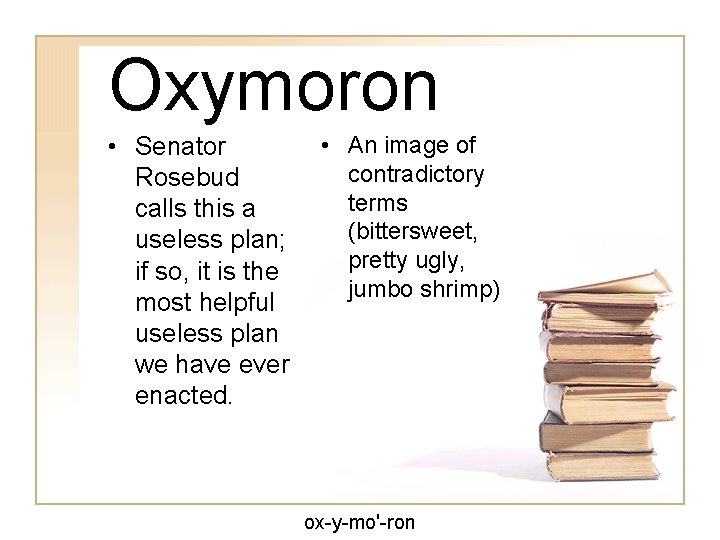
Oxymoron • An image of • Senator contradictory Rosebud terms calls this a (bittersweet, useless plan; pretty ugly, if so, it is the jumbo shrimp) most helpful useless plan we have ever enacted. ox-y-mo'-ron
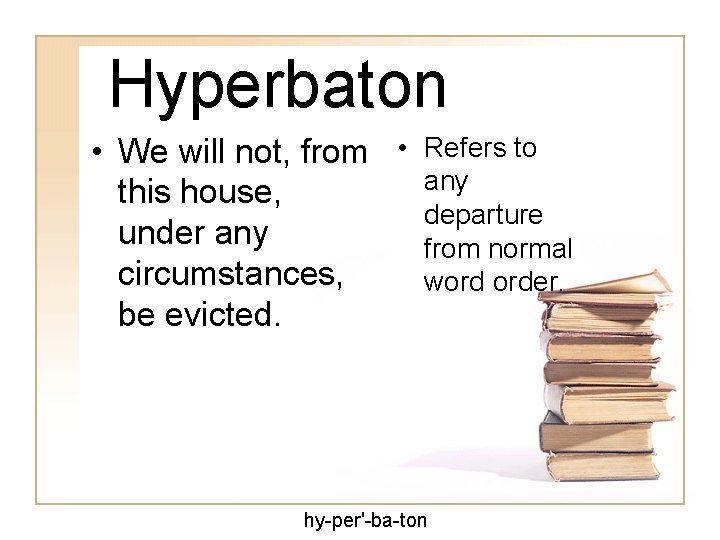
Hyperbaton • We will not, from • Refers to any this house, departure under any from normal circumstances, word order. be evicted. hy-per'-ba-ton
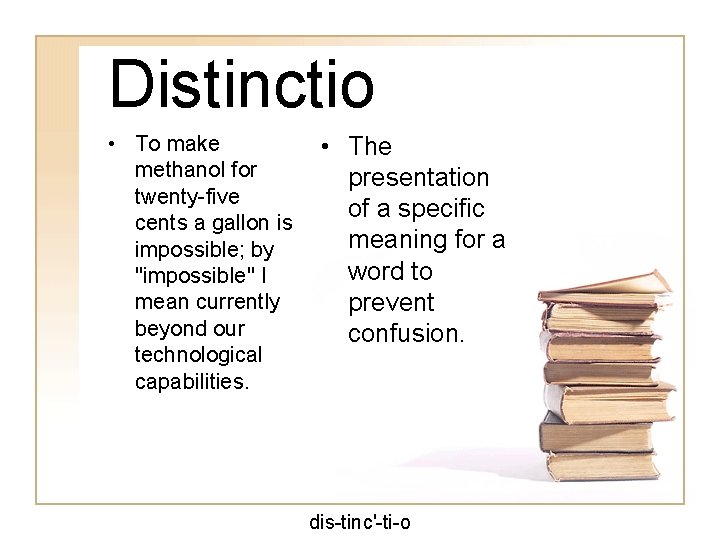
Distinctio • To make • The methanol for presentation twenty-five of a specific cents a gallon is meaning for a impossible; by word to "impossible" I mean currently prevent beyond our confusion. technological capabilities. dis-tinc'-ti-o
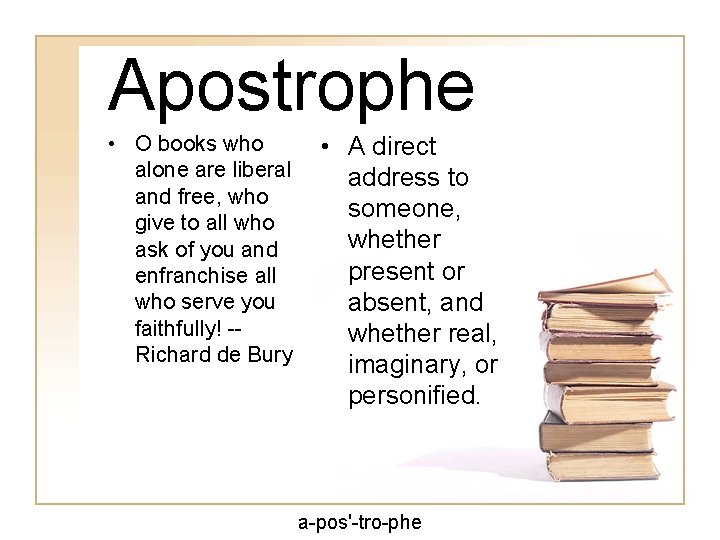
Apostrophe • O books who • A direct alone are liberal address to and free, who someone, give to all who whether ask of you and present or enfranchise all who serve you absent, and faithfully! -- whether real, Richard de Bury imaginary, or personified. a-pos'-tro-phe
Anadiplosis • In the beginning was the Word, and the Word was with God, and the Word was God. --John 1: 1 • Formed by the repetition of the last word or words of a sentence or clause at or very near the beginning of the next. an'-a-di-plo'-sis
Scesis Onomaton • But there is one thing these glassy-eyed idealists forget: such a scheme would be extremely costly, horrendously expensive, and require a ton of money. • Emphasizes an idea by expressing it in a string of generally synonymous phrases or statements. ske'-sis o-no'-ma-ton
Onomatopoeia • The flies • Words that buzzing and sound like whizzing the sound around their they ears kept them represent from finishing (hiss, gurgle, the experiment at the swamp. pop) on-o-mat-o-pee'-a
Expletive • But the lake was not, in fact, drained before April. • An interjection to lend emphasis; sometimes a profanity. ek-spli-tiv
Dirimens Copulatio • This car is extremely sturdy and durable. It's low maintenance; things never go wrong with it. Of course, if you abuse it, it will break. • Mentioning a balancing or opposing fact to prevent the argument from being onesided or unqualified: di'-ri-mens ko-pu-la'-ti-o
Aposiopesis • I've got to make the team or I'll--. • Stopping abruptly and leaving a statement unfinished: a-pos-i-o-pee’-sis
Anacoluthon • And then the • A sentence deep rumble whose two from the pieces do not fit explosion together began to grammatically shake the very bones of--no one had ever felt anything like it. an-a-co-lu'-thon
Rhetorical Question • Shouldn’t parents be encouraged to join with the school in the children’s summer reading program? After all, parents and guardians will be the ones who must monitor and encourage their children’s reading at home. • In a rhetorical question the answer is self -evident and expected ri-ˈto r-i-kəl
Metonymy • You can't fight city hall. • A figure of speech in which a representative term is used for a larger idea (The pen is the mightier than the sword). me-ton'-y-my
Epanalepsis • To report that • Repeats the your beginning committee is word or still words of a investigating clause or the matter is to sentence at tell me that you have the end. nothing to report. ep-an-a-lep'-sis
Asyndeton • On his return he received medals, honors, treasures, titles, fame. • A sentence construction in which elements are presented in a series without conjunctions. a-syn'-de-ton
Antanagoge • True, he always forgets my birthday, but he buys me presents all year round. • Placing a good point or benefit next to a fault, criticism, or problem in order to reduce the impact or significance of the negative point. Ant`an*a*go"ge
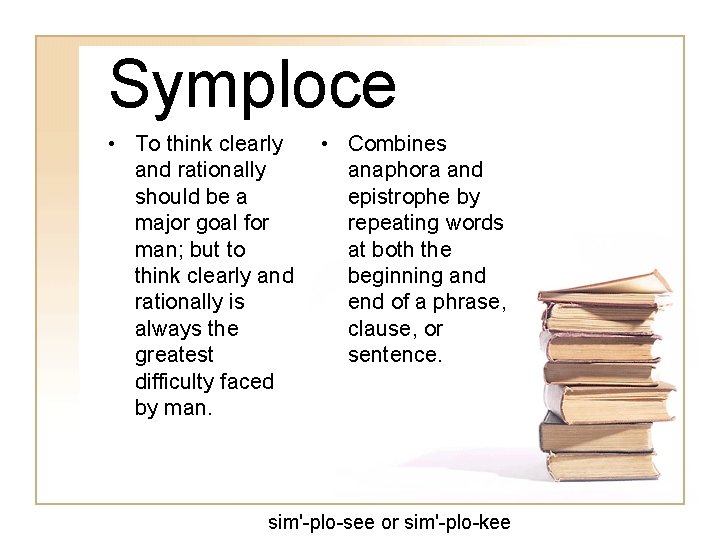
Symploce • To think clearly • Combines and rationally anaphora and should be a epistrophe by major goal for repeating words man; but to at both the think clearly and beginning and rationally is end of a phrase, always the clause, or greatest sentence. difficulty faced by man. sim'-plo-see or sim'-plo-kee
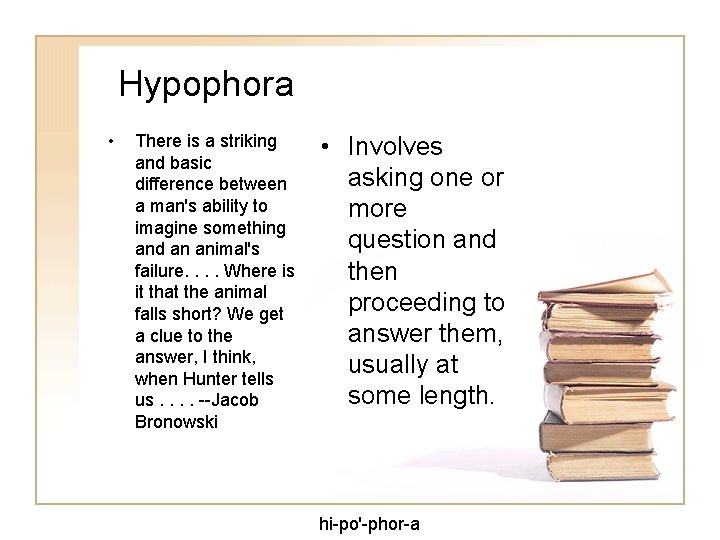
Hypophora • There is a striking and basic difference between a man's ability to imagine something and an animal's failure. . Where is it that the animal falls short? We get a clue to the answer, I think, when Hunter tells us. . --Jacob Bronowski • Involves asking one or more question and then proceeding to answer them, usually at some length. hi-po'-phor-a
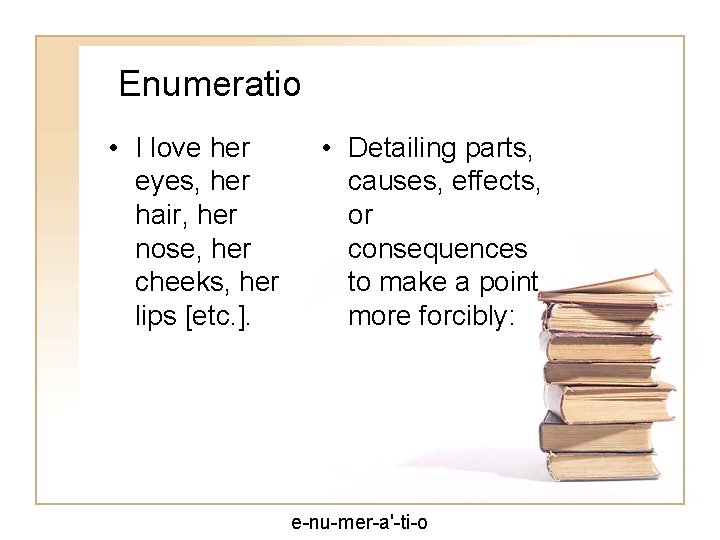
Enumeratio • I love her eyes, her hair, her nose, her cheeks, her lips [etc. ]. • Detailing parts, causes, effects, or consequences to make a point more forcibly: e-nu-mer-a'-ti-o
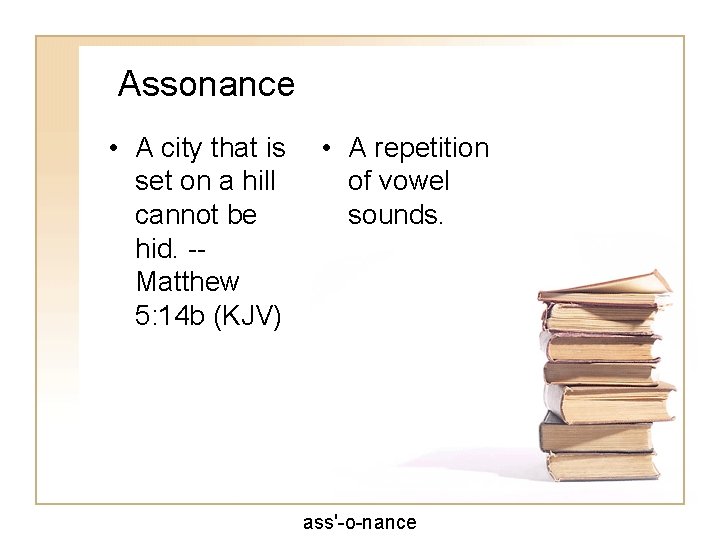
Assonance • A city that is • A repetition set on a hill of vowel cannot be sounds. hid. -Matthew 5: 14 b (KJV) ass'-o-nance
Anaphora • The repetition death it is a of words or misery, / To phrases at think on life it is the beginning a vanity; / To of think on the world verily it consecutive is, / To think that lines or here man hath sentences. To think on no perfect bliss. --Peacham an-aph'-o-ra
Simile • The soul in the body is like a bird in a cage. • An indirect comparison that uses the words like or as to link the differing items in the comparison. ("You eyes are like stars. ") si'-mi-lee
Parallelism • The use of • To think corresponding carefully and grammatical or to write syntactical forms. precisely are interrelated goals. par-uh-le-liz-uhm
Hyperbole • There a thousand reasons why more research is needed on solar energy. • Extreme exaggeration, often humorous, it can also be ironic; the opposite of understatement hy-per'-bo-lee
Enthymeme • He is an • An informally. American stated two-part citizen, so he is syllogism which entitled to due omits either one of process. the premises or the conclusion. The omitted part • Omitted must be clearly premise: understood by the [All American reader. citizens are entitled to due process. ] en’-thy-meem
Appositive • Henry Jameson, the boss of the operation, always wore a red baseball cap. • A noun or noun substitute placed next to another noun to be described or defined by the appositive. The appositive can be placed before or after the noun uh-poz-i-tiv
Analogy • In order to solve a problem, you first have to know what the problem is, really is, in the same way that you can’t untie a knot until you’ve found the knot. – Aristotle • A literary device employed to serve as a basis for comparison
Zeugma • Fred excelled at sports; Harvey at eating; Tom with girls. Commentary: Excelled is the link. • Grammatically correct linkage of ideas or phrases. A type of parallel. • The main benefit of the linking is that it shows relationships between ideas and actions more clearly.
Chiasmus • He labors • Might be called "reverse without parallelism, " since complaining the second part of a grammatical and without bragging rests. construction is balanced or paralleled by the first part, only in reverse order.
Antiphrasis • "Come here, • One word Tiny, " he irony, said to the established fat man. by context.
Personification • This coffee is strong enough to get up and walk away. • The assigning of Human qualities to inanimate objects or concepts (Wordsworth personifies "The sea that bares her bosom to the moon" In the poem "London 1802". )
Litotes • Heat waves are not rare in the summer. • A type of understatement in which an idea is expressed by negating its opposite. (describing a particularly horrific scene by saying "It was not a pretty picture". )
Epistrophe • Where affections • A repetition bear rule, there technique reason is • (also called subdued, honesty antistrophe) forms is subdued, good the counterpart to will is subdued, anaphora, because and all things else the repetition of the that withstand same word or words evil, for ever are comes at the end of subdued. -successive phrases, Wilson clauses, or sentences:
Catachresis • The little old • An lady turtled extravagant, along at ten implied miles per metaphor hour. using words in an alien or unusual way.
Antimetabole • All work and no play is as harmful to mental health as all play and no work. • Word ordering technique • Reversing the order of repeated words or phrases (a loosely chiastic structure, AB-BA) to intensify the final formulation, to present alternatives, or to show contrast: an'-ti-me-ta'-bo-lee
Synecdoche • The army • A figure of included two speech that hundred utilizes a horse and part as three representati hundred ve of the feet. whole. ("All hands on deck" is an example. )
Parenthesis • But the new calculations-and here we see the value of relying upon upto-date information-showed that man-powered flight was possible with this design. • A final form of hyperbaton, consists of a word, phrase, or whole sentence inserted as an aside in the middle of another sentence.
Hypotaxis • They asked • Using subordination the question to show the because relationship they were between curious. clauses or phrases (and hence the opposite of parataxis)
Parataxis • In the beginning God created the heaven and the earth. And the earth was without form and void; and darkness was upon the face of the deep. And the Spirit of God moved upon the face of the waters. --Genesis 1: 1 -2 • Consists of combining several sentences with coordinating conjunctions.